

Graphene Conductive Coatings for Industrial Electronics
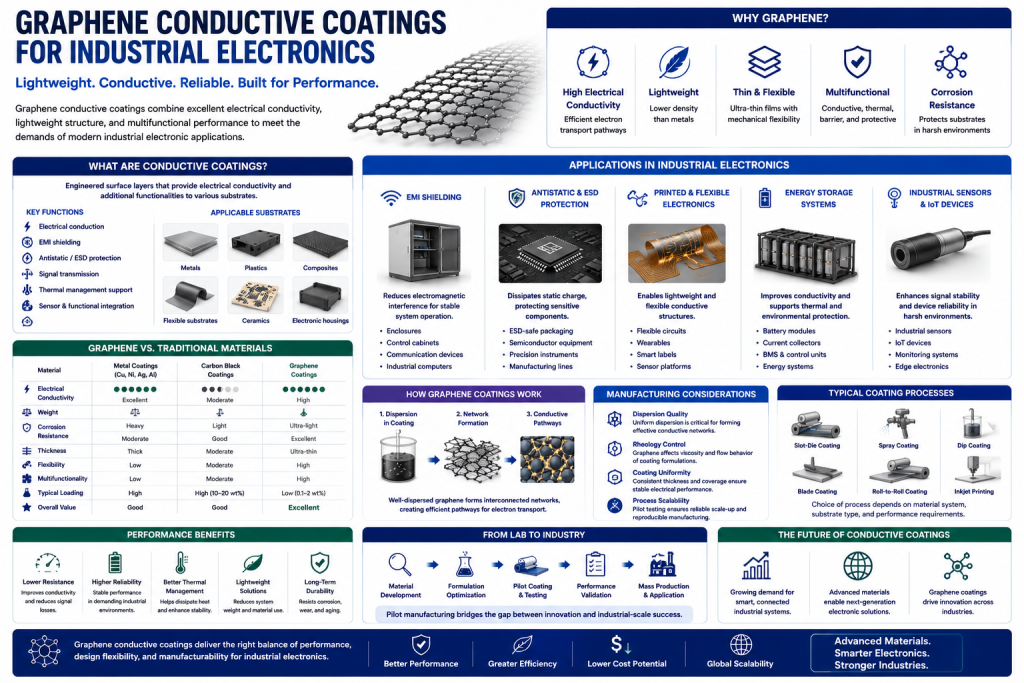
Industrial electronics are becoming increasingly sophisticated, compact, and power-dense.
Applications such as:
- Industrial automation systems
- Power electronics
- Energy storage equipment
- Telecommunications infrastructure
- Smart manufacturing systems
- Industrial sensors
all require materials that provide reliable electrical performance while supporting durability, thermal management, and long-term stability.
Among emerging advanced materials, graphene has attracted significant attention for its potential role in conductive coatings.
By combining electrical conductivity with lightweight structure, flexibility, and multifunctional performance, graphene-based conductive coatings are opening new opportunities for industrial electronic applications.
What Are Conductive Coatings?
Conductive coatings are engineered surface layers designed to provide electrical conductivity on a substrate.
Depending on application requirements, conductive coatings may serve several functions:
- Electrical conduction
- Static charge dissipation
- Electromagnetic interference (EMI) shielding
- Signal transmission
- Sensor functionality
- Thermal management support
These coatings can be applied to:
- Metals
- Plastics
- Composite materials
- Flexible substrates
- Electronic housings
Conductive coatings often enable functionality that would otherwise require heavier or more expensive conductive components.
Why Graphene Is Attractive for Conductive Coatings
Graphene offers several characteristics that make it attractive for industrial electronics.
High Electrical Conductivity
Graphene provides efficient electron transport pathways when properly dispersed and integrated into coating systems.
Lightweight Design
Compared with traditional metal-based conductive solutions, graphene can help reduce weight.
Thin-Film Capability
Graphene can be incorporated into ultra-thin coatings without significantly affecting component dimensions.
Mechanical Flexibility
Graphene coatings can maintain conductivity even on flexible or mechanically stressed substrates.
Multifunctional Performance
In addition to conductivity, graphene may contribute to:
- Thermal management
- Barrier protection
- Mechanical reinforcement
This multifunctionality is particularly valuable in advanced industrial systems.
How Graphene Conductive Coatings Work
Graphene coatings typically rely on the formation of interconnected conductive pathways.
When graphene particles or sheets are properly dispersed within a coating matrix, they create conductive networks that allow electrons to travel efficiently across the surface.
The effectiveness of the coating depends on factors such as:
- Graphene loading level
- Dispersion quality
- Coating thickness
- Network connectivity
- Substrate compatibility
Achieving a stable conductive network is often one of the most important aspects of coating design.
Applications in EMI Shielding
Electromagnetic interference has become a growing concern in modern industrial electronics.
Electronic systems increasingly operate in environments containing:
- High-frequency signals
- Wireless communications
- Power conversion equipment
- Sensitive electronic components
Graphene conductive coatings can contribute to EMI shielding by helping absorb and dissipate electromagnetic energy.
Potential applications include:
- Electronic enclosures
- Control cabinets
- Communication equipment
- Industrial computing systems
As industrial automation expands, EMI management continues to gain importance.
Applications in Antistatic and ESD Protection
Electrostatic discharge (ESD) can damage sensitive electronic components.
Conductive coatings help dissipate static charges before harmful discharge occurs.
Graphene-based coatings are being explored for:
- Electronic packaging
- Semiconductor handling equipment
- Manufacturing environments
- Precision instrumentation
Effective charge dissipation improves equipment reliability and product quality.
Applications in Printed and Flexible Electronics
The growth of flexible and printed electronics is creating demand for lightweight conductive materials.
Graphene coatings are being evaluated for:
- Flexible circuits
- Smart labels
- Wearable electronics
- Sensor platforms
Their combination of conductivity and flexibility makes them attractive for next-generation electronic devices.
Applications in Energy Storage Systems
Industrial energy storage systems require numerous conductive components.
Graphene conductive coatings may support:
- Battery module components
- Current collection structures
- Monitoring systems
- Electronic control units
In some cases, graphene coatings may also contribute to thermal management and environmental protection.
Graphene vs Traditional Conductive Materials
Several conductive materials are commonly used in industrial coatings.
Metal-Based Conductive Coatings
Advantages:
- Very high conductivity
- Mature manufacturing processes
Challenges:
- Weight
- Corrosion concerns
- Material cost volatility
Carbon Black Coatings
Advantages:
- Low cost
- Established supply chains
Challenges:
- Higher loading requirements
- Lower conductivity efficiency
Graphene Conductive Coatings
Potential advantages:
- Lower filler loading
- Lightweight construction
- Multifunctional properties
- Flexible integration
The optimal solution depends on application requirements and manufacturing constraints.
Manufacturing Challenges
Although graphene offers significant potential, industrial implementation requires careful process development.
Dispersion Stability
Graphene naturally tends to agglomerate and restack.
Poor dispersion can reduce conductivity and coating consistency.
Rheology Control
Graphene influences coating viscosity and flow behavior.
Maintaining stable processing conditions is essential.
Coating Uniformity
Electrical performance often depends on consistent coating thickness and graphene distribution.
Scale-Up
Processes that work in laboratory environments may behave differently during pilot and commercial production.
Successful scale-up requires validation under realistic manufacturing conditions.
Why Pilot Manufacturing Matters
Many graphene conductive coatings demonstrate promising laboratory results.
However, industrial adoption requires:
- Consistent quality
- Repeatable production
- Cost-effective processing
- Long-term reliability
Pilot manufacturing enables engineers to evaluate:
- Coating process stability
- Conductive network formation
- Product consistency
- Scale-up feasibility
This stage is critical for reducing commercialization risk.
Future Trends
Several market trends are expected to support continued growth.
Smart Manufacturing
Increasing use of connected industrial equipment.
Advanced Electronics
Growing demand for lightweight and multifunctional materials.
Flexible Electronic Systems
Expanding opportunities for conductive coatings.
Integrated Functional Coatings
Combining conductivity, thermal management, and environmental protection in a single coating system.
These trends align well with the capabilities of graphene-enhanced materials.
Graphene conductive coatings offer a promising pathway for improving the performance of industrial electronic systems.
By providing conductive networks within lightweight, thin, and multifunctional coating structures, graphene can support applications ranging from EMI shielding and ESD protection to flexible electronics and energy storage systems.
However, successful commercialization depends on more than graphene itself. Dispersion quality, coating process optimization, pilot-scale validation, and manufacturing scalability remain essential factors.
As industrial electronics continue to evolve, graphene conductive coatings are expected to become an increasingly important component of next-generation electronic materials and manufacturing technologies.