

Why CNT Networks Improve Lithium-Ion Battery Performance
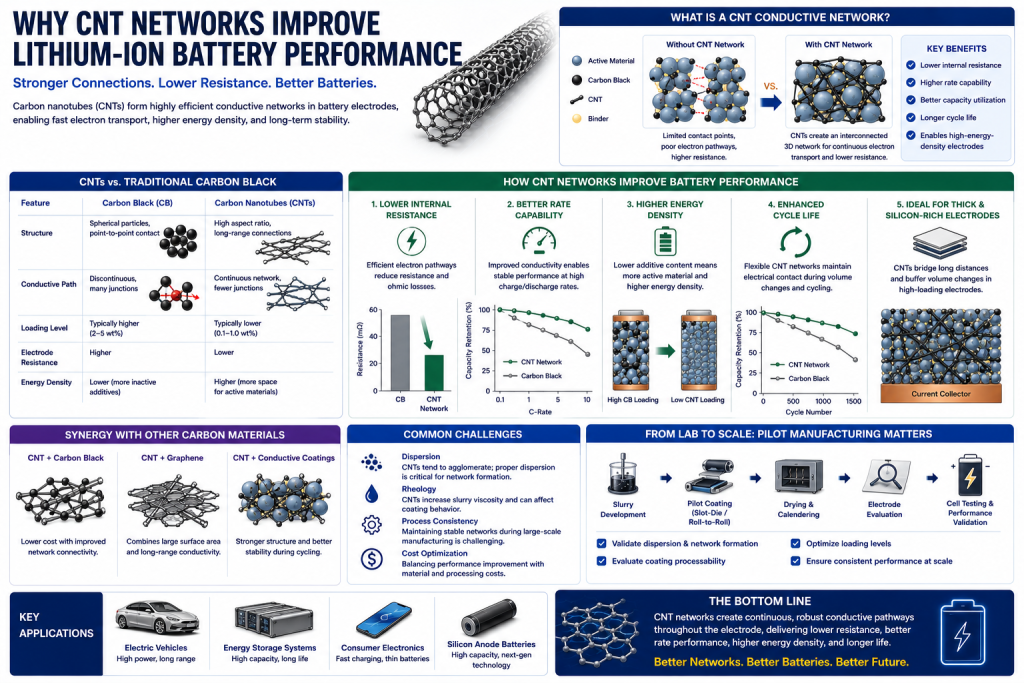
As lithium-ion batteries continue to evolve toward higher energy density, faster charging capability, and longer cycle life, electrode design has become increasingly important.
While active materials often receive the most attention, conductive additives play a critical role in determining how efficiently electrons move through the electrode.
Among various conductive additives, carbon nanotubes (CNTs) have emerged as one of the most effective solutions for improving battery performance.
The reason is not simply the conductivity of CNTs themselves, but their ability to form highly efficient conductive networks throughout the electrode structure.
These networks help maintain electrical connectivity, improve energy utilization, and support the development of next-generation battery technologies.
What Are CNT Networks?
Carbon nanotubes are cylindrical carbon nanostructures with extremely high aspect ratios.
Unlike traditional conductive particles, CNTs can span long distances within an electrode.
When properly dispersed, CNTs create interconnected pathways that link:
- Active material particles
- Conductive additives
- Current collectors
The resulting structure is known as a conductive network.
Instead of relying on point-to-point electrical contacts, electrons can travel through a continuous three-dimensional pathway.
This significantly improves electrode conductivity and stability.
Why Conductive Networks Matter
Inside a battery electrode, electrons must move efficiently between active material particles and the current collector.
If conductive pathways are incomplete or unstable:
- Internal resistance increases
- Power performance decreases
- Capacity utilization drops
- Cycle life may be reduced
A robust conductive network helps maintain electrical connectivity throughout battery operation.
As electrodes become thicker and energy density increases, the importance of conductive networks becomes even greater.
CNTs vs Traditional Carbon Black
Carbon black has long been used as the standard conductive additive in lithium-ion batteries.
However, carbon black particles are relatively small and typically form conductivity through particle-to-particle contact.
This creates several limitations:
- Higher additive loading requirements
- Less efficient conductive pathways
- Increased inactive material content
CNTs behave differently.
Because of their long, fibrous structure, a small amount of CNT material can connect a large number of particles.
Advantages include:
Lower Loading Levels
CNTs often achieve conductivity at significantly lower concentrations.
Better Connectivity
Long conductive pathways improve electron transport.
Reduced Electrode Resistance
More efficient networks lower impedance.
Higher Energy Density
Less conductive additive means more space for active materials.
These benefits make CNTs particularly attractive for advanced battery systems.
Supporting High-Energy-Density Electrodes
Battery manufacturers continuously seek higher energy density.
One common approach is increasing active material loading.
However, thicker electrodes create longer electron transport pathways.
Traditional conductive additives may struggle to maintain connectivity across these larger distances.
CNT networks help overcome this challenge by creating conductive bridges throughout the electrode.
Benefits include:
- Improved conductivity in thick electrodes
- Better active material utilization
- Higher achievable energy density
This capability has made CNTs increasingly important in next-generation battery development.
Improving Fast-Charging Performance
Fast charging places significant demands on electrode conductivity.
During rapid charging:
- Current density increases
- Internal resistance becomes more important
- Heat generation rises
CNT conductive networks can help reduce resistance and improve charge transport.
Potential benefits include:
- Improved charging efficiency
- Lower polarization
- Reduced heat generation
- Better high-rate performance
For applications such as electric vehicles and energy storage systems, these improvements can be highly valuable.
Enhancing Cycle Life
Battery electrodes undergo repeated expansion and contraction during cycling.
Over time, this can damage conductive pathways.
CNT networks provide a degree of structural flexibility that helps maintain electrical contact.
As a result, electrodes may experience:
- Improved conductivity retention
- Better long-term stability
- Reduced performance degradation
This is particularly important for silicon-containing anodes, which undergo substantial volume changes during operation.
CNT Networks in Silicon Anodes
Silicon is widely viewed as a promising next-generation anode material because of its high theoretical capacity.
However, silicon expansion during cycling can disrupt conventional conductive networks.
CNTs help address this challenge by:
- Bridging active material particles
- Maintaining conductive pathways
- Accommodating mechanical movement
As a result, CNT additives have become increasingly important in advanced silicon-based battery research.
Synergy with Graphene and Other Carbon Materials
CNTs are often combined with other conductive materials.
Examples include:
CNT + Carbon Black
Balancing performance and cost.
CNT + Graphene
Combining long-range conductivity with large conductive surfaces.
CNT + Conductive Carbon Coatings
Improving both conductivity and structural stability.
These hybrid systems are becoming increasingly common in advanced battery formulations.
Manufacturing Challenges
Although CNT networks offer significant advantages, successful implementation requires overcoming several challenges.
Dispersion Quality
CNTs naturally tend to form agglomerates.
Poor dispersion can reduce network effectiveness.
Slurry Rheology
CNTs can significantly affect viscosity and coating behavior.
Process Consistency
Network formation must remain stable during large-scale manufacturing.
Cost Optimization
Performance benefits must justify material and processing costs.
Addressing these issues requires careful formulation and process development.
The Importance of Pilot Manufacturing
Laboratory-scale results do not always translate directly to industrial production.
Pilot-scale validation allows engineers to evaluate:
- CNT dispersion stability
- Slurry processability
- Coating performance
- Electrode consistency
- Scale-up feasibility
Pilot manufacturing helps bridge the gap between material innovation and commercial battery production.
Future Trends
Several developments are expected to drive continued CNT adoption.
High-Energy-Density Batteries
Requiring stronger conductive networks.
Silicon-Rich Anodes
Benefiting from CNT structural support.
Fast-Charging Technologies
Demanding lower electrode resistance.
Advanced Carbon Material Integration
Combining CNTs with graphene and other nanomaterials.
As battery technologies evolve, conductive network engineering will become increasingly important.
CNTs improve lithium-ion battery performance not simply because they are conductive, but because they create efficient conductive networks throughout the electrode structure.
These networks support electron transport, reduce resistance, enhance energy utilization, and improve long-term stability.
As battery manufacturers pursue higher energy density, faster charging, and longer cycle life, CNT conductive networks are becoming a critical component of next-generation electrode design.
The future of battery performance may depend not only on better active materials, but also on better conductive architectures—and CNT networks are at the center of that evolution.