

Hybrid Carbon Networks: Combining CNT and Graphene
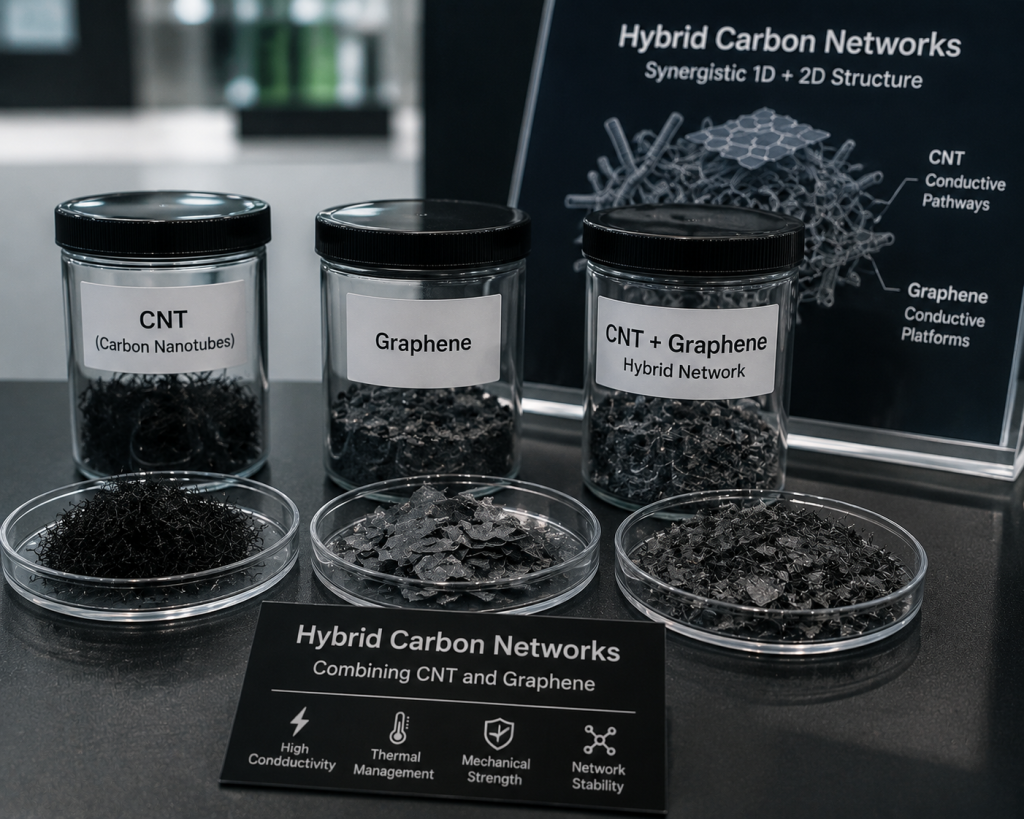
Advanced carbon materials are enabling new generations of energy storage, electronics, and thermal management technologies.
Among these materials, carbon nanotubes (CNTs) and graphene have attracted significant attention due to their outstanding electrical, thermal, and mechanical properties.
However, each material has its own advantages and limitations.
CNTs provide excellent one-dimensional conductive pathways, while graphene offers two-dimensional structures with large surface areas and strong thermal transport capability.
By combining CNTs and graphene, researchers and engineers can create hybrid carbon networks that integrate the strengths of both materials.
These hybrid systems are increasingly being explored for applications including:
- Battery electrodes
- Conductive coatings
- Thermal management films
- EMI shielding
- Flexible electronics
Why Combine CNT and Graphene?
Although both CNT and graphene are carbon-based materials, their structures provide different functional advantages.
CNT: One-Dimensional Conductive Bridges
Carbon nanotubes have a unique tubular structure with extremely high aspect ratios.
Their advantages include:
- Excellent electrical conductivity
- Strong mechanical reinforcement
- Ability to form interconnected networks
- Low loading requirements
CNTs are particularly effective at creating conductive pathways between particles.
Graphene: Two-Dimensional Conductive Platforms
Graphene consists of atomically thin carbon layers with exceptional properties.
Key advantages include:
- High thermal conductivity
- Large surface area
- Mechanical strength
- Barrier properties
Graphene can provide broad conductive surfaces and improve structural stability.
The Concept of Hybrid Carbon Networks
A hybrid CNT-graphene system combines different dimensions of carbon structures.
CNTs act as:
“Conductive bridges”
connecting separated graphene sheets or active material particles.
Graphene acts as:
“Conductive platforms”
providing larger-area pathways for electron and heat transport.
Together, they form a three-dimensional interconnected carbon network.
This structure can improve:
- Electrical conductivity
- Thermal transport
- Mechanical stability
- Material efficiency
Applications in Battery Manufacturing
Battery electrodes are one of the most important applications for hybrid carbon networks.
Improving Conductive Pathways
Active battery materials often have limited electrical conductivity.
CNT and graphene networks help create efficient electron transport channels.
Benefits include:
- Lower internal resistance
- Improved rate capability
- Better electrode utilization
Supporting High-Loading Electrodes
As battery manufacturers increase active material loading, maintaining conductivity becomes more challenging.
Hybrid carbon networks help maintain electrical connectivity even with higher electrode density.
Enhancing Mechanical Stability
During battery cycling, electrode materials experience expansion and contraction.
Graphene and CNT structures can provide mechanical reinforcement and reduce structural degradation.
Applications in Conductive Coatings
Hybrid carbon networks are also valuable in functional coatings.
Potential applications include:
- Conductive coatings
- EMI shielding coatings
- Anti-static surfaces
- Flexible electronics
Compared with single-material systems, CNT and graphene combinations can provide better balance between:
- Conductivity
- Coating processability
- Mechanical durability
Applications in Thermal Management
Thermal management is becoming increasingly important in:
- AI servers
- Data centers
- Power electronics
- Electric vehicles
Graphene provides excellent heat spreading capability, while CNTs can create additional thermal pathways.
Hybrid systems may improve:
- Heat distribution
- Thermal interface performance
- Lightweight thermal solutions
Challenges in Hybrid Carbon Material Development
Although hybrid carbon networks show strong potential, several challenges remain.
Dispersion Control
CNTs and graphene tend to form aggregates due to strong interactions between carbon surfaces.
Achieving uniform dispersion is critical.
Interface Engineering
The interaction between CNTs, graphene, binders, and other materials determines final performance.
Poor interfaces may limit the benefits of hybrid structures.
Manufacturing Consistency
Industrial applications require:
- Stable formulations
- Repeatable processing
- Consistent quality
Laboratory success must be translated into scalable manufacturing processes.
The Importance of Formulation Engineering
Hybrid carbon materials are not simply mixed together.
Performance depends on:
- CNT-to-graphene ratio
- Particle size distribution
- Dispersion method
- Binder compatibility
- Processing conditions
Optimization of the formulation is essential for achieving the desired properties.
Pilot Manufacturing and Scale-Up
Pilot validation plays an important role in commercializing hybrid carbon systems.
Pilot trials help evaluate:
- Large-scale dispersion stability
- Coating performance
- Process repeatability
- Material utilization
- Production feasibility
This step reduces uncertainty before full industrial implementation.
Future Development Trends
Advanced Battery Materials
Hybrid carbon networks will continue supporting:
- High-energy batteries
- Fast-charging systems
- Silicon-based electrodes
Multifunctional Coatings
Future coatings may combine:
- Electrical conductivity
- Thermal management
- Corrosion resistance
- Mechanical reinforcement
Sustainable Manufacturing
Industrial development will focus on:
- Lower-cost production
- Environmentally friendly processes
- Higher material efficiency
Intelligent Material Design
Simulation and AI-assisted optimization may accelerate the discovery of improved hybrid carbon architectures.
CNT and graphene represent two of the most important advanced carbon materials, but their greatest potential may come from combining them.
Hybrid carbon networks utilize the complementary advantages of both materials:
- CNTs provide interconnected conductive bridges
- Graphene provides large-area conductive and thermal pathways
Together, they create multifunctional carbon architectures with improved electrical, thermal, and mechanical performance.
However, successful commercialization depends not only on material innovation but also on dispersion technology, formulation engineering, pilot validation, and scalable manufacturing.
The future of advanced carbon materials will increasingly depend on designing complete material systems rather than relying on individual components.