
Why Sodium-Ion Batteries Need Flexible Pilot Platforms
The rapid growth of energy storage demand is accelerating the search for battery technologies beyond traditional lithium-ion systems.
Among emerging technologies, sodium-ion batteries have attracted increasing attention due to the abundance, availability, and lower cost potential of sodium resources.
Sodium-ion batteries offer promising opportunities for applications such as:
- Stationary energy storage
- Grid-scale systems
- Low-cost electric mobility
- Renewable energy integration
However, commercializing sodium-ion batteries requires overcoming significant challenges.
Unlike mature lithium-ion manufacturing, sodium-ion technology is still evolving, with multiple material systems and manufacturing approaches under development.
This creates a critical need for flexible pilot manufacturing platforms that can quickly test, optimize, and validate different battery concepts.
The Development Stage of Sodium-Ion Batteries
Lithium-ion batteries have benefited from decades of industrial optimization.
Manufacturers have established:
- Mature material supply chains
- Standardized electrode processes
- Large-scale production experience
Sodium-ion batteries are at a different stage.
Multiple technical pathways are still being explored, including:
- Cathode materials
- Anode materials
- Electrolyte systems
- Electrode formulations
- Cell designs
This diversity creates both opportunities and challenges.
Why Material Flexibility Is Important
One of the biggest advantages of sodium-ion technology is the availability of different material options.
Potential cathode systems include:
- Layered oxide materials
- Prussian blue analogues
- Polyanionic compounds
Potential anode systems include:
- Hard carbon
- Carbon composites
- Advanced carbon materials
Each material system has different:
- Particle characteristics
- Conductivity requirements
- Processing behavior
- Electrode structure requirements
A fixed manufacturing approach may limit development speed.
The Challenge of Scaling New Battery Materials
A material that performs well in laboratory testing may face unexpected challenges during scale-up.
Common issues include:
Material Processing
Different powders may require different:
- Mixing conditions
- Binder systems
- Conductive additives
Electrode Quality
Manufacturers must control:
- Thickness uniformity
- Density
- Porosity
- Mechanical stability
Manufacturing Compatibility
New materials must work with:
- Existing equipment
- Production processes
- Quality control systems
Pilot platforms provide the environment to identify these challenges early.
What Is a Flexible Pilot Platform?
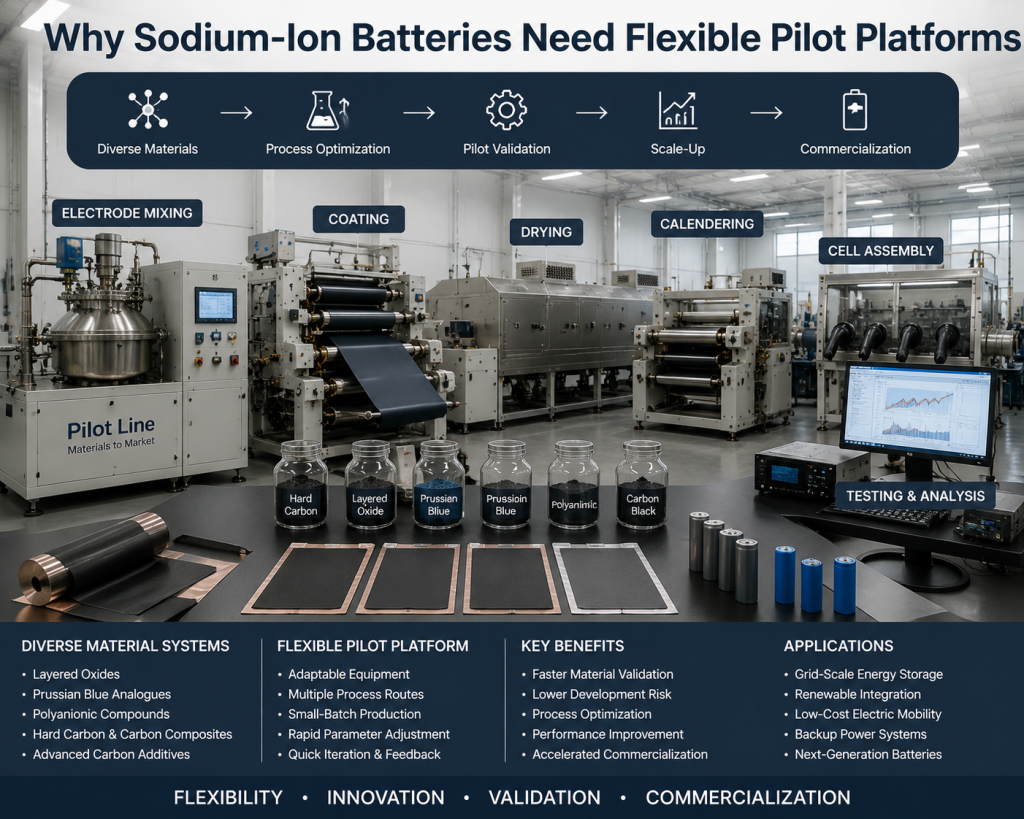
A flexible pilot platform is a manufacturing environment designed to test multiple material systems and production approaches.
Unlike dedicated mass-production lines, flexible pilot lines allow:
- Rapid process adjustment
- Small-batch validation
- Multiple material trials
- Faster engineering feedback
Typical capabilities include:
- Electrode mixing
- Coating
- Drying
- Calendering
- Cell assembly
- Performance testing
Advantages of Flexible Pilot Platforms
Faster Material Validation
Researchers and companies can evaluate different sodium-ion materials without building separate production systems.
This accelerates:
- Material screening
- Formula optimization
- Process improvement
Lower Development Risk
Battery commercialization requires significant investment.
Pilot platforms reduce risk by identifying:
- Manufacturing limitations
- Material compatibility issues
- Process bottlenecks
before large-scale investment.
Supporting Multiple Technologies
A flexible platform can support different battery concepts.
Examples include:
- Sodium-ion batteries
- Lithium-ion improvements
- Advanced carbon electrodes
- New conductive additives
This flexibility increases long-term value.
The Role of Advanced Carbon Materials
Carbon materials remain critical in sodium-ion battery development.
Hard Carbon
Hard carbon is one of the most widely studied sodium-ion anode materials.
Challenges include:
- Structure optimization
- Surface chemistry control
- Capacity improvement
Carbon Nanotubes (CNT)
CNTs can improve:
- Electrical connectivity
- Mechanical stability
- Electrode conductivity
Graphene
Graphene may contribute:
- Conductive pathways
- Structural reinforcement
- Interface improvement
Hybrid Carbon Networks
Combining CNT and graphene may create:
- Three-dimensional conductive structures
- Improved electrode performance
- Better material utilization
Pilot platforms allow these materials to be tested under realistic manufacturing conditions.
Pilot Validation in Sodium-Ion Battery Development
Pilot validation helps answer important industrial questions:
Can the material be manufactured consistently?
Can the electrode process achieve required quality?
Can the cell performance be reproduced?
Can the process be scaled economically?
Key evaluation areas include:
Electrode Manufacturing
- Slurry or dry process behavior
- Coating quality
- Electrode density
Cell Performance
- Capacity
- Cycle life
- Rate performance
Manufacturing Stability
- Batch consistency
- Process repeatability
- Production efficiency
Flexible Manufacturing and Future Battery Innovation
Future battery development will require faster innovation cycles.
A flexible pilot platform enables:
- Material companies to validate products
- Battery companies to test new technologies
- Research institutions to bridge laboratory and industry
This creates a stronger connection between innovation and commercialization.
Challenges Ahead
Flexible pilot platforms also require advanced engineering capabilities.
Challenges include:
- Maintaining process consistency
- Managing different material requirements
- Developing accurate quality evaluation methods
- Balancing flexibility and efficiency
Successful platforms must combine:
- Equipment capability
- Process expertise
- Material knowledge
- Testing capability
Future Outlook
As sodium-ion batteries continue developing, flexible pilot manufacturing will become increasingly important.
The future battery industry will not depend on a single material system.
Instead, it will require adaptable manufacturing ecosystems capable of rapidly evaluating:
- New materials
- New electrode structures
- New production technologies
Pilot platforms will become essential infrastructure for accelerating next-generation battery commercialization.
Sodium-ion batteries represent an important pathway toward more diverse and sustainable energy storage solutions.
However, their commercialization requires more than discovering new materials.
The industry needs flexible pilot platforms that can connect laboratory innovation with industrial manufacturing.
By enabling rapid testing, process optimization, and scale-up validation, flexible pilot platforms reduce development risks and accelerate the transition from promising battery concepts to reliable commercial products.
The future of sodium-ion batteries will depend not only on better chemistry, but also on smarter and more adaptable manufacturing systems.