
Pouch Cell Development from Lab to Pilot Production
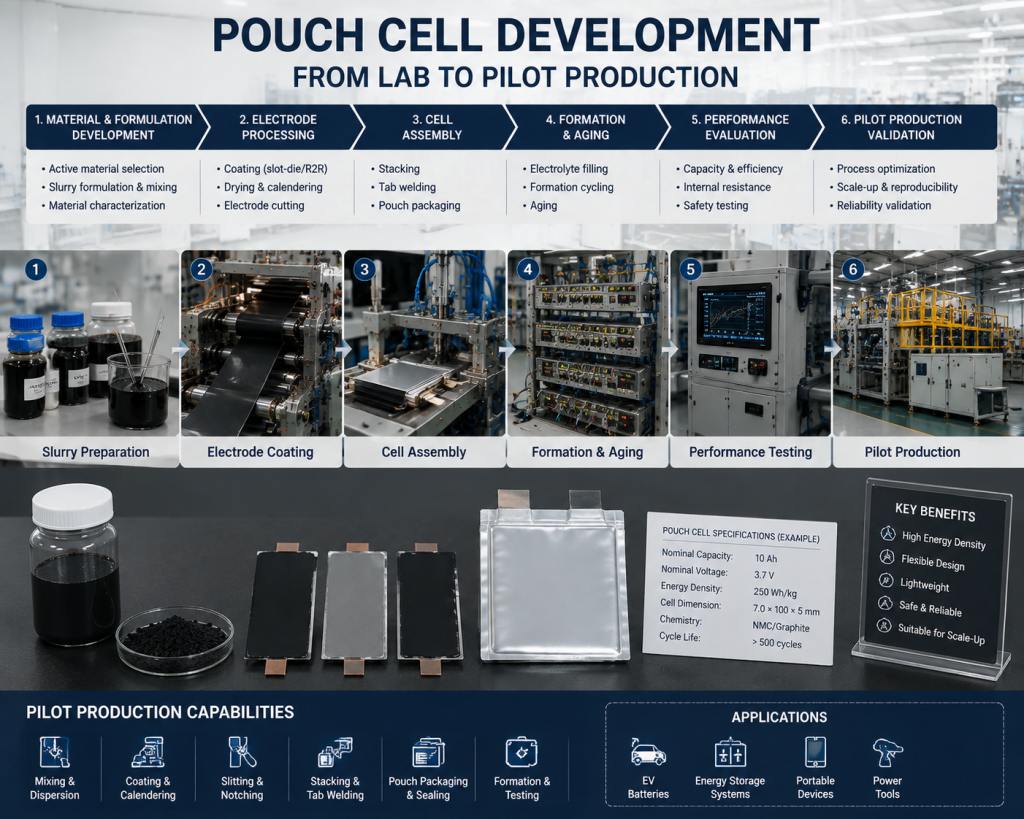
Pouch cells are widely used in advanced battery development because of their flexible design, high packaging efficiency, and suitability for laboratory research and pilot-scale validation.
Many next-generation battery technologies—including:
- High-energy lithium-ion batteries
- Sodium-ion batteries
- Solid-state battery concepts
- Advanced carbon electrode systems
begin their journey in laboratory pouch cells.
However, moving from laboratory prototypes to pilot production requires solving many engineering challenges.
The transition involves more than increasing production volume.
It requires establishing reliable processes for:
- Electrode manufacturing
- Cell assembly
- Formation
- Performance evaluation
- Manufacturing repeatability
The journey from lab to pilot production is where battery concepts become practical technologies.
Why Pouch Cells Are Important for Battery Development
Pouch cells provide several advantages during technology development.
Flexible Design
Compared with cylindrical or prismatic formats, pouch cells allow easier adjustment of:
- Electrode size
- Layer number
- Cell capacity
- Material combinations
This flexibility makes them suitable for early-stage technology validation.
High Material Utilization
Pouch cells have fewer inactive components compared with some other formats.
This allows researchers to evaluate:
- Electrode performance
- Energy density
- Interface behavior
more directly.
Suitable for Pilot Validation
Pilot-scale pouch cell production provides realistic manufacturing data before large-scale commercialization.
Stage 1: Laboratory Electrode Development
The first step begins with electrode formulation.
Key components include:
- Active materials
- Conductive additives
- Binders
- Solvents or dry processing systems
Engineers optimize:
- Material ratios
- Mixing conditions
- Coating parameters
- Electrode loading
Slurry Development and Mixing
For traditional wet electrode processes, slurry preparation is a critical step.
Important factors include:
Dispersion Quality
Conductive materials such as:
- Carbon black
- CNT
- Graphene
must be uniformly distributed.
Poor dispersion may cause:
- Uneven conductivity
- Coating defects
- Performance variation
Rheology Control
Slurry properties influence:
- Pumping behavior
- Coating stability
- Electrode uniformity
Important parameters include:
- Viscosity
- Solid content
- Flow behavior
Stage 2: Electrode Coating and Processing
After slurry development, electrodes are produced through coating processes.
Typical steps include:
- Mixing
- Coating
- Drying
- Calendering
- Cutting
Coating Process Optimization
Pilot coating requires control of:
- Coating thickness
- Loading consistency
- Surface quality
Technologies may include:
- Slot-die coating
- Roll coating
- Laboratory coating systems
The goal is to create electrodes that are representative of future manufacturing conditions.
Stage 3: Electrode Assembly
After electrode preparation, pouch cell assembly begins.
Key processes include:
Electrode Cutting
Electrodes are prepared according to designed dimensions.
Stacking or Winding
Pouch cells commonly use:
- Z-stacking
- Lamination structures
These processes influence:
- Internal resistance
- Mechanical stability
- Cell consistency
Tab Welding
Reliable tab connection is essential for:
- Current collection
- Safety
- Long-term cycling performance
Stage 4: Pouch Cell Packaging
The assembled electrodes are placed inside aluminum laminate packaging.
Important steps include:
- Cell positioning
- Electrolyte filling
- Vacuum sealing
Packaging quality directly affects:
- Moisture control
- Gas management
- Cell reliability
Stage 5: Formation and Aging
Formation is one of the most important stages in battery manufacturing.
During formation:
- Initial SEI layers are created
- Electrochemical behavior stabilizes
- Cell performance develops
Key evaluation factors include:
- Initial capacity
- Internal resistance
- Voltage behavior
- Gas generation
Moving From Laboratory to Pilot Production
Laboratory cells focus on proving battery chemistry.
Pilot production focuses on proving manufacturing capability.
The transition requires optimization of:
Process Repeatability
Can the same cell quality be achieved repeatedly?
Equipment Compatibility
Can the process operate reliably on pilot equipment?
Quality Control
Can performance variations be identified and controlled?
Common Challenges During Pilot Scale-Up
Challenge 1: Electrode Uniformity
Small laboratory samples may hide production variations.
Pilot manufacturing must control:
- Thickness variation
- Density variation
- Surface defects
Challenge 2: Material Consistency
Advanced materials require stable supply quality.
Variations in:
- Particle size
- Surface properties
- Purity
can affect cell performance.
Challenge 3: Process Transfer
A laboratory recipe may not directly transfer to pilot equipment.
Adjustments may be needed for:
- Mixing energy
- Coating speed
- Drying conditions
- Compression pressure
Challenge 4: Data Reproducibility
Pilot validation requires sufficient data to confirm:
- Performance stability
- Manufacturing reliability
- Technology readiness
The Role of Advanced Carbon Materials in Pouch Cells
Advanced carbon materials are increasingly used to improve electrode performance.
Applications include:
CNT Conductive Networks
CNTs can improve:
- Electron transport
- Mechanical stability
- High-rate performance
Graphene-Based Additives
Graphene may contribute to:
- Conductivity improvement
- Thermal management
- Structural reinforcement
Hybrid Carbon Systems
CNT + graphene combinations can create:
- Three-dimensional conductive networks
- Improved electrode integrity
The Importance of Flexible Pilot Platforms
A flexible pilot line enables developers to test different:
- Electrode formulations
- Cell designs
- Manufacturing parameters
This is especially valuable for emerging technologies where optimization is still ongoing.
Future Trends in Pouch Cell Development
Future pouch cell manufacturing will focus on:
- Higher energy density
- Faster charging
- Sustainable production
- Dry electrode processes
- Advanced carbon materials
- Digital manufacturing control
Pilot production will continue to play a critical role in accelerating battery commercialization.
Pouch cell development is a critical bridge between battery research and industrial production.
The journey from laboratory prototypes to pilot manufacturing requires integration of:
- Material development
- Electrode engineering
- Cell assembly
- Process optimization
- Quality control
A successful pouch cell is not created only through advanced chemistry.
It requires a complete manufacturing system capable of producing consistent, reliable, and scalable battery products.
As next-generation battery technologies continue to develop, flexible pilot production platforms will remain essential for transforming innovative materials into commercial energy solutions.