
From Material Performance to Manufacturing Compatibility
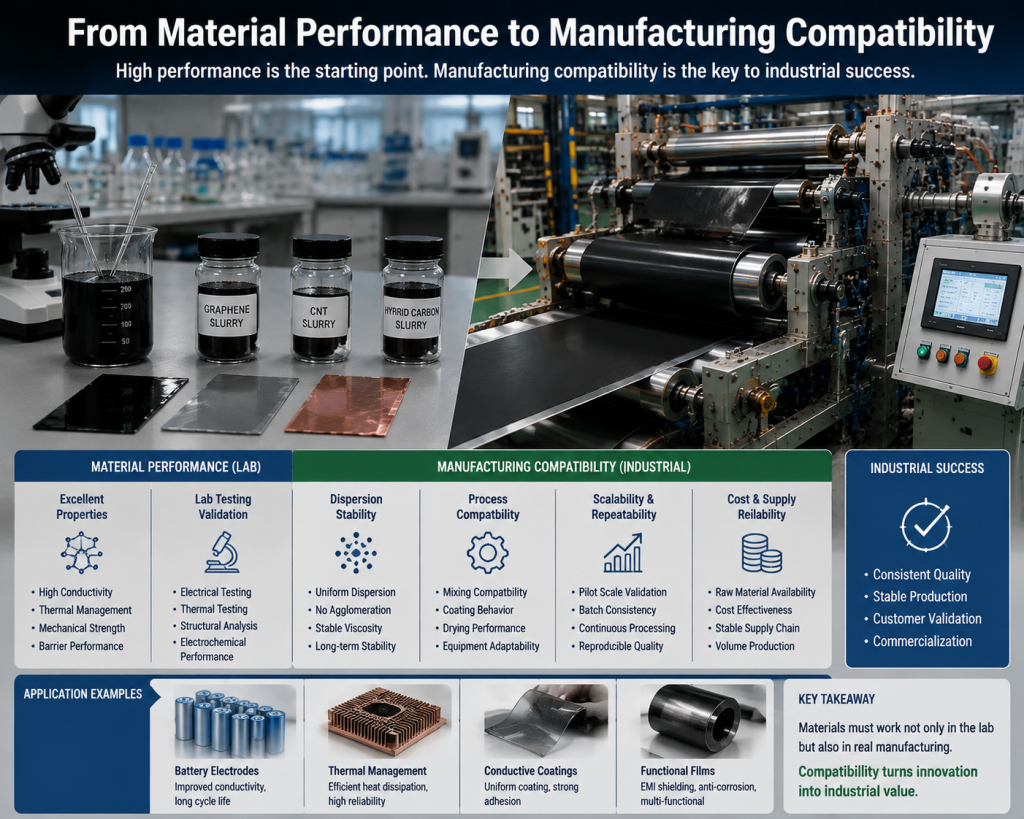
In advanced materials development, performance is often the first measure of success.
Researchers typically focus on questions such as:
- How conductive is the material?
- How strong is the material?
- How high is the thermal conductivity?
- How much performance improvement can it provide?
These questions are important, but they represent only the beginning of commercialization.
A material that performs exceptionally well in a laboratory environment may still fail during industrial adoption if it cannot be processed consistently, integrated into existing manufacturing systems, or produced economically.
The transition from innovation to industrial application requires a shift in focus:
From:
“How good is the material?”
To:
“How well does the material work within a manufacturing system?”
Why Material Performance Alone Is Not Enough
Laboratory testing usually evaluates material properties under controlled conditions.
Typical measurements include:
- Electrical conductivity
- Thermal conductivity
- Mechanical strength
- Chemical stability
- Surface properties
However, industrial production involves many additional requirements.
Manufacturers need materials that can achieve:
- Stable processing
- Repeatable quality
- Reliable supply
- Cost-effective production
- Compatibility with existing equipment
A material must succeed not only as a scientific innovation but also as a manufacturing component.
The Difference Between Material Properties and Manufacturing Requirements
Material Performance
Material performance describes the intrinsic characteristics of a material.
Examples include:
- High electrical conductivity
- Excellent heat transfer capability
- Strong mechanical properties
- Superior chemical resistance
These properties demonstrate technical potential.
Manufacturing Compatibility
Manufacturing compatibility describes how well a material integrates into a real production process.
Important factors include:
- Dispersion behavior
- Processing stability
- Equipment compatibility
- Coating performance
- Quality consistency
A high-performance material with poor manufacturing compatibility may never reach commercial scale.
Challenge 1: Dispersion and Process Stability
Many advanced materials have excellent properties but are difficult to process.
This is especially true for nanomaterials such as:
- Graphene
- Carbon nanotubes (CNT)
- Advanced carbon fillers
Because of their high surface area, these materials tend to:
- Aggregate
- Form clusters
- Reduce formulation stability
Industrial applications require stable dispersion during:
- Storage
- Mixing
- Coating
- Continuous production
A material must maintain performance throughout the entire process.
Challenge 2: Compatibility With Existing Equipment
Industrial customers rarely build completely new production systems for every new material.
Instead, new materials must often work with existing manufacturing infrastructure.
Important considerations include:
- Mixing equipment
- Coating machines
- Drying systems
- Calendering processes
- Quality inspection methods
For example, a graphene material intended for electrode coating must be compatible with:
- Slurry preparation
- Coating uniformity
- Drying behavior
- Electrode processing
Challenge 3: Scaling Changes Material Behavior
Many materials perform differently when moving from laboratory scale to pilot production.
At small scale:
- Mixing is easier
- Conditions are highly controlled
- Sample variation is limited
At larger scale:
- Equipment effects increase
- Process variations accumulate
- Quality control becomes more challenging
Successful commercialization requires understanding how material behavior changes during scale-up.
Challenge 4: Balancing Performance and Manufacturability
The highest-performing material is not always the best industrial choice.
Manufacturers must balance:
Performance
- Conductivity
- Thermal properties
- Mechanical strength
with:
Manufacturing Factors
- Cost
- Processability
- Availability
- Consistency
A slightly lower-performance material that can be produced reliably may create greater commercial value.
Examples in Advanced Carbon Materials
Graphene
Graphene provides excellent:
- Electrical conductivity
- Thermal conductivity
- Barrier properties
However, industrial use requires solving challenges such as:
- Dispersion stability
- Coating compatibility
- Large-area uniformity
Carbon Nanotubes
CNTs provide:
- Efficient conductive networks
- Mechanical reinforcement
However, successful application depends on:
- Proper dispersion
- Loading optimization
- Integration with existing formulations
Hybrid Carbon Systems
Combining graphene and CNT can improve multifunctional performance.
However, the final benefit depends on:
- Material ratio
- Processing conditions
- Manufacturing environment
The Role of Pilot Manufacturing
Pilot manufacturing provides the critical connection between material development and industrial production.
A pilot platform allows engineers to evaluate:
- Material-process compatibility
- Production stability
- Coating behavior
- Product consistency
Pilot trials answer important questions:
Can this material be processed continuously?
Can quality be maintained?
Can customers reproduce the expected performance?
Manufacturing Compatibility in Battery Applications
Battery manufacturing provides a clear example.
A conductive additive may show excellent conductivity in laboratory testing.
However, commercial battery production requires:
- Stable slurry formulation
- Uniform electrode coating
- Controlled drying
- Reliable cell performance
The material must support the entire manufacturing workflow.
Manufacturing Compatibility in Coating Applications
For graphene-based coatings, industrial success requires:
- Stable dispersion
- Suitable viscosity
- Good adhesion
- Uniform film formation
- Compatibility with coating equipment
Processes such as:
- Slot-die coating
- Roll-to-roll coating
- Spray coating
all require materials designed for manufacturing conditions.
Building Materials for Industrial Success
Successful advanced materials development should follow an integrated approach:
Step 1: Define Application Requirements
Understand the final product needs.
Step 2: Design Material Properties
Develop materials with targeted performance.
Step 3: Validate Manufacturing Compatibility
Test materials under realistic production conditions.
Step 4: Optimize Through Pilot Trials
Adjust formulation and processes before scale-up.
Future Trends
The future of advanced materials will increasingly focus on:
- Application-driven material design
- Manufacturing-aware development
- Flexible pilot platforms
- Digital process monitoring
- AI-assisted optimization
The strongest material technologies will be those designed from the beginning with industrial production in mind.
Material performance creates opportunity, but manufacturing compatibility creates commercial success.
Advanced materials must go beyond excellent laboratory results and demonstrate reliable processing, scalable production, and consistent quality.
The path from innovation to industrial adoption requires a combination of:
- Material science
- Process engineering
- Pilot validation
- Manufacturing expertise
The future of advanced materials will not be defined only by discovering better materials, but by successfully integrating those materials into real industrial systems.