
Why Graphene Coatings Matter in Harsh Industrial Environments
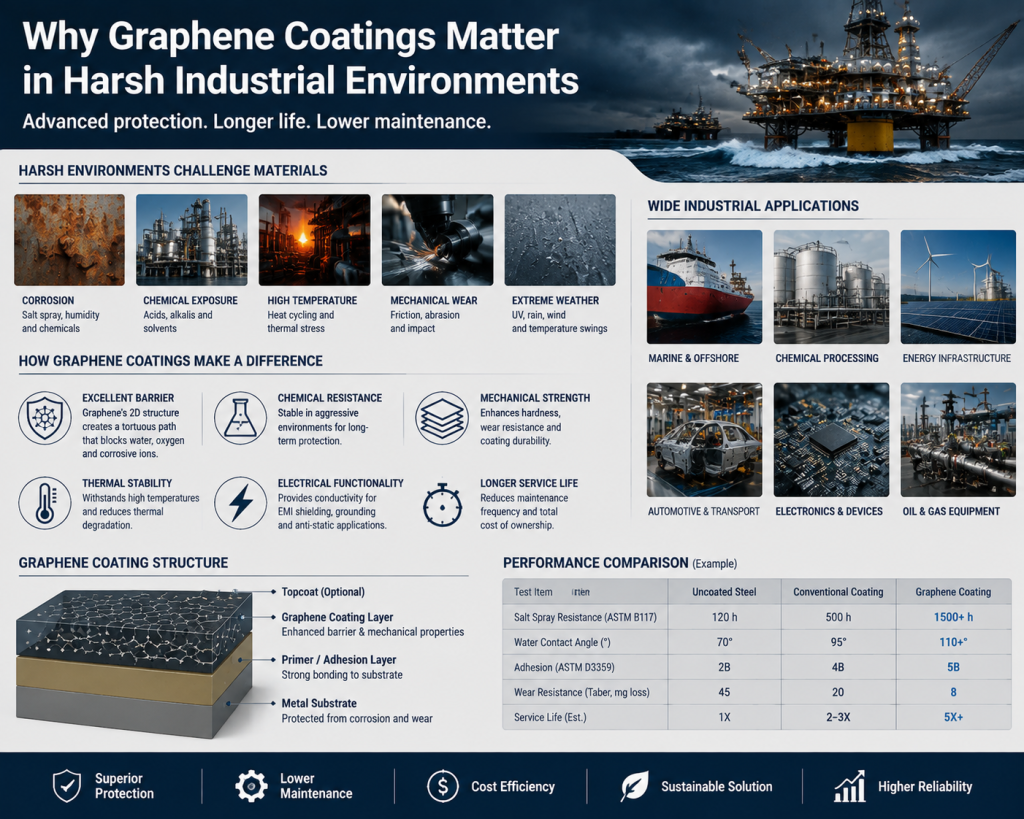
Industrial equipment is often exposed to extreme operating conditions, including:
- High humidity
- Salt spray
- Chemical exposure
- Temperature fluctuations
- Mechanical wear
These harsh environments can accelerate material degradation and reduce equipment lifetime.
Traditional protective coatings provide effective solutions, but increasing industrial demands require coatings with improved:
- Corrosion resistance
- Mechanical durability
- Thermal stability
- Electrical functionality
Graphene-based coatings have attracted attention as an advanced protection technology because of graphene’s unique structure and exceptional barrier properties.
By integrating graphene into coating systems, manufacturers aim to develop multifunctional protective layers capable of improving reliability in demanding industrial applications.
The Challenge of Harsh Industrial Environments
Industrial materials face multiple degradation mechanisms.
Corrosion
Metal surfaces exposed to:
- Water
- Oxygen
- Salt ions
- Industrial chemicals
may experience accelerated corrosion.
Corrosion can lead to:
- Reduced mechanical strength
- Equipment failure
- Increased maintenance costs
Chemical Exposure
Chemical processing environments may involve:
- Acids
- Alkalis
- Solvents
- Reactive substances
Protective coatings must maintain stability under long-term exposure.
Mechanical Wear
Industrial components often experience:
- Friction
- Impact
- Abrasion
A protective coating must provide both barrier protection and mechanical durability.
Why Graphene Is Attractive for Protective Coatings
Graphene provides several properties that make it valuable in harsh environments.
1. Excellent Barrier Properties
Graphene has a highly dense layered structure.
When incorporated into coatings, graphene sheets can create a more complex pathway for:
- Water molecules
- Oxygen
- Corrosive ions
This barrier effect can help slow the penetration of external contaminants.
2. Chemical Stability
Graphene demonstrates strong chemical resistance.
This makes graphene-based coatings attractive for applications requiring resistance against:
- Moisture
- Chemical exposure
- Environmental aging
3. Mechanical Reinforcement
Graphene has exceptional mechanical strength.
Within a coating matrix, graphene may contribute to:
- Improved hardness
- Better wear resistance
- Enhanced coating durability
4. Thermal and Electrical Functions
Unlike traditional protective coatings, graphene coatings can provide additional functions.
Potential capabilities include:
- Thermal spreading
- Electrical conductivity
- Electromagnetic shielding
This multifunctionality creates opportunities in advanced industrial applications.
Graphene Coatings in Different Industrial Environments
Marine Applications
Marine equipment faces severe corrosion challenges due to:
- Salt water
- High humidity
- Continuous exposure cycles
Potential graphene coating applications include:
- Ship components
- Offshore structures
- Marine equipment
Chemical Industry
Chemical processing equipment requires protection against aggressive environments.
Graphene-enhanced coatings may help improve:
- Chemical resistance
- Surface durability
- Maintenance intervals
Energy Infrastructure
Energy systems require long-term reliability.
Applications may include:
- Battery systems
- Renewable energy equipment
- Power infrastructure
Protective coatings can help improve equipment lifetime under demanding conditions.
Electronics and Advanced Manufacturing
Modern electronics require protection while maintaining functionality.
Graphene coatings may provide:
- Conductive surfaces
- Thermal management
- Protective barriers
The Importance of Graphene Dispersion
The performance of graphene coatings depends strongly on dispersion quality.
Poor dispersion may cause:
- Agglomeration
- Uneven protection
- Reduced coating performance
Industrial coating systems require:
- Stable graphene distribution
- Controlled formulation
- Repeatable processing
Graphene Coating Formulation Considerations
A practical industrial coating system usually includes:
Graphene Material
Important characteristics include:
- Layer structure
- Particle size
- Purity
- Surface properties
Binder System
The binder determines:
- Adhesion
- Flexibility
- Mechanical strength
Graphene must work effectively with the selected coating matrix.
Processing Parameters
Industrial manufacturing requires control of:
- Viscosity
- Coating thickness
- Drying conditions
- Surface preparation
From Laboratory Coating to Industrial Application
Many graphene coating technologies demonstrate excellent laboratory results.
However, industrial adoption requires additional validation.
Important evaluation areas include:
- Long-term durability
- Environmental resistance
- Adhesion performance
- Manufacturing consistency
Pilot-scale coating trials help determine whether graphene formulations can meet industrial requirements.
The Role of Pilot Validation
Pilot validation connects material development with real manufacturing conditions.
It helps evaluate:
Coating Process Compatibility
Can the coating work with existing production equipment?
Performance Repeatability
Can the same protection level be achieved consistently?
Scale-Up Feasibility
Can laboratory formulations transition to larger production volumes?
Challenges in Graphene Coating Commercialization
Despite its advantages, graphene coating technology still faces challenges.
Cost Optimization
Industrial customers require:
- Competitive pricing
- Efficient material usage
- Long-term supply stability
Formulation Stability
Large-scale production requires stable formulations over:
- Storage periods
- Transportation
- Continuous operation
Application-Specific Development
Different industries require different coating solutions.
A marine coating and an electronic protection coating may require completely different formulations.
Future Development Trends
Graphene coatings are expected to evolve toward:
Multifunctional Protection
Future coatings may combine:
- Corrosion resistance
- Thermal management
- Electrical conductivity
- Mechanical reinforcement
Sustainable Water-Based Systems
Water-based graphene coatings may become increasingly important due to:
- Lower environmental impact
- Safer manufacturing
- Easier industrial handling
Advanced Manufacturing Integration
Future production may integrate:
- Roll-to-roll coating
- Automated quality monitoring
- Digital process control
Harsh industrial environments create significant challenges for conventional protective materials.
Graphene coatings provide a promising approach by combining:
- Barrier protection
- Chemical resistance
- Mechanical reinforcement
- Functional properties
However, successful industrial adoption requires more than excellent graphene performance.
It requires:
- Stable formulations
- Manufacturing compatibility
- Pilot validation
- Application-specific engineering
As industries demand longer equipment lifetime and higher reliability, graphene-based coatings will continue to attract attention as an advanced solution for protecting critical industrial systems.