
What Customers Really Need Beyond Material Data Sheets
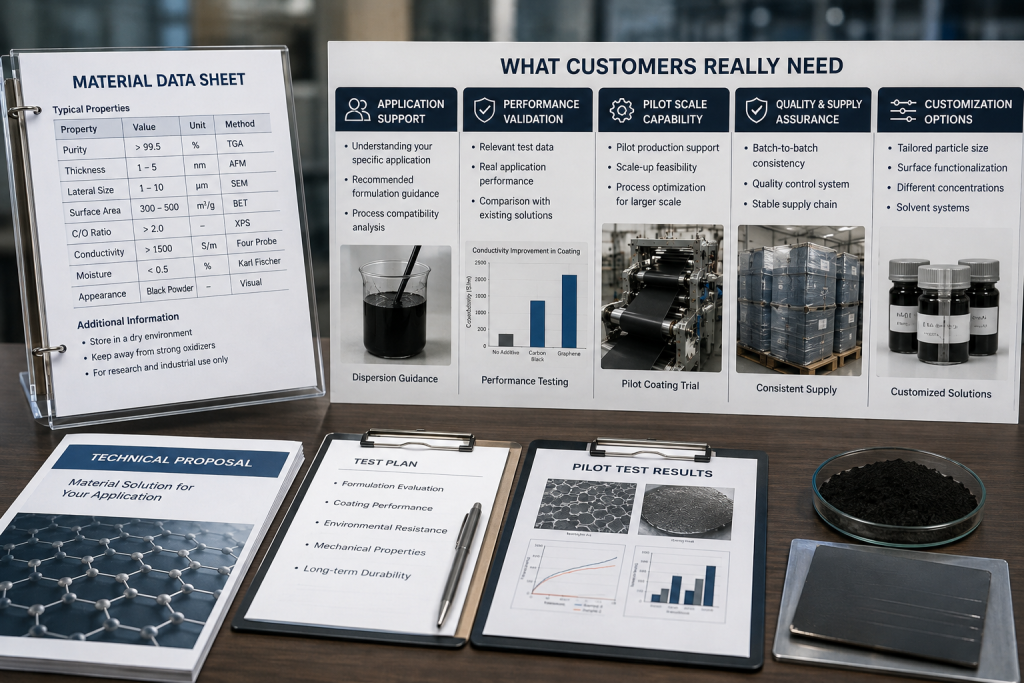
When a new material is introduced to an industrial customer, the first document is usually a technical data sheet.
It may include:
- Purity
- Particle size
- Conductivity
- Surface area
- Thickness
- Thermal properties
- Mechanical properties
These specifications are important.
However, for customers developing real industrial products, a data sheet is only the beginning.
The more important questions often come later:
Can the material work in our process?
Can we reproduce the performance?
Can you provide consistent quality?
Can we test it at pilot scale?
What happens if our process needs to be modified?
These questions reveal the difference between selling a material and supporting industrial material adoption.
A Data Sheet Describes a Material — Not the Entire Solution
A technical data sheet describes measurable properties under defined conditions.
It helps customers understand what a material is.
But it does not necessarily explain:
- How the material should be processed
- How it behaves in a specific formulation
- How it interacts with other materials
- How it performs in a customer’s manufacturing process
- Whether it can be scaled economically
For industrial applications, these factors can be just as important as the material’s basic specifications.
What Customers Really Want to Know
1. Can the Material Solve My Application Problem?
Customers rarely purchase advanced materials simply because the specification looks impressive.
They usually have a specific problem.
For example:
Battery Customers
They may need to improve:
- Electrode conductivity
- High-loading electrode performance
- Cycle stability
- Fast charging
Coating Customers
They may need:
- Corrosion protection
- Electrical conductivity
- Thermal management
- Surface durability
Electronics Customers
They may need:
- Heat dissipation
- EMI shielding
- Conductive surfaces
- Lightweight functional materials
Therefore, the first question should not always be:
“What is the specification?”
It should be:
“What problem are we trying to solve?”
2. Can the Material Be Processed?
A material can have excellent properties and still be difficult to manufacture with.
Customers need to understand:
- Dispersion behavior
- Mixing requirements
- Viscosity effects
- Processing temperature
- Coating compatibility
- Drying behavior
For graphene and CNT materials, dispersion can be particularly important.
A material that performs well as a powder may behave very differently after being incorporated into:
- A slurry
- A polymer
- A coating
- An electrode formulation
Manufacturing compatibility therefore becomes a critical part of material qualification.
3. Can the Performance Be Reproduced?
One successful laboratory test is not enough for industrial customers.
They need confidence that the same performance can be achieved:
- Across different batches
- Over longer production periods
- At larger quantities
- Under realistic manufacturing conditions
This is why repeatability is often more important than a single excellent data point.
4. Is the Material Supply Consistent?
Industrial customers are not only evaluating today’s sample.
They are evaluating future supply.
Important questions include:
- Can the same material be supplied repeatedly?
- Is batch-to-batch quality controlled?
- Can production volume increase?
- Are specifications stable?
- Is there a realistic supply plan?
A material that works technically but cannot be supplied consistently creates significant commercial risk.
5. Can Customers Obtain Application Support?
Advanced materials often require process optimization.
Customers may need help understanding:
- Recommended loading range
- Dispersion methods
- Mixing sequence
- Compatible binders
- Coating conditions
- Drying considerations
This does not mean providing a universal recipe.
Different customers may require different process conditions.
Instead, the goal is to provide enough technical understanding to help customers begin meaningful validation.
6. Can the Material Be Tested at Pilot Scale?
Laboratory samples are useful for initial screening.
But industrial customers eventually need larger and more realistic validation.
This may involve:
- Larger electrode batches
- Pilot coating
- Small-batch pouch cells
- Functional coating trials
- Larger-area films
Pilot validation helps determine whether laboratory performance can survive the transition to realistic manufacturing conditions.
7. What Happens When the Material Is Not Perfect?
This is one of the most important questions in industrial development.
Real projects rarely proceed exactly according to the original specification.
A customer may discover that:
- Viscosity is too high
- Dispersion is unstable
- Conductivity improvement is insufficient
- Adhesion needs improvement
- The material is too expensive
A useful material supplier should be able to discuss alternatives.
These may include:
- Different particle sizes
- Different surface treatments
- Different graphene grades
- CNT/graphene hybrid systems
- Functionalized materials
- Modified formulations
Industrial development is usually an optimization process rather than a simple product selection exercise.
8. Can the Material Be Customized?
Research projects often begin with standard materials.
As development progresses, customers may require:
- Specific particle size
- Controlled layer number
- Surface functionalization
- Different concentration
- Specific dispersion medium
- Customized conductivity
- Application-specific formulations
Customization becomes especially important when the material enters a proprietary manufacturing process.
The objective is not customization for its own sake.
It is to make the material better suited to the customer’s application and production environment.
9. What About Cost at Production Scale?
Laboratory testing and industrial production have very different economics.
A material may be technically successful at a small quantity but become impractical at high volume.
Customers therefore need to understand:
- Sample pricing
- Pilot-scale pricing
- Production-scale cost expectations
- Material utilization
- Potential formulation optimization
A good development discussion should consider the future manufacturing cost, not only the current sample price.
10. Can the Technology Pass Customer Qualification?
Industrial customers often have their own qualification processes.
These may include:
- Technical evaluation
- Prototype testing
- Pilot production
- Reliability testing
- Internal approval
The supplier needs to understand where the customer is in this process.
A material sample is only the first step.
The real objective is successful qualification.
From Data Sheet to Application Package
For advanced materials, a more useful technical package may include several layers.
Layer 1 — Material Data
Basic technical specifications:
- Purity
- Particle size
- Conductivity
- Surface area
- Thickness
- Moisture
- Appearance
Layer 2 — Processing Information
Information related to:
- Dispersion
- Mixing
- Coating
- Drying
- Storage
Layer 3 — Application Data
Relevant performance results under realistic conditions.
For example:
- Electrode conductivity
- Cell cycling
- Coating resistance
- Thermal performance
- Corrosion resistance
Layer 4 — Pilot Validation
Evidence from:
- Pilot coating
- Small-batch cell production
- Larger-area films
- Application-specific testing
Layer 5 — Scale-Up Information
Customers ultimately need confidence in:
- Production capacity
- Quality consistency
- Supply stability
- Cost structure
- Customization capability
This creates a much more complete picture than a traditional data sheet.
The Importance of Application Engineering
The relationship between a material supplier and an industrial customer increasingly resembles engineering cooperation.
The supplier needs to understand:
Material
↓
Formulation
↓
Process
↓
Product
↓
Performance
The customer is usually interested in the final result, not simply the material itself.
This is particularly important for advanced materials such as:
- Graphene
- CNT
- Hard carbon
- Functional carbon coatings
- Hybrid carbon systems
A Better Way to Qualify Advanced Materials
A practical qualification process can follow several stages.
Stage 1 — Material Screening
Determine whether the material meets the basic technical requirements.
Stage 2 — Formulation Testing
Evaluate how the material behaves in the customer’s formulation.
Stage 3 — Application Testing
Test the material in a realistic product environment.
Stage 4 — Pilot Validation
Evaluate manufacturing repeatability at larger scale.
Stage 5 — Customer Qualification
Complete the customer’s technical and commercial approval process.
Stage 6 — Production Scale-Up
Move toward stable industrial supply.
This approach reduces uncertainty at every stage.
Why This Matters for Graphene and Advanced Carbon Materials
Advanced carbon materials often demonstrate impressive properties.
But their industrial value depends on how effectively those properties can be translated into products.
For example:
Graphene conductivity
is useful only when it produces meaningful conductivity improvement in the final system.
CNT network formation
is valuable only when it improves electrode performance without creating unacceptable processing problems.
Graphene thermal conductivity
matters only when it contributes to measurable thermal improvement in the actual application.
The final application is therefore the ultimate test.
Beyond Selling Materials
The future of advanced material supply is moving toward a more integrated model.
Instead of:
Material → Customer
the development process increasingly becomes:
Material
↓
Application Matching
↓
Formulation
↓
Pilot Validation
↓
Customer Qualification
↓
Industrial Production
This model creates stronger technical relationships and reduces the risk of failed development projects.
A material data sheet is essential, but it is not the complete answer for an industrial customer.
Customers need to know whether a material can:
- Solve a real application problem
- Be processed reliably
- Deliver repeatable performance
- Scale to larger production
- Meet cost requirements
- Maintain consistent quality
- Pass customer qualification
For advanced materials, successful commercialization depends on connecting material performance with application engineering and manufacturing capability.
The most valuable material suppliers will therefore provide more than specifications.
They will help customers answer the much more important question:
“Can this material become part of our real product and our real manufacturing process?”
That is where advanced materials move from laboratory potential to industrial value.