
Quality Control Methods in Graphene Pilot Manufacturing
Moving graphene materials from laboratory development to pilot manufacturing introduces a new challenge: quality consistency.
A graphene formulation may perform well in a laboratory experiment, but pilot production involves larger material quantities, longer processing times, and more complex equipment.
Small variations in material properties or processing conditions can influence the final product.
For this reason, quality control must become an integral part of graphene pilot manufacturing.
A reliable quality control system connects:
Raw Material → Dispersion → Processing → Coating → Final Product
The objective is not simply to measure the material after production.
It is to identify potential variation throughout the entire manufacturing process.
Why Quality Control Becomes More Important at Pilot Scale
Laboratory experiments typically use relatively small quantities of material.
At pilot scale, several additional variables become important:
- Larger batch size
- Longer mixing time
- Equipment differences
- Temperature variation
- Material handling
- Storage conditions
These factors can create differences between laboratory and pilot results.
Therefore, pilot manufacturing requires a more systematic approach to quality control.
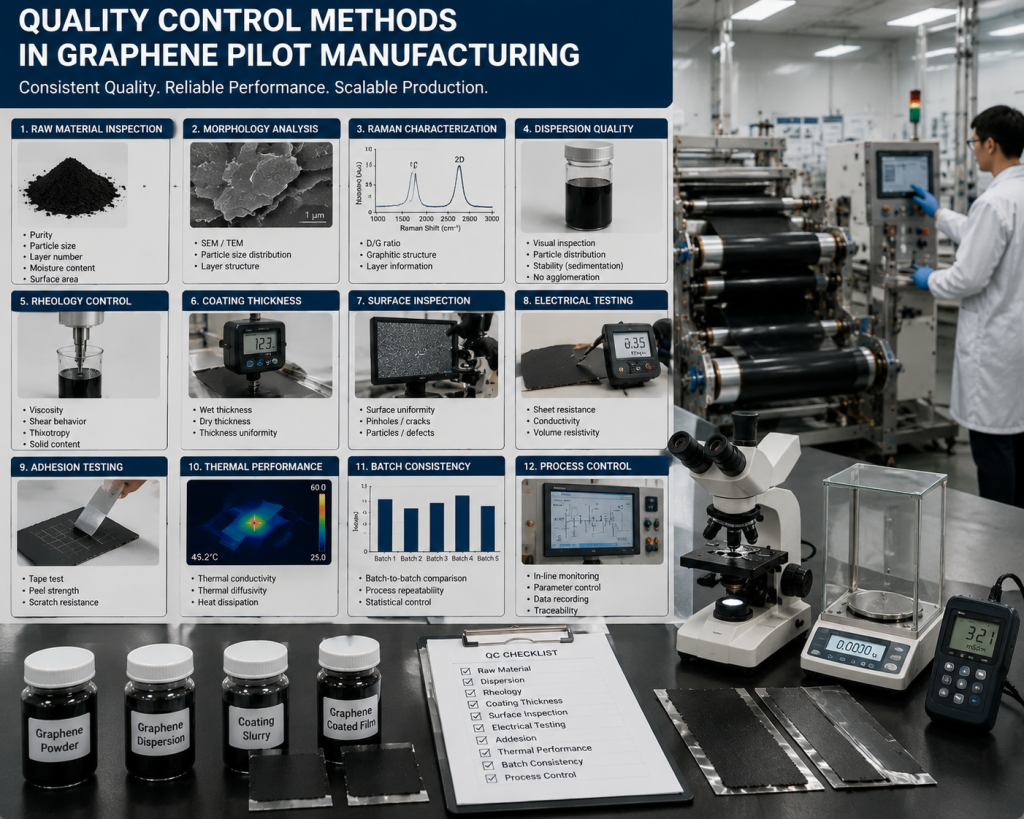
1. Raw Material Inspection
The first step is controlling the incoming graphene material.
Typical characteristics may include:
- Purity
- Particle size
- Layer number
- Moisture content
- Surface area
- Electrical properties
Not every project requires measurement of every parameter.
The appropriate specification should be selected according to the intended application.
For example, a conductive coating may prioritize electrical performance, while a thermal coating may place greater emphasis on thermal transport and dispersion behavior.
2. Particle and Morphology Analysis
Graphene morphology can influence dispersion and final product performance.
Analytical methods may include:
- SEM
- TEM
- Optical microscopy
- Particle-size analysis
These techniques can help identify:
- Aggregation
- Particle distribution
- Morphological changes
- Abnormal material structures
Consistent morphology is particularly important when the material is being used in a controlled coating or electrode process.
3. Raman Characterization
Raman spectroscopy is widely used for characterizing graphene and related carbon materials.
Important features may include:
- D band
- G band
- 2D band
Raman analysis can provide information related to:
- Defect characteristics
- Graphitic structure
- Layer-related features
For pilot manufacturing, Raman testing can be useful as part of material qualification and batch comparison.
4. Electrical Performance Testing
For conductive graphene applications, electrical performance is a critical quality indicator.
Depending on the product, testing may include:
- Electrical conductivity
- Sheet resistance
- Volume resistivity
- Surface resistance
Testing should use consistent sample preparation and measurement conditions.
This is important because electrical results can be strongly influenced by:
- Material loading
- Film thickness
- Compression
- Dispersion quality
5. Dispersion Quality Control
Dispersion is one of the most important process variables for graphene-containing formulations.
Poor dispersion can lead to:
- Agglomeration
- Uneven coating
- Local conductivity variation
- Surface defects
Quality control may include evaluation of:
- Particle distribution
- Sedimentation behavior
- Viscosity
- Visual uniformity
- Microscopic morphology
The objective is to ensure that the graphene remains sufficiently distributed throughout the formulation.
6. Slurry Rheology Control
For graphene coatings and electrode applications, slurry behavior directly affects manufacturing performance.
Important parameters include:
- Viscosity
- Solid content
- Flow behavior
- Stability over time
Rheology control helps determine whether a formulation is suitable for processes such as:
- Slot-die coating
- Roll coating
- Spray coating
A formulation that cannot maintain stable processing behavior may create coating defects even if the graphene itself has excellent properties.
7. Coating Thickness and Uniformity
During pilot coating, thickness control becomes a major quality parameter.
Important measurements include:
- Wet thickness
- Dry thickness
- Thickness variation
- Surface uniformity
Uniform coating thickness helps ensure consistent:
- Electrical performance
- Thermal performance
- Material utilization
- Product quality
For continuous coating systems, measurement should ideally be performed at multiple positions across the web.
8. Surface Inspection
Visual and microscopic inspection can identify coating defects that may not be detected by basic material testing.
Common defects include:
- Pinholes
- Cracks
- Streaks
- Particles
- Edge defects
- Uneven surfaces
Surface inspection is especially important during early pilot trials because it helps engineers identify process-related problems.
9. Adhesion Testing
For functional coatings, graphene must remain securely attached to the substrate.
Depending on the application, evaluation may include:
- Adhesion strength
- Peel resistance
- Scratch resistance
- Abrasion resistance
The final test method should be selected according to the customer’s application requirements.
10. Thermal Performance Testing
For graphene-based thermal materials, quality control may include:
- Thermal conductivity
- Thermal diffusivity
- Thermal resistance
However, thermal performance should ideally be evaluated using standardized sample preparation and testing conditions.
This allows results from different batches and pilot trials to be compared more reliably.
11. Batch-to-Batch Consistency
One of the most important objectives of pilot manufacturing is demonstrating repeatability.
Multiple batches should be compared using defined quality indicators.
For example:
| Quality Area | Possible Control Parameter |
|---|---|
| Raw material | Purity / morphology |
| Dispersion | Particle distribution / stability |
| Slurry | Viscosity / solid content |
| Coating | Thickness / uniformity |
| Electrical | Resistance / conductivity |
| Thermal | Thermal performance |
| Surface | Defect inspection |
The specific control parameters should be adapted to the application.
Process Control Is as Important as Final Inspection
Quality control should not happen only at the end of production.
A stronger approach is:
Incoming Material Control
↓
Process Monitoring
↓
Intermediate Inspection
↓
Final Product Testing
↓
Batch Comparison
This approach allows problems to be detected earlier.
It also reduces the risk of discovering manufacturing problems only after a complete pilot batch has been produced.
Building a Practical QC System
A pilot manufacturing quality system should define:
What to Measure
Identify the parameters that directly influence product performance.
When to Measure
Determine whether testing should occur:
- Before production
- During processing
- After coating
- After final product preparation
How to Measure
Use consistent testing methods and sample preparation procedures.
What Is Acceptable
Define practical specification ranges rather than relying only on single target values.
Quality Control for Graphene Coating Pilot Trials
For graphene coating projects, a practical QC framework may include:
Material
- Purity
- Particle characteristics
- Raman characteristics
Slurry
- Solid content
- Viscosity
- Dispersion stability
Coating
- Thickness
- Surface quality
- Adhesion
Functional Performance
- Electrical conductivity
- Thermal performance
- Corrosion resistance
Manufacturing
- Production repeatability
- Batch consistency
- Material utilization
This creates a direct connection between material properties and final application performance.
From Quality Control to Industrial Scale-Up
Pilot manufacturing is not simply about producing larger quantities.
It is about demonstrating that the manufacturing process can produce consistent results repeatedly.
A successful pilot trial should therefore generate information that can support:
- Process optimization
- Quality specifications
- Customer qualification
- Production planning
- Future scale-up
Quality data becomes an important part of the technology transfer process.
The Role of Digital Quality Monitoring
As graphene manufacturing becomes more advanced, digital monitoring can further improve process control.
Potential technologies include:
- Inline thickness measurement
- Automated surface inspection
- Real-time viscosity monitoring
- Statistical process control
- Digital batch tracking
These systems can help manufacturers identify process deviations earlier and improve production consistency.
Quality control is one of the most important elements in graphene pilot manufacturing.
Excellent graphene material properties are valuable, but industrial customers ultimately require:
- Consistent quality
- Stable processing
- Repeatable performance
- Reliable production
A robust quality control system connects raw material characterization with process monitoring and final product validation.
The goal is not simply to produce one successful pilot batch.
The goal is to demonstrate that the same level of performance can be achieved repeatedly and can eventually be transferred to industrial-scale manufacturing.
For graphene and other advanced carbon materials, quality consistency is the foundation for commercialization.