
Custom Battery Development Through Collaborative R&D
The battery industry is entering a period of rapid innovation.
New technologies such as:
- Advanced lithium-ion batteries
- Sodium-ion batteries
- Silicon-based anodes
- Solid-state battery concepts
- Advanced carbon materials
are creating new opportunities for energy storage applications.
However, developing a successful battery technology requires more than a promising material or laboratory result.
Companies need to solve multiple challenges simultaneously:
- Material selection
- Electrode engineering
- Cell design
- Manufacturing process
- Performance validation
- Scale-up strategy
For many organizations, building a complete battery development capability internally is expensive and time-consuming.
Collaborative R&D provides an effective approach by combining material expertise, engineering capability, and pilot manufacturing resources.
Why Custom Battery Development Is Becoming Important
Traditional battery suppliers usually provide standardized products.
However, emerging applications often require customized solutions.
Different customers may require different battery characteristics:
- Higher energy density
- Faster charging
- Longer cycle life
- Improved safety
- Different form factors
- Specific operating conditions
A standard battery design may not always meet these requirements.
Custom development allows battery technologies to be optimized for specific applications.
From Material Innovation to Battery System Development
A successful battery requires integration across multiple levels.
Material Level
Selection and optimization of:
- Cathode materials
- Anode materials
- Conductive additives
- Binders
- Electrolytes
Electrode Level
Engineering of:
- Slurry formulation
- Mixing process
- Coating parameters
- Electrode loading
- Density control
Cell Level
Optimization of:
- Cell structure
- Capacity design
- Packaging
- Formation process
- Performance testing
Application Level
Validation under real operating conditions.
A collaborative development approach connects all these stages.
The Role of Collaborative R&D
Collaborative R&D combines different technical strengths.
A typical partnership may involve:
Material Developers
Providing:
- New materials
- Functional additives
- Advanced formulations
Battery Engineering Teams
Supporting:
- Electrode design
- Cell development
- Process optimization
Pilot Manufacturing Platforms
Providing:
- Prototype production
- Process validation
- Scale-up evaluation
End Users
Defining:
- Application requirements
- Performance targets
- Qualification standards
Together, these partners accelerate technology development.
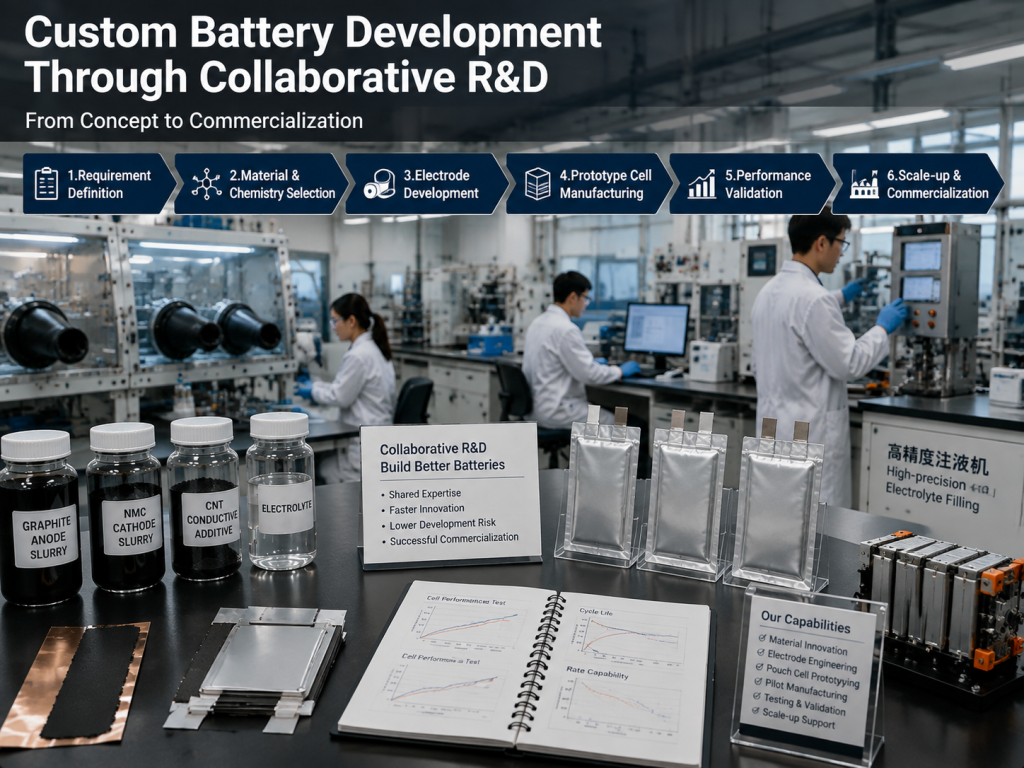
Key Stages of Custom Battery Development
Stage 1: Requirement Definition
Every project begins with understanding the target application.
Important factors include:
- Required capacity
- Voltage range
- Operating environment
- Cycle life target
- Safety requirements
A clear development target reduces unnecessary iteration.
Stage 2: Material and Chemistry Selection
Based on application requirements, teams evaluate:
- Electrode materials
- Conductive systems
- Electrolyte options
- Cell chemistry
The objective is not simply selecting the highest-performing material.
The goal is selecting the best overall solution.
Stage 3: Electrode Development
Electrode engineering determines how materials perform inside a real battery.
Key activities include:
- Slurry optimization
- Dispersion control
- Coating trials
- Drying optimization
- Electrode characterization
This stage transforms material concepts into practical electrodes.
Stage 4: Prototype Cell Manufacturing
Prototype pouch cells provide realistic validation.
Typical processes include:
- Electrode cutting
- Stacking
- Tab welding
- Electrolyte filling
- Vacuum sealing
- Formation
Prototype manufacturing reveals challenges that cannot always be identified through laboratory testing.
Stage 5: Performance Validation
Battery prototypes are evaluated through:
Electrochemical Testing
Including:
- Capacity
- Energy density
- Rate performance
- Cycle life
Safety Evaluation
Including:
- Thermal behavior
- Stability
- Operational reliability
Manufacturing Evaluation
Including:
- Process repeatability
- Quality consistency
- Scale-up potential
Why Pilot Manufacturing Capability Matters
Pilot production provides the bridge between research and commercial manufacturing.
It allows companies to evaluate:
- Real production processes
- Material compatibility
- Manufacturing stability
- Customer samples
Without pilot validation, moving directly from laboratory results to mass production creates significant risks.
Advantages of Collaborative Battery Development
Faster Technology Validation
Companies can access:
- Engineering experience
- Manufacturing equipment
- Testing capability
without building everything internally.
Lower Development Risk
Early validation helps identify:
- Technical issues
- Process limitations
- Cost challenges
before large investments are made.
Flexible Innovation
Different materials and designs can be evaluated efficiently.
Examples include:
- New electrode formulations
- Alternative conductive additives
- New cell structures
- Customized battery solutions
Advanced Carbon Materials in Collaborative Battery Development
Advanced carbon materials demonstrate why collaboration is important.
Materials such as:
- Graphene
- CNT
- Hybrid carbon networks
can improve:
- Electrical conductivity
- Electrode stability
- Thermal performance
However, their benefits depend on:
- Dispersion technology
- Electrode formulation
- Manufacturing conditions
Collaborative development helps optimize the complete system rather than evaluating materials separately.
Supporting Emerging Battery Companies
Many battery startups and research teams have strong technology concepts but limited manufacturing resources.
Collaborative R&D platforms can support:
- Small-batch cell production
- Pilot validation
- Engineering optimization
- Customer sample preparation
This allows innovators to focus on technology development while accessing practical manufacturing capabilities.
From Research Partnership to Commercialization
A successful collaboration often follows this pathway:
Research Concept
↓
Material Evaluation
↓
Electrode Development
↓
Prototype Cell Manufacturing
↓
Pilot Validation
↓
Customer Qualification
↓
Industrial Production
Each stage builds confidence and reduces commercialization risk.
Future Trends
Battery development will increasingly rely on collaborative ecosystems.
Future innovation will involve cooperation between:
- Material companies
- Battery manufacturers
- Research institutions
- Application companies
Flexible development platforms will become increasingly important for accelerating next-generation battery commercialization.
Custom battery development requires integration of materials, engineering, manufacturing, and application knowledge.
Collaborative R&D provides an effective pathway for transforming innovative battery concepts into practical products.
By combining:
- Advanced materials
- Cell engineering
- Pilot manufacturing
- Performance validation
companies can accelerate development while reducing technical and commercial risks.
The future of battery innovation will not only depend on discovering better materials, but also on building effective partnerships that can successfully move technologies from the laboratory to real-world applications.