
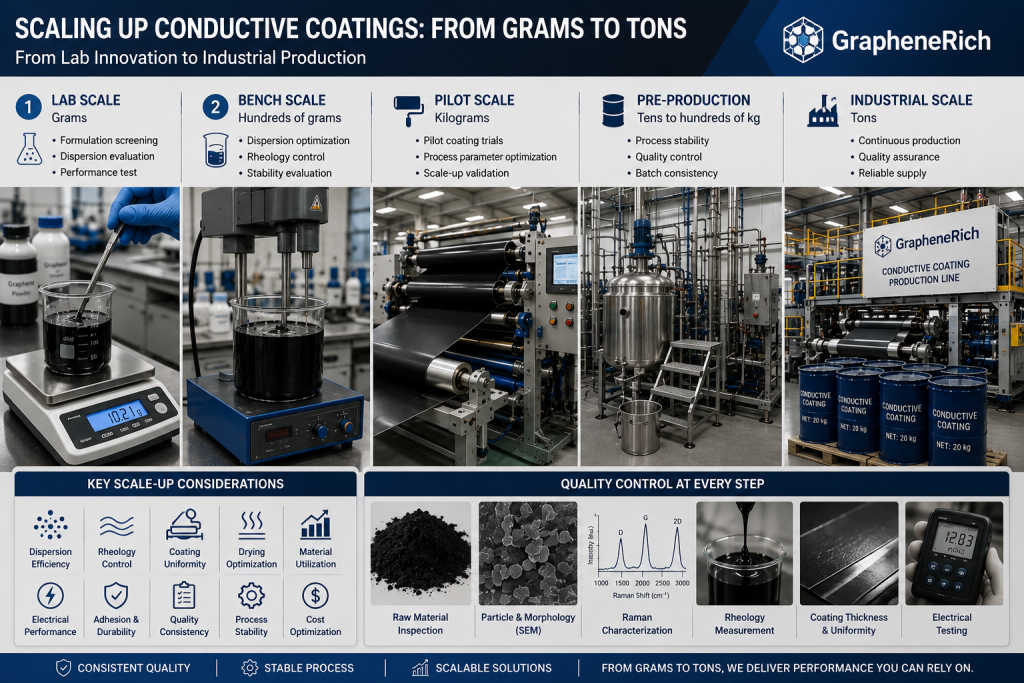
Scaling Up Conductive Coatings: From Grams to Tons
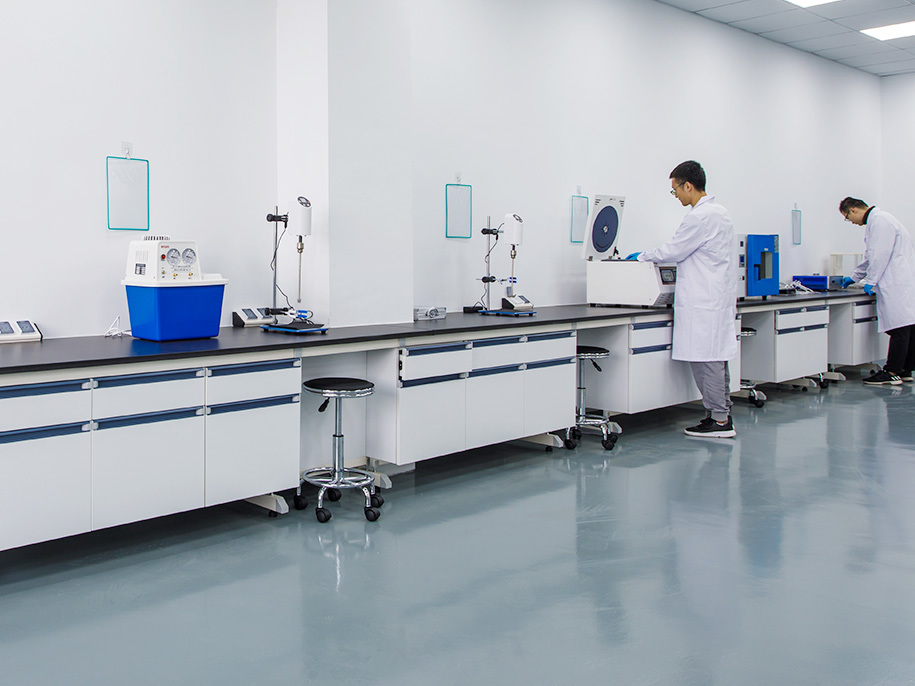
Many conductive coating technologies begin with a small laboratory experiment.
A researcher may start with only a few grams of graphene, CNT, or another conductive material and successfully produce a coating with excellent electrical performance.
The next question is much more difficult:
Can the same coating be produced consistently at kilogram, hundred-kilogram, or even ton scale?
Scaling conductive coatings from grams to tons is not simply a matter of increasing the amount of every ingredient.
Larger production volumes introduce new challenges in:
- Mixing
- Dispersion
- Rheology
- Heat transfer
- Coating
- Drying
- Quality control
- Material handling
Successful scale-up therefore requires a systematic transition from laboratory formulation to pilot manufacturing and eventually industrial production.
Why Conductive Coating Scale-Up Is Difficult
A laboratory formulation is usually developed under highly controlled conditions.
Small batches benefit from:
- Short mixing distances
- Rapid temperature control
- Easy manual adjustment
- Small material quantities
At industrial scale, the physical behavior of the system changes.
Larger equipment creates:
- Different shear conditions
- Longer mixing times
- Different heat-transfer behavior
- Larger temperature gradients
- More complex material flow
As a result, a formulation that works perfectly at 10 grams may not behave the same way at 100 kilograms.
From Material to Manufacturing System
A conductive coating is not just a mixture of conductive material and binder.
It is a complete manufacturing system involving:
Raw Materials
↓
Dispersion
↓
Formulation
↓
Coating
↓
Drying
↓
Inspection
↓
Final Product
Every stage can influence the final conductivity and coating quality.
Stage 1: Laboratory Formulation
The first stage is normally formulation development.
Typical components include:
- Graphene
- CNT
- Carbon black
- Binder
- Solvent or water
- Functional additives
The laboratory team evaluates:
- Conductivity
- Adhesion
- Viscosity
- Surface quality
- Stability
At this stage, the primary objective is to identify a promising formulation.
Stage 2: Dispersion Optimization
Dispersion becomes increasingly important during scale-up.
Graphene and CNT materials tend to form aggregates because of their high surface area and strong interactions.
Poor dispersion can result in:
- Uneven conductivity
- Coating defects
- Sedimentation
- Increased viscosity
- Reduced material utilization
At larger scale, the dispersion process must be carefully engineered.
Important variables include:
- Mixing sequence
- Shear conditions
- Mixing time
- Temperature
- Solid concentration
Stage 3: Pilot-Scale Validation
Pilot production provides the bridge between laboratory development and industrial manufacturing.
A pilot system allows engineers to evaluate:
- Larger batch sizes
- Realistic mixing conditions
- Continuous coating
- Drying behavior
- Process repeatability
This stage helps answer a critical question:
Does the laboratory formulation remain stable when the manufacturing environment changes?
Scaling the Mixing Process
One of the most common mistakes is assuming that laboratory mixing conditions can simply be multiplied.
For example:
10 g → 100 g → 1 kg → 100 kg → 1 ton
The equipment does not behave proportionally at every scale.
Engineers may need to optimize:
- Impeller design
- Mixing speed
- Power input
- Mixing sequence
- Residence time
The goal is to reproduce the required dispersion state rather than simply reproduce the same mixing time.
Controlling Rheology at Larger Scale
Coating viscosity is another critical parameter.
A formulation that is easy to coat in the laboratory may become difficult to process at larger scale.
Changes in:
- Solid content
- Particle distribution
- Binder concentration
- Dispersion quality
can significantly affect viscosity.
Stable rheology is essential for processes such as:
- Slot-die coating
- Roll coating
- Spray coating
- Gravure coating
Scaling the Coating Process
Once the formulation is stable, coating becomes the next major challenge.
Important parameters include:
- Coating speed
- Wet thickness
- Dry thickness
- Line tension
- Substrate speed
- Drying rate
At laboratory scale, coating defects may be easy to correct manually.
At industrial scale, small process deviations can affect hundreds or thousands of meters of material.
Drying Becomes a Major Engineering Issue
Drying is often underestimated during early development.
When production volume increases, engineers must control:
- Temperature
- Airflow
- Residence time
- Solvent evaporation
Uneven drying can create:
- Surface defects
- Cracking
- Poor adhesion
- Non-uniform conductivity
The drying system must therefore be designed together with the coating process.
Maintaining Conductivity at Large Scale
The ultimate objective of a conductive coating is functional performance.
For graphene- or CNT-based coatings, electrical properties can depend on:
- Conductive material concentration
- Dispersion quality
- Film thickness
- Network structure
- Drying conditions
Small variations can influence the final resistance.
Therefore, conductivity testing should become part of the scale-up quality system.
Batch-to-Batch Consistency
Industrial customers need more than one successful production batch.
They require repeatable performance.
Important parameters may include:
| Area | Typical Control |
|---|---|
| Raw material | Purity / particle characteristics |
| Dispersion | Stability / particle distribution |
| Slurry | Viscosity / solids |
| Coating | Thickness / uniformity |
| Electrical | Surface resistance |
| Adhesion | Bond strength |
| Appearance | Defect inspection |
The exact specifications should be established according to the application.
Scaling From Kilograms to Tons
Once pilot production is successful, industrial scale-up begins.
At this stage, additional factors become important:
- Raw material supply
- Production capacity
- Equipment utilization
- Energy consumption
- Packaging
- Storage
- Logistics
- Production cost
The material itself must also be available in sufficiently stable quality.
A successful formulation is only commercially useful if the complete supply chain can support it.
Cost Optimization
Industrial production changes the economic equation.
At laboratory scale, material cost may be secondary.
At ton scale, every component matters.
Optimization may involve:
- Reducing conductive additive loading
- Increasing material utilization
- Improving mixing efficiency
- Reducing solvent consumption
- Increasing coating speed
- Reducing production waste
The goal is not simply to maximize conductivity.
It is to achieve the required performance at an economically viable production cost.
Graphene and CNT Hybrid Conductive Coatings
Hybrid conductive systems can provide additional opportunities.
For example:
CNT
can create long-range conductive bridges.
Graphene
can provide large-area conductive pathways.
Combining the two can create a more efficient conductive network.
However, hybrid systems also introduce additional formulation and dispersion challenges.
They therefore require careful pilot validation before industrial scale-up.
Quality Control During Scale-Up
Quality control should become progressively more systematic.
A practical approach is:
Laboratory
Material and formulation screening
↓
Pilot
Process repeatability and application testing
↓
Pre-Production
Production stability and quality specification
↓
Industrial
Continuous process monitoring and batch control
This approach reduces the risk of unexpected quality problems during commercial production.
Common Scale-Up Mistakes
Mistake 1: Simply Multiplying the Formula
A laboratory formula does not automatically scale linearly.
Mistake 2: Ignoring Dispersion
Poor dispersion can destroy the expected performance of advanced conductive materials.
Mistake 3: Focusing Only on Conductivity
A coating may have excellent conductivity but poor:
- Adhesion
- Flexibility
- Stability
- Processability
Mistake 4: Skipping Pilot Production
Moving directly from laboratory testing to mass production creates unnecessary technical risk.
A Practical Scale-Up Roadmap
A typical development pathway can be:
Gram-Scale Formulation
↓
Hundred-Gram Screening
↓
Kilogram-Scale Validation
↓
Pilot Coating
↓
Tens to Hundreds of Kilograms
↓
Industrial Production
The exact scale depends on the application and manufacturing process.
The important principle is progressive validation.
What Successful Scale-Up Really Means
Successful scale-up does not simply mean producing a larger quantity.
It means maintaining:
- Material consistency
- Dispersion quality
- Process stability
- Coating uniformity
- Functional performance
- Economic feasibility
as production volume increases.
This is the real transition from laboratory innovation to industrial manufacturing.
Scaling conductive coatings from grams to tons is a complex engineering process.
Graphene, CNT, and other conductive materials may demonstrate excellent laboratory performance, but industrial success requires much more.
Manufacturers must control:
- Dispersion
- Formulation
- Rheology
- Coating
- Drying
- Quality
- Cost
Pilot manufacturing provides the critical bridge between laboratory development and large-scale production.
The most successful conductive coating technologies will therefore be those that are designed not only for high performance, but also for repeatable, scalable, and economically viable manufacturing.