

Multi-Dimensional Conductive Networks Explained
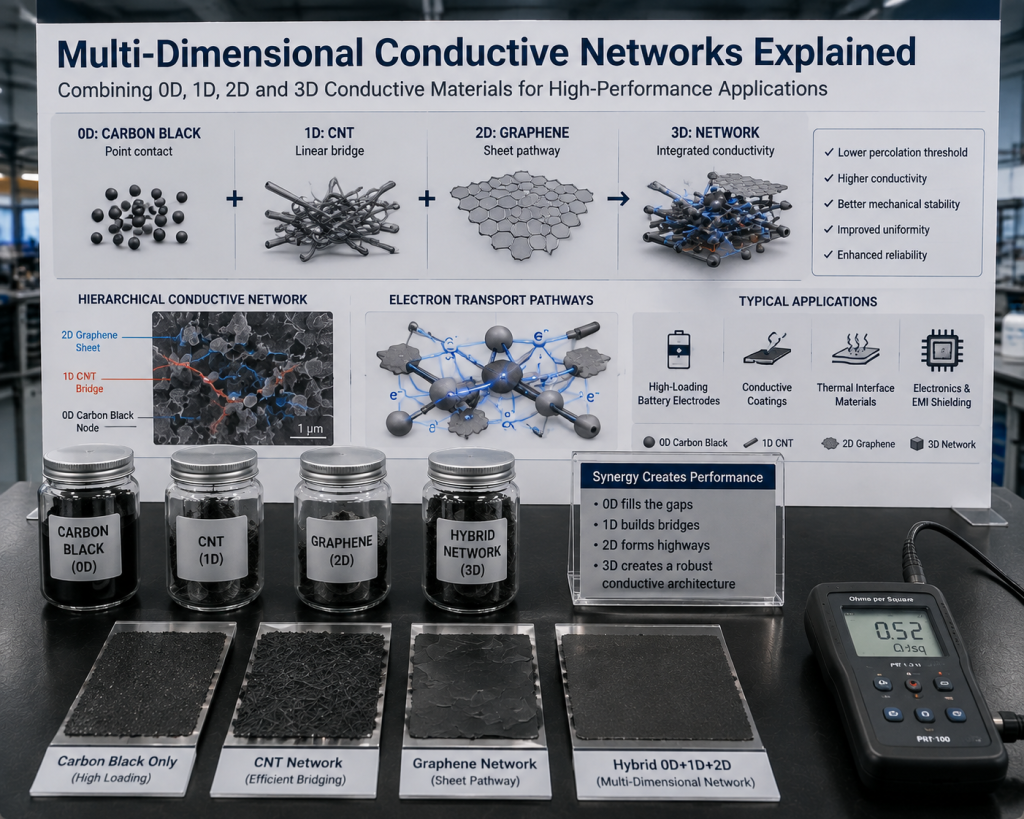
Electrical conductivity in advanced materials is rarely determined by a single conductive component.
In modern batteries, conductive coatings, polymers, and electronic materials, engineers increasingly use combinations of conductive materials to create interconnected networks.
These systems can include:
- Zero-dimensional carbon particles
- One-dimensional carbon nanotubes
- Two-dimensional graphene
- Three-dimensional interconnected structures
Each dimensional structure provides a different type of conductive pathway.
By combining them, engineers can create multi-dimensional conductive networks that improve electrical connectivity, mechanical stability, and overall material utilization.
What Is a Conductive Network?
A conductive network is a continuous pathway through which electrons can move across a material.
Consider an electrode containing active material particles.
If the particles are isolated from one another, electron transport becomes inefficient.
Conductive additives create connections between these particles.
The objective is not simply to add more conductive material.
The objective is to create a continuous network using the minimum effective amount of conductive additive.
The Four Basic Dimensions of Conductive Materials
0D: Conductive Particles
Examples include:
- Carbon black
- Conductive nanoparticles
- Certain carbon-based particles
These materials are relatively small and can fill gaps between larger structures.
Their primary function is to create local conductive contacts.
However, particle-based networks may require relatively high loading to achieve continuous connectivity.
1D: Carbon Nanotubes
Carbon nanotubes provide a fundamentally different structure.
Their high aspect ratio allows them to bridge relatively large distances between particles.
A CNT can connect multiple active material particles and create long-range conductive pathways.
Potential advantages include:
- Efficient electrical bridging
- Lower conductive additive loading
- Mechanical reinforcement
- Improved network connectivity
This makes CNTs particularly attractive for high-loading electrodes.
2D: Graphene
Graphene provides a large two-dimensional conductive surface.
Instead of acting primarily as a point-to-point bridge, graphene can create broader conductive pathways across the material.
Potential advantages include:
- Large contact area
- High electrical conductivity
- Thermal transport
- Surface interaction with surrounding materials
Graphene can therefore complement CNT-based conductive structures.
3D: Integrated Conductive Networks
Three-dimensional conductive networks are formed when different conductive structures connect throughout the material.
For example:
Carbon Black
provides local contacts.
CNT
provides long-range bridges.
Graphene
provides large-area conductive pathways.
Together, they can form a three-dimensional conductive architecture.
This is the fundamental idea behind multi-dimensional conductive networks.
Why Combine Different Conductive Materials?
Using one conductive material does not always provide the best overall solution.
Different materials have different structural advantages.
For example:
| Material | Structure | Primary Function |
|---|---|---|
| Carbon Black | 0D | Local conductive contacts |
| CNT | 1D | Long-range conductive bridges |
| Graphene | 2D | Large-area conductive pathways |
| Hybrid Network | 3D | Integrated conductive architecture |
The objective is to make these structures work together.
CNT + Graphene: A Typical Hybrid System
CNT and graphene are particularly complementary.
CNTs can connect separated particles.
Graphene can provide broader conductive surfaces.
A simplified network can therefore be understood as:
Active Material
↔ CNT Bridge
↔ Graphene Sheet
↔ CNT Bridge
↔ Active Material
This creates multiple possible electron transport pathways.
Multi-Dimensional Networks in Battery Electrodes
Battery electrodes are one of the most important applications.
As active material loading increases, maintaining electrical connectivity becomes more difficult.
This is especially relevant for:
- High-loading electrodes
- Silicon-based anodes
- High-nickel cathodes
- Thick electrodes
- Fast-charging systems
A multi-dimensional conductive network can help maintain electrical contact throughout a thicker electrode structure.
High-Loading Electrodes
Increasing active material loading can improve energy density.
However, thicker electrodes create:
- Longer electron pathways
- Greater internal resistance
- More difficult conductive network formation
CNT and graphene can help address these problems by providing complementary conductive pathways.
The objective is to achieve sufficient conductivity without excessively increasing the amount of inactive material.
Multi-Dimensional Networks in Conductive Coatings
The concept is also relevant to functional coatings.
Applications may include:
- Conductive coatings
- Antistatic coatings
- EMI shielding
- Thermal interface materials
- Heating films
- Smart surfaces
A hybrid conductive network can improve electrical connectivity across a coating layer.
The Importance of Dispersion
A multi-dimensional network only works if the conductive components are properly distributed.
Poor dispersion can cause:
- CNT bundles
- Graphene aggregation
- Uneven conductivity
- Coating defects
Therefore, dispersion is one of the most important process parameters.
The goal is to distribute each conductive component while preserving its ability to connect with other components.
Network Formation vs. Conductive Loading
More conductive material does not automatically mean better performance.
At low loading:
The network may be incomplete.
As loading increases:
Conductive pathways begin to connect.
Eventually:
A continuous network is formed.
After this point, additional conductive material may provide diminishing returns.
This behavior is often associated with the conductive percolation threshold.
Therefore, formulation optimization should focus on finding an efficient network rather than simply maximizing conductive additive concentration.
Balancing Conductivity and Processability
Increasing conductive additive content can also create manufacturing problems.
For example:
- Higher viscosity
- Poor dispersion
- Difficult coating
- Increased material cost
- Reduced active material fraction
Therefore, an industrial formulation must balance:
Conductivity
with
Processability
and
Cost
This is why pilot-scale testing is important.
Multi-Dimensional Networks and Mechanical Stability
Conductive networks can also contribute to structural stability.
CNTs can act as flexible bridges.
Graphene sheets can provide reinforcement across larger areas.
Together, they may help maintain conductive connections during:
- Electrode expansion
- Contraction
- Mechanical deformation
- Thermal cycling
This is particularly interesting for materials with significant volume changes, such as silicon-based electrodes.
Thermal and Electrical Applications
The concept of multi-dimensional networks is not limited to batteries.
Hybrid carbon networks can also be designed for thermal applications.
Graphene can provide efficient in-plane thermal pathways, while CNT structures can contribute to three-dimensional connectivity.
Potential applications include:
- AI server thermal materials
- Heat-spreading coatings
- Thermal interface materials
- Electronic packaging
- Battery thermal management
The network architecture can therefore be designed according to the required transport direction.
From Material Selection to Network Design
Advanced conductive materials should not be selected only by comparing individual data sheets.
Engineers increasingly need to consider:
Material Properties
↓
Structure
↓
Dispersion
↓
Network Formation
↓
Manufacturing Process
↓
Final Performance
This approach shifts development from material selection toward network engineering.
Pilot Validation of Multi-Dimensional Networks
Laboratory experiments can demonstrate that a hybrid network is promising.
However, pilot production is needed to determine whether the network can be reproduced consistently.
Important validation parameters may include:
- Conductivity
- Resistance uniformity
- Coating thickness
- Dispersion stability
- Mechanical durability
- Batch-to-batch consistency
The optimum formulation must also remain compatible with the intended manufacturing process.
The Future of Conductive Network Engineering
Future conductive materials will increasingly move toward engineered architectures rather than single-component systems.
Potential developments include:
- CNT + graphene hybrids
- Carbon black + CNT systems
- Graphene + metallic networks
- Functionalized carbon networks
- Three-dimensional porous conductive structures
The objective will be to create conductive pathways that are:
- Efficient
- Stable
- Lightweight
- Economical
- Scalable
Multi-dimensional conductive networks provide a practical framework for understanding how different conductive materials can work together.
Each dimensional structure contributes differently:
- 0D materials provide local conductive contacts.
- 1D CNTs create long-range conductive bridges.
- 2D graphene provides large-area conductive pathways.
- 3D hybrid structures integrate these components into interconnected networks.
The real value comes from combining these structures intelligently.
For batteries, conductive coatings, thermal materials, and advanced electronics, the future of conductive material design will increasingly depend on network architecture rather than individual material properties alone.
Successful industrial development therefore requires more than selecting a high-performance conductive material.
It requires designing a conductive network that can be formulated, manufactured, validated, and scaled consistently.