
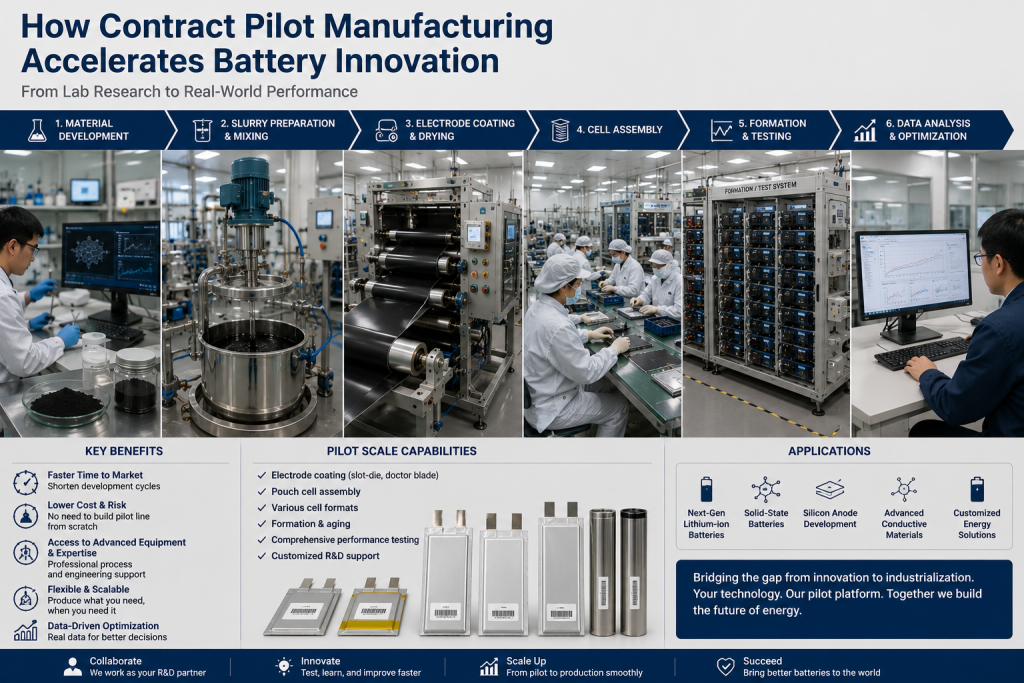
How Contract Pilot Manufacturing Accelerates Battery Innovation
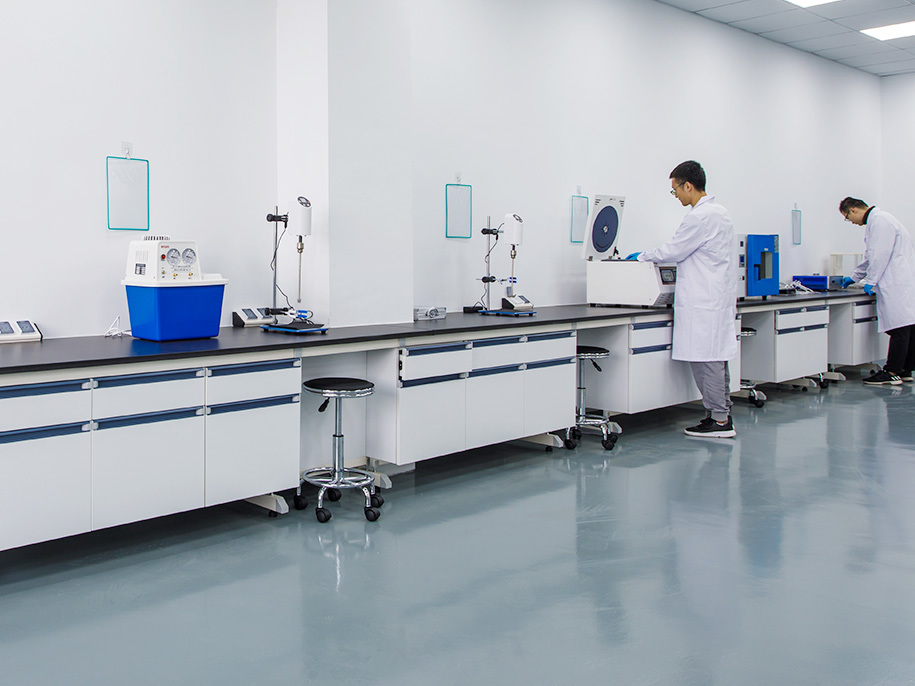
Battery innovation often begins in a laboratory.
A research team may develop a new electrode formulation, advanced conductive material, or next-generation battery chemistry and achieve promising experimental results.
But moving from laboratory research to commercial production requires a completely different level of capability.
Companies need access to:
- Electrode processing equipment
- Cell assembly equipment
- Formation and testing systems
- Controlled manufacturing environments
- Experienced process engineers
- Pilot-scale production capability
Building all of these resources internally can require significant investment.
This is where contract pilot manufacturing can play an important role.
Instead of immediately building a complete battery production line, companies can work with an external pilot manufacturing partner to produce small batches, validate processes, and generate realistic cell data.
What Is Contract Pilot Manufacturing?
Contract pilot manufacturing means using an external manufacturing platform to produce battery materials, electrodes, or cells according to a customer’s development requirements.
Depending on the project, the scope may include:
- Electrode preparation
- Slurry mixing
- Coating
- Drying
- Electrode processing
- Cell assembly
- Formation
- Capacity grading
- Performance testing
The exact scope can be customized according to the development stage.
The objective is not necessarily mass production.
The objective is to bridge the gap between laboratory research and industrial manufacturing.
Why the Gap Between Laboratory and Production Is So Difficult
Laboratory research usually focuses on proving whether a technology works.
Industrial manufacturing must answer additional questions:
- Can the process be repeated?
- Can the material be processed consistently?
- Can production quality be controlled?
- Can the process be scaled?
- Can the final product meet customer requirements?
A technology can therefore demonstrate excellent laboratory performance while still facing significant manufacturing challenges.
Pilot manufacturing provides an intermediate validation step.
The Traditional Development Path
A conventional approach may look like:
Laboratory Research
↓
Internal Engineering Development
↓
Pilot Line Construction
↓
Process Validation
↓
Production
This approach can require substantial investment before the technology has been fully validated.
For startups and emerging battery technologies, this creates significant financial and technical risk.
A More Flexible Development Model
Contract pilot manufacturing introduces another pathway:
Laboratory Research
↓
External Pilot Manufacturing
↓
Small-Batch Cell Validation
↓
Customer Testing
↓
Process Optimization
↓
Industrial Scale-Up
This allows companies to validate the technology before committing to large manufacturing investments.
1. Faster Access to Manufacturing Equipment
A major advantage is immediate access to existing pilot equipment.
Depending on the platform, this may include:
- Mixing systems
- Coating equipment
- Drying ovens
- Slitting equipment
- Electrode processing systems
- Stacking equipment
- Welding systems
- Electrolyte filling systems
- Formation equipment
Companies can therefore begin practical validation without waiting for a new production line to be designed and installed.
2. Lower Initial Capital Investment
Building a dedicated battery pilot line can require substantial capital.
It also involves:
- Factory space
- Utility systems
- Dry rooms
- Equipment installation
- Maintenance
- Process engineering
Contract pilot manufacturing changes this cost structure.
Instead of investing heavily in infrastructure immediately, companies can purchase manufacturing capacity as needed during development.
This is particularly valuable for:
- Startups
- Universities
- Research institutes
- Material companies
- Early-stage battery developers
3. Faster Technology Validation
Time is critical in battery innovation.
A new chemistry may need to be evaluated against:
- Existing battery technologies
- Competing materials
- Customer requirements
Contract pilot manufacturing can shorten the time between:
Laboratory Result
and
Real Cell Validation
This allows development teams to make decisions based on realistic cell data much earlier.
4. Small-Batch Pouch Cell Production
Pouch cells are particularly useful for technology validation.
Compared with very small laboratory cells, pouch cells provide a more realistic platform for evaluating:
- Electrode loading
- Cell capacity
- Energy density
- Electrolyte behavior
- Formation characteristics
- Cycle performance
Small-batch production allows developers to evaluate their technology without immediately moving to large-scale manufacturing.
5. Testing Manufacturing Compatibility
A material may perform well in a laboratory experiment but behave differently during manufacturing.
For example, an advanced conductive additive may create:
- Unexpected slurry viscosity
- Dispersion problems
- Coating defects
- Drying difficulties
Pilot manufacturing exposes these problems earlier.
This is particularly important for:
- Graphene
- CNT
- Silicon materials
- High-loading electrodes
- New binder systems
6. Supporting Advanced Carbon Materials
Contract pilot manufacturing can be particularly valuable for companies developing advanced carbon materials.
A material supplier may have excellent data showing:
- High conductivity
- Large surface area
- Good dispersion
- Excellent thermal properties
But customers eventually need to know:
How does this material perform inside a real battery?
Pilot manufacturing provides a pathway from:
Material Sample
↓
Electrode Formulation
↓
Prototype Cell
↓
Performance Validation
This creates stronger evidence for commercialization.
7. Reducing Development Risk
Battery development involves many uncertainties.
Potential problems include:
- Material incompatibility
- Poor electrode processing
- Insufficient cycle life
- Low manufacturing yield
- High production cost
Finding these problems during laboratory development is much less expensive than discovering them after a large production line has been built.
Contract pilot manufacturing therefore acts as a risk-reduction stage.
8. Generating Customer-Ready Samples
Many industrial customers need physical samples before they can begin qualification.
Depending on the project, these may include:
- Coated electrodes
- Prototype cells
- Small-batch pouch cells
- Customized battery samples
External pilot manufacturing can help technology developers generate these samples without building their own complete manufacturing infrastructure.
9. Supporting Collaborative R&D
Contract pilot manufacturing does not have to be a simple manufacturing service.
It can become part of a collaborative R&D process.
A typical project may involve:
Customer
Defines application requirements.
↓
Material Developer
Provides materials or chemistry.
↓
Pilot Manufacturing Partner
Produces electrodes and cells.
↓
Testing Team
Evaluates performance.
↓
All Partners
Optimize the next development cycle.
This collaborative model can significantly accelerate innovation.
10. Flexible Development for Different Chemistries
Battery innovation is not limited to one chemistry.
Pilot platforms may support development of:
- Lithium-ion batteries
- Sodium-ion batteries
- Silicon-based batteries
- Advanced cathode systems
- New conductive additive systems
A flexible platform allows developers to test different approaches without constructing a dedicated production line for every technology.
From Electrode Development to Cell Validation
A contract pilot project may include several stages.
Stage 1 — Material Preparation
Materials are evaluated and prepared for processing.
Stage 2 — Slurry Development
The formulation is optimized for:
- Solid content
- Viscosity
- Dispersion
- Coating compatibility
Stage 3 — Pilot Coating
Electrodes are produced under controlled conditions.
Stage 4 — Electrode Processing
The coated electrodes are:
- Dried
- Calendered
- Slit
- Prepared for assembly
Stage 5 — Cell Assembly
Cells are assembled according to the target design.
Stage 6 — Formation and Testing
The cells undergo:
- Formation
- Capacity grading
- Cycling
- Resistance testing
This creates a complete development feedback loop.
The Importance of Process Data
One of the most valuable outputs of contract pilot manufacturing is not simply the physical battery sample.
It is the process data.
Useful information may include:
- Mixing conditions
- Coating parameters
- Electrode loading
- Thickness
- Density
- Assembly conditions
- Formation behavior
This information helps developers understand how their technology behaves during manufacturing.
Contract Manufacturing Is Not the Same as Mass Production
It is important to distinguish pilot manufacturing from commercial production.
The objective of pilot manufacturing is usually:
- Technology validation
- Process development
- Prototype production
- Customer qualification
Mass production focuses on:
- High throughput
- Low unit cost
- High yield
- Long-term production stability
Pilot manufacturing prepares the technology for this next stage.
When Should Companies Use Contract Pilot Manufacturing?
Contract pilot manufacturing can be particularly useful when:
The technology is technically promising but not yet fully validated.
The company does not have its own pilot line.
The required production volume is still relatively small.
The customer needs prototype cells for testing.
The company wants to validate manufacturing before investing in a factory.
Multiple material or chemistry options need to be compared.
How to Select a Pilot Manufacturing Partner
The right partner should be evaluated beyond equipment availability.
Important considerations include:
Technical Capability
Can the platform support the required:
- Cell format
- Chemistry
- Electrode design
- Manufacturing process?
Process Flexibility
Can the partner adapt to experimental requirements rather than only running standardized production?
Testing Capability
Can the project include appropriate:
- Electrochemical testing
- Physical characterization
- Quality inspection?
Data Transparency
Will the customer receive meaningful process and testing information?
Scale-Up Capability
Can successful pilot results eventually be transferred toward larger production?
From Contract Pilot Manufacturing to Industrial Production
The ultimate purpose of pilot manufacturing is to prepare for scale-up.
A typical development pathway is:
Research
↓
Laboratory Prototype
↓
Contract Pilot Manufacturing
↓
Small-Batch Validation
↓
Customer Qualification
↓
Pre-Production
↓
Industrial Manufacturing
At each stage, technical uncertainty is reduced.
The Future of Battery Development
Battery innovation is becoming increasingly collaborative.
Material developers, battery startups, research institutions, and industrial companies are all looking for ways to shorten development cycles.
Flexible pilot manufacturing platforms can provide the infrastructure required to support this ecosystem.
Instead of every company building a complete manufacturing system from the beginning, specialized pilot platforms can provide shared development capabilities.
This creates a more efficient innovation model.
Contract pilot manufacturing can significantly accelerate battery innovation by providing flexible access to manufacturing equipment, engineering capability, and small-batch production.
It allows companies to:
- Validate new materials
- Develop electrodes
- Produce prototype cells
- Test manufacturing compatibility
- Generate customer samples
- Reduce scale-up risks
Most importantly, it creates a practical bridge between laboratory research and industrial production.
For emerging battery technologies, the ability to move quickly from concept → prototype → pilot validation → customer qualification can be as important as the underlying material innovation itself.
The future of battery development will increasingly depend on flexible manufacturing platforms and collaborative development models that allow promising technologies to be tested, improved, and scaled before major capital investments are made.