

Graphene-Based EMI Shielding Materials Explained
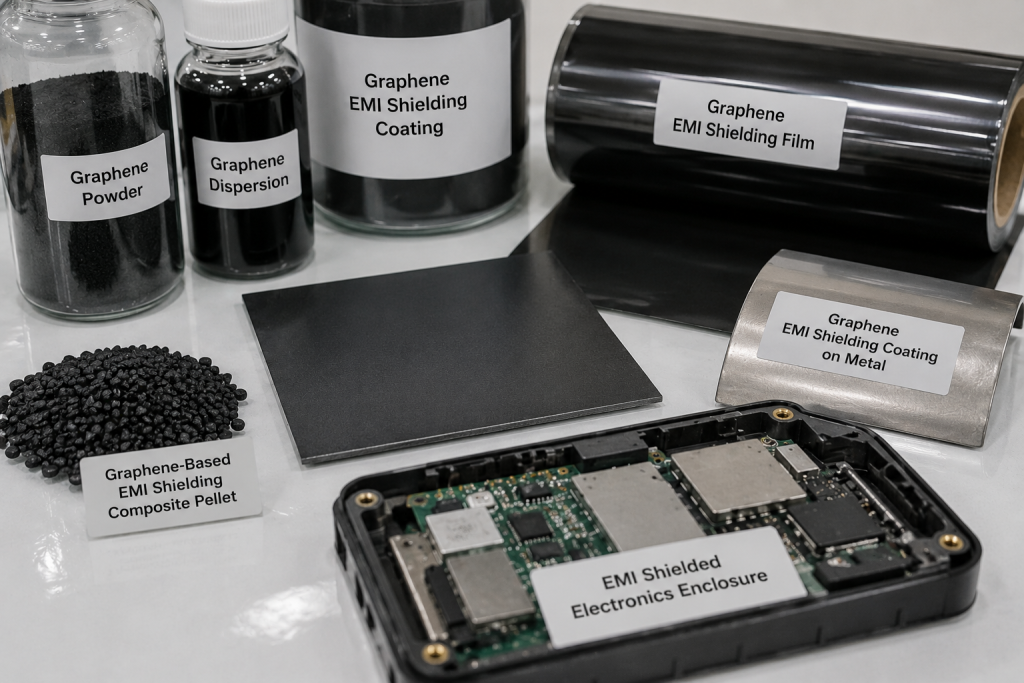
As electronic systems become smaller, faster, and more powerful, electromagnetic interference (EMI) is becoming an increasingly important engineering challenge. High-frequency processors, power electronics, wireless communication systems, electric vehicles, battery systems, data centers, and advanced sensors can all generate or experience unwanted electromagnetic radiation.
Traditional EMI shielding materials, particularly metals, remain widely used because of their excellent electrical conductivity. However, metals can be heavy, difficult to process into complex geometries, and vulnerable to corrosion. In applications where weight reduction, flexibility, multifunctionality, or advanced composite structures are important, graphene-based EMI shielding materials are attracting increasing attention.
Graphene combines high electrical conductivity, large specific surface area, low density, mechanical strength, and excellent compatibility with polymer and composite systems. These characteristics make graphene a promising functional material for developing lightweight EMI shielding coatings, films, plastics, elastomers, and hybrid shielding structures.
Understanding how graphene-based EMI shielding works—and how material structure, graphene loading, dispersion, thickness, and processing affect performance—is essential for moving from laboratory materials toward practical applications.
What Is EMI Shielding?
Electromagnetic interference occurs when unwanted electromagnetic energy affects the operation of an electronic device, circuit, communication system, or sensor.
EMI can originate from many sources, including:
- High-speed processors
- Switching power supplies
- Motors and inverters
- Battery management systems
- Wireless communication devices
- RF transmitters
- Power converters
- Data center equipment
- Electric vehicle power electronics
An EMI shielding material is designed to reduce the electromagnetic energy transmitted through or into a protected region.
Shielding effectiveness is commonly expressed in decibels (dB). A higher shielding effectiveness generally indicates greater attenuation of electromagnetic energy.
The overall shielding mechanism can involve three primary processes:
Reflection + Absorption + Multiple Internal Reflection
The relative contribution of each mechanism depends on the material’s electrical properties, thickness, structure, frequency range, and interface characteristics.
Why Graphene Is Attractive for EMI Shielding
Graphene consists of carbon atoms arranged in a two-dimensional structure. Its electrical, mechanical, thermal, and surface properties make it fundamentally different from conventional bulk fillers.
For EMI shielding, several characteristics are particularly valuable.
High Electrical Conductivity
Electrical conductivity enables electromagnetic energy to interact strongly with the material.
A sufficiently conductive graphene network can facilitate reflection and absorption of electromagnetic waves.
However, maximum conductivity is not always the only objective. A practical shielding material must balance conductivity with weight, thickness, flexibility, processability, and application requirements.
Large Specific Surface Area
Graphene has a very high surface area relative to its mass.
This provides extensive interfaces when graphene is incorporated into a polymer matrix or combined with other functional materials.
These interfaces can contribute to electromagnetic energy attenuation through interfacial polarization and multiple scattering mechanisms.
Low Density
Compared with many metallic shielding materials, graphene-based composites can potentially provide significant weight reduction.
This is particularly attractive for:
- Electric vehicles
- Aerospace electronics
- Portable electronics
- Drones
- Lightweight communication equipment
- Wearable electronics
Mechanical Reinforcement
Graphene can simultaneously provide EMI shielding and mechanical reinforcement.
A properly designed graphene-polymer composite may therefore perform several functions within one material system rather than requiring separate structural and shielding components.
How Graphene-Based EMI Shielding Works
The shielding mechanism of graphene composites is more complicated than simply “blocking” electromagnetic waves.
When electromagnetic radiation reaches a graphene-based material, part of the energy can be reflected from the surface. Another portion can enter the material and be absorbed.
Inside the composite, electromagnetic energy can encounter multiple interfaces, conductive pathways, defects, pores, and graphene-polymer boundaries.
These structures can increase scattering and energy dissipation.
A simplified description is:
Incident electromagnetic wave → Reflection → Transmission into material → Absorption + Internal Reflection/Scattering → Reduced transmitted energy
This is why the microstructure of a graphene composite can be just as important as its nominal graphene content.
Graphene Loading and Conductive Networks
One of the most important factors in graphene-based EMI shielding is graphene concentration.
At very low concentrations, graphene particles may remain electrically isolated within a polymer matrix. The material may therefore have limited electrical conductivity and relatively weak shielding performance.
As graphene loading increases, the distance between conductive structures decreases.
At a certain concentration, a continuous or semi-continuous conductive network can begin to form. This phenomenon is associated with the percolation threshold.
Beyond this threshold, electrical conductivity can increase dramatically.
However, simply increasing graphene loading indefinitely is not necessarily an optimal strategy.
High filler loading may cause:
- Higher viscosity
- Poor processability
- Graphene agglomeration
- Increased material cost
- Reduced flexibility
- Increased density
- Difficult injection molding or coating
- Poor surface quality
Therefore, practical material development focuses on creating an effective conductive network with the lowest reasonable graphene loading.
Dispersion Is Critical
Graphene’s performance in a composite depends strongly on dispersion quality.
If graphene flakes are uniformly distributed, they can form a more effective network throughout the matrix.
If the graphene forms large agglomerates, however, the conductive network may become discontinuous.
Agglomeration can also create:
- Local conductivity variations
- Surface defects
- Mechanical weaknesses
- Processing instability
- Inconsistent EMI shielding
This makes dispersion technology a key part of graphene-based EMI material development.
Mixing equipment, shear conditions, solvent selection, dispersants, graphene morphology, and processing temperature can all influence the final structure.
In industrial applications, the goal is not simply to achieve maximum dispersion. The objective is to establish a reproducible dispersion state that provides the required electrical and shielding performance while remaining compatible with production equipment.
Graphene-Based EMI Shielding Coatings
One of the most practical approaches is to develop graphene-based EMI shielding coatings.
A conductive coating can be applied to:
- Plastic housings
- Electronic enclosures
- Battery components
- Communication equipment
- Sensors
- Aerospace components
- Automotive parts
Compared with manufacturing an entirely conductive component, coating technology can introduce shielding functionality onto an existing substrate.
Graphene coatings can be formulated using water-based or solvent-based systems depending on substrate compatibility and processing requirements.
Important coating parameters include:
- Graphene concentration
- Binder chemistry
- Viscosity
- Surface tension
- Coating thickness
- Drying temperature
- Curing conditions
- Surface preparation
- Adhesion
For industrial roll-to-roll production, coating speed and drying capacity become additional critical parameters.
Graphene Films for EMI Shielding
Graphene can also be engineered into thin conductive films.
Thin films are attractive when space and weight are limited.
Potential applications include:
- Flexible electronics
- Displays
- Wearable electronics
- RF devices
- Communication modules
- Aerospace electronics
- Battery and power electronics
The challenge is to achieve sufficient shielding effectiveness without making the film excessively thick.
This requires careful control of graphene orientation, network connectivity, film density, defects, and surface morphology.
A thin graphene film with a well-connected conductive network can potentially provide significant shielding performance while maintaining flexibility.
Graphene-Polymer Composites
Graphene can be incorporated into polymers to produce lightweight EMI shielding structures.
Common matrix materials may include:
- ABS
- PC
- PA
- PP
- PE
- TPU
- Epoxy
- Silicone
- Other engineering polymers
The polymer provides structural properties and processability, while graphene introduces electrical conductivity and electromagnetic attenuation.
This approach is particularly attractive for injection-molded electronic housings and structural components.
However, the processing method can strongly influence graphene distribution.
Injection molding, extrusion, compression molding, and other processes may produce different graphene orientations and conductive network structures.
Therefore, material formulation and manufacturing process development should be considered together.
Hybrid Graphene EMI Shielding Materials
Graphene does not necessarily have to be used alone.
Hybrid systems can combine graphene with:
- Carbon nanotubes
- Carbon black
- Metal nanoparticles
- Metal fibers
- Magnetic particles
- Ferrites
- MXenes
- Conductive polymers
Hybridization can create complementary shielding mechanisms.
For example, graphene can provide a lightweight conductive network while magnetic components contribute additional electromagnetic absorption.
Graphene and carbon nanotubes can also form interconnected conductive networks that improve electrical pathways at relatively low total carbon loading.
The objective of hybrid design is to achieve better shielding performance without sacrificing mechanical properties, processability, or cost.
Reflection vs. Absorption
An important consideration in EMI shielding is whether a material primarily reflects or absorbs electromagnetic energy.
Highly conductive metals can provide strong reflection because of their high electrical conductivity.
However, in certain sensitive electronic environments, excessive reflection may not always be desirable because reflected electromagnetic energy can interfere with nearby components.
Graphene-based composites can be engineered to provide a more balanced combination of reflection and absorption.
For applications requiring absorption-dominated shielding, graphene may be combined with magnetic or dielectric materials to increase energy dissipation inside the material.
This is an important direction for advanced EMI shielding material design.
Frequency Range Matters
EMI shielding performance cannot be evaluated using one universal number.
A material may perform differently at different frequencies.
Relevant frequency ranges can include:
- MHz-range electronics
- GHz-range wireless communication
- Radar frequencies
- High-frequency communication systems
- Microwave applications
Therefore, EMI shielding measurements should be performed across the frequency range relevant to the actual application.
A material with excellent shielding effectiveness at one frequency may not necessarily provide the same performance across a broad frequency spectrum.
Key Parameters for Material Development
When developing graphene-based EMI shielding materials, several parameters should be evaluated together.
Electrical Conductivity
Electrical conductivity provides an indication of the effectiveness of conductive pathways.
Shielding Effectiveness
The final EMI shielding performance should be measured using an appropriate standardized test method and frequency range.
Thickness
Increasing thickness can improve attenuation, but excessive thickness may reduce the advantages of lightweight graphene-based systems.
Graphene Content
The optimum loading depends on graphene morphology, matrix chemistry, dispersion, and target performance.
Flake Size and Aspect Ratio
Graphene with different lateral dimensions and aspect ratios can create significantly different conductive networks.
Dispersion Quality
Uniform dispersion is important for repeatable electrical and shielding performance.
Mechanical Properties
For structural or flexible applications, tensile strength, elongation, impact resistance, and flexibility may be important.
Environmental Stability
Temperature, humidity, chemical exposure, and long-term aging can influence composite performance.
Testing and Characterization
A comprehensive development program should combine electrical, structural, mechanical, and electromagnetic characterization.
Potential characterization methods include:
- Four-point probe conductivity testing
- Surface resistance measurement
- Raman spectroscopy
- SEM
- TEM
- XRD
- TGA
- Mechanical testing
- Contact angle analysis
- Thickness measurement
- EMI shielding effectiveness testing
SEM can help identify graphene dispersion and conductive network morphology.
Raman spectroscopy can provide information about graphene structure and defects.
Electrical measurements can establish conductivity and resistance characteristics.
EMI testing then connects these material properties with actual shielding performance.
From Laboratory Material to Industrial Product
A major challenge is transferring graphene EMI shielding technology from laboratory samples to scalable manufacturing.
A laboratory formulation may work well on a small sample but encounter difficulties during industrial production.
Potential scale-up issues include:
- Raw material batch variation
- Dispersion consistency
- Higher mixing volumes
- Coating width
- Production speed
- Drying capacity
- Filler sedimentation
- Viscosity drift
- Surface defects
- Adhesion variation
This is why pilot production is important.
A pilot line can be used to establish a stable process window for graphene concentration, dispersion conditions, coating speed, thickness, drying, and final shielding performance.
The resulting process data can then be used to design commercial manufacturing conditions.
Applications of Graphene-Based EMI Shielding
Potential application areas continue to expand.
Electric Vehicles
Graphene-based shielding materials can potentially be used around battery systems, power electronics, inverters, sensors, and communication modules.
Data Centers
High-density computing environments contain large numbers of electronic components operating simultaneously. EMI management can become increasingly important as system density increases.
Consumer Electronics
Lightweight conductive coatings and polymer composites can provide shielding without significantly increasing component weight.
Telecommunications
High-frequency communication equipment requires careful electromagnetic management to maintain signal integrity.
Aerospace and Defense Electronics
Weight reduction is particularly valuable in aerospace applications, creating opportunities for lightweight conductive composites.
Energy Storage
Battery packs and power conversion systems can incorporate EMI shielding materials around sensitive electronic components and control systems.
Future Development Trends
Future graphene EMI shielding materials are likely to focus on multifunctionality.
Instead of providing EMI shielding alone, a single material may combine:
- EMI shielding
- Thermal management
- Mechanical reinforcement
- Electrical grounding
- Corrosion protection
- Fire resistance
- Lightweight structural performance
This creates opportunities for multifunctional graphene composite systems.
Another important direction is the development of thin, flexible, and scalable graphene coatings and films that can be integrated into continuous manufacturing processes.
At the same time, process control will become increasingly important. Commercial success will depend not only on achieving high shielding effectiveness but also on producing consistent material at a competitive cost.
Graphene-based EMI shielding materials offer an attractive pathway toward lightweight, conductive, flexible, and multifunctional electromagnetic protection.
Their performance is determined by more than graphene’s intrinsic electrical conductivity. Graphene loading, dispersion, flake morphology, conductive network formation, composite structure, thickness, frequency, and manufacturing conditions all influence the final shielding effectiveness.
For practical applications, the most effective development strategy is to optimize the material, structure, and manufacturing process together.
Graphene coatings, films, polymer composites, and hybrid systems each provide different advantages. The best solution depends on the required frequency range, shielding effectiveness, mechanical properties, thickness, weight, environmental conditions, and manufacturing method.
As electronic systems continue to become more compact, powerful, and interconnected, the demand for advanced EMI management is likely to grow. Graphene-based materials are well positioned to become part of this next generation of lightweight and multifunctional shielding technologies.