
The Industrialization Gap in Next-Generation Materials
Why promising advanced materials often succeed in the laboratory but struggle in commercial manufacturing
Advanced materials such as graphene, carbon nanotubes (CNTs), MXenes, solid-state electrolytes, silicon-based anodes, advanced ceramics, and high-performance nanocomposites are driving innovation across industries ranging from energy storage and electronics to aerospace and AI infrastructure. Every year, research laboratories publish thousands of breakthroughs demonstrating improved conductivity, higher energy density, stronger mechanical properties, or superior thermal performance.
Yet only a small percentage of these materials successfully reach large-scale industrial production.
This disconnect is commonly referred to as the industrialization gap—the difference between laboratory-scale success and commercially viable manufacturing. Bridging this gap is one of the biggest challenges facing next-generation materials today.
This article explains why the industrialization gap exists, the technical and commercial barriers involved, and the strategies companies use to successfully scale advanced materials from research to production.
What Is the Industrialization Gap?
The industrialization gap describes the stage where a material has demonstrated excellent technical performance in research or prototype development but has not yet achieved reliable, cost-effective, scalable manufacturing.
In many cases, a new material successfully completes laboratory testing but encounters unexpected challenges when production moves beyond small experimental batches.
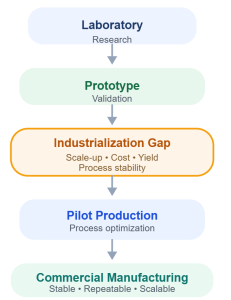
A typical development pathway looks like this:
<img decoding="async" src="data:;base64,
The most difficult transition is often between prototype validation and pilot production, where technical success must be transformed into a repeatable manufacturing process.
Why Laboratory Success Does Not Guarantee Commercial Success
Laboratory research is designed to prove scientific concepts. Industrial manufacturing is designed to produce consistent products at competitive cost.
These objectives are fundamentally different.
In a research laboratory:
-
Small sample sizes are acceptable.
-
Highly controlled conditions are common.
-
Manual processing is often possible.
-
Expensive materials may be justified.
-
Production speed is not a priority.
In industrial manufacturing:
-
Thousands or millions of products must be produced.
-
Raw material variation must be managed.
-
Automated production is required.
-
Cost becomes critical.
-
Yield and quality consistency determine commercial viability.
A material that performs exceptionally well in a laboratory may still be impossible to manufacture economically.
Why Advanced Materials Face Bigger Scale-Up Challenges
Many next-generation materials have complex microstructures that are highly sensitive to processing conditions.
Examples include:
-
Graphene nanosheets
-
Carbon nanotubes
-
MXenes
-
Nanostructured ceramics
-
Solid-state battery materials
-
Functional coatings
-
Advanced conductive composites
Their performance often depends on factors such as:
-
Particle size distribution
-
Surface chemistry
-
Dispersion quality
-
Layer thickness
-
Crystal structure
-
Moisture sensitivity
-
Interface engineering
Small changes during manufacturing can significantly affect final performance.
The Six Major Industrialization Barriers
1. Material Consistency
One of the first challenges is maintaining consistent material quality.
Research laboratories often work with carefully selected material batches. Industrial production must handle normal variation in raw materials.
For example, graphene batches may vary in:
-
Layer number
-
Flake size
-
Surface area
-
Purity
-
Oxygen content
-
Moisture
Without consistent input materials, consistent product performance becomes difficult.
2. Manufacturing Process Stability
A laboratory process may involve manual mixing, hand coating, or small-scale assembly.
Industrial production requires:
-
Automated equipment
-
Continuous production
-
Process repeatability
-
Stable operating windows
-
High production efficiency
Even a small change in viscosity, temperature, or mixing energy can influence the final material.
3. Scale-Up Is Not Linear
One of the biggest misconceptions is that production can simply be “made larger.”
In reality, many physical processes change during scale-up.
For example:
|
Laboratory |
Industrial Production |
|---|---|
|
100 mL mixing |
500 L mixing |
|
Manual coating |
Continuous roll-to-roll coating |
|
Small furnace |
Large continuous furnace |
|
Single sample |
Thousands of products |
Heat transfer, mixing behavior, drying, pressure, and material flow may all behave differently at larger scale.
4. Cost Performance
A technically superior material is not always commercially attractive.
Industrial customers evaluate:
-
Material cost
-
Processing cost
-
Manufacturing yield
-
Production speed
-
Equipment investment
-
Supply chain reliability
A material that improves performance by 5% may not be adopted if it increases manufacturing cost by 50%.
5. Quality Control
Advanced materials require much tighter quality control than many traditional materials.
Typical quality parameters include:
-
Electrical conductivity
-
Thermal conductivity
-
Particle size
-
Coating thickness
-
Mechanical strength
-
Surface roughness
-
Chemical purity
As production volume increases, inspection methods must also become faster and more reliable.
6. Supply Chain Readiness
Even if the material itself is ready, commercialization may still fail because the surrounding supply chain is not prepared.
This includes:
-
Raw material availability
-
Specialized equipment
-
Process chemicals
-
Packaging
-
Transportation
-
Regulatory compliance
-
Customer qualification
Industrialization is therefore a supply-chain challenge as much as a materials challenge.
The Role of Pilot Production
Pilot production is the most important bridge across the industrialization gap.
A pilot line is not simply a smaller factory. It is a learning platform that helps engineers understand how a material behaves under realistic manufacturing conditions.


Typical pilot activities include:
-
Process optimization
-
Material validation
-
Equipment evaluation
-
Manufacturing trials
-
Quality testing
-
Customer sample production
-
Scale-up verification
Instead of producing large quantities, the pilot stage focuses on reducing technical risk.
Process Window Development
A successful industrial process requires a process window—the range of operating conditions that consistently produce acceptable product quality.
For advanced materials, this may include:
-
Temperature
-
Pressure
-
Mixing speed
-
Viscosity
-
Drying conditions
-
Coating speed
-
Material concentration
-
Environmental humidity
Rather than identifying one perfect parameter, engineers define an operating range that remains stable during production.
This is essential for commercial manufacturing.
Why Dispersion Matters for Nanomaterials
For materials such as graphene and carbon nanotubes, dispersion is often one of the most critical manufacturing challenges.
Poor dispersion can lead to:
-
Agglomeration
-
Uneven conductivity
-
Surface defects
-
Reduced mechanical properties
-
Inconsistent product quality
A successful industrial process must achieve repeatable dispersion while remaining compatible with large-scale manufacturing equipment.


Manufacturing Yield Is Often More Important Than Peak Performance
Laboratory research usually focuses on achieving the highest possible performance.
Industry often focuses on achieving the highest repeatable yield.
Consider two materials:
|
Material |
Laboratory Performance |
Production Yield |
|---|---|---|
|
Material A |
Excellent |
40% |
|
Material B |
Very Good |
95% |
In many industrial applications, Material B is the better commercial choice.
High manufacturing yield reduces waste, lowers cost, and improves production efficiency.
Co-Development Accelerates Industrialization
Many companies now use co-development models to reduce the industrialization gap.
Instead of working independently, different partners contribute complementary expertise.
A typical collaboration may involve:
-
Material developer
-
Battery manufacturer
-
Equipment supplier
-
Pilot production partner
-
Research institution
-
End customer
This approach allows manufacturing challenges to be identified much earlier in the development process.


Case Example: Graphene Conductive Coatings
Graphene provides an excellent example of the industrialization challenge.
In the laboratory, graphene coatings may demonstrate:
-
High electrical conductivity
-
Excellent flexibility
-
Lightweight structure
-
Strong thermal performance
However, industrial production introduces additional questions:
-
Can the coating be produced continuously?
-
Does the dispersion remain stable?
-
Is the viscosity suitable for coating equipment?
-
Can drying be controlled at production speed?
-
Is the coating thickness consistent across large areas?
These questions are often more important than the original laboratory measurements.
Battery Materials: A Typical Industrialization Journey
Next-generation battery materials follow a similar development pathway.


The journey typically includes:
-
Material discovery
-
Laboratory validation
-
Small prototype cells
-
Pilot-scale manufacturing
-
Process optimization
-
Customer qualification
-
Commercial production
Many technologies fail not because the material is ineffective, but because manufacturing cannot be stabilized.
Digital Manufacturing Is Changing Scale-Up
Modern industrialization increasingly relies on digital tools.
These include:
-
Process simulation
-
AI-assisted process optimization
-
Digital twins
-
Automated quality inspection
-
In-line monitoring
-
Predictive maintenance
-
Statistical process control
These technologies help manufacturers identify process variations much earlier than traditional inspection methods.
Key Success Factors for Industrializing Advanced Materials
Successful commercialization usually depends on several factors working together.
Strong Material Design
The material should be designed with manufacturing in mind—not only laboratory performance.
Scalable Manufacturing Process
Processes should be compatible with industrial equipment and continuous production.
Robust Quality Control
Quality must remain consistent across different production batches.
Reliable Supply Chain
Materials, equipment, logistics, and manufacturing partners must all support commercial production.
Pilot Validation
Pilot-scale manufacturing significantly reduces commercialization risk before full production investment.
Industries Driving Demand
The industrialization of advanced materials is becoming increasingly important in sectors including:
-
Electric vehicles
-
Energy storage systems
-
AI data centers
-
Consumer electronics
-
Aerospace
-
Telecommunications
-
Semiconductor manufacturing
-
Medical devices
-
Renewable energy
These industries require materials that are not only high-performing but also manufacturable at scale.


Future Trends
Several trends are helping reduce the industrialization gap:
-
Greater use of pilot manufacturing platforms.
-
Earlier collaboration between material suppliers and manufacturers.
-
AI-driven process optimization.
-
Digital quality monitoring.
-
Sustainable and lower-cost material development.
-
Faster transition from laboratory research to commercial validation.
As industries demand shorter product development cycles, the ability to industrialize new materials efficiently will become a major competitive advantage.
The industrialization gap is one of the most important challenges in the development of next-generation materials. Scientific breakthroughs alone are not enough—commercial success depends on transforming innovative materials into stable, repeatable, and economically viable manufacturing processes.
Whether the material is graphene, carbon nanotubes, advanced battery materials, functional coatings, or high-performance composites, the path to commercialization requires much more than laboratory validation. Process optimization, pilot production, quality control, supply chain readiness, and manufacturing scalability all play essential roles.
Companies that successfully bridge the industrialization gap typically combine advanced material innovation with strong process engineering, pilot-scale validation, and collaborative industrial development. As demand for high-performance materials continues to grow across AI infrastructure, energy storage, electronics, and transportation, industrialization capability will become just as valuable as the material technology itself.