
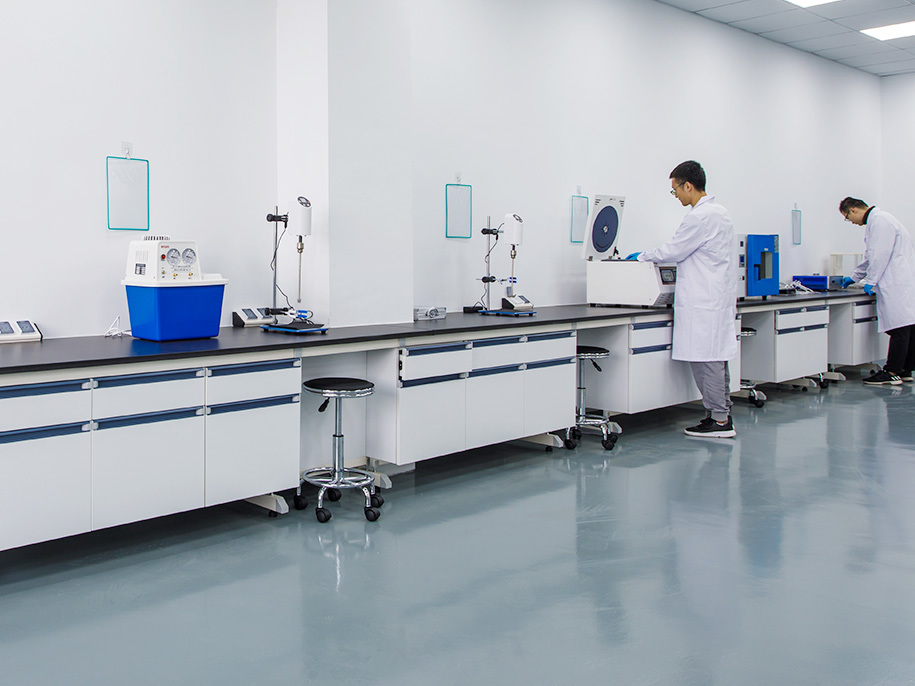
Building the Bridge Between Battery Innovation and Manufacturing
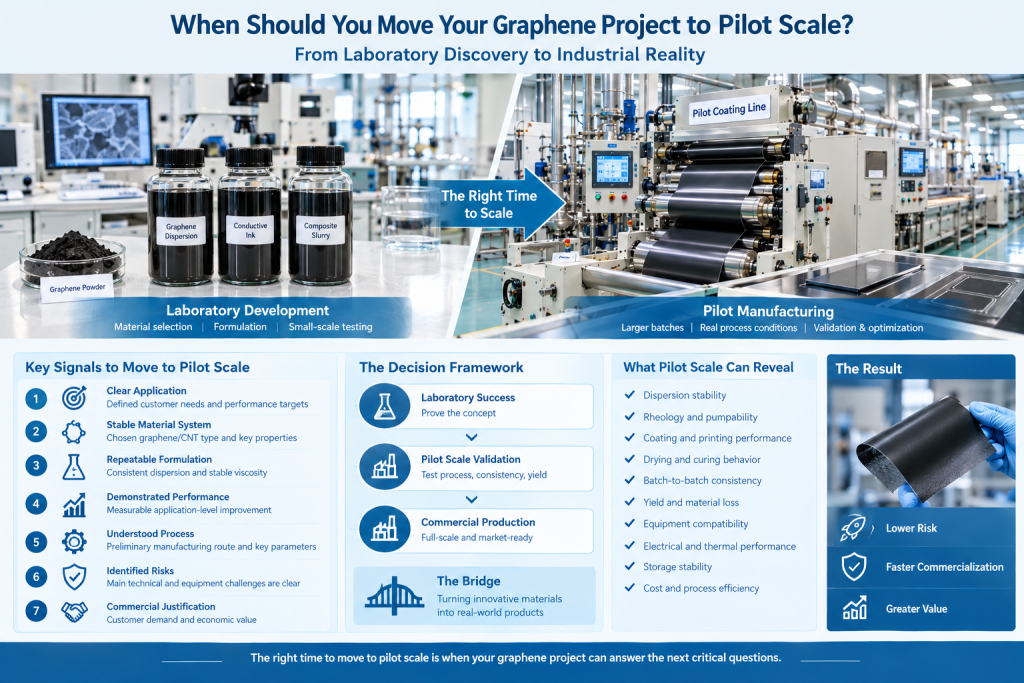
Battery technology is advancing rapidly.
New cathode materials, silicon-based anodes, solid-state electrolytes, conductive additives, advanced separators, high-performance binders, new cell architectures, and innovative manufacturing processes continue to emerge from laboratories and research institutions around the world.
Yet innovation alone does not create a commercial battery.
The real challenge begins when a promising technology must leave the laboratory and enter a manufacturing environment.
A material that works in a coin cell may behave differently in a pouch cell.
A coating process that works at a few meters per minute may become unstable at industrial line speed.
A new formulation may deliver excellent laboratory performance but prove difficult to mix, coat, dry, calender, assemble, or scale economically.
This is why the battery industry needs a strong bridge between innovation and manufacturing.
That bridge is built through formulation engineering, pilot production, process validation, equipment integration, cell-level testing, quality control, and manufacturing-oriented design.
Battery Innovation Is More Than a New Material
Battery innovation is often associated with a new material.
For example:
- A new cathode chemistry
- Silicon or silicon-rich anodes
- Lithium-metal anodes
- New electrolyte systems
- Solid-state materials
- Graphene or CNT conductive additives
- Advanced separator coatings
- High-performance binders
But a battery is not simply a collection of materials.
It is a manufacturing system in which many components must work together.
The commercial performance of a new material therefore depends on whether it can be integrated into:
Slurry preparation → coating → drying → calendering → electrode preparation → cell assembly → electrolyte filling → formation → aging → testing
A material that improves one property but disrupts the manufacturing process may create less overall value than a material offering a smaller performance improvement but much better process compatibility.
The Laboratory-to-Factory Gap
The gap between laboratory development and industrial production is one of the biggest challenges facing advanced batteries.
Laboratory experiments are usually optimized for scientific discovery.
Manufacturing is optimized for:
- Reproducibility
- Throughput
- Yield
- Cost
- Safety
- Equipment utilization
- Quality control
These objectives are not always identical.
A researcher may optimize a formulation to achieve the highest measured conductivity.
A manufacturing engineer may instead ask:
Can the slurry be pumped continuously for eight hours without viscosity drift?
A materials scientist may demonstrate high specific capacity.
A production engineer may ask:
Can the electrode maintain uniform thickness across a wide web?
These are different questions, and commercial battery development must answer both.
Manufacturing Should Be Considered Earlier
One of the most effective ways to reduce battery development risk is to consider manufacturing at an early stage.
Instead of:
Material discovery → prototype → manufacturing problems
a more effective model is:
Material discovery + manufacturing requirements → formulation → process development → prototype → pilot validation
This approach is often called design for manufacturing.
The objective is not to limit innovation.
It is to make innovation easier to industrialize.
Formulation Is the First Bridge
Many advanced battery materials cannot be used directly.
They must become a processable formulation.
For electrodes, this may involve:
- Active material
- Conductive additive
- Binder
- Solvent
- Dispersant
- Functional additives
A material with excellent intrinsic properties may still fail if it produces a slurry with poor rheology or unstable dispersion.
Therefore, formulation engineering provides one of the first connections between material science and manufacturing.
Dispersion Matters at Industrial Scale
Graphene, CNTs, conductive carbon, and other fine particles can strongly influence electrode processing.
CNTs may form bundles.
Graphene can restack.
Conductive carbon may agglomerate.
Poor dispersion can lead to:
- Higher viscosity
- Coating defects
- Uneven conductivity
- Non-uniform current distribution
- Reduced active-material utilization
- Batch-to-batch variation
A stable conductive network therefore requires more than selecting a high-performance conductive additive.
The dispersion process itself must be engineered.
Rheology Is a Manufacturing Property
A battery slurry must flow through the actual production system.
This means rheology is not simply a laboratory characterization parameter.
It is a manufacturing property.
Important factors can include:
- Viscosity
- Shear thinning
- Yield stress
- Thixotropy
- Temperature dependence
- Solid content
- Storage stability
The optimal rheological behavior depends on the coating method.
A formulation suitable for one coating process may not perform well on another.
This is why formulation development should be closely connected to equipment selection and coating conditions.
Coating Connects Materials With Production
Electrode coating is one of the most important manufacturing steps.
The objective is to deposit a controlled amount of slurry onto a current collector with:
- Uniform thickness
- Uniform loading
- Stable edges
- Good adhesion
- Low defect density
As electrode width and coating speed increase, process stability becomes more difficult.
Variables such as:
- Slurry flow
- Web speed
- Die gap
- Viscosity
- Surface tension
- Drying conditions
must be controlled together.
A new battery formulation therefore should be evaluated using coating equipment representative of its intended production environment.
Drying Is Part of Electrochemical Design
Drying is often treated as a thermal process.
In reality, it can influence the internal structure of the electrode.
During drying:
- Solvent evaporates
- Particles migrate
- Binder may redistribute
- Conductive additives form networks
- Porosity develops
- Surface structure changes
The drying profile can therefore influence electrical resistance, adhesion, porosity, and ionic transport.
This means that drying should be optimized together with the electrode formulation.
Calendering Creates Another Trade-Off
Calendering compresses the electrode to achieve the required density and thickness.
Higher density can improve volumetric energy density.
However, excessive compression can reduce porosity and slow lithium-ion transport.
This is particularly important for fast-charging applications.
A high-energy-density electrode therefore requires a careful balance between:
Energy density + electronic conductivity + ionic transport + mechanical integrity
The appropriate calendering conditions cannot be determined from active material properties alone.
They must be established through integrated process development.
Cell Architecture Matters
Battery innovation also involves cell design.
The same electrode formulation may behave differently in:
- Coin cells
- Cylindrical cells
- Prismatic cells
- Pouch cells
Differences in:
- Electrode area
- Current distribution
- Thermal behavior
- Stack pressure
- Electrolyte distribution
- Tab configuration
can influence performance.
Therefore, laboratory cell results should be treated as an important step rather than the final proof of commercial viability.
Scaling From Coin Cells to Practical Cells
Small laboratory cells are useful for screening materials.
However, they often have different conditions from larger cells.
When moving toward larger formats, issues such as:
- Longer ion-transport distances
- Higher absolute heat generation
- Non-uniform pressure
- Current distribution
- Manufacturing tolerances
become more significant.
A new chemistry should therefore be progressively evaluated in increasingly representative cell formats.
This is another reason pilot lines are important.
Pilot Lines as Translation Platforms
A battery pilot line is more than a small production line.
It is a technology translation platform.
It allows developers to test whether:
- Materials can be mixed consistently
- Slurries can be coated
- Electrodes can be dried
- Calendering can be controlled
- Cells can be assembled
- Formation can be completed reproducibly
- Quality can be measured
A good pilot line therefore reduces uncertainty before full-scale investment.
Pilot Production Should Test Multiple Batches
A single successful pilot run does not demonstrate industrial readiness.
Multiple batches are necessary to evaluate:
- Reproducibility
- Raw-material variation
- Process drift
- Equipment stability
- Yield
- Quality consistency
This is especially important for advanced materials because small changes in particle properties, moisture, or surface chemistry can affect the formulation.
Pilot production should therefore generate enough data to determine the robustness of the process.
Manufacturing Yield Changes the Economics
Laboratory experiments usually focus on performance.
Commercial battery production also depends heavily on yield.
Yield can be affected by:
- Slurry defects
- Coating defects
- Electrode breakage
- Misalignment
- Contamination
- Welding problems
- Electrolyte filling
- Formation failures
- Cell rejection
A material that improves battery performance but increases manufacturing scrap may not provide a positive economic result.
Therefore:
Performance improvement must be evaluated together with yield impact.
Cost Should Be Evaluated at Cell Level
The cost of a new material is not just its price per kilogram.
A better question is:
How does the material affect the cost and performance of the finished cell?
For example, a conductive additive may be more expensive than conventional carbon black but could enable:
- Lower loading
- Higher energy density
- Lower resistance
- Better fast charging
- Longer cycle life
The economic value should therefore be evaluated at the cell level rather than solely at the raw-material level.
Quality Control Must Follow the Process
Battery manufacturing requires extensive quality control.
For new technologies, the challenge is determining which parameters are truly critical.
A useful approach is to connect process variables with final performance.
For example:
Raw material → slurry → coating → electrode → cell
At each stage, measurements can be introduced.
Raw Material
Particle size, moisture, purity, morphology, surface chemistry
Slurry
Solid content, viscosity, dispersion, stability
Electrode
Thickness, loading, density, porosity, resistance
Cell
Capacity, impedance, efficiency, thermal behavior, cycle life
This chain creates a traceable relationship between manufacturing conditions and cell performance.
Formation Is a Critical Manufacturing Step
Formation is where the electrochemical characteristics of the cell are developed and stabilized.
It can strongly influence:
- SEI formation
- Initial efficiency
- Gas generation
- Resistance
- Capacity retention
For new materials and chemistries, formation conditions may require optimization.
A material that performs well before formation may behave differently after the first several cycles.
This is why electrochemical innovation must eventually be validated under realistic formation conditions.
Reliability Must Be Designed In
Commercial batteries must survive much longer than laboratory demonstrations.
Depending on the application, validation may include:
- Long-term cycling
- High-temperature storage
- Low-temperature performance
- Fast-charging cycles
- Thermal cycling
- High-rate discharge
- Overcharge-related testing
- Mechanical stress
- Environmental exposure
Reliability testing should begin before full-scale commercialization.
The objective is to identify degradation mechanisms early enough to modify the material or process.
Fast Charging Is a Manufacturing Problem Too
Fast charging is often discussed as a materials challenge.
It is also a manufacturing challenge.
High-rate charging can expose weaknesses in:
- Electrode thickness
- Porosity
- Conductivity
- Current distribution
- Thermal management
- Electrolyte transport
- Formation conditions
For example, a high-conductivity electrode may still exhibit poor fast charging if its ionic transport is inadequate.
This means fast-charge optimization requires coordination between materials, electrode design, and manufacturing.
Safety Cannot Be Added at the End
Battery safety must be considered throughout development.
Changes to:
- Electrolyte
- Cathode chemistry
- Anode structure
- Separator
- Electrode loading
- Cell geometry
can affect thermal and electrochemical behavior.
Pilot manufacturing provides a controlled environment for identifying safety-related manufacturing risks before commercial production.
Process consistency itself is also part of battery safety.
A repeatable process reduces the probability of cells falling outside expected performance ranges.
Data Connects Innovation With Manufacturing
One of the most powerful tools for bridging laboratory development and production is process data.
Relevant information may include:
- Mixing torque
- Temperature
- Slurry viscosity
- Flow rate
- Coating speed
- Coating thickness
- Drying temperature
- Electrode density
- Cell resistance
- Formation data
When these parameters are connected, engineers can identify relationships between manufacturing conditions and battery performance.
This allows process development to become increasingly data-driven.
Build a Manufacturing Feedback Loop
The most effective development systems create continuous feedback:
Material properties → formulation → process → electrode structure → cell performance → failure analysis → material/process optimization
This loop prevents development teams from treating each stage as an isolated activity.
For example, if fast charging produces lithium plating, the solution may not be simply to change the charging protocol.
The team may need to revisit:
- Electrode porosity
- Particle size
- Conductive network
- Electrolyte
- Coating thickness
- Calendering
- Formation
The manufacturing system becomes part of the innovation process.
Co-Development Between Material and Cell Companies
Advanced battery commercialization often requires cooperation among multiple organizations.
These may include:
- Material suppliers
- Battery manufacturers
- Equipment suppliers
- Research institutes
- Cell-development teams
- Application companies
A material supplier may understand the chemistry.
An equipment company understands the process.
A cell manufacturer understands production constraints.
The end user understands application requirements.
Combining these perspectives can significantly improve development efficiency.
Design of Experiments Supports Faster Scale-Up
When many variables interact, trial-and-error development can become expensive.
Design of experiments can help identify which variables have the strongest effects on:
- Viscosity
- Coating quality
- Electrode resistance
- Capacity
- Rate capability
- Cycle life
This allows development teams to focus resources on the parameters that matter most.
Pilot production then provides the environment to confirm these relationships under more realistic conditions.
Digital Manufacturing Can Strengthen the Bridge
Modern battery pilot lines increasingly benefit from digital process monitoring.
Real-time data can be used to monitor:
- Slurry properties
- Coating conditions
- Electrode quality
- Equipment stability
- Formation performance
This creates better traceability.
It also makes it easier to compare material batches and identify process drift.
For advanced battery technologies, digital traceability can become an important part of qualification.
Building a Practical Battery Innovation Roadmap
A structured roadmap can reduce commercialization risk.
Stage 1: Define the Application
Identify required energy density, power, charging speed, lifetime, safety, and cost.
Stage 2: Select the Technology
Evaluate cathode, anode, electrolyte, separator, conductive additives, and other components.
Stage 3: Formulate
Develop slurries and formulations compatible with target manufacturing processes.
Stage 4: Prototype
Produce laboratory cells and establish initial electrochemical performance.
Stage 5: Pilot Process Development
Use representative equipment to validate mixing, coating, drying, calendering, assembly, and formation.
Stage 6: Multi-Batch Validation
Evaluate reproducibility and process robustness.
Stage 7: Reliability Testing
Study degradation, thermal behavior, fast charging, and long-term cycling.
Stage 8: Customer or Application Validation
Test the technology under realistic operating conditions.
Stage 9: Commercial Scale-Up
Optimize equipment, yield, quality control, supply chain, and cost.
This roadmap helps transform battery innovation into a manufacturing strategy.
What a Successful Innovation-to-Manufacturing Bridge Looks Like
A strong bridge should connect five dimensions:
1. Material Performance
The technology must provide a meaningful advantage.
2. Processability
The material must work within a practical manufacturing process.
3. Reproducibility
The process must produce consistent results across batches.
4. Reliability
The cell must maintain performance during realistic operation.
5. Economics
The technology must create enough value to justify adoption.
If any of these five elements is missing, commercialization becomes more difficult.
The Most Important Shift: From Material to System
Perhaps the most important lesson for advanced battery development is that commercial value does not exist at the material level alone.
A better material does not automatically produce a better battery.
A better battery does not automatically produce a better manufacturing process.
And a better manufacturing process does not automatically produce a commercially successful product.
The entire system must work together.
This is why future battery innovation will increasingly depend on collaboration between:
Materials Science + Electrochemistry + Process Engineering + Equipment + Manufacturing + Quality + Economics
Building the bridge between battery innovation and manufacturing is one of the most important challenges in advanced energy-storage development.
New materials and cell concepts continue to create enormous opportunities, but laboratory results represent only the beginning of the commercialization journey.
The real challenge is translating those innovations into formulations, electrodes, cells, and production processes that are repeatable, scalable, safe, reliable, and economically viable.
Pilot manufacturing plays a central role in this transition.
It provides the environment where materials can be tested under realistic processing conditions, manufacturing windows can be established, multiple batches can be compared, and application-level performance can be validated.
The most successful battery development strategies therefore do not treat manufacturing as the final stage.
They build manufacturing considerations into innovation from the beginning.
The real bridge is:
Material Innovation → Formulation → Process Development → Pilot Manufacturing → Cell Validation → Reliability → Customer Qualification → Commercial Production
When these stages are connected, promising battery technologies have a much stronger path toward industrialization.
The ultimate goal is not simply to demonstrate that a new battery material works.
It is to demonstrate that the material can become part of a repeatable, scalable, high-yield, safe, and commercially competitive battery manufacturing system.
That is the point where battery innovation becomes industrial technology.
- for batteries