Pilot Coating Validation for Thermal Management Materials
Thermal management materials are becoming increasingly important as modern electronic, battery, power, and computing systems generate higher heat loads within increasingly compact spaces.
Graphene, graphite, carbon-based composites, ceramic fillers, metal-based materials, and hybrid thermal compounds are being developed for applications including thermal coatings, heat-spreading films, thermal interface materials, battery thermal management, power electronics cooling, and advanced electronics.
At laboratory scale, it is relatively easy to prepare a thermal coating and measure its thermal conductivity.
However, a laboratory coating experiment does not necessarily predict industrial coating performance.
When a thermal management material moves to pilot coating, new variables emerge:
- Coating width
- Line speed
- Wet-film thickness
- Slurry flow
- Rheology
- Drying
- Curing
- Web tension
- Substrate compatibility
- Surface uniformity
- Batch consistency
The purpose of pilot coating validation is therefore not simply to produce a larger quantity of coated material.
It is to determine whether the thermal formulation can be converted into a uniform, repeatable, reliable, and scalable functional coating.
Why Pilot Coating Matters
A thermal material can have excellent intrinsic properties and still fail during coating.
For example, graphene may provide excellent thermal conductivity at the individual-material level, but the final coating may show limited thermal performance because of:
- Poor dispersion
- Graphene restacking
- Insufficient network formation
- Excessive binder content
- Uneven film thickness
- High interfacial resistance
- Poor adhesion
- Defects introduced during drying
Pilot coating provides a more realistic environment for identifying these problems.
The objective is to connect:
Material → Formulation → Coating Process → Film Structure → Thermal Performance
This connection is essential for industrialization.
What Is Pilot Coating Validation?
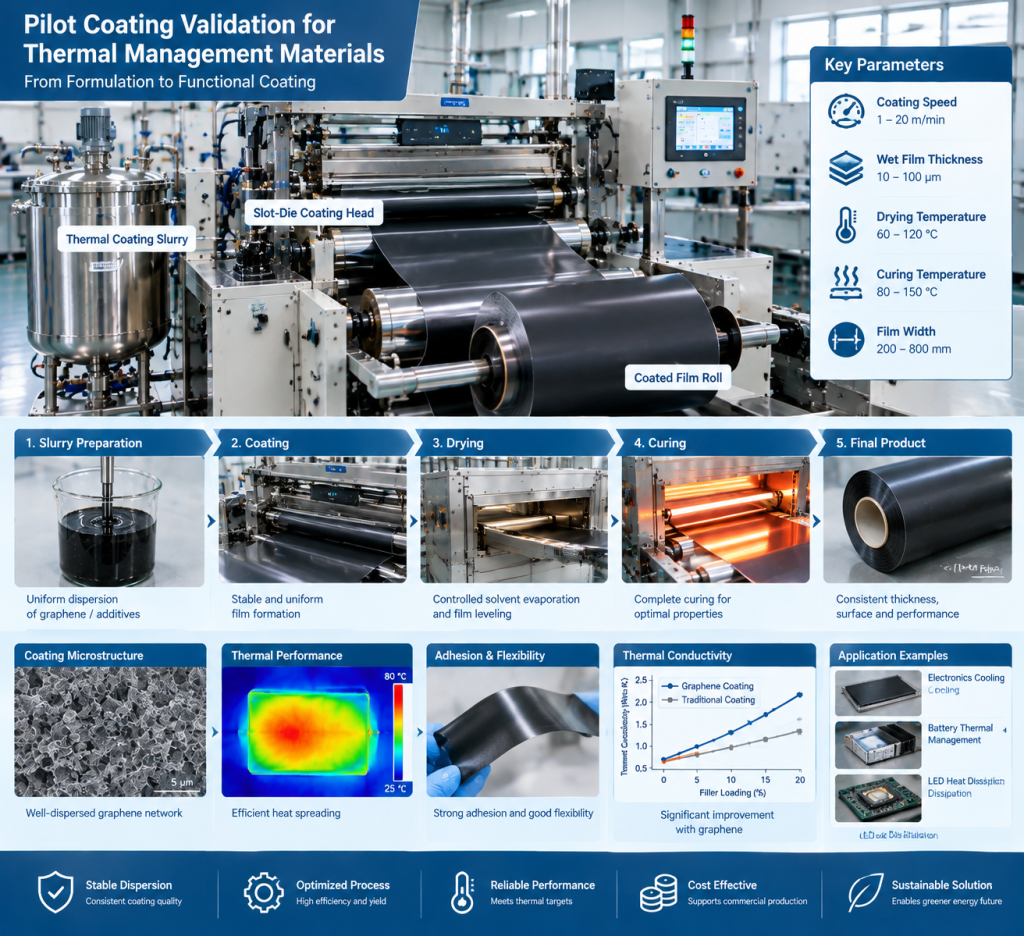
Pilot coating validation is the controlled testing of a thermal-management formulation on equipment that more closely represents commercial manufacturing conditions.
The equipment may include:
- Slot-die coating systems
- Roll-to-roll coating lines
- Knife or blade coaters
- Gravure systems
- Spray systems
- Other continuous coating equipment
The appropriate technology depends on the product design and required production volume.
Pilot validation normally examines both process behavior and final product performance.
A successful pilot run should demonstrate that the formulation can be coated within an acceptable process window while maintaining the required thermal and mechanical properties.
The First Step: Define the Thermal Objective
Before coating begins, the target thermal function must be clearly defined.
Different applications require different thermal properties.
Examples include:
- High in-plane thermal conductivity
- High through-plane thermal conductivity
- Low thermal resistance
- Heat spreading
- Localized heat dissipation
- Thermal insulation
- Thermal barrier performance
For example, a heat-spreading film may prioritize in-plane heat transport.
A thermal interface coating may be more concerned with through-plane thermal resistance.
A battery thermal-management coating may require a combination of thermal conductivity, electrical behavior, adhesion, flexibility, and environmental stability.
Pilot coating validation should therefore begin with an application-specific performance target.
Formulation Must Be Ready Before Pilot Coating
Pilot coating should not be used as a substitute for basic formulation development.
Before entering the pilot stage, the formulation should ideally have:
- Stable dispersion
- Controlled viscosity
- Acceptable storage stability
- Known solid content
- Appropriate surface tension
- Reasonable adhesion
- Preliminary thermal performance
The formulation does not need to be completely optimized.
However, the major variables should be understood well enough for pilot trials to produce meaningful information.
Dispersion Quality Controls Coating Quality
Thermal coatings often contain high concentrations of functional fillers.
These may include:
- Graphene
- Graphite
- CNTs
- Boron nitride
- Aluminum nitride
- Aluminum oxide
- Other thermally conductive particles
Poor dispersion can cause agglomeration and non-uniform coating.
Large agglomerates may create:
- Surface defects
- Thickness variation
- Weak interfaces
- Localized thermal pathways
- Filter blockage
- Coating instability
Therefore, dispersion validation should be completed before or during the pilot coating program.
Rheology Is Critical for Coating
A thermal coating formulation must flow correctly through the selected coating system.
The relevant rheological properties may include:
- Viscosity
- Shear-thinning behavior
- Yield stress
- Thixotropy
- Temperature dependence
A formulation that performs well in a beaker may behave differently when passing through a coating head at higher shear.
For slot-die coating, in particular, stable flow is essential.
Changes in viscosity or flow rate may lead to coating-thickness variation or edge instability.
The objective is not simply to achieve a specific viscosity value.
It is to establish rheological behavior that remains stable throughout the intended coating window.
Surface Tension and Substrate Wetting
Thermal coatings often need to be applied to:
- Aluminum foil
- Copper foil
- Polymer films
- Metal housings
- Composite substrates
- Electronic components
The interaction between the coating and substrate influences:
- Wetting
- Adhesion
- Surface uniformity
- Defect formation
- Drying behavior
If the coating does not wet the substrate properly, it may produce:
- Pinholes
- Fish-eyes
- Craters
- Uneven edges
- Local thickness variation
Surface treatment of the substrate may therefore need to be evaluated alongside the coating formulation.
Coating Method Affects Thermal Performance
Different coating methods can produce different microstructures.
For example, shear generated during coating may influence the orientation of graphene flakes or other anisotropic fillers.
This can affect directional thermal transport.
A material designed for high in-plane conductivity may benefit from greater platelet orientation.
A through-plane thermal material may require a different structural arrangement.
Therefore, coating is not simply a deposition process.
It can influence the internal architecture of the final thermal material.
Coating Thickness Must Be Controlled
Film thickness is one of the most important pilot-coating variables.
Too thin, and the thermal network may be incomplete.
Too thick, and several problems may emerge:
- Longer drying time
- Higher material consumption
- Internal stress
- Cracking
- Poor adhesion
- Increased production cost
The optimal thickness therefore depends on the application.
Pilot validation should evaluate both average thickness and thickness uniformity.
Important measurements may include:
- Cross-web thickness
- Machine-direction thickness
- Local defects
- Edge profile
- Surface roughness
Wet Thickness vs. Dry Thickness
Wet-film thickness and dry-film thickness can be significantly different.
The difference depends on:
- Solids content
- Solvent content
- Binder concentration
- Drying conditions
- Shrinkage
Therefore, pilot coating should establish the relationship between:
Wet thickness → Dry thickness → Density → Thermal performance
This relationship is important for production control.
Line Speed Changes the Process
One of the major advantages of pilot coating is the ability to study higher production speeds.
When line speed increases, available drying time decreases.
This can change:
- Solvent evaporation
- Surface leveling
- Film consolidation
- Defect formation
- Coating stability
A formulation that performs well at laboratory speed may not remain stable at pilot speed.
Developers should therefore identify the acceptable line-speed window during pilot validation.
Drying Is Part of the Thermal Design
Drying has a direct influence on the final film structure.
As liquid evaporates:
- Graphene sheets move closer together
- Particles form contacts
- Polymer concentration increases
- Porosity changes
- Internal stresses develop
The drying process may therefore influence both thermal and mechanical properties.
Important variables include:
- Drying temperature
- Airflow
- Residence time
- Oven-zone temperature
- Film thickness
- Solvent composition
A pilot line allows these variables to be evaluated under continuous conditions.
Multi-Zone Drying Can Be Important
For some thermal coatings, a single drying temperature may not provide the best result.
A staged drying process can allow:
Initial solvent removal → controlled film leveling → final drying or curing
This can reduce surface defects and help maintain coating uniformity.
The optimal drying profile depends on the formulation and substrate.
Pilot testing provides the practical data required to establish it.
Curing Can Change Thermal Conductivity
For polymer-based thermal materials, curing can significantly change the final structure.
The curing process can affect:
- Crosslink density
- Shrinkage
- Filler distribution
- Interface quality
- Mechanical properties
- Thermal resistance
Therefore, thermal conductivity should be measured after the complete curing process.
Testing only the uncured material may provide misleading conclusions.
Graphene Orientation and Thermal Pathways
Graphene has strongly anisotropic thermal properties.
Within a coating, the orientation of graphene sheets can influence thermal transport.
Coating shear, drying, compression, and curing may alter this orientation.
For example, a predominantly in-plane orientation could support heat spreading along the coating surface while providing less enhancement through the film thickness.
Therefore, pilot validation should distinguish between:
In-plane thermal conductivity
and
Through-plane thermal conductivity.
These values can lead to very different application outcomes.
Thermal Conductivity Alone Is Not Enough
One of the most important principles in thermal management is that bulk thermal conductivity does not completely describe system performance.
For a thermal interface material, the relevant parameter may be:
Thermal Resistance = Temperature Difference / Heat Flow
Interfacial resistance, contact pressure, surface roughness, and material conformity can all influence actual performance.
A coating with relatively high bulk conductivity may therefore perform worse in an application than expected if the interfaces are poor.
Pilot validation should include application-relevant thermal testing.
Measuring Thermal Performance
Depending on the application, useful methods may include:
- Thermal conductivity
- Thermal diffusivity
- Thermal resistance
- Thermal impedance
- Infrared thermal imaging
- Temperature-rise testing
- Heat-flow measurements
The testing method should match the intended thermal function.
For example, a heat-spreading coating should be evaluated for actual spreading behavior.
A thermal interface coating should be tested under realistic contact conditions.
Infrared Imaging Can Reveal Non-Uniformity
Thermal imaging can provide useful information beyond a single conductivity number.
Under controlled heat input, an infrared camera can reveal:
- Hotspots
- Uneven heat spreading
- Coating defects
- Local delamination
- Thickness variation
This can be particularly useful during pilot development.
A visually uniform coating may still contain regions with different thermal resistance.
Thermal imaging can help identify these areas.
Adhesion Is a Critical Requirement
A thermal coating that has excellent thermal properties but weak adhesion may not be commercially useful.
Pilot validation should therefore examine:
- Adhesion strength
- Peel behavior
- Scratch resistance
- Flexibility
- Thermal cycling
Adhesion can also change after environmental aging.
Therefore, testing should consider both initial and aged performance.
Mechanical Flexibility
Many thermal-management products must tolerate mechanical deformation.
This is particularly important for flexible electronics, battery components, and thin thermal films.
Potential stresses include:
- Bending
- Folding
- Vibration
- Thermal expansion
- Repeated handling
A highly filled thermal coating may provide good conductivity but become brittle.
Pilot validation should therefore balance thermal performance with mechanical flexibility.
Thermal Cycling and Reliability
Thermal management materials repeatedly experience temperature changes during operation.
For example, electronics may heat during operation and cool during standby.
Batteries can experience repeated temperature fluctuations during charging and discharging.
Thermal cycling can create stresses due to differences in thermal expansion between the coating and substrate.
Over time, this may cause:
- Cracking
- Delamination
- Increased thermal resistance
- Loss of adhesion
- Changes in conductivity
Pilot-produced samples should therefore be subjected to realistic thermal-cycle testing.
Environmental Validation
Depending on the application, coatings may need to withstand:
- High humidity
- High temperature
- Low temperature
- Salt exposure
- UV exposure
- Chemical contact
Environmental testing can reveal changes in:
- Thermal conductivity
- Adhesion
- Surface structure
- Mechanical properties
- Electrical behavior
The appropriate tests should be selected according to the customer’s actual operating environment.
Pilot Coating Can Reveal Manufacturing Defects
Many coating defects become more obvious when the process moves from laboratory scale to pilot scale.
Common defects include:
- Streaks
- Pinholes
- Bubbles
- Particles
- Edge defects
- Uneven thickness
- Surface roughness
- Drying marks
Understanding the causes of these defects is one of the most useful outputs of pilot coating.
Each defect should be connected to process variables rather than treated simply as a quality-control problem.
Batch-to-Batch Consistency
A commercial thermal coating cannot depend on one successful pilot run.
Multiple batches should be produced to evaluate consistency.
Relevant indicators may include:
- Viscosity
- Solid content
- Dispersion quality
- Coating thickness
- Thermal conductivity
- Thermal resistance
- Adhesion
- Surface appearance
The objective is to establish how much variation the manufacturing process naturally produces.
Process Window Development
A mature pilot coating program should establish an operating window.
For example:
| Process Parameter | Pilot Validation Objective |
|---|---|
| Viscosity | Stable coating flow |
| Solids content | Consistent dry thickness |
| Line speed | Stable coating at target throughput |
| Wet thickness | Controlled final thickness |
| Drying temperature | Complete solvent removal |
| Drying time | No defects or residual solvent |
| Curing temperature | Stable final structure |
| Web tension | Dimensional stability |
| Coating width | Uniform cross-web performance |
The process window becomes the foundation for future commercial scale-up.
Defining Critical Quality Attributes
Pilot development should identify which product properties are truly critical.
For thermal coatings, these may include:
Thermal conductivity
Thermal resistance
Coating thickness
Adhesion
Surface uniformity
Mechanical durability
Environmental stability
Not every parameter has equal importance.
The development team should determine which properties are most strongly linked to customer performance.
Connecting Process Parameters to Product Performance
The most valuable pilot data comes from connecting process variables with final properties.
For example:
Higher coating speed → shorter drying time → different film structure → changed thermal resistance
Or:
Higher graphene loading → higher viscosity → altered coating uniformity → different thermal performance
These relationships allow engineers to understand the actual process mechanisms.
They also make later optimization much more efficient.
Pilot Scale Supports Customer Validation
Customers often require more than a laboratory sample.
They may need enough coated material to perform:
- Prototype assembly
- Device testing
- Thermal cycling
- Environmental testing
- Production-line trials
Pilot coating can produce sufficient material under representative conditions.
This gives customers greater confidence that the material is not merely a laboratory prototype.
Pilot Production Can Reduce Scale-Up Risk
Full-scale coating equipment represents a significant investment.
If the thermal formulation has not been properly validated, problems may only become visible after commercial equipment is installed.
Pilot coating reduces this risk by providing earlier information about:
- Coating stability
- Drying capacity
- Defect formation
- Material consumption
- Process yield
- Equipment compatibility
This makes pilot production an important risk-reduction stage.
Yield Matters
Pilot coating should measure not only product quality but also yield.
Material losses can occur during:
- Start-up
- Line threading
- Coating transitions
- Filter changes
- Edge trimming
- Defective runs
- Cleaning
Yield data is essential for realistic cost calculations.
A formulation that performs well but produces excessive scrap may need additional development.
Material Consumption and Cost
Thermal coatings should be evaluated according to their actual cost contribution.
Important variables include:
- Thermal filler loading
- Coating weight
- Final thickness
- Material utilization
- Production speed
- Drying energy
- Waste
A higher-cost graphene formulation may still be attractive if it achieves the required thermal function at a much lower loading or thickness.
Therefore, economic evaluation should be connected to functional performance.
A Practical Pilot Coating Validation Workflow
A structured pilot program can follow this sequence:
Step 1: Define the Application
Determine the thermal target and operating environment.
Step 2: Finalize the Initial Formulation
Establish a stable dispersion and acceptable rheology.
Step 3: Select the Coating Method
Choose slot-die, roll-to-roll, blade, gravure, spray, or another appropriate method.
Step 4: Establish Initial Process Conditions
Define coating speed, wet thickness, drying, and curing parameters.
Step 5: Produce Pilot Samples
Run the coating line under controlled conditions.
Step 6: Measure Process Stability
Monitor viscosity, flow, thickness, appearance, and defects.
Step 7: Test Thermal Performance
Measure conductivity, thermal resistance, diffusivity, and application-level behavior.
Step 8: Conduct Reliability Testing
Evaluate thermal cycling, adhesion, environmental stability, and mechanical properties.
Step 9: Produce Multiple Batches
Confirm reproducibility and identify process variation.
Step 10: Establish the Process Window
Define the acceptable operating range before commercial scale-up.
What Makes a Successful Pilot Coating Trial?
A successful pilot trial should ideally demonstrate:
Stable formulation
Reliable coating behavior
Uniform film thickness
Controlled drying and curing
Strong substrate adhesion
Consistent thermal performance
Acceptable defect rate
Repeatable batch quality
Known yield
Practical production economics
The trial should therefore produce both physical samples and process knowledge.
Common Pilot Coating Mistakes
Mistake 1: Optimizing Only Thermal Conductivity
A high conductivity number does not guarantee good coating or interface performance.
Mistake 2: Ignoring Rheology
Poor flow behavior can prevent the formulation from running reliably.
Mistake 3: Scaling Mixing Without Revalidation
A larger batch may have a different dispersion structure.
Mistake 4: Treating Drying as an Afterthought
Drying conditions can significantly influence film structure.
Mistake 5: Running Only One Pilot Batch
One successful run does not prove reproducibility.
Mistake 6: Ignoring Substrate Compatibility
Good thermal properties are irrelevant if the coating cannot adhere to the required substrate.
Mistake 7: Testing Only Initial Performance
Long-term thermal and mechanical stability also need validation.
From Pilot Coating to Commercial Production
The purpose of pilot coating is to make commercial scale-up more predictable.
By the end of the pilot stage, the development team should ideally understand:
- Which formulation works
- Which coating method works
- Which process parameters are critical
- Which defects are likely to occur
- How thermal performance changes with process conditions
- What the acceptable process window looks like
- What the expected yield is
- What quality-control parameters are required
This information creates a much stronger foundation for commercial manufacturing.
The Real Value of Pilot Coating
Pilot coating is often described as a manufacturing trial.
In practice, it is much more than that.
It is a technology validation platform.
It connects:
Advanced Material → Formulation → Process → Structure → Thermal Function → Reliability → Commercial Product
This connection is especially important for graphene-based thermal materials because the performance of graphene inside a real coating depends strongly on dispersion, orientation, interfaces, binder content, drying, and film architecture.
Pilot coating validation is a critical stage in the industrial development of thermal management materials.
A laboratory sample can demonstrate that a graphene, CNT, graphite, ceramic, or hybrid formulation has thermal potential.
But a pilot coating trial answers a much more practical question:
Can this material be converted into a uniform, reliable, and scalable thermal-management product?
To answer that question, developers must evaluate far more than thermal conductivity.
They must understand dispersion, rheology, substrate compatibility, coating thickness, line speed, drying, curing, orientation, adhesion, mechanical durability, thermal cycling, environmental stability, yield, and cost.
The most valuable pilot coating project therefore does not simply produce more coated material.
It establishes a repeatable process window that connects formulation parameters with final thermal performance.
For industrial thermal-management materials, that process knowledge can be just as valuable as the material itself.
The transition can be summarized as:
Material Discovery → Formulation → Laboratory Coating → Pilot Coating → Thermal Validation → Reliability Testing → Customer Qualification → Commercial Production
That is the bridge from a promising thermal material to a manufacturable industrial product.