
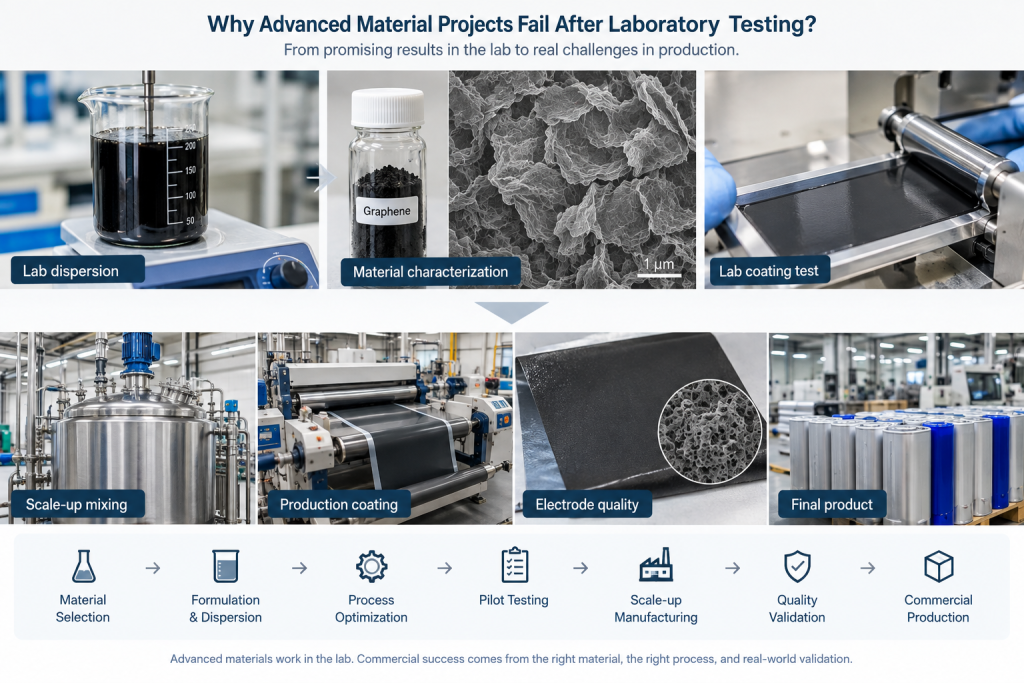
Why Do Advanced Material Projects Fail After Laboratory Testing?
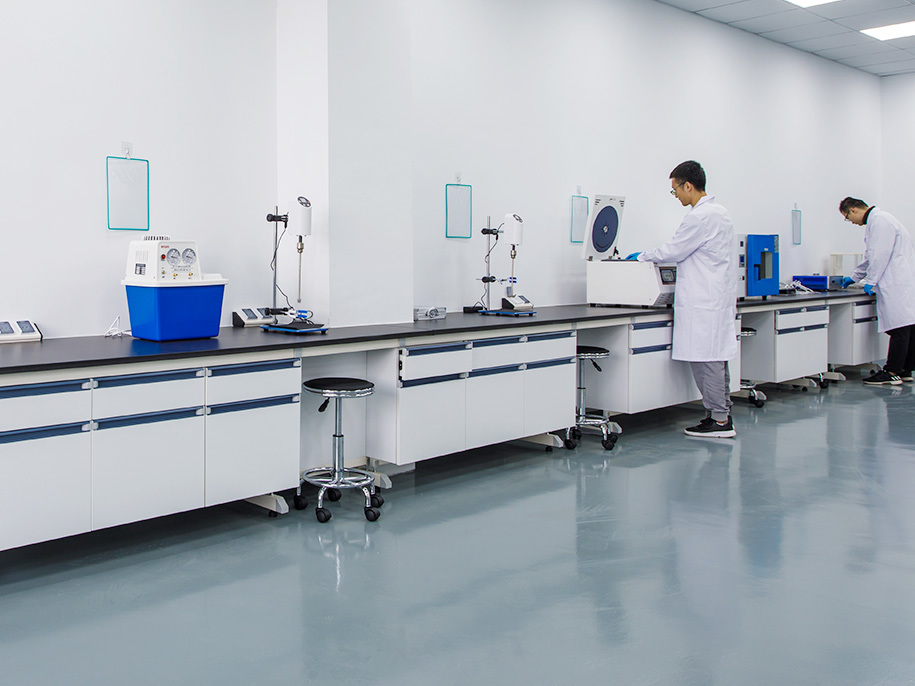
A new advanced material can perform extremely well in a laboratory and still fail when the project moves toward pilot production or commercial manufacturing.
This is one of the most common challenges in advanced material development.
Graphene, carbon nanotubes (CNTs), conductive additives, thermal materials, coatings, composites, and other functional materials often demonstrate promising laboratory results. However, when the same material is introduced into a real manufacturing process, unexpected problems can appear:
- Performance becomes inconsistent.
- Dispersion becomes difficult.
- Processing conditions change.
- Material consumption increases.
- Production costs become too high.
- Raw material batches behave differently.
- Equipment cannot reproduce laboratory conditions.
- Customers cannot integrate the material into their existing process.
The underlying problem is that laboratory validation and industrial validation answer different questions.
Laboratory testing asks:
“Can this material achieve the desired technical performance?”
Industrial development asks a much broader question:
“Can this material achieve the required performance consistently, economically, and reproducibly within a real manufacturing process?”
Understanding this difference is critical for the commercialization of advanced materials.
1. Laboratory Performance Does Not Equal Industrial Performance
Laboratory experiments are normally designed to isolate specific variables.
Researchers may use:
- Small material quantities
- Carefully controlled temperatures
- Highly purified raw materials
- Optimized mixing conditions
- Small laboratory equipment
- Experienced operators
- Longer processing times
- Highly controlled environmental conditions
These conditions are useful for understanding material behavior.
However, industrial manufacturing introduces additional variables.
A production process may involve:
Raw material → mixing → processing → coating/forming → drying/curing → assembly → quality control → final product
Each step can affect the final performance.
For example, a graphene dispersion may show excellent thermal conductivity in a laboratory test. But when transferred to a large-scale coating process, changes in dispersion quality, viscosity, coating thickness, drying conditions, or substrate compatibility may reduce the actual performance.
Therefore, a successful laboratory experiment should be considered a starting point for industrial validation, not the final proof of commercialization.
2. Scale-Up Changes the Process
One of the biggest reasons advanced material projects fail is that laboratory equipment and production equipment behave differently.
Consider a dispersion process.
At laboratory scale, a researcher may use a high-speed mixer to process 500 mL of material. The mixing conditions can be carefully adjusted until the dispersion appears uniform.
At production scale, the manufacturer may process hundreds of kilograms.
The following parameters can change:
- Mixing geometry
- Shear distribution
- Mixing time
- Heat generation
- Residence time
- Material feeding rate
- Powder wetting
- Local concentration
- Cooling efficiency
As a result, the same nominal formulation may produce a different material structure.
This is why scale-up should be treated as a technical development stage rather than simply increasing the batch size.
3. Dispersion Problems Become More Visible at Scale
Dispersion is particularly important for advanced materials such as graphene, CNTs, carbon black, nanocellulose, and other high-surface-area materials.
At laboratory scale, a formulation may appear homogeneous.
At larger scale, however, manufacturers may encounter:
- Agglomeration
- Sedimentation
- High viscosity
- Inconsistent particle distribution
- Filter blockage
- Coating defects
- Batch-to-batch variation
For CNT-based conductive additives, for example, the objective is not simply to “mix CNT powder with a solvent.”
The manufacturer must control the entire dispersion system:
CNT material → wetting → deagglomeration → dispersion stability → slurry rheology → coating → electrode performance
A laboratory dispersion result therefore needs to be translated into a reproducible manufacturing process.
4. The Material May Work, but the Process May Not
Another common failure occurs when the advanced material itself is technically successful, but the customer’s existing manufacturing process cannot accommodate it.
For example, a new additive may improve:
- Thermal conductivity
- Electrical conductivity
- Mechanical strength
- Corrosion resistance
- Flame resistance
- Energy density
But the additive may also change:
- Viscosity
- Mixing time
- Curing temperature
- Drying time
- Surface energy
- Adhesion
- Equipment requirements
If the customer needs to redesign a large part of its manufacturing process, the commercial barrier becomes much higher.
Therefore, advanced material development should evaluate process compatibility, not only material performance.
5. Laboratory Formulations Can Be Too Optimized
A laboratory researcher naturally tries to achieve the highest possible performance.
This may lead to a formulation that works exceptionally well under controlled conditions but is difficult to manufacture economically.
For example, a laboratory formulation may require:
- High additive loading
- Long mixing time
- Special solvents
- High-purity materials
- Multiple processing steps
- Narrow temperature windows
The resulting material may demonstrate excellent technical performance.
However, if the commercial product requires a much lower cost and faster processing cycle, the laboratory formulation may not be commercially viable.
This creates an important distinction:
Maximum laboratory performance is not always the same as optimum industrial performance.
Industrial development usually requires balancing:
Performance + Processability + Consistency + Cost + Supply
6. Raw Material Variability Can Change the Result
Advanced materials are often more sensitive to raw material characteristics than conventional materials.
Two materials may have the same product name but behave differently because of differences in:
- Particle size
- Surface area
- Purity
- Functional groups
- Defect density
- Morphology
- Moisture
- Bulk density
- Dispersion behavior
- Manufacturing method
For graphene, CNTs, and other nanomaterials, these differences can have a significant impact on application performance.
A customer may successfully validate one batch and then discover that a subsequent batch produces different processing behavior.
This is why industrial qualification needs to evaluate batch-to-batch consistency, rather than relying on a single successful sample.
7. The Wrong Performance Metric May Be Selected
Another reason advanced material projects fail is that the laboratory measures the wrong thing.
For example, a material supplier may demonstrate:
“30% improvement in thermal conductivity.”
But the customer may actually care about:
“Can the final component reduce operating temperature by 5°C?”
These are not necessarily the same question.
Similarly:
Material-level metric
Thermal conductivity
Component-level metric
Thermal resistance
Product-level metric
Operating temperature
System-level metric
Energy efficiency or equipment lifetime
The closer the validation metric is to the customer’s actual application, the more meaningful the development result becomes.
Advanced material projects should therefore move through multiple validation levels:
Material → Formulation → Component → Product → System
8. Laboratory Repeatability Is Not Production Repeatability
A laboratory experiment may be repeated five times with excellent results.
That demonstrates laboratory repeatability.
Industrial customers may require:
- Dozens of batches
- Hundreds of production lots
- Multiple operators
- Different production machines
- Different raw material batches
- Long-term storage
- Transportation
- Environmental exposure
The question becomes:
Can the same performance be reproduced under normal manufacturing variation?
This is a much higher standard.
For this reason, repeatability and reproducibility should be part of advanced material validation from an early stage.
9. Cost Can Kill a Technically Successful Project
Some advanced material projects fail not because the technology does not work, but because the economics do not work.
A laboratory project may use only a few grams of an expensive material.
Commercial production may require:
- Hundreds of kilograms
- Tons per year
- Continuous supply
- Strict quality control
- Packaging
- Transportation
- Storage
- Additional processing
The customer therefore needs to understand the economics at commercial scale.
A useful cost model should consider:
Material cost + processing cost + yield loss + equipment cost + labor + quality control + logistics
The real question is not:
“Is the advanced material expensive?”
It is:
“Does the performance improvement justify the total cost of implementation?”
10. Supply Chain Qualification Is Often Ignored
A material can pass laboratory testing and still fail commercial qualification because the supply chain is not sufficiently robust.
Industrial customers may require:
- Stable annual capacity
- Multiple production batches
- Technical documentation
- COA
- SDS
- Traceability
- Quality specifications
- Change-control procedures
- Long-term supply capability
For critical applications, customers may also require an approved second source.
This means that commercialization involves both technical qualification and supply-chain qualification.
11. Customer Manufacturing Equipment Matters
A material does not operate independently.
It operates inside a customer’s manufacturing system.
For example, the same coating formulation may behave differently depending on:
- Coating equipment
- Roller configuration
- Slot-die geometry
- Line speed
- Drying temperature
- Substrate
- Mixing equipment
- Filtration
- Storage conditions
This is why advanced material suppliers should obtain sufficient process information from customers before proposing a final material.
Useful information may include:
- Existing formulation
- Target application
- Equipment type
- Processing temperature
- Mixing conditions
- Coating speed
- Target thickness
- Current material limitations
- Required performance improvement
Without this information, material selection can become trial-and-error.
12. The Technology Readiness Gap
Advanced material projects often fail because they jump directly from laboratory proof-of-concept to commercial production.
A more realistic development pathway is:
Stage 1 — Material Screening
Identify candidate materials and characterize basic properties.
Stage 2 — Laboratory Formulation
Determine whether the material works in the target formulation.
Stage 3 — Application Validation
Evaluate the material in a representative component or application.
Stage 4 — Pilot Testing
Produce larger quantities using equipment and processes closer to industrial manufacturing.
Stage 5 — Process Optimization
Optimize formulation, mixing, coating, curing, forming, and other manufacturing parameters.
Stage 6 — Customer Qualification
Validate performance, consistency, reliability, and documentation.
Stage 7 — Commercial Production
Establish stable manufacturing, quality control, supply chain, and cost structure.
The further a project progresses through these stages, the more realistic the commercial assessment becomes.
13. What Should Be Validated Before Pilot Production?
Before moving from laboratory testing to pilot production, an advanced material project should ideally have answers to several questions.
Material
- Is the material specification clearly defined?
- Is the raw material consistent?
- Are critical quality parameters identified?
Formulation
- Is the formulation stable?
- Is the dispersion reproducible?
- Is viscosity within the required range?
Process
- Can the material be processed using existing equipment?
- Is the process window sufficiently broad?
- Is the process sensitive to small variations?
Performance
- Does the material improve the customer’s actual performance metric?
- Does the improvement remain after scale-up?
Economics
- What is the expected material consumption?
- What is the estimated cost at production scale?
- Does the value created justify the additional cost?
Supply
- Can the material be supplied consistently?
- Is there sufficient production capacity?
- Can quality documentation and traceability be maintained?
These questions can identify many commercialization risks before significant investment is made.
14. A Better Advanced Material Development Workflow
A practical development workflow can be structured as follows:
Customer Application Definition
↓
Material Screening
↓
Laboratory Formulation
↓
Application Testing
↓
Failure Analysis
↓
Pilot-Scale Validation
↓
Process Optimization
↓
Cost & Supply Chain Assessment
↓
Customer Qualification
↓
Commercial Production
This approach reduces the risk of spending too much time optimizing a material that cannot ultimately be integrated into the customer’s manufacturing process.
15. From Material Supplier to Development Partner
For advanced materials, the role of a supplier can extend beyond simply providing a powder or additive.
A customer may need support with:
- Material selection
- Grade comparison
- Dispersion
- Formulation adjustment
- Processing recommendations
- Sample preparation
- Application testing
- Pilot-scale validation
- Failure analysis
- Technical documentation
This is especially relevant for emerging materials such as graphene, CNTs, advanced thermal materials, conductive nanomaterials, and hybrid composites.
The most valuable development process is often not:
“Here is our material. Please test it.”
Instead, it is:
“Let us understand your application, identify the material-processing interface, validate the formulation, and progressively move toward production.”
Advanced Material Commercialization: The Key Lesson
The biggest lesson is simple:
A material is not commercially validated when it works once in a laboratory. It is commercially validated when its performance can be reproduced within a real manufacturing process at an acceptable cost.
This requires more than material characterization.
It requires integration of:
Material Science + Process Engineering + Application Testing + Manufacturing + Quality + Economics + Supply Chain
For graphene, CNTs, and other advanced materials, the transition from laboratory success to industrial adoption is therefore not a single step.
It is a structured validation process.
FAQ: Advanced Material Scale-Up
Why do advanced materials fail during scale-up?
Common causes include changes in mixing conditions, raw material variability, dispersion problems, process incompatibility, insufficient repeatability, high cost, and differences between laboratory and production equipment.
What is the biggest difference between laboratory testing and industrial validation?
Laboratory testing focuses primarily on whether a material can achieve a specific technical result. Industrial validation also requires consistent performance, process compatibility, cost control, quality stability, and scalable supply.
How can graphene projects be successfully scaled up?
Graphene projects generally require progressive validation from material characterization to formulation, application testing, pilot production, process optimization, and customer qualification.
Why do CNT formulations become difficult during scale-up?
CNTs have high aspect ratios and strong interactions between nanotubes. Changes in mixing geometry, shear conditions, concentration, and formulation can significantly affect dispersion and slurry rheology.
When should pilot testing begin?
Pilot testing should begin after the laboratory formulation has demonstrated sufficient technical feasibility and the key material and process variables have been identified. Pilot testing then determines whether the formulation can be reproduced under more representative manufacturing conditions.
What should an advanced material supplier provide during commercialization?
Depending on the project, support may include material specifications, COA, SDS, formulation guidance, dispersion support, application testing, pilot-scale validation, quality documentation, and technical collaboration.
Advanced material commercialization is not simply a matter of proving that a material works.
The real challenge is proving that it can work repeatedly, economically, and within the customer’s manufacturing process.
That is why the most successful development programs treat laboratory testing as the beginning of validation rather than the end.
For emerging materials such as graphene, CNTs, conductive nanomaterials, thermal materials, and advanced composites, the path from laboratory to market should be built around progressive validation:
Material → Formulation → Application → Pilot → Process → Qualification → Production
This approach can help reduce scale-up risk and create a more reliable path from advanced material innovation to industrial application.