
Pilot-Scale Validation for Conductive Coatings and Electrodes
Conductive coatings and electrodes are widely used in battery manufacturing, electronics, functional films, electromagnetic shielding, industrial components, and advanced energy systems. As manufacturers explore new conductive materials such as graphene, carbon nanotubes (CNTs), carbon black, and hybrid conductive networks, laboratory testing is often the first step toward evaluating their potential.
However, promising laboratory results do not automatically translate into reliable industrial performance.
A conductive formulation may demonstrate low electrical resistance on a small test coupon but encounter coating defects, poor adhesion, unstable dispersion, or inconsistent conductivity when processed on larger equipment. Similarly, an electrode formulation may perform well in a laboratory cell but become difficult to manufacture consistently at pilot scale.
Pilot-scale validation bridges the gap between material development and commercial manufacturing. It evaluates whether a conductive material, formulation, and production process can work together under conditions that more closely resemble real manufacturing.
1. Why Laboratory Results Are Not Enough
Laboratory experiments are essential for material screening and formulation development. They allow researchers to compare conductive additives, adjust concentrations, investigate dispersion methods, and evaluate initial electrical performance.
However, laboratory conditions are usually more controlled than industrial production.
A small laboratory batch may be mixed using a specific sequence, processed at a relatively low speed, and applied to a limited surface area. Industrial or pilot-scale equipment introduces different mixing dynamics, residence times, coating speeds, drying conditions, and environmental variables.
These differences can change the final performance of a conductive coating or electrode.
Common challenges include:
- Dispersion instability: Conductive particles or nanosheets may agglomerate or redistribute during processing and storage.
- Formulation sensitivity: Small changes in solids content, binder concentration, or solvent composition can affect rheology and conductivity.
- Coating defects: Larger coating areas may reveal pinholes, streaks, uneven thickness, or local variations in conductive pathways.
- Adhesion problems: A formulation that adheres well to a small coupon may perform differently on another substrate or after environmental exposure.
- Drying effects: Solvent evaporation can change particle distribution, film structure, and contact between conductive components.
- Batch variation: Different production batches may exhibit different viscosity, coating behavior, or electrical properties.
These issues explain why pilot-scale testing should be treated as a structured validation stage rather than simply a larger laboratory experiment.
2. What Should Be Validated at Pilot Scale?
Pilot-scale validation should examine the complete relationship between material properties, formulation, processing conditions, and application performance.
2.1 Material and Dispersion Stability
The first step is to confirm that the conductive material can be incorporated into the intended formulation.
For graphene and CNT-based systems, dispersion quality can significantly influence the formation of conductive pathways. Agglomeration may create local defects, while excessive processing may damage certain structures or alter the formulation.
Validation should consider:
- Compatibility between the conductive material, binder, solvent, and other additives
- Dispersion uniformity and agglomeration behavior
- Stability during storage and processing
- Changes in viscosity over time
- Reproducibility between preparation batches
The appropriate dispersion method depends on the material and application. A process suitable for CNTs in one binder system may not be suitable for graphene in another.
The objective is not merely to obtain a visually uniform dispersion. It is to establish a formulation that remains processable and delivers consistent performance.
2.2 Electrical Conductivity and Resistance
Electrical performance is a central requirement for conductive coatings and electrodes, but a single resistance measurement rarely provides enough information.
Different applications may require surface resistance, sheet resistance, volume resistivity, through-plane conductivity, or in-plane conductivity. The appropriate metric depends on how current flows through the finished component.
For conductive coatings, important factors include film thickness, substrate properties, coating uniformity, and contact resistance.
For battery electrodes, conductivity must be considered alongside active-material loading, electrode density, porosity, binder distribution, and the structure of the conductive network.
Pilot-scale testing should therefore establish:
- A suitable electrical measurement method
- A consistent sample preparation procedure
- Defined measurement locations and sampling frequency
- Acceptable performance ranges
- Correlations between electrical results and processing conditions
For example, a coating may show low average sheet resistance while still containing localized high-resistance areas. Mapping electrical properties across the coated surface can help reveal these inconsistencies.
2.3 Coating Uniformity and Thickness
Coating uniformity becomes increasingly important as production speed and coated area increase.
At pilot scale, the coating process should be evaluated for wet-film and dry-film thickness, edge quality, surface appearance, pinholes, streaks, and other application-specific defects.
The validation process should also determine whether coating quality remains stable as process parameters change.
Relevant variables may include:
- Coating speed and application method
- Slurry viscosity and solids content
- Substrate surface energy and cleanliness
- Wet-film thickness
- Drying temperature and airflow
- Web tension for roll-to-roll processes
For conductive films, thickness variation can affect resistance and functional performance. For electrodes, coating defects can also influence local current distribution, mechanical integrity, and downstream processing.
A successful pilot trial should demonstrate not only that a coating can be produced, but also that it can be produced consistently within a defined process window.
3. Adhesion, Flexibility, and Mechanical Durability
Conductivity is only one part of the performance equation.
A conductive coating must remain attached to its substrate under the mechanical and environmental conditions expected during use. An electrode must also withstand the stresses associated with handling, slitting, winding or stacking, assembly, and potentially repeated electrochemical cycling.
Pilot-scale validation may include:
- Adhesion testing using an application-appropriate method
- Flexibility and bending tests where relevant
- Abrasion or scratch resistance for protective and functional coatings
- Crack formation after drying or mechanical deformation
- Delamination or particle shedding during downstream processing
- Changes in electrical resistance after mechanical testing
These tests should reflect the intended application rather than rely on a universal checklist.
For instance, a flexible conductive film may require resistance measurements before and after repeated bending. A conductive coating on a rigid metal component may place greater emphasis on adhesion, corrosion exposure, thermal cycling, or abrasion.
For battery electrodes, coating adhesion and mechanical integrity should be assessed together with electrode processing and cell-level requirements.
4. Process Compatibility and Manufacturing Stability
A conductive material can have excellent intrinsic properties but still be unsuitable for a particular manufacturing process.
Pilot-scale trials help determine whether the formulation can operate within the capabilities of existing production equipment.
Important considerations include mixing energy, pumping behavior, filtration requirements, coating-head compatibility, drying capacity, line speed, and cleaning procedures.
For roll-to-roll manufacturing, changes in web tension, coating speed, or drying conditions may affect film uniformity and defect formation.
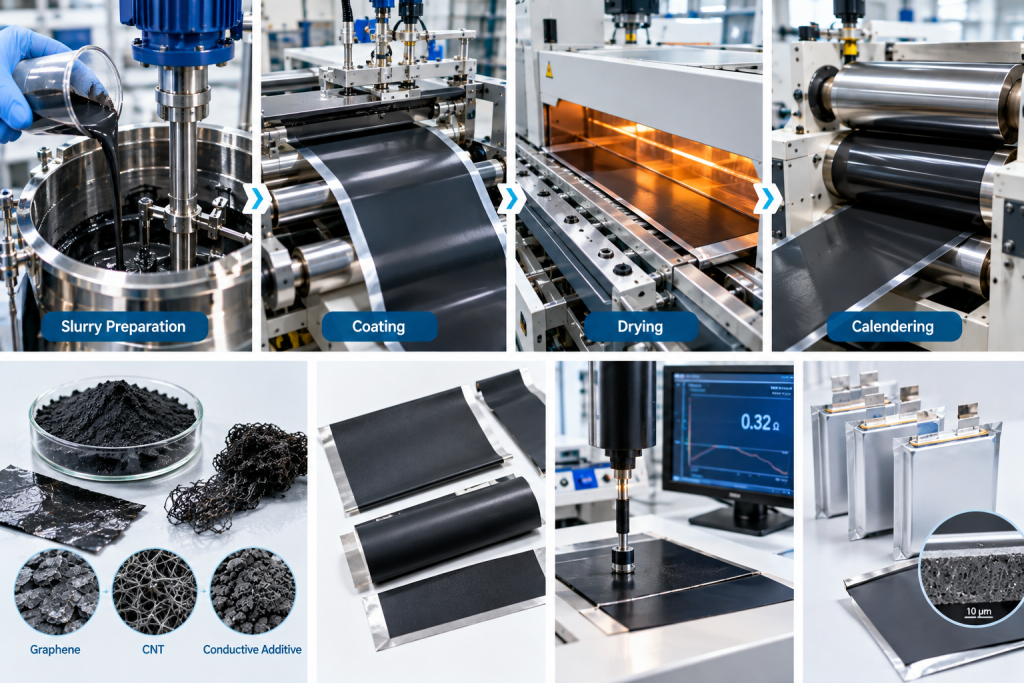
For electrode manufacturing, slurry preparation, coating, drying, calendering, and subsequent handling must be considered as interconnected operations.
A change in one stage may influence later results. For example, modifying the conductive additive concentration may improve electrical performance but also increase viscosity, making uniform coating more difficult.
The goal is to identify a practical operating window in which the material achieves the required performance without creating unacceptable manufacturing complexity.
5. Validating Graphene and CNT-Based Conductive Systems
Graphene and carbon nanotubes are attractive conductive additives because they can support conductive networks at relatively low loading levels in some formulations. However, their performance depends strongly on material characteristics, dispersion, orientation, and interaction with other formulation components.
Graphene-Based Conductive Coatings
Graphene may contribute to electrical conductivity, barrier performance, or other functional properties depending on its structure and formulation.
Pilot-scale validation should examine:
- Flake size distribution and material consistency
- Dispersion and orientation within the coating
- Film continuity and thickness
- Adhesion to the target substrate
- Electrical performance across the coated area
- Compatibility with drying and curing conditions
Graphene should not be assumed to improve every coating property automatically. The result depends on the graphene grade, binder chemistry, loading, processing method, and intended function.
CNT-Based Conductive Electrodes
CNTs can help form interconnected conductive networks in electrode formulations. Their high aspect ratio may be useful when the formulation and dispersion process are appropriately designed.
However, CNT systems can also introduce challenges related to dispersion, viscosity, mixing energy, and processability.
Pilot-scale validation should investigate:
- CNT dispersion quality and stability
- Slurry viscosity and flow behavior
- Conductive network formation
- Coating uniformity and electrode loading
- Electrode density and porosity after calendering
- Electrical and electrochemical performance
The relevant objective is not simply to minimize resistance. It is to achieve the required conductivity while preserving manufacturability, mechanical integrity, and overall application performance.
6. Pilot-Scale Validation for Battery Electrodes
Battery electrodes require particular attention because material behavior, electrode structure, manufacturing conditions, and cell performance are closely connected.
A formulation that performs well in a small laboratory cell may encounter problems when transferred to larger coated areas or more representative production conditions.
Pilot-scale electrode validation should consider several stages.
Stage 1: Slurry preparation
Evaluate mixing sequence, dispersion stability, solids content, viscosity, and batch-to-batch reproducibility.
Stage 2: Electrode coating
Assess coating uniformity, loading distribution, surface defects, and consistency across the web or coated area.
Stage 3: Drying
Investigate residual solvent or moisture where relevant, binder and conductive-additive distribution, cracking, and the effects of drying conditions.
Stage 4: Calendering
Evaluate electrode thickness, density, porosity, mechanical integrity, and the influence of compaction on electrical performance.
Stage 5: Cell validation
Use representative cell testing to evaluate relevant performance indicators, which may include capacity, internal resistance, rate capability, cycle life, and safety-related behavior.
The exact validation plan depends on the battery chemistry, electrode design, cell format, and intended operating conditions.
Importantly, a successful coating trial does not by itself demonstrate successful cell performance. Material-level, electrode-level, and cell-level results should be evaluated separately and then connected through a defined validation process.
7. Batch-to-Batch Consistency and Quality Control
Pilot-scale validation should establish whether performance can be reproduced, not merely achieved once.
A single successful batch may reflect favorable processing conditions or an unusually consistent material lot. Commercial manufacturing requires a more systematic understanding of variation.
A practical quality-control framework may include:
| Validation area | Parameters to monitor |
|---|---|
| Incoming materials | Material identity, key specifications, moisture where relevant |
| Dispersion | Particle or agglomerate characteristics, stability, viscosity |
| Coating | Thickness, appearance, defect rate, coating weight |
| Electrical performance | Sheet resistance, resistivity, or other application-specific metrics |
| Mechanical properties | Adhesion, flexibility, integrity, or abrasion resistance |
| Electrode quality | Loading, density, porosity, and thickness |
| Process stability | Speed, temperature, mixing conditions, and other critical parameters |
| Batch consistency | Variation between batches and across the coated area |
Not every parameter needs to be measured for every application. The validation team should identify critical quality attributes and determine which process variables have the greatest influence on them.
Measurement methods must also be consistent. Differences in sample preparation, conditioning, electrode contact, or instrument settings can produce misleading comparisons between batches or suppliers.
8. How to Design an Effective Pilot-Scale Trial
A useful pilot trial begins with a clear validation objective.
Rather than testing every possible parameter simultaneously, the team should define the principal uncertainty and build a structured plan around it.
Step 1: Define the Application Requirements
Establish the target substrate, coating method, required electrical performance, mechanical requirements, operating environment, and manufacturing constraints.
Step 2: Select the Material and Formulation
Compare candidate conductive materials and formulations based on application fit, processability, supply consistency, and cost—not just intrinsic conductivity.
Step 3: Establish Baseline Performance
Record laboratory results using documented test methods. These measurements provide a reference for comparison during pilot production.
Step 4: Identify Critical Process Variables
Determine which variables are most likely to influence performance, such as mixing conditions, solids content, coating speed, drying temperature, or calendering pressure.
Step 5: Run Controlled Pilot Trials
Change selected variables systematically, record process conditions, and collect representative samples across batches and coating positions.
Step 6: Validate the Finished Component
Evaluate electrical, mechanical, and application-specific performance using methods relevant to the intended operating environment.
Step 7: Review Repeatability and Commercial Feasibility
Confirm that the process can meet performance requirements consistently. Assess material consumption, production yield, process complexity, quality-control requirements, and supply capacity.
This approach helps identify the reasons behind performance variation and reduces the risk of moving an unsuitable formulation into commercial production.
9. Common Mistakes in Pilot-Scale Validation
Several mistakes can reduce the value of a pilot trial.
Focusing only on conductivity. Low resistance is important, but it cannot compensate for poor adhesion, unstable processing, excessive defect rates, or inadequate durability.
Scaling up before stabilizing the formulation. If the laboratory formulation changes significantly from one batch to another, larger trials may amplify rather than resolve the underlying problem.
Changing too many variables at once. Without controlled experiments and process records, it becomes difficult to determine which changes caused the observed result.
Testing only selected samples. Measurements from a few favorable locations may conceal nonuniformity across a larger coated area.
Ignoring downstream operations. Coating quality should be evaluated in the context of drying, calendering, slitting, assembly, or other relevant manufacturing steps.
Treating one successful run as proof of readiness. Commercial readiness requires evidence of repeatability, an acceptable process window, and an appropriate level of quality control.
Overlooking cost and supply constraints. A technically successful material may still be unsuitable if its formulation cost, processing requirements, or supply capacity cannot support the target application.
10. From Pilot Validation to Commercial Manufacturing
Pilot-scale validation should produce more than a collection of test results. It should generate the technical evidence needed to make a decision about the next stage of development.
A useful validation package may include:
- Material specifications and batch identification
- Formulation and processing records
- Defined testing methods and acceptance criteria
- Coating or electrode quality results
- Electrical and mechanical performance data
- Application-level validation results
- Observed failure modes and corrective actions
- A documented operating window
- Initial yield, cost, and supply assessments
- Recommendations for the next production stage
The resulting decision may be to proceed toward larger-scale manufacturing, optimize selected process variables, modify the formulation, or discontinue an unsuitable material option.
A pilot trial that identifies a critical failure can still be valuable if it explains why the material failed and how the next experiment should be designed.
The purpose of validation is not to guarantee that every material succeeds. It is to reduce uncertainty before additional resources are committed.
Validate the Complete System, Not Just the Material
Pilot-scale validation is a critical step in commercializing conductive coatings and electrodes.
It connects material properties with formulation behavior, manufacturing conditions, component performance, and quality-control requirements. For graphene, CNTs, and other advanced conductive materials, this connection is particularly important because dispersion, conductive-network formation, and process compatibility can strongly influence the final result.
The most reliable path to commercialization is to establish application requirements, stabilize the formulation, identify critical process variables, validate representative production conditions, and demonstrate repeatable performance.
A conductive material is commercially valuable only when its performance can be reproduced through a practical and controllable manufacturing process.
For material developers, manufacturers, and application teams, pilot-scale validation provides the evidence needed to move from promising laboratory results toward reliable industrial implementation.
Frequently Asked Questions
What is pilot-scale validation for conductive coatings?
Pilot-scale validation evaluates whether a conductive coating formulation can be manufactured under representative production conditions while meeting requirements for conductivity, coating uniformity, adhesion, durability, and process stability.
Why is pilot-scale testing important for graphene and CNT coatings?
Graphene and CNT performance depends on dispersion, formulation, and the formation of conductive networks. Pilot testing helps determine whether these properties can be maintained across larger batches and coated areas.
What parameters should be measured during pilot-scale electrode production?
Typical parameters include slurry viscosity, dispersion stability, coating thickness, loading uniformity, electrode density, porosity, electrical properties, and relevant cell-level performance. The exact selection depends on the battery chemistry and electrode design.
Does low electrical resistance guarantee a successful conductive coating?
No. A coating may have low resistance but still suffer from poor adhesion, cracking, nonuniform thickness, environmental degradation, or manufacturing defects. Electrical performance must be evaluated alongside the other requirements of the application.
How many pilot-scale batches are required?
There is no universal number. The trial plan should provide sufficient evidence to evaluate repeatability, process variation, and the influence of critical variables. Higher-risk applications may require more extensive validation and qualification.
When is a conductive material ready for commercial manufacturing?
A material is better positioned for commercialization when it meets application-specific performance criteria, can be processed within a defined operating window, demonstrates repeatable quality, and has a feasible cost and supply pathway.