Why Industrial Graphene Coatings Require Pilot Validation
Graphene has attracted significant interest in industrial coatings because of its potential to improve corrosion resistance, electrical conductivity, barrier performance, mechanical durability, and thermal management. However, incorporating graphene into a coating formulation does not automatically deliver these benefits.
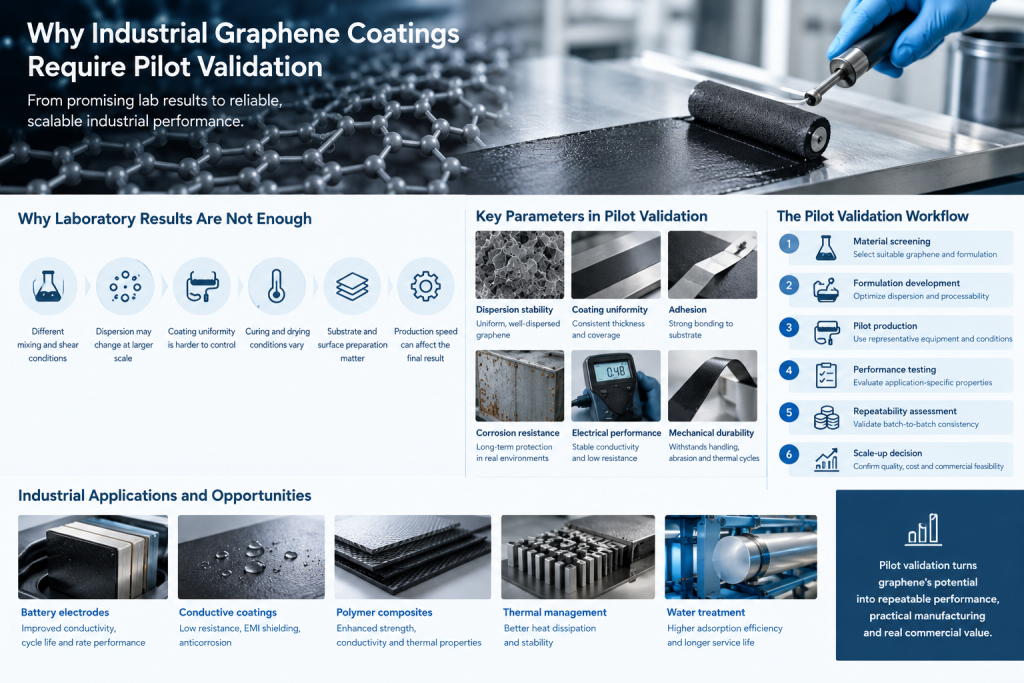
A graphene coating that performs well in a laboratory may behave very differently when applied to a larger surface, processed with industrial equipment, or exposed to long-term operating conditions. Differences in dispersion quality, coating thickness, curing conditions, substrate preparation, and production speed can all affect the final result.
Pilot validation is the critical step between laboratory formulation and reliable industrial application. It helps manufacturers determine whether a graphene-enhanced coating can be produced consistently, applied using practical manufacturing processes, and deliver measurable performance at an acceptable cost.
This article explains why pilot validation is essential for industrial graphene coatings, which parameters should be evaluated, and how to structure a validation program that reduces technical and commercial risk.
1. Laboratory Performance Does Not Guarantee Industrial Performance
Laboratory testing is useful for screening graphene materials and identifying promising formulations. Small samples allow researchers to control mixing conditions, coating thickness, substrate preparation, and curing parameters.
Industrial production introduces additional variables.
For example, a formulation that produces a uniform coating on a small metal coupon may develop agglomerates, pinholes, thickness variations, or adhesion problems when applied to larger components.
Several factors contribute to this gap:
- Mixing scale: Larger batches have different shear distribution, circulation patterns, and mass-transfer characteristics.
- Dispersion quality: Graphene sheets can reaggregate during storage, pumping, mixing, or application.
- Application conditions: Spraying, brushing, dipping, and roll coating produce different film structures.
- Curing behavior: Temperature distribution, humidity, airflow, and curing time can vary between laboratory and production equipment.
- Substrate variability: Surface roughness, contamination, pretreatment, and material composition influence coating adhesion.
- Production speed: Faster application or shorter curing cycles may change film formation and final properties.
These differences mean that laboratory results should be treated as evidence of potential performance, not proof of industrial readiness.
2. Graphene Dispersion Must Remain Stable at Production Scale
Dispersion is one of the most important variables in graphene coating development.
Graphene has a high surface area and strong interactions between sheets. Depending on the material, surface chemistry, solvent system, binder, and additives, graphene may form aggregates or gradually settle during storage.
Poor dispersion can lead to several problems:
- Uneven electrical conductivity across the coated surface.
- Local defects that reduce barrier performance.
- Inconsistent film appearance and surface roughness.
- Reduced mechanical integrity in areas containing large agglomerates.
- Unstable viscosity and difficulties during pumping or spraying.
- Differences between the beginning and end of a production batch.
A formulation that is stable for a few hours in a laboratory may not remain stable during a full production shift or after transportation and storage.
Pilot validation should therefore assess more than the initial appearance of the dispersion. Relevant parameters include viscosity, particle or agglomerate distribution, sedimentation, redispersibility, storage stability, and compatibility with the selected binder.
The evaluation should also establish whether the dispersion remains suitable after realistic mixing, transfer, pumping, and application operations.
The objective is not simply to achieve a good dispersion once. It is to develop a dispersion process that can be reproduced reliably.
3. Coating Uniformity Becomes More Difficult as Surface Area Increases
Uniform coating thickness is essential for many industrial applications.
In corrosion-protection systems, local thin spots or pinholes can create pathways for moisture, oxygen, and corrosive species. In conductive coatings, uneven thickness and nonuniform graphene distribution can produce inconsistent electrical resistance. In thermal or functional coatings, localized differences may affect heat transfer or other application-specific properties.
At laboratory scale, an operator can often adjust the application manually and inspect individual samples closely. Industrial production may involve large panels, complex geometries, long components, or continuous coating lines.
Pilot testing should examine:
- Wet-film and dry-film thickness distribution.
- Surface coverage and visible defects.
- Pinholes, cracks, bubbles, and edge effects.
- Graphene distribution across different regions.
- Adhesion on flat and complex surfaces.
- Reproducibility across multiple coated parts.
Where relevant, measurements should be taken at multiple positions on each component rather than relying on a single reading.
A coating should not be considered industrially validated merely because one test coupon meets the target specification. The process must demonstrate acceptable uniformity across representative production surfaces.
4. Corrosion Resistance Must Be Verified in the Complete Coating System
Corrosion protection is one of the most discussed potential applications for graphene-enhanced coatings. Graphene sheets may create a tortuous diffusion pathway that slows the movement of corrosive substances through a coating film.
However, the actual result depends on the entire formulation and coating structure.
Graphene’s effectiveness can be influenced by:
- Graphene quality, dimensions, and surface chemistry.
- Dispersion and orientation within the coating.
- Loading level and compatibility with the binder.
- Coating thickness and film continuity.
- Substrate preparation and adhesion.
- Moisture transport and defects.
- The type of corrosive environment.
Higher graphene loading does not necessarily provide better protection. Excessive loading may increase viscosity, impair film formation, introduce agglomerates, or compromise adhesion. In some systems, poorly dispersed or improperly oriented graphene can create defects that undermine the expected barrier effect.
Pilot validation should compare the graphene-enhanced coating against an appropriate baseline, such as the existing commercial coating or the same binder formulation without graphene.
Depending on the intended application, testing may include salt spray exposure, humidity testing, immersion, electrochemical impedance spectroscopy (EIS), adhesion measurements, and inspection for blistering, cracking, or underfilm corrosion.
No single test proves universal corrosion resistance. The test program should reflect the actual service environment and the applicable customer or industry requirements.
5. Adhesion and Mechanical Durability Must Survive Real Operating Conditions
A coating may initially show good conductivity or corrosion resistance but fail when subjected to handling, vibration, impact, bending, abrasion, or thermal cycling.
Graphene changes the structure of a coating, and its effects on mechanical properties depend on the binder, dispersion, loading, and curing process.
For example, a formulation optimized for barrier performance may not provide the flexibility required for a component that experiences repeated bending. A highly filled formulation may become difficult to apply or may develop stress during curing.
Pilot validation should assess mechanical properties relevant to the application, including:
- Adhesion to the actual substrate.
- Abrasion and scratch resistance.
- Impact resistance where required.
- Flexibility and resistance to cracking.
- Thermal cycling and temperature-dependent adhesion.
- Compatibility with subsequent processing or assembly.
The order of testing matters. A coating that passes a corrosion test before mechanical damage may not provide the same protection after scratching or abrasion.
For demanding applications, it is useful to evaluate performance both before and after representative mechanical or environmental conditioning.
6. Industrial Application Methods Can Change the Final Coating
Graphene coating formulations are sensitive to processing conditions. A change in application equipment can alter film thickness, surface morphology, solvent evaporation, and the distribution of conductive or barrier-forming structures.
Common application methods include:
- Spray coating.
- Dip coating.
- Brush or roller application.
- Roll-to-roll coating.
- Automated industrial coating lines.
Each method presents different requirements.
Spray coating, for example, requires suitable viscosity, atomization, flow behavior, and control of overspray. Roll-to-roll coating requires stable rheology, consistent web speed, controlled drying, and uniform film formation across the substrate width.
A formulation developed using laboratory mixing and manual coating may not transfer directly to high-throughput equipment.
Pilot trials should therefore use equipment and process conditions that reasonably represent the intended manufacturing route. Parameters such as mixing energy, addition sequence, coating speed, application pressure, wet-film thickness, drying profile, and curing time should be documented.
The goal is to establish a practical process window: a range of operating conditions under which the coating consistently meets its performance requirements.
7. Electrical and Thermal Performance Require Application-Specific Validation
Some graphene coatings are designed to provide electrical conductivity, antistatic behavior, electromagnetic interference shielding, or thermal-management functionality.
In these applications, material characterization alone is insufficient. The coating must be evaluated in its final geometry and operating environment.
For conductive coatings, relevant measurements may include:
- Sheet resistance or surface resistivity.
- Electrical continuity across the coated area.
- Uniformity between different production locations.
- Resistance changes after bending, abrasion, or environmental exposure.
- Contact resistance where the coating connects to other components.
For thermal-management applications, testing may include thermal conductivity or thermal resistance measurements using a method suitable for the coating and substrate system. The full assembly should be considered because substrate properties, contact interfaces, film thickness, and measurement conditions can strongly influence system-level results.
For electromagnetic shielding, the test method should reflect the frequency range and shielding requirements of the intended application.
A graphene coating may show promising properties in a material sample but deliver limited system-level improvement if the film is too thin, poorly bonded, electrically discontinuous, or incompatible with the surrounding components.
Pilot validation connects laboratory measurements to actual product requirements.
8. Batch-to-Batch Repeatability Is Essential for Commercialization
Industrial customers need more than one successful sample. They need a process that produces consistent results over time.
Graphene raw materials may vary in layer structure, lateral dimensions, defect density, surface chemistry, moisture content, and residual impurities. Binder and additive variations, equipment differences, and changes in processing conditions can introduce further variability.
A robust pilot program should evaluate multiple batches and establish a defined set of material and process controls.
These may include:
- Incoming graphene material specifications.
- Dispersion preparation records.
- Mixing and processing parameters.
- Viscosity and solids content.
- Coating thickness and visual inspection criteria.
- Application-specific performance measurements.
- Batch identification and traceability.
- Defined acceptance limits and corrective-action procedures.
Not every material property needs to become a routine release test. The most useful control plan identifies which characteristics correlate meaningfully with coating performance.
For example, if dispersion quality strongly influences sheet resistance, dispersion control and electrical testing may both be necessary. If a particular raw-material characteristic has little demonstrated relationship to the final result, it may be better treated as a development or periodic verification parameter.
The purpose is to build a practical quality-control system rather than accumulate measurements without clear decision value.
9. Pilot Validation Helps Determine the True Cost of the Coating
A graphene coating may appear economically attractive when only the price of graphene is considered. In industrial production, however, the total cost includes much more than the active material.
Important cost factors include:
- Graphene material consumption.
- Dispersion preparation and equipment time.
- Solvents, binders, and additives.
- Energy required for mixing, drying, and curing.
- Application speed and labor.
- Yield loss and rejected parts.
- Cleaning, maintenance, and equipment compatibility.
- Inspection, rework, and waste treatment.
- Packaging, storage, and shelf-life requirements.
An expensive graphene grade may be justified if it delivers a measurable performance improvement at a low loading level. Conversely, a low-cost material may become uneconomical if it requires extensive processing, creates application defects, or produces inconsistent results.
Pilot trials provide realistic data for calculating cost per coated unit or cost per square meter at an acceptable quality level.
They also help determine whether the coating provides enough incremental value to justify its adoption compared with existing commercial alternatives.
10. A Practical Pilot Validation Workflow for Graphene Coatings
A structured workflow reduces uncertainty and prevents unnecessary scale-up expenditure.
Stage 1: Define the application and success criteria
Identify the substrate, coating method, service environment, required properties, and applicable standards. Agree on measurable acceptance criteria before starting trials.
Stage 2: Screen graphene materials and formulations
Compare suitable graphene grades, binders, dispersion systems, and loading levels. Establish a baseline formulation and identify the variables most likely to influence performance.
Stage 3: Optimize laboratory processing
Evaluate mixing sequence, dispersion method, viscosity, coating thickness, drying, and curing. Confirm that promising results can be reproduced before moving to larger batches.
Stage 4: Conduct representative pilot trials
Prepare larger batches and apply the coating using equipment representative of the intended manufacturing process. Record process parameters, material consumption, defects, and yield.
Stage 5: Test performance and durability
Assess the properties that matter to the application, such as corrosion resistance, adhesion, conductivity, abrasion resistance, or thermal performance. Include relevant environmental conditioning where appropriate.
Stage 6: Evaluate repeatability
Repeat the process across multiple batches or production runs. Examine variation in both process parameters and final coating performance.
Stage 7: Confirm economics and production readiness
Calculate realistic production costs, review equipment compatibility, establish quality-control criteria, and document the process window.
Stage 8: Approve scale-up against defined criteria
Proceed to full production only when the technical, operational, quality, and commercial requirements have been met or when remaining risks have been explicitly accepted.
Pilot validation should be a decision-making stage, not merely a demonstration that the coating can be produced at a larger volume.
11. Common Mistakes in Graphene Coating Scale-Up
Several avoidable mistakes can delay commercialization.
Mistake 1: Selecting a graphene grade based only on laboratory specifications.
A material with attractive purity or surface area may not be the best option for a particular binder or coating method. Compatibility and final performance matter more than isolated specifications.
Mistake 2: Increasing graphene loading without optimizing the formulation.
Higher loading may increase viscosity, worsen dispersion, or weaken film integrity. The best loading is the level that meets performance requirements with acceptable processability and cost.
Mistake 3: Testing only initial performance.
Initial conductivity or corrosion results may not reflect performance after storage, abrasion, humidity exposure, or thermal cycling.
Mistake 4: Scaling up before defining acceptance criteria.
Without agreed targets, a pilot trial can generate large amounts of data without producing a clear decision.
Mistake 5: Ignoring the existing production process.
A technically promising formulation may be commercially unsuitable if it requires equipment modifications, excessive curing time, or operating conditions that conflict with the manufacturing line.
Mistake 6: Treating one successful batch as proof of repeatability.
Industrial adoption requires evidence that the process can deliver consistent results across multiple batches and representative production conditions.
Avoiding these mistakes makes pilot validation more efficient and improves the quality of scale-up decisions.
12. Working with External Partners for Pilot Validation
Companies developing graphene coatings do not always need to build a complete internal pilot facility. Depending on the project, they may work with coating manufacturers, formulation specialists, graphene suppliers, testing laboratories, or engineering partners.
The right partner should be selected according to the validation objective.
For example, a laboratory may be suitable for standardized corrosion testing, while a coating manufacturer may be better equipped to assess application compatibility and production yield. A graphene supplier may provide material characterization and dispersion guidance, but this alone may not establish whether the final coating is production-ready.
Before beginning a pilot project, define:
- The formulation and material specifications.
- The responsibilities of each party.
- The required batch size and trial conditions.
- The test methods and acceptance criteria.
- The expected data, reports, and retained samples.
- Confidentiality and intellectual-property arrangements.
- The treatment of unsuccessful trials and additional development work.
- The criteria for moving to the next stage.
This structure helps ensure that pilot work produces usable engineering information rather than only a small quantity of coated samples.
Industrial graphene coatings require pilot validation because their performance depends on the interaction between graphene characteristics, formulation chemistry, application methods, substrate conditions, curing, and the manufacturing process.
Laboratory results are valuable for identifying promising approaches, but they cannot independently establish industrial reliability. Pilot validation helps confirm dispersion stability, coating uniformity, adhesion, durability, functional performance, batch repeatability, and realistic production costs.
The most effective approach is to define application-specific targets, validate the formulation under representative manufacturing conditions, and use measurable acceptance criteria to guide each scale-up decision.
For graphene coating developers, the objective is not simply to demonstrate that graphene can improve a coating. It is to establish a reproducible, process-compatible, economically viable coating system that delivers verified performance in its intended application.
Frequently Asked Questions
Why is pilot validation important for graphene coatings?
Pilot validation determines whether laboratory formulations can be manufactured consistently at a larger scale. It identifies issues involving dispersion, coating uniformity, adhesion, durability, process compatibility, and production cost before full-scale investment.
Can laboratory corrosion tests predict industrial coating performance?
Laboratory tests provide useful comparative data, but their predictive value depends on the test method and service environment. Representative substrates, application conditions, defects, mechanical damage, and long-term exposure may need additional evaluation.
Does adding more graphene always improve coating performance?
No. Excessive graphene loading can increase viscosity, cause agglomeration, impair film formation, and increase cost. The optimum loading depends on the material, binder, processing method, and target application.
What properties should be tested during graphene coating pilot trials?
Common parameters include dispersion stability, viscosity, film thickness, surface uniformity, adhesion, corrosion resistance, abrasion resistance, conductivity, and environmental durability. The final test plan should be tailored to the intended application.
How many pilot batches are needed to validate a graphene coating?
There is no universal number. The required number depends on process variability, application risk, customer requirements, and the evidence needed to establish repeatability. Multiple representative batches are generally more informative than a single successful run.
When is a graphene coating ready for industrial production?
A coating is ready when it consistently meets agreed performance and quality requirements under representative production conditions, the manufacturing process is sufficiently controlled, and the economics and supply arrangements support commercial use.