

Conductive Network Engineering with Carbon Nanotubes
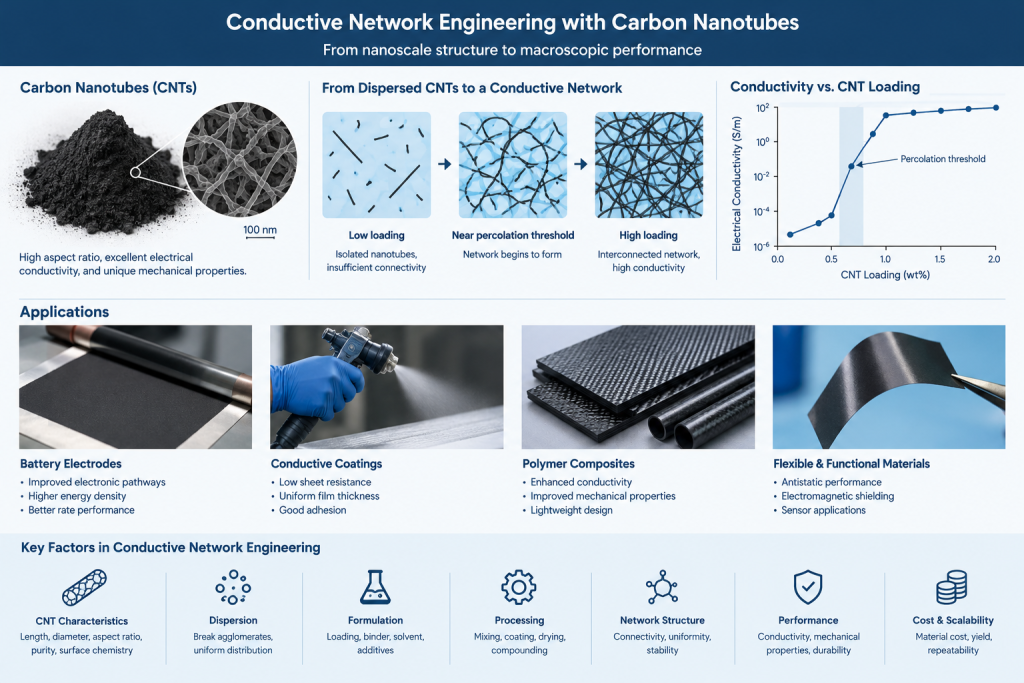
Carbon nanotubes (CNTs) are widely investigated as conductive additives for batteries, conductive coatings, polymer composites, and other functional materials. Their high aspect ratio and electrical properties make them attractive for applications that require interconnected conductive pathways within a host material.
However, achieving reliable electrical conductivity is not simply a matter of adding carbon nanotubes to a formulation.
The performance of a CNT-based system depends on how nanotubes are dispersed, distributed, connected, and maintained throughout the material. Poor dispersion can leave isolated agglomerates, while excessive processing may shorten nanotubes or alter the network structure. An unsuitable formulation may also prevent effective contact between neighboring nanotubes.
Conductive network engineering is the process of designing and controlling the structure of interconnected conductive pathways to achieve the required electrical performance, processability, and product reliability.
For industrial applications, the objective is not merely to maximize conductivity. It is to establish a conductive network that performs consistently under realistic manufacturing and operating conditions.
1. What Is a Conductive Network?
A conductive network consists of interconnected conductive components that allow electrical charge to move through a material.
In CNT-based systems, individual nanotubes can form pathways through direct contact or sufficiently close electrical interactions with neighboring nanotubes. As the concentration and distribution of nanotubes change, the connectivity of the network can change as well.
At relatively low CNT concentrations, nanotubes may remain separated, leaving the material electrically insulating or weakly conductive. As the network becomes more interconnected, conductivity can increase significantly.
This transition is commonly associated with the concept of electrical percolation.
The percolation threshold is the concentration at which a sufficiently connected conductive network begins to form within a particular material system. It is not a universal value for CNTs. It depends on nanotube characteristics, dispersion, matrix properties, processing conditions, and the criteria used to define electrical conduction.
For industrial formulation development, understanding this transition helps engineers identify an appropriate loading range without unnecessarily increasing material consumption.
2. Why Carbon Nanotubes Are Suitable for Conductive Network Engineering
CNTs have a distinctive geometry that can support network formation at relatively low loading levels in some formulations.
Their potential advantages include:
- High aspect ratio: Long, slender nanotubes can connect regions of a material that are separated by distances greater than the nanotube diameter.
- Network formation: Interconnected nanotubes may provide conductive pathways throughout a polymer, coating, or electrode.
- Mechanical flexibility: CNT networks can accommodate certain forms of deformation, depending on the surrounding matrix and interface.
- Formulation versatility: CNTs can be incorporated into selected aqueous, solvent-based, polymeric, and electrode formulations when compatibility is established.
- Hybrid conductive structures: CNTs can be combined with carbon black, graphene, or other conductive components to modify network connectivity.
These advantages depend on the specific CNT grade and application.
For example, a long CNT may be beneficial for network connectivity but more difficult to disperse uniformly. A shorter CNT may be easier to process in some systems but may require a different loading level to achieve comparable connectivity.
The optimal material is therefore the one that meets the application requirements within a practical processing window.
3. The Role of CNT Length, Diameter, and Aspect Ratio
The geometry of carbon nanotubes influences how they connect within a host material.
Aspect ratio is commonly defined as length divided by diameter. In many systems, a higher aspect ratio can support network formation at lower concentrations because individual nanotubes can bridge larger distances.
However, aspect ratio alone does not determine performance.
Long nanotubes may entangle more easily, increasing dispersion difficulty and formulation viscosity. Processing can also reduce nanotube length, changing the network characteristics relative to the original material.
Other important factors include:
- Diameter and wall structure
- Length distribution
- Bundling and agglomeration
- Surface functionalization
- Purity and residual catalyst content
- Compatibility with the surrounding matrix
Material specifications should be evaluated in relation to the intended formulation and manufacturing process.
A CNT grade selected for a high-conductivity electrode may not be the best choice for a sprayable coating that requires low viscosity and smooth surface appearance.
4. Dispersion: Balancing Network Formation and Uniformity
Dispersion is one of the most important variables in CNT conductive network engineering.
As-produced CNTs may form bundles because of interactions between nanotubes. If these bundles remain poorly distributed, the resulting material may contain highly conductive regions alongside areas with insufficient conductive connectivity.
This nonuniformity can cause inconsistent electrical measurements and unreliable product performance.
4.1 Why Agglomeration Matters
Agglomerates can create several problems:
- Local variations in conductive additive concentration
- Uneven electrical resistance
- Coating defects and surface roughness
- Unstable slurry rheology
- Reduced reproducibility between batches
Increasing the CNT loading does not necessarily solve these problems. Adding more nanotubes may increase conductivity in some regions while leaving dispersion defects unresolved.
4.2 Selecting a Suitable Dispersion Process
Dispersion methods may include mechanical mixing, rotor-stator mixing, high-shear processing, and selected ultrasonic or other specialized techniques.
The appropriate method depends on the formulation, batch size, CNT grade, equipment, and target application.
Excessive processing can be counterproductive if it shortens nanotubes or introduces other undesirable changes. Conversely, insufficient processing may leave bundles that prevent uniform network formation.
The objective is to achieve a suitable balance between dispersion quality, nanotube integrity, processability, and electrical performance.
4.3 Evaluate the Complete Formulation
A dispersion that appears uniform may still produce poor electrical performance after drying or curing.
The binder, solvent, dispersant, and other additives can influence how nanotubes are distributed and whether conductive contacts are maintained in the finished material.
For this reason, CNT dispersion should be evaluated in the intended formulation and through the relevant manufacturing stages.
5. CNT Loading and Electrical Percolation
CNT concentration is a critical design variable because it influences network connectivity, material cost, and processing behavior.
At low loading levels, the conductive network may be incomplete. Increasing the concentration can create additional connections and improve conductivity.
However, further increases may produce diminishing returns or introduce other problems.
For example, excessive CNT loading can increase viscosity, complicate coating, reduce formulation stability, or affect mechanical properties.
The relationship between loading and conductivity is therefore often nonlinear.
A practical formulation study should evaluate several CNT concentrations around the anticipated network-formation region. Each formulation should be assessed using consistent sample preparation and electrical testing.
Relevant measurements may include:
- Electrical conductivity or resistivity
- Sheet resistance for conductive films
- Viscosity and flow behavior
- Dispersion stability
- Coating uniformity
- Mechanical integrity
- Cost per finished component
The best loading is not necessarily the concentration that produces the lowest resistance. It is the concentration that achieves the required electrical performance while meeting processing, reliability, and cost constraints.
6. Conductive Network Engineering in Battery Electrodes
Battery electrodes are an important application for CNT conductive networks.
In an electrode, conductive additives help establish electrical pathways between active-material particles and the current collector. CNTs may provide extended connections between particles, depending on their geometry, dispersion, and interaction with other electrode components.
However, electrode performance depends on more than electronic conductivity.
6.1 Slurry Preparation
CNTs can influence slurry viscosity and flow behavior. Their high aspect ratio and tendency to form networks may increase the sensitivity of the formulation to mixing conditions and solids content.
A practical development program should evaluate dispersion quality, viscosity, stability, and compatibility with the active material, binder, and solvent system.
6.2 Electrode Coating and Drying
An electrode slurry must be processable using the intended coating method.
Uneven dispersion or unsuitable rheology may contribute to coating defects and nonuniform conductive additive distribution. Drying can further influence the distribution of formulation components within the electrode.
Pilot-scale testing should therefore examine coating uniformity, loading distribution, thickness, and relevant electrical properties.
6.3 Calendering and Electrode Structure
Calendering changes electrode thickness, density, porosity, and particle contact.
These changes can affect electronic conductivity as well as ionic transport. A formulation that provides favorable electrical conductivity before calendering may behave differently after compaction.
The conductive network should therefore be evaluated in the finished electrode structure rather than only in the initial slurry or dried coating.
6.4 Cell-Level Validation
Improved electrode conductivity does not automatically guarantee higher battery capacity, longer cycle life, or improved safety.
Cell performance depends on the complete electrode design, electrolyte, interfaces, operating conditions, and manufacturing quality.
A successful CNT development program should connect material characterization with electrode-level testing and representative cell evaluation.
7. Conductive Networks in Coatings and Polymer Composites
Outside battery manufacturing, CNT networks can support conductive and antistatic coatings, electromagnetic shielding materials, sensors, and conductive polymer composites.
Each application imposes different requirements on network structure.
Conductive Coatings
Coatings may require low sheet resistance, uniform coverage, acceptable surface appearance, and reliable adhesion.
CNT loading and dispersion must be optimized without creating excessive viscosity or coating defects.
Electrical measurements should be taken at multiple locations to identify spatial variation that could be hidden by a single average value.
Antistatic Materials
Antistatic formulations generally require controlled electrical behavior rather than the lowest possible resistance.
The formulation should deliver the required performance consistently while maintaining processability, mechanical integrity, and environmental stability.
Conductive Polymer Composites
In polymer composites, CNT networks must form within the matrix while remaining compatible with the required mechanical properties and manufacturing process.
Compounding conditions, polymer viscosity, filler distribution, and interface interactions can influence network formation.
Processing may also change nanotube length or orientation, which can affect the final electrical response.
The design objective should reflect the intended component and its operating conditions.
8. Hybrid Conductive Networks: Combining CNTs with Other Materials
CNTs can be combined with other conductive materials to create hybrid networks.
For example, CNTs and graphene may provide complementary geometries: nanotubes can connect separated regions, while graphene sheets may provide extended conductive surfaces.
CNTs may also be combined with carbon black or other conductive additives, depending on the formulation and performance requirements.
However, hybrid systems should not be assumed to outperform single-additive formulations automatically.
Potential benefits must be evaluated against additional formulation complexity, dispersion requirements, material cost, and quality-control needs.
A useful comparison should examine:
- The performance of each additive individually
- The performance of the hybrid formulation
- The total conductive additive loading
- Processing and dispersion behavior
- Finished-component performance
- Batch-to-batch repeatability and cost
A hybrid network is commercially attractive when it provides a measurable advantage that justifies its additional complexity.
9. How to Evaluate a CNT Conductive Network
A structured evaluation program should connect material properties, network characteristics, and final application performance.
| Evaluation area | What to examine |
|---|---|
| CNT characteristics | Length distribution, diameter, purity, surface chemistry |
| Dispersion | Agglomeration, uniformity, stability |
| Formulation | Loading, viscosity, compatibility, processability |
| Electrical performance | Conductivity, resistivity, sheet resistance |
| Component uniformity | Variation across the sample or coated area |
| Mechanical behavior | Adhesion, flexibility, integrity where relevant |
| Process stability | Sensitivity to mixing, coating, drying, or compounding |
| Repeatability | Variation between batches and production runs |
| Economics | Material consumption, yield, processing cost |
Not every project requires every measurement. The validation plan should prioritize the parameters that determine success in the target application.
Electrical measurements should also use appropriate sample preparation, conditioning, and test methods. Otherwise, differences in thickness, contact conditions, or measurement geometry may be mistaken for changes in network quality.
10. From Laboratory Formulation to Pilot-Scale Production
A CNT formulation that performs well in a laboratory may encounter different conditions when processed in larger equipment.
Changes in mixing geometry, shear distribution, residence time, temperature, and throughput can influence dispersion and network formation.
A practical scale-up process should include several stages.
Stage 1: Laboratory screening
Compare CNT grades and loading levels to identify promising formulations.
Stage 2: Formulation optimization
Evaluate dispersion, viscosity, electrical performance, and compatibility with other ingredients.
Stage 3: Process validation
Identify critical process parameters and determine how they influence the resulting network.
Stage 4: Pilot production
Process representative batches using equipment and conditions relevant to the intended manufacturing route.
Stage 5: Repeatability testing
Compare results across batches and sample locations.
Stage 6: Application validation
Test the finished electrode, coating, or composite under relevant operating conditions.
Stage 7: Commercial assessment
Evaluate yield, material cost, production efficiency, quality requirements, and supply reliability.
The outcome should be a documented process and a clear understanding of the conditions required to reproduce the desired performance.
11. Common Mistakes in Conductive Network Engineering
Several mistakes can undermine CNT formulation development.
Focusing only on CNT purity. Purity is important, but network performance also depends on geometry, dispersion, surface chemistry, and processing.
Assuming more CNT always means better conductivity. Higher loading can increase viscosity and cost while producing diminishing electrical benefits.
Overprocessing the dispersion. Excessive shear or other processing may alter nanotube length or structure.
Ignoring the matrix. The binder, polymer, solvent, and other ingredients influence network formation and electrical contact.
Measuring only one point. Local measurements may conceal nonuniformity across a coating or composite.
Scaling up without process controls. Larger equipment may produce different dispersion and network structures from laboratory equipment.
Evaluating conductivity without application testing. Low resistance does not automatically establish adhesion, durability, cell performance, or commercial suitability.
Avoiding these mistakes requires a development strategy that considers the entire material system rather than CNTs in isolation.
Engineer the Network, Not Just the Additive
Carbon nanotubes provide valuable opportunities for creating conductive pathways in batteries, coatings, polymers, and other functional materials.
Their performance, however, depends on how the network is formed and maintained within the host material. CNT geometry, dispersion, loading, matrix compatibility, and processing conditions all influence electrical connectivity and final product behavior.
Effective conductive network engineering requires application-specific specifications, controlled formulation development, standardized testing, and validation under representative manufacturing conditions.
The goal is not simply to add conductive nanotubes. It is to create a uniform, reproducible, and economically viable network that delivers the required performance in the finished product.
For material developers and manufacturers, this approach turns CNT selection from a simple additive decision into a systematic engineering process.
Frequently Asked Questions
What is conductive network engineering?
Conductive network engineering involves designing and controlling interconnected conductive pathways within a material to achieve defined electrical performance, processability, and reliability.
Why are carbon nanotubes useful as conductive additives?
Their high aspect ratio and conductive properties can help form interconnected pathways at relatively low loading levels in some systems. Actual performance depends on CNT characteristics, dispersion, formulation, and processing.
What is the percolation threshold for CNTs?
It is the concentration at which a sufficiently connected conductive network begins to form. The threshold varies with CNT geometry, dispersion, matrix properties, processing conditions, and the measurement method.
Does better CNT dispersion always improve conductivity?
Not necessarily. Better dispersion can improve network uniformity, but electrical performance also depends on nanotube integrity, loading, orientation, and contact between conductive components. Dispersion and conductivity should be evaluated together.
Can CNTs and graphene be used together?
Yes. Hybrid formulations can be investigated to combine complementary network structures. Their benefits should be demonstrated through controlled comparisons of conductivity, processing behavior, repeatability, and total cost.
How can CNT conductive networks be validated for industrial use?
Validation may include material characterization, dispersion testing, electrical measurements, component-level evaluation, pilot-scale processing, batch repeatability, and application-specific performance testing.