
Why Corona Treatment Is Essential for Functional Heat Dissipation Films Before Coating
Functional heat dissipation films are increasingly used in electronics, battery systems, industrial equipment, and thermal management components. Depending on the application, these films may provide thermal spreading, electrical insulation, corrosion protection, surface protection, or a combination of functional properties.
However, the performance of a functional film does not depend only on its base material or coating formulation. The interface between the substrate and the coating is equally important.
Poor surface compatibility can lead to incomplete wetting, weak adhesion, coating defects, and premature delamination. These problems become particularly significant when films are exposed to temperature fluctuations, humidity, mechanical stress, or corrosive environments.
Corona treatment is a widely used surface modification process that helps improve the surface characteristics of polymer films and other suitable substrates before coating or lamination.
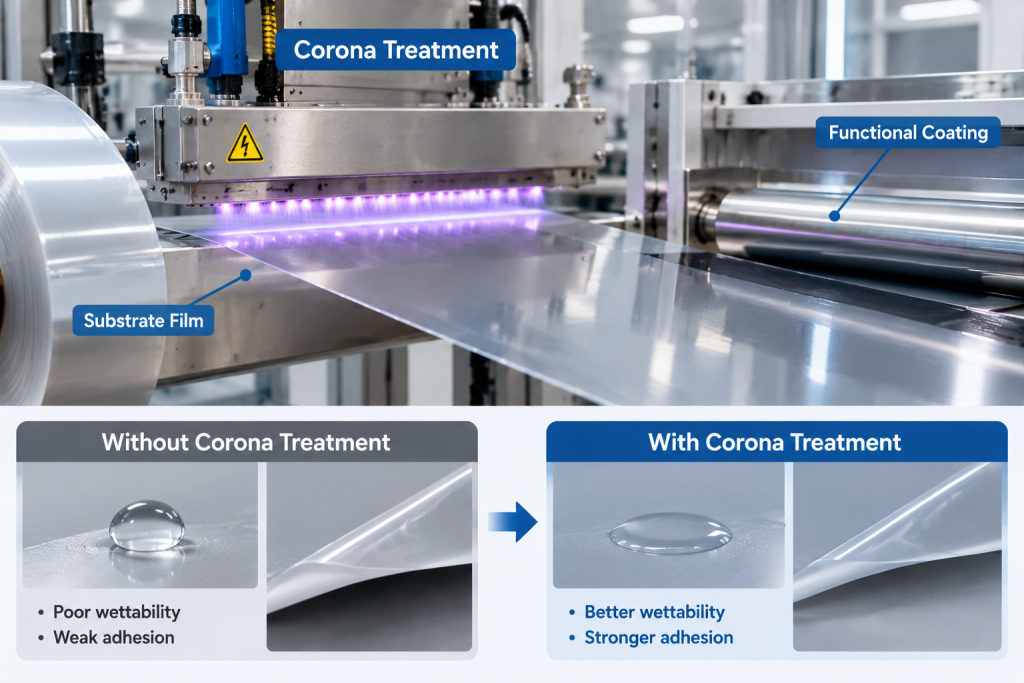
For functional heat dissipation films, corona treatment can improve coating wettability and interfacial adhesion, supporting more reliable integration of thermal and protective layers.
This article explains how corona treatment works, why it matters before coating, and how manufacturers can evaluate its influence on the adhesion and durability of functional heat dissipation films.
1. Why Surface Preparation Matters Before Coating
A coating must establish sufficient contact with the substrate to form a stable interface.
Even when a coating formulation has excellent thermal conductivity, corrosion resistance, or chemical stability, poor adhesion can prevent it from delivering reliable performance.
Several substrate characteristics can interfere with coating adhesion:
- Low surface energy
- Poor wettability
- Surface contamination
- Residual processing agents
- Incompatible surface chemistry
- Excessively smooth or chemically inert surfaces
Polymer films are particularly challenging because many commonly used polymers have relatively low surface energy.
Materials such as polyethylene (PE), polypropylene (PP), and certain polyester-based films may require additional surface preparation before applying functional coatings.
Without suitable treatment, a liquid coating may retract, spread unevenly, or form weakly bonded regions.
For heat dissipation films, these defects can affect not only appearance but also thermal interface stability, protective performance, and service life.
2. What Is Corona Treatment?
Corona treatment is a surface activation process that uses high-voltage electrical discharge to modify the outermost surface of a material.
During treatment, an electrical discharge is generated between an electrode and a grounded treatment roller or substrate surface. The resulting plasma-like discharge interacts with the material surface.
The process can introduce polar functional groups, increase surface energy, and improve the wettability of suitable polymer substrates.
Common effects include:
Surface activation: Electrical discharge modifies the surface chemistry, making the substrate more receptive to certain coating systems.
Improved wettability: Coating liquids can spread more uniformly across the treated surface.
Enhanced interfacial compatibility: Increased surface polarity can improve interactions between the substrate and compatible coating formulations.
Better coating uniformity: Improved wetting can reduce certain surface defects associated with poor liquid spreading.
Corona treatment primarily modifies the surface rather than the bulk material. Under properly controlled conditions, the objective is to improve the interface without significantly changing the film’s underlying mechanical or thermal properties.
However, the actual treatment effect depends on the substrate, discharge conditions, processing speed, and coating chemistry.
3. How Corona Treatment Improves Coating Adhesion
The main value of corona treatment is its ability to improve the conditions required for a coating to bond to a substrate.
3.1 Increasing Surface Energy
Surface energy is an important factor in determining whether a liquid coating can spread across a solid surface.
When the substrate has low surface energy, the coating may form droplets or retract instead of creating continuous contact.
Corona treatment can increase the surface energy of compatible materials, improving the interaction between the liquid coating and the substrate.
A common practical indicator is the surface tension or wetting level measured using dyne solutions.
However, dyne testing should be regarded as a process-control indicator rather than direct proof of coating adhesion.
3.2 Improving Coating Wettability
Uniform wetting is essential for producing consistent functional layers.
If the coating liquid does not spread properly, manufacturers may encounter:
- Pinholes and uncovered areas
- Uneven coating thickness
- Localized coating accumulation
- Poor edge coverage
- Surface defects and irregularities
Corona treatment can help reduce these problems by improving the interaction between the coating liquid and the substrate.
The extent of improvement depends on coating viscosity, solvent system, surface tension, application method, and drying conditions.
3.3 Strengthening Interfacial Bonding
Improved surface polarity can contribute to stronger interactions between the substrate and coating.
Depending on the material system, these interactions may include polar interactions, hydrogen bonding, and other forms of interfacial attraction.
Corona treatment does not guarantee chemical bonding between every substrate and coating. Its effectiveness must be evaluated against the actual formulation.
Nevertheless, when the substrate and coating are compatible, surface activation can improve adhesion and reduce the risk of coating separation.
4. Why Corona Treatment Matters for Anti-Corrosion Heat Dissipation Films
Functional heat dissipation films may combine a thermally conductive layer with a protective coating.
For example, a film may use a polymer substrate, a thermally conductive coating containing ceramic or carbon-based fillers, and an additional protective surface layer.
In some designs, the film is applied to a metal component or integrated into a multilayer structure.
In these systems, coating adhesion is important for several reasons.
4.1 Maintaining Protective Layer Integrity
An anti-corrosion coating must remain continuous and sufficiently bonded to the underlying surface.
If the coating separates, cracks, or develops localized defects, moisture and corrosive substances may penetrate the protective layer.
Corona treatment can help improve the adhesion of compatible coatings on suitable substrates, reducing one potential cause of premature coating failure.
However, corona treatment itself does not provide corrosion protection. Corrosion resistance comes from the coating formulation, barrier properties, substrate compatibility, and overall system design.
4.2 Reducing Delamination Under Environmental Stress
Functional films may experience:
- Temperature cycling
- High humidity
- Condensation
- Mechanical vibration
- Bending or deformation
- Contact with chemicals or cleaning agents
Differences in thermal expansion between the substrate and coating can generate interfacial stress.
If initial adhesion is insufficient, these stresses may accelerate delamination.
Improving the initial interface through appropriate surface treatment can help the coating withstand these conditions.
Long-term durability must still be confirmed through environmental aging and adhesion testing.
4.3 Supporting Consistent Multilayer Coating Structures
Some advanced heat dissipation films contain multiple functional layers.
These may include:
- Thermally conductive layers
- Electrically insulating layers
- Anti-corrosion coatings
- Adhesive or bonding layers
- Surface protection layers
Each interface creates a potential point of failure.
Corona treatment may be used before selected coating or lamination steps to improve compatibility between layers.
The treatment should be designed around the specific interface rather than automatically applied to every layer.
5. Does Corona Treatment Improve Thermal Conductivity?
This is an important distinction.
Corona treatment is a surface activation process. It does not directly increase the intrinsic thermal conductivity of the substrate or the thermally conductive filler.
For example, if a coating contains aluminum oxide, boron nitride, aluminum nitride, graphite, or graphene-based fillers, the thermal performance is mainly determined by factors such as:
- Filler type and intrinsic thermal properties
- Filler loading and distribution
- Particle size and morphology
- Orientation of anisotropic fillers
- Contact resistance between particles
- Coating thickness and uniformity
- Interface resistance between functional layers
Corona treatment may indirectly support thermal performance by helping produce a more uniform and stable coating.
A coating with improved adhesion may be less likely to develop gaps, cracks, or delaminated regions that disrupt the intended thermal pathway.
However, this indirect benefit should not be confused with an increase in the material’s intrinsic thermal conductivity.
For applications requiring accurate thermal performance, manufacturers should measure thermal resistance or thermal conductivity using an appropriate method rather than relying on surface energy measurements.
6. Corona Treatment vs. Other Surface Preparation Methods
Corona treatment is not the only available surface activation technology.
The appropriate method depends on substrate chemistry, coating requirements, production scale, and the desired level of surface modification.
| Method | Main mechanism | Typical advantages | Important considerations |
|---|---|---|---|
| Corona treatment | Electrical discharge activation | Continuous processing, suitable for many film substrates | Treatment uniformity and aging must be controlled |
| Atmospheric plasma | Plasma-based surface activation | Flexible treatment and potential for localized processing | Equipment configuration and process parameters matter |
| Flame treatment | Controlled oxidation using a flame | High-speed treatment for suitable materials | Heat sensitivity and process safety |
| Chemical primer | Application of a compatible intermediate layer | Can improve bonding with difficult coating systems | Adds material, processing steps, and curing requirements |
| Mechanical abrasion | Surface roughening | Can improve mechanical anchoring in suitable systems | May damage thin films or introduce particles |
Corona treatment is especially attractive for roll-to-roll film manufacturing because it can be integrated into continuous production lines.
However, it is not universally superior. Atmospheric plasma, primers, or other methods may provide better results for certain substrates and coating systems.
7. Key Process Parameters in Corona Treatment
Effective surface treatment requires more than simply switching on the corona equipment.
Several parameters influence treatment performance.
7.1 Treatment Power
Discharge power affects the intensity of surface activation.
Insufficient power may produce limited surface modification, while excessive treatment may damage sensitive films or create undesirable surface changes.
The appropriate operating range must be established for each substrate.
7.2 Line Speed
For continuous film processing, line speed influences the treatment exposure.
Higher production speeds may reduce the effective treatment delivered to each unit of surface area if other parameters remain unchanged.
Manufacturers should establish a suitable relationship between power, line speed, electrode configuration, and substrate width.
7.3 Electrode Gap and Treatment Uniformity
The distance between the electrode and the substrate affects discharge characteristics.
An unsuitable gap can result in inconsistent treatment or unstable discharge.
Uniform treatment across the full film width is particularly important for large-area functional coatings.
7.4 Substrate Condition
Dust, oil, moisture, release agents, and other contaminants can interfere with treatment effectiveness and coating adhesion.
Corona treatment should not be regarded as a substitute for proper cleaning.
The substrate should be inspected and prepared before treatment.
7.5 Time Between Treatment and Coating
Surface activation may decline over time due to molecular rearrangement, migration of additives, or surface contamination.
This phenomenon is often described as hydrophobic recovery.
For this reason, manufacturers should define an appropriate interval between corona treatment and coating.
Where possible, treatment and coating should be integrated into the same production line or performed within a validated time window.
8. How to Evaluate Corona Treatment Before Industrial Production
A reliable evaluation should compare untreated and treated samples under the same coating and curing conditions.
A practical validation process can include the following stages.
Step 1: Characterize the Untreated Substrate
Record the initial substrate condition, including:
- Material type
- Thickness
- Surface cleanliness
- Initial surface energy or wetting level
- Existing surface treatment
This provides a baseline for comparison.
Step 2: Establish Corona Treatment Conditions
Prepare samples using different treatment levels.
Record the relevant equipment settings, including treatment power, line speed, electrode gap, and substrate conditions.
The goal is to identify an effective treatment window rather than simply maximizing surface energy.
Step 3: Measure Surface Wettability
Use suitable dyne solutions or contact-angle measurements to evaluate surface changes.
Contact-angle measurements can provide additional information about wetting behavior, particularly when water or another defined test liquid is used.
These measurements should be performed consistently because test-liquid selection and surface contamination can affect the results.
Step 4: Apply the Functional Coating
Apply the same coating formulation to untreated and treated samples.
Keep coating thickness, application method, drying conditions, and curing parameters consistent.
This helps isolate the influence of corona treatment.
Step 5: Test Adhesion
Depending on the film and coating structure, suitable tests may include:
- Cross-cut adhesion testing
- Peel testing
- Tape testing
- Scratch or abrasion testing
- Cohesive and interfacial failure analysis
The test method should be selected according to the coating thickness, substrate flexibility, and intended application.
Step 6: Evaluate Environmental Durability
Initial adhesion is not sufficient to establish long-term reliability.
Additional testing may include:
- Humidity aging
- Thermal cycling
- Heat aging
- Water immersion
- Salt spray testing where relevant
- Chemical exposure
- Repeated bending or mechanical loading
After aging, adhesion and coating integrity should be reassessed.
For anti-corrosion applications, corrosion testing should also evaluate the actual protective performance of the coated system.
Step 7: Verify Thermal Performance
If the film is designed for heat dissipation, thermal testing should be performed before and after relevant aging procedures.
Possible evaluation indicators include:
- Thermal conductivity
- Thermal resistance
- Temperature distribution
- Interface stability
- Changes in performance after environmental exposure
This confirms whether improved coating adhesion also contributes to more stable thermal performance at the component level.
9. Common Mistakes When Using Corona Treatment
Even when corona treatment is widely available, incorrect implementation can reduce its effectiveness.
Mistake 1: Assuming a higher dyne level always means better adhesion
Surface energy is useful for monitoring treatment, but it does not fully describe interfacial compatibility. Adhesion must be tested using the actual coating system.
Mistake 2: Treating corona as a cleaning process
Corona treatment can modify surface chemistry, but it does not reliably remove all oils, dust, or processing residues. Cleaning and surface preparation remain important.
Mistake 3: Applying excessive treatment
Over-treatment may damage sensitive substrates or create an unsuitable surface condition. A controlled process window is preferable.
Mistake 4: Ignoring treatment aging
A surface activated today may not retain the same wetting behavior after prolonged storage. The time between treatment and coating should be controlled.
Mistake 5: Evaluating adhesion only before aging
A coating may pass an initial adhesion test but fail after humidity exposure or thermal cycling. Environmental durability is essential for industrial applications.
Mistake 6: Assuming corona treatment improves thermal conductivity
Corona treatment mainly affects the surface. Thermal performance must be evaluated through independent thermal measurements.
10. Integrating Corona Treatment into Functional Film Manufacturing
For manufacturers producing functional heat dissipation films, corona treatment should be considered part of the overall coating process rather than an isolated equipment operation.
A typical production workflow may include:
- Substrate inspection and incoming quality control
- Surface cleaning and preparation
- Corona treatment
- Surface energy or wettability verification
- Functional coating application
- Drying and curing
- Adhesion and appearance inspection
- Thermal and protective performance testing
- Final product inspection and batch traceability
For roll-to-roll manufacturing, the corona station can be installed before the coating unit.
This arrangement can reduce the time between activation and coating while improving production consistency.
Manufacturers should also establish control limits for treatment conditions and periodically verify surface performance.
The objective is not simply to achieve a higher surface energy value. It is to create a repeatable interface that supports coating adhesion, thermal stability, and environmental durability.
Conclusion
Corona treatment is an important surface preparation technology for many functional heat dissipation films, particularly when low-surface-energy polymer substrates are used.
By increasing surface energy and improving wettability, it can help compatible coating systems form more uniform and reliable interfaces.
For anti-corrosion and thermal management films, this may reduce the risk of coating defects and delamination, supporting more stable protective and thermal performance over time.
However, corona treatment is not a universal solution. Its effectiveness depends on substrate chemistry, coating formulation, process parameters, and environmental conditions.
The most reliable approach is to evaluate untreated and treated samples side by side, verify adhesion after environmental aging, and independently measure the thermal and corrosion performance of the finished film.
In industrial manufacturing, surface activation is not just a preliminary step. It is part of the engineering process that determines whether a functional coating can perform consistently beyond the laboratory.
Frequently Asked Questions
1. What is the main purpose of corona treatment before coating?
Its main purpose is to modify the substrate surface, increase surface energy, and improve wettability so that compatible coatings can spread more uniformly and develop better adhesion.
2. Can corona treatment improve the adhesion of anti-corrosion coatings?
Yes, it can improve adhesion when the substrate and coating are chemically compatible. However, the actual improvement must be confirmed through adhesion and environmental durability testing.
3. Does corona treatment increase the thermal conductivity of heat dissipation films?
No. Corona treatment primarily modifies the surface and does not directly increase the intrinsic thermal conductivity of the material. It may indirectly support stable thermal performance by improving coating uniformity and adhesion.
4. How long does corona treatment remain effective?
There is no universal time limit. Surface activation may decline due to hydrophobic recovery, additive migration, and contamination. Manufacturers should determine a suitable treatment-to-coating interval through testing.
5. Is corona treatment suitable for all polymer films?
No. Its suitability depends on polymer chemistry, film thickness, additives, and process conditions. Some materials may require atmospheric plasma, chemical primers, or alternative surface preparation methods.
6. How can manufacturers confirm that corona treatment is effective?
A combination of surface energy or contact-angle measurements, coating adhesion tests, environmental aging, and application-specific performance testing provides a more reliable evaluation than any single measurement.