
The Future of Hybrid Thermal and Conductive Interface Materials
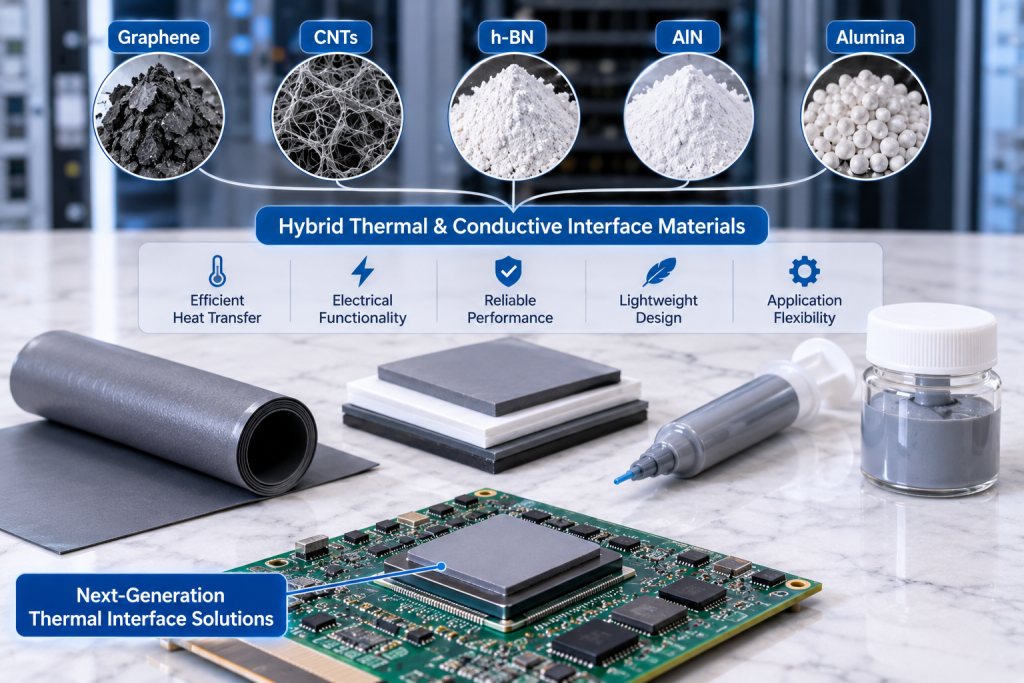
As electronic devices become smaller, more powerful, and more densely integrated, thermal management is becoming an increasingly important engineering challenge.
AI servers, high-performance computing systems, power electronics, electric vehicles, battery systems, and advanced semiconductor packages all generate significant amounts of heat within increasingly limited spaces.
At the same time, modern electronic systems require reliable electrical connections, electromagnetic compatibility, mechanical protection, and long-term operational stability.
Traditional thermal interface materials (TIMs) primarily focus on reducing thermal resistance between two surfaces. However, next-generation electronic applications are creating demand for more multifunctional materials that can combine thermal management with electrical conductivity, electrical insulation, electromagnetic interference (EMI) control, and mechanical adaptability.
This is driving interest in hybrid thermal and conductive interface materials.
By combining different functional fillers, polymer matrices, and engineered interfaces, manufacturers may develop materials with more precisely controlled thermal, electrical, and mechanical properties.
However, designing these materials involves several challenges. High thermal conductivity does not necessarily mean high electrical conductivity, and adding more conductive fillers does not automatically improve overall interface performance.
The future of hybrid interface materials will depend on how effectively manufacturers balance thermal transport, electrical requirements, processability, reliability, and cost.
1. Why Are Traditional Thermal Interface Materials Evolving?
Thermal interface materials are used to fill microscopic gaps and surface irregularities between two components.
Even apparently flat surfaces contain microscopic imperfections. When two solid surfaces are brought together, air gaps can remain between them.
Because air has relatively low thermal conductivity, these gaps create additional thermal resistance.
A TIM fills the gaps and improves heat transfer between the contacting surfaces.
Common TIM categories include:
- Thermal greases
- Gap-filling pads
- Thermal gels
- Phase-change materials
- Electrically insulating thermal adhesives
- Thermally conductive films
- Thermally conductive potting materials
Traditional TIM selection is generally based on several parameters:
- Thermal conductivity
- Thermal resistance
- Bond-line thickness
- Contact pressure
- Viscosity or compressibility
- Electrical insulation requirements
- Operating temperature
- Long-term reliability
However, increasingly complex electronic architectures require materials that perform more than one function.
For example, a material used between electronic components may need to provide thermal transfer while maintaining electrical isolation, resisting vibration, accommodating thermal expansion, and supporting stable contact over many operating cycles.
In other applications, an interface material may need to provide both heat transfer and electrical conduction.
This is where hybrid interface material engineering becomes important.
2. Understanding Hybrid Thermal and Conductive Interface Materials
A hybrid thermal and conductive interface material combines two or more functional material systems to achieve a specific combination of properties.
The term can describe different material architectures depending on the intended application.
For example:
Thermally conductive and electrically insulating materials
These materials transfer heat while preventing unwanted electrical current flow.
Typical applications include power electronics, battery systems, semiconductor modules, and electrical insulation interfaces.
Thermally and electrically conductive materials
These materials provide both heat transfer and electrical conduction.
They may be relevant to selected electronic contacts, conductive thermal interfaces, grounding structures, and specialized functional components.
Thermal and EMI-functional materials
These materials combine heat dissipation with electromagnetic shielding or absorption.
They may be used in high-density electronic assemblies where thermal and electromagnetic problems occur simultaneously.
Thermally conductive and mechanically adaptive materials
These materials are designed to accommodate gaps, surface irregularities, vibration, and thermal expansion while maintaining effective heat transfer.
The central principle is that thermal and electrical performance must be engineered independently before being integrated into a single material system.
3. The Role of Advanced Carbon Materials
Advanced carbon materials, particularly graphene and carbon nanotubes (CNTs), are attracting attention in hybrid interface material development.
Their distinctive structures offer opportunities to engineer thermal and electrical transport pathways.
3.1 Graphene: A Two-Dimensional Thermal and Electrical Filler
Graphene consists of carbon atoms arranged in a two-dimensional hexagonal lattice.
Its high intrinsic in-plane thermal conductivity and electrical conductivity make it attractive for thermal management and conductive composite applications.
Potential roles include:
- Thermal spreading layers
- Thermally conductive polymer composites
- Electrically conductive interface films
- EMI shielding materials
- Flexible thermal management components
- Graphene-enhanced coatings
Graphene’s sheet-like structure can create extended transport pathways within a polymer matrix.
However, the performance of a graphene composite depends on more than the intrinsic properties of individual graphene sheets.
Important factors include:
- Sheet size and thickness
- Defect concentration
- Dispersion quality
- Filler orientation
- Sheet-to-sheet contact
- Polymer compatibility
- Interfacial thermal resistance
Poorly distributed graphene sheets may form agglomerates rather than an effective transport network.
In addition, the thermal conductivity of a finished composite can be substantially lower than the intrinsic in-plane conductivity of graphene.
3.2 Carbon Nanotubes: One-Dimensional Conductive Networks
CNTs have a high aspect ratio and can form interconnected networks within polymer matrices.
Their elongated structure allows them to bridge particles and connect different regions of a composite.
Potential functions include:
- Electrical conductivity enhancement
- Thermal transport network formation
- Conductive interface reinforcement
- EMI shielding
- Flexible conductive structures
In hybrid formulations, CNTs may help connect graphene sheets or other conductive fillers.
This creates opportunities for designing interconnected networks rather than relying on individual particles or sheets.
However, CNT dispersion is a critical challenge.
Excessive aggregation can increase viscosity, reduce processability, and create non-uniform electrical and thermal properties.
3.3 Graphene and CNT Hybrid Systems
Combining graphene and CNTs is an interesting strategy for functional interface materials.
The two structures have different geometries:
- Graphene provides two-dimensional sheet-like pathways.
- CNTs provide one-dimensional bridging connections.
Under suitable conditions, CNTs may connect adjacent graphene sheets, while graphene provides broader in-plane transport pathways.
This structure may improve network connectivity in selected formulations.
However, the actual benefit depends on dispersion, filler ratio, interface quality, orientation, and processing conditions.
A graphene-CNT hybrid system should therefore be compared with individual filler systems under the same formulation and testing conditions.
4. Electrically Insulating Thermal Interface Materials
One of the most important requirements in electronics is the ability to transfer heat without allowing unwanted electrical conduction.
This is particularly relevant to power electronics, semiconductor packages, battery modules, and high-voltage systems.
For these applications, highly electrically conductive carbon materials may not be appropriate as the primary filler.
Instead, manufacturers often investigate electrically insulating but thermally conductive materials.
Common candidates include:
- Hexagonal boron nitride (h-BN)
- Aluminum nitride (AlN)
- Alumina (Al₂O₃)
- Magnesium oxide (MgO)
- Aluminum oxide-based ceramic fillers
- Selected silicon-based ceramic materials
4.1 Hexagonal Boron Nitride
Hexagonal boron nitride is sometimes described as white graphene because of its layered structure.
Unlike graphene, h-BN is electrically insulating.
Its anisotropic thermal properties and layered morphology make it attractive for thermally conductive insulating composites.
Potential applications include:
- Electrically insulating thermal pads
- Thermal interface films
- Semiconductor packaging
- Flexible thermal management layers
- Insulating coatings
4.2 Aluminum Nitride and Alumina
Aluminum nitride offers relatively high thermal conductivity and electrical insulation.
It is used in selected high-performance thermal management materials and electronic substrates.
Alumina is another widely used ceramic filler.
Although its thermal conductivity is generally lower than that of high-performance AlN, its cost, availability, and established industrial use make it attractive for many formulations.
4.3 Why Filler Selection Matters
The ideal filler depends on the application’s electrical requirements, thermal performance targets, mechanical properties, and manufacturing conditions.
For example, a thermally conductive but electrically insulating interface may benefit from h-BN or AlN.
A conductive thermal interface may instead use graphene, CNTs, graphite, or metal-based fillers.
The objective is not to choose the material with the highest intrinsic thermal conductivity.
It is to select a filler system that achieves the required performance in the final composite.
5. Hybrid Filler Engineering: Combining Different Materials
One important direction in next-generation interface materials is hybrid filler engineering.
Instead of relying on a single filler, manufacturers combine materials with different shapes, sizes, and physical properties.
Possible combinations include:
| Hybrid System | Potential Function | Key Consideration |
|---|---|---|
| Graphene + CNTs | Connected thermal and electrical pathways | Dispersion and network formation |
| Graphene + h-BN | Tunable thermal transport with controlled electrical properties | Electrical isolation and filler distribution |
| CNTs + ceramic fillers | Combined conductive and insulating network design | Electrical percolation control |
| AlN + alumina | High-loading insulating thermal composites | Packing density and viscosity |
| Graphite + polymer | Thermal spreading and flexible interfaces | Anisotropy and electrical requirements |
| Graphene + metal particles | Hybrid conductive and thermal structures | Interface resistance and oxidation |
These combinations should not be treated as universally compatible.
For example, adding graphene to an electrically insulating h-BN composite may introduce unwanted electrical pathways if the graphene concentration and distribution cause electrical percolation.
Likewise, combining fillers with different surface chemistries may create dispersion and interface compatibility problems.
Hybrid filler design must therefore consider the complete electrical and thermal architecture.
6. Thermal Conductivity Is Not the Same as Thermal Interface Performance
A common mistake in TIM development is focusing exclusively on bulk thermal conductivity.
A material with high thermal conductivity may still perform poorly as an interface if it cannot establish sufficient contact with the surfaces.
The actual thermal resistance of an interface depends on several factors.
6.1 Bulk Thermal Conductivity
This describes the material’s ability to conduct heat through its own structure.
It is influenced by filler type, filler loading, orientation, network connectivity, and polymer properties.
6.2 Contact Thermal Resistance
Even a highly conductive material may have poor contact with the surfaces if it cannot conform to their microscopic roughness.
This creates additional thermal resistance at the interfaces.
6.3 Bond-Line Thickness
The thickness of the material between two surfaces influences heat transfer.
A simplified relationship is:
[
R_{\mathrm{bulk}}=\frac{t}{kA}
]
Where:
- (R_{\mathrm{bulk}}) is the bulk thermal resistance
- (t) is the material thickness
- (k) is the effective thermal conductivity
- (A) is the contact area
This equation illustrates why both material conductivity and bond-line thickness matter.
A material with higher thermal conductivity may not deliver the expected improvement if the final bond-line thickness increases substantially.
6.4 Compression and Contact Pressure
Thermal pads and gap fillers often depend on compression to establish good contact.
However, excessive pressure may damage sensitive components or cause long-term material deformation.
A suitable interface material must balance compliance, contact pressure, and mechanical stability.
7. The Challenge of Balancing Thermal and Electrical Conductivity
Thermal conductivity and electrical conductivity are related in some materials, but they are not interchangeable properties.
For metallic and many electrically conductive materials, electrons contribute significantly to both electrical and thermal transport.
However, this relationship does not apply universally to composite materials, especially those containing electrically insulating ceramic fillers.
A material can be highly thermally conductive while remaining electrically insulating.
This distinction is central to hybrid interface engineering.
7.1 When Electrical Conductivity Is Required
For selected conductive contacts and functional electronic interfaces, both thermal and electrical transport may be desirable.
Graphene, CNTs, graphite, and metallic fillers can be considered.
The design must address:
- Electrical resistance
- Contact resistance
- Thermal resistance
- Current distribution
- Mechanical stability
- Oxidation and environmental exposure
7.2 When Electrical Insulation Is Required
In power electronics and many semiconductor interfaces, electrical isolation is essential.
Using graphene or CNTs without controlling their concentration and distribution may create unwanted conductive pathways.
In such applications, ceramic fillers such as h-BN, AlN, and alumina may be more appropriate.
7.3 Designing Different Functional Regions
An emerging engineering concept is to use different material compositions in different regions of the same component.
For example:
- A thermally conductive insulating layer near an electrical component
- A conductive heat-spreading layer in a separate region
- A flexible interface layer to accommodate surface irregularities
- An EMI shielding layer positioned to control electromagnetic interference
This approach may offer more precise functionality than attempting to achieve every property through one homogeneous material.
8. Manufacturing Challenges for Hybrid Interface Materials
Even when a hybrid formulation demonstrates attractive laboratory properties, manufacturing remains a major challenge.
The processing method determines whether the intended filler network can be reproduced consistently.
8.1 Filler Dispersion
Graphene and CNTs may agglomerate, while ceramic fillers can settle or distribute unevenly depending on particle size and surface treatment.
Manufacturers need to optimize:
- Mixing sequence
- Shear rate
- Mixing time
- Filler loading
- Dispersants
- Surface treatment
- Temperature
- Storage stability
The objective is to achieve uniform filler distribution without damaging the functional structures.
8.2 High Filler Loading and Viscosity
Increasing filler content can improve thermal conductivity by creating more transport pathways.
However, excessive loading may increase viscosity and reduce processability.
Possible consequences include:
- Poor coating uniformity
- Difficult dispensing
- Reduced flexibility
- Increased processing pressure
- Incomplete gap filling
- Reduced adhesion
The optimal formulation must balance thermal performance with manufacturing requirements.
8.3 Filler Orientation and Anisotropy
Graphene, graphite, and h-BN have anisotropic structures.
Their thermal conductivity can differ significantly depending on direction.
During coating, extrusion, calendaring, or compression molding, fillers may become preferentially oriented.
This can produce different thermal properties in-plane and through-plane.
For example, a graphene film may spread heat effectively along its surface but provide less effective heat transfer through its thickness.
For an interface material, through-plane performance is often particularly important.
Therefore, manufacturers must evaluate thermal conductivity in the direction relevant to the actual application.
8.4 Polymer-Filler Interface Engineering
Heat must transfer from the polymer matrix into the filler network and between adjacent fillers.
Poor interfacial contact can increase thermal resistance.
Surface functionalization and coupling agents may improve compatibility between fillers and polymers.
However, chemical modification may also introduce defects or affect the intrinsic properties of the fillers.
The challenge is to improve interface bonding without compromising the material’s functional performance.
9. Reliability: From Initial Performance to Long-Term Stability
Thermal interface materials operate under changing temperatures, mechanical stresses, and environmental conditions.
Initial thermal conductivity measurements are not sufficient to establish long-term suitability.
Important reliability considerations include:
- Thermal cycling
- High-temperature aging
- Humidity exposure
- Compression set
- Pump-out
- Material migration
- Cracking
- Delamination
- Adhesion degradation
- Electrical insulation breakdown, where applicable
9.1 Thermal Cycling
Repeated heating and cooling can create stress because the interface material, substrate, and adjacent components may have different coefficients of thermal expansion.
This can lead to changes in contact pressure, cracking, or delamination.
9.2 Pump-Out and Material Migration
Some thermal greases and soft interface materials may move away from the contact region during repeated temperature and mechanical cycles.
This can increase thermal resistance over time.
9.3 Electrical Stability
For electrically insulating TIMs, dielectric strength and insulation resistance must remain acceptable under relevant operating conditions.
For electrically conductive interfaces, electrical resistance and contact stability must be evaluated after environmental and mechanical aging.
A reliable material must retain its intended functional properties throughout its service life.
10. Applications Driving the Future of Hybrid Interface Materials
Several industries are creating demand for more advanced interface materials.
10.1 AI Servers and High-Performance Computing
AI accelerators and high-performance processors generate concentrated heat loads.
Thermal interface materials are required between semiconductor packages, heat spreaders, cold plates, and other cooling structures.
Future materials may need to offer:
- Low thermal resistance
- Controlled bond-line thickness
- Long-term contact stability
- Compatibility with liquid cooling systems
- Electrical insulation where required
- Low outgassing and suitable material reliability
Graphene-based films, ceramic-filled TIMs, and hybrid thermal composites may contribute to different parts of these thermal management architectures.
10.2 Power Electronics
Power modules used in electric vehicles, industrial drives, and renewable energy systems require reliable thermal transfer and electrical isolation.
Ceramic-based hybrid TIMs may be especially relevant where dielectric properties are essential.
10.3 Battery Systems
Battery packs and modules require thermal management to control temperature differences and support safe operation.
Potential interface material functions include:
- Heat transfer between cells and cooling plates
- Thermal gap filling
- Electrical insulation
- Mechanical accommodation
- Selected thermal barrier functions
It is important to distinguish between thermal interface materials and thermal runaway propagation barriers. They serve different purposes and require different qualification tests.
10.4 Consumer Electronics
Smartphones, tablets, wearable devices, and compact electronic products have limited internal space.
Thin thermal spreading films and flexible interface materials may help manage local hotspots.
Graphene and graphite-based films are of interest because of their low thickness and in-plane heat-spreading characteristics.
10.5 Semiconductor Packaging
Advanced semiconductor packages create increasingly demanding requirements for heat transfer, mechanical reliability, and electrical isolation.
Hybrid materials may be used in die attach, package-level thermal interfaces, underfill-related structures, and heat-spreading components, depending on their chemistry and qualification.
11. How to Develop and Validate Next-Generation Hybrid Interface Materials
A practical development program should begin with the functional requirements of the target component.
The following workflow can help manufacturers reduce technical and commercialization risks.
Stage 1: Define Application Requirements
Identify:
- Required thermal conductivity
- Required through-plane or in-plane performance
- Electrical conductivity or insulation requirements
- Operating temperature
- Required thickness
- Contact pressure
- Mechanical flexibility
- Environmental exposure
- Expected service life
Stage 2: Select Functional Fillers
Choose suitable fillers according to the application.
Examples include:
- Graphene for conductive and thermal network development
- CNTs for interconnected conductive structures
- h-BN for electrically insulating thermal composites
- AlN for high-performance insulating thermal applications
- Alumina for established ceramic-filled formulations
- Graphite for thermal spreading
Stage 3: Formulation and Dispersion
Evaluate filler ratios, surface treatments, matrix compatibility, viscosity, and dispersion stability.
Compare single-filler and hybrid-filler formulations.
Stage 4: Prototype Manufacturing
Produce samples using the intended processing method.
Possible methods include:
- Mixing and dispersion
- Casting
- Coating
- Extrusion
- Compression molding
- Film formation
- Curing
The process should reflect the intended industrial manufacturing route as closely as possible.
Stage 5: Functional Testing
Evaluate both thermal and electrical properties.
Relevant measurements may include:
- Through-plane thermal conductivity
- In-plane thermal conductivity
- Thermal impedance or interface resistance
- Electrical conductivity
- Volume or surface resistivity
- Dielectric strength
- Adhesion
- Compression behavior
- Viscosity and rheology
Testing methods should be selected according to the intended product geometry and application.
Stage 6: Reliability Validation
Conduct relevant aging and environmental tests.
These may include:
- Thermal cycling
- High-temperature aging
- Humidity testing
- Compression set
- Mechanical fatigue
- Electrical insulation aging
- Contact resistance stability
Stage 7: Pilot-Scale Manufacturing
Once the formulation demonstrates suitable performance, evaluate production repeatability.
Important indicators include:
- Batch consistency
- Filler distribution
- Thickness uniformity
- Manufacturing yield
- Processing time
- Material consumption
- Cost per component
The final objective is to establish a material that performs reliably and can be manufactured at a commercially acceptable cost.
12. Future Trends in Hybrid Thermal and Conductive Interface Materials
Several development directions are likely to influence the next generation of interface materials.
12.1 Multifunctional Composite Systems
Future materials may combine thermal management, electrical functionality, EMI shielding, mechanical compliance, and environmental protection.
However, these functions will increasingly be designed as application-specific combinations rather than as a universal material specification.
12.2 Three-Dimensional Conductive Networks
Instead of relying on randomly distributed fillers, manufacturers may develop more controlled three-dimensional structures.
These networks could improve filler connectivity and reduce the amount of material required to achieve specific transport properties.
12.3 Oriented Filler Architectures
Controlling the orientation of graphene, graphite, h-BN, and other anisotropic fillers may allow manufacturers to engineer different thermal properties in different directions.
This is particularly relevant for applications requiring high in-plane heat spreading or through-plane heat transfer.
12.4 Interface and Surface Engineering
Future improvements may come not only from selecting better fillers but also from improving the interfaces between fillers and polymer matrices.
Surface modification, coupling chemistry, and controlled interfacial structures may help reduce thermal resistance and improve mechanical stability.
12.5 Application-Specific Material Platforms
Rather than developing one universal high-performance TIM, suppliers may develop different material platforms for:
- Electrically insulating thermal interfaces
- Electrically conductive thermal contacts
- Flexible heat-spreading films
- High-compression gap fillers
- EMI-functional thermal composites
- High-temperature electronic interfaces
This approach allows material properties to be matched more closely to the actual engineering requirements.
The future of thermal interface materials will be shaped by the growing need for more integrated thermal, electrical, and mechanical functionality.
Graphene, CNTs, h-BN, AlN, alumina, graphite, and other advanced fillers offer different opportunities for designing hybrid composite systems.
However, no single filler can solve every interface challenge.
The key is to understand the relationship between thermal transport, electrical requirements, filler connectivity, interface resistance, processability, and long-term reliability.
For some applications, the priority will be combining thermal conductivity with electrical insulation. For others, simultaneous electrical and thermal conduction or EMI shielding may be required.
The most successful hybrid interface materials will therefore be developed through application-specific engineering, controlled formulation, pilot-scale processing, and comprehensive validation.
Ultimately, the future of hybrid thermal and conductive interface materials is not simply about achieving higher conductivity. It is about creating reliable, manufacturable, and multifunctional interfaces that meet the increasingly complex requirements of modern electronics.
Frequently Asked Questions
1. What are hybrid thermal interface materials?
They are composite materials designed to combine thermal management with additional functions, such as electrical conductivity, electrical insulation, EMI shielding, or mechanical compliance.
2. Can graphene improve thermal interface materials?
Graphene may help develop thermal transport networks in suitable composites. Its effectiveness depends on dispersion, filler orientation, interface quality, loading, and the thermal conductivity of the final material.
3. Are graphene-based TIMs electrically conductive?
Many graphene-based formulations are electrically conductive or can become conductive above certain filler concentrations. This is not always desirable. Electrically insulating applications may require ceramic fillers such as h-BN, AlN, or alumina.
4. What is the difference between thermal conductivity and thermal resistance?
Thermal conductivity describes a material’s ability to conduct heat. Thermal resistance describes how strongly a complete material layer or interface opposes heat transfer. Thickness, contact area, and surface contact conditions all influence thermal resistance.
5. Why combine graphene and CNTs in thermal composites?
Their different geometries may help create interconnected transport networks. Graphene provides sheet-like pathways, while CNTs can bridge adjacent sheets or particles. The actual improvement must be confirmed through formulation and testing.
6. What materials are suitable for electrically insulating thermal composites?
Common candidates include h-BN, AlN, and alumina. The appropriate choice depends on thermal performance, dielectric requirements, mechanical properties, processing conditions, and cost.
7. What are the main challenges in developing hybrid TIMs?
Key challenges include filler dispersion, high-loading viscosity, anisotropic thermal transport, interfacial resistance, electrical property control, manufacturing consistency, and long-term reliability.
8. How should manufacturers validate a new hybrid thermal interface material?
They should evaluate thermal conductivity in relevant directions, interface thermal resistance, electrical properties, mechanical behavior, processability, and environmental reliability using application-representative test conditions.