
From Concept to Manufacturable Material Systems: Bridging Material Innovation and Industrial Production
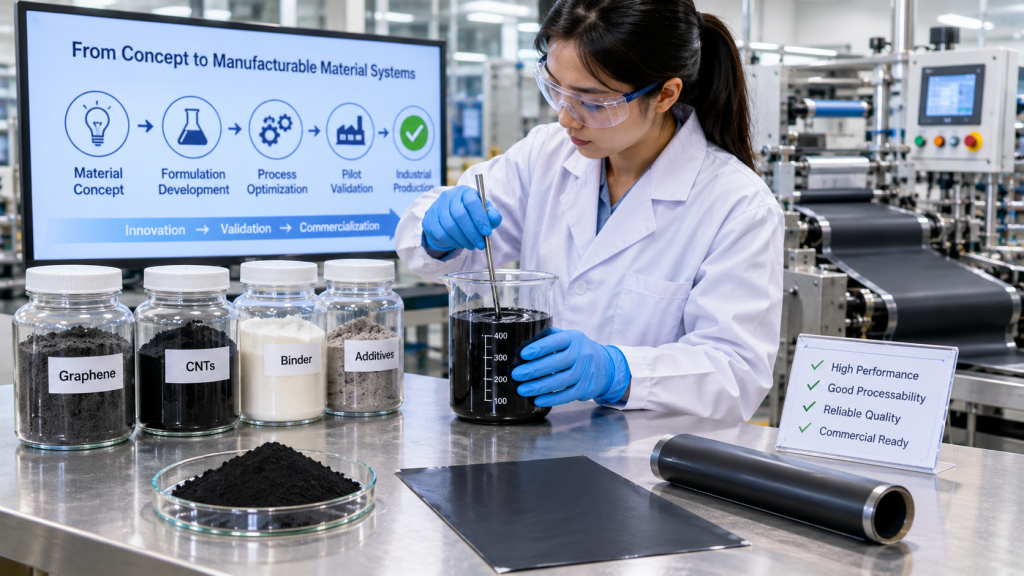
The development of advanced materials often begins with a promising scientific concept. Researchers identify a new material structure, discover an improved property, or develop a formulation that demonstrates potential in a specific application.
However, transforming a promising material concept into a commercially manufacturable product requires much more than proving that the material works.
A material may exhibit excellent electrical conductivity, thermal performance, mechanical strength, or chemical stability in laboratory testing. Yet its industrial value depends on whether it can be consistently produced, processed, integrated into components, and delivered at an acceptable cost.
This is where the concept of a manufacturable material system becomes important.
A manufacturable material system is not simply a material with defined specifications. It is an integrated combination of raw materials, formulation, processing methods, equipment, quality controls, and application requirements that can operate consistently within a manufacturing environment.
For graphene, carbon nanotubes (CNTs), battery materials, functional coatings, thermal composites, and other advanced material technologies, this system-level approach is essential.
This article explores how companies can move from material concepts to manufacturable material systems, the challenges involved in each development stage, and why coordinated validation is critical for industrial commercialization.
1. Why a Promising Material Is Not Yet a Manufacturable Product
Material innovation and manufacturing readiness represent two different stages of development.
In laboratory research, the primary objective is often to demonstrate a specific property or technical improvement.
For example:
- Graphene may demonstrate high electrical or thermal conductivity.
- Carbon nanotubes may improve conductive network formation.
- A new battery additive may improve electrode performance.
- A functional coating may demonstrate corrosion resistance.
- A ceramic-filled polymer may improve thermal conductivity while maintaining electrical insulation.
These results provide a technical foundation, but they do not automatically establish manufacturing feasibility.
Industrial production introduces additional requirements:
- Raw material availability and consistency
- Formulation stability
- Process compatibility
- Equipment suitability
- Production yield
- Batch repeatability
- Quality control
- Product cost
- Packaging and storage
- Customer qualification
A material that performs well under carefully controlled laboratory conditions may behave differently when processed in larger quantities or integrated into an industrial product.
For example, a graphene dispersion may remain stable in a small laboratory container but become difficult to process after scaling up the mixing volume. A CNT formulation may demonstrate good electrical conductivity but create excessive viscosity during electrode slurry preparation.
The challenge is therefore not simply to reproduce a laboratory result. It is to build a complete system that can repeatedly deliver the required performance under practical manufacturing conditions.
2. Understanding the Structure of a Manufacturable Material System
A manufacturable material system connects several development layers.
These layers are interdependent. A change in raw material properties may affect formulation behavior, while a change in processing conditions may influence the final product’s performance.
A typical development structure includes:
Raw Materials → Formulation → Process → Equipment → Component → Quality Control → Application Validation
Each stage has a specific role.
2.1 Raw Material Selection
The first step is defining the raw materials required for the intended application.
For advanced materials, this may involve graphene, GO, rGO, CNTs, conductive carbon, ceramic fillers, polymers, binders, solvents, or surface modifiers.
Important parameters include:
- Purity
- Particle size and morphology
- Layer number and lateral dimensions
- Surface chemistry
- Moisture content
- Bulk density
- Electrical properties
- Thermal properties
- Batch consistency
Raw material selection should be application-driven.
A material with excellent intrinsic properties may not be suitable if its particle size, surface chemistry, dispersion behavior, or supply consistency is incompatible with the downstream manufacturing process.
2.2 Formulation Development
Raw materials rarely function independently in complex industrial applications.
They are usually incorporated into a formulation containing binders, solvents, dispersants, fillers, stabilizers, or other functional ingredients.
The formulation determines how different materials interact and how they behave during processing.
For example, a CNT-based battery electrode slurry must balance conductive network formation with viscosity, dispersion stability, coating behavior, and drying performance.
A graphene-based thermal composite must balance filler loading, dispersion, polymer compatibility, thermal conductivity, mechanical properties, and electrical insulation requirements where applicable.
The objective is to develop a formulation that provides the required application performance while remaining compatible with manufacturing processes.
2.3 Process Development
A formulation is only useful if it can be processed consistently.
Depending on the material system, manufacturing processes may include:
- Mixing and dispersion
- Milling and homogenization
- Filtration and separation
- Drying and powder processing
- Extrusion and compounding
- Coating and curing
- Lamination
- Molding
- CNC machining
- Surface treatment
Each process introduces variables that may affect the final product.
Process development must therefore identify the appropriate operating conditions and establish a practical process window.
2.4 Equipment Compatibility
A laboratory process cannot always be transferred directly to industrial equipment.
Mixing geometry, shear distribution, heating and cooling capacity, residence time, material feeding, and production speed can all influence the outcome.
Equipment selection should be based on the actual material and process requirements rather than simply choosing the largest available machine.
A manufacturable system must work with equipment that can reliably reproduce the required process conditions.
2.5 Quality Control and Application Validation
The final system must have measurable acceptance criteria.
These may include:
- Material specifications
- Formulation parameters
- Process tolerances
- Product dimensions
- Electrical or thermal performance
- Mechanical properties
- Adhesion
- Environmental durability
- Batch consistency
Quality control should connect raw material inspection with final product performance.
Application validation then determines whether the manufactured material or component meets the requirements of the intended customer or system.
3. The Transition from Material Properties to Application Performance
One of the most common mistakes in advanced material development is focusing too heavily on intrinsic material properties.
A high-performance raw material does not necessarily produce a high-performance industrial component.
The final result depends on how the material is formulated, processed, and integrated into the application.
3.1 Electrical Conductivity
Graphene and CNTs are often selected for their electrical conductivity and conductive network characteristics.
However, the conductivity of a raw material does not directly determine the conductivity of a finished coating, composite, or electrode.
Important factors include:
- Filler loading
- Dispersion quality
- Particle contact
- Network connectivity
- Binder distribution
- Coating thickness
- Drying conditions
- Mechanical compression
For example, a CNT-based electrode formulation may require a carefully controlled dispersion process to establish effective conductive pathways between active material particles.
3.2 Thermal Conductivity
Thermal composites containing graphene, graphite, CNTs, or ceramic fillers may be designed for battery systems, power electronics, and data center thermal management.
However, thermal performance depends on more than the conductivity of the filler.
Other important variables include:
- Filler orientation
- Filler concentration
- Interface resistance
- Polymer matrix properties
- Bond-line thickness
- Contact pressure
- Through-plane versus in-plane heat transfer
A composite with excellent in-plane thermal conductivity may still have limited through-plane performance.
The final material must therefore be evaluated according to the actual direction and conditions of heat transfer in the target application.
3.3 Corrosion Resistance
A functional coating may demonstrate good corrosion resistance in an initial laboratory test.
However, industrial durability also depends on substrate preparation, coating thickness, adhesion, curing conditions, surface defects, and environmental exposure.
A coating formulation that performs well on one metal substrate may not produce the same results on another.
Application-specific testing is necessary before making broader performance claims.
3.4 Mechanical Performance
In polymer composites and functional films, mechanical properties are affected by filler dispersion, interfacial bonding, matrix composition, and processing conditions.
Increasing filler loading may improve certain functional properties while reducing flexibility, elongation, or impact resistance.
The formulation must therefore balance multiple performance requirements rather than optimizing one property in isolation.
4. Formulation Stability: A Critical Requirement for Manufacturing
A material system must remain stable not only during laboratory testing but also throughout manufacturing, storage, transportation, and application.
Formulation instability can lead to inconsistent product quality and production interruptions.
Common challenges include:
Agglomeration
Nanomaterials such as graphene and CNTs can form aggregates due to strong interparticle interactions.
Poor dispersion may create local defects and inconsistent electrical, thermal, or mechanical performance.
Sedimentation
Differences in particle size, density, and liquid-phase properties may cause solid particles to settle during storage.
This can create concentration gradients and inconsistent material application.
Viscosity Changes
Changes in temperature, storage time, solids concentration, or material interactions can influence viscosity.
This may affect pumping, coating, dispensing, and other processing operations.
Chemical Compatibility
Binders, solvents, dispersants, fillers, and additives must be compatible with one another.
Unwanted reactions or interactions may affect stability and final performance.
Storage and Shelf Life
A formulation that performs well immediately after preparation may not maintain the same properties after several weeks or months.
Storage conditions and shelf-life requirements should therefore be established through relevant testing.
A manufacturable material system needs defined preparation procedures, storage conditions, handling requirements, and acceptance criteria.
5. Process Development: Establishing a Repeatable Manufacturing Window
Process development is the stage where material performance begins to translate into manufacturing capability.
The objective is to determine which process parameters control the final product and how much variation can be tolerated.
5.1 Identifying Critical Process Parameters
Depending on the application, critical parameters may include:
- Mixing speed and duration
- Temperature
- Pressure
- Shear conditions
- Material addition sequence
- Solids content
- Residence time
- Coating speed
- Coating thickness
- Drying temperature
- Curing conditions
- Cooling rate
These variables should be recorded and evaluated systematically.
5.2 Understanding Process Interactions
Manufacturing parameters rarely operate independently.
For example, increasing mixing speed may improve dispersion initially but also increase temperature and processing energy.
Increasing solids content may reduce solvent consumption but make pumping and coating more difficult.
Increasing coating speed may improve production efficiency but introduce challenges related to wet-film stability and drying capacity.
Process optimization should therefore consider interactions between variables.
5.3 Establishing the Process Window
A process window defines the acceptable range of operating conditions within which product quality remains within specification.
For example, a coating process may require a controlled combination of:
- Slurry viscosity
- Solids content
- Coating speed
- Wet-film thickness
- Drying temperature
The objective is not to identify one ideal operating point that works only under perfect conditions.
It is to establish a practical range that supports stable production despite normal equipment and material variation.
6. Pilot-Scale Validation: Connecting Development with Manufacturing
Pilot-scale validation is essential when a material system moves beyond laboratory development.
Pilot lines allow developers to evaluate whether formulations and processes remain effective under larger production volumes and more realistic equipment conditions.
A structured validation program can include several stages.
Stage 1: Laboratory Screening
Evaluate raw materials, formulation options, and initial application performance.
The objective is to identify promising combinations and eliminate unsuitable candidates.
Stage 2: Formulation Optimization
Adjust material ratios, dispersion methods, binder systems, and other formulation variables.
The goal is to establish a stable formulation with acceptable performance and processability.
Stage 3: Process Feasibility
Evaluate whether the selected formulation can be handled by the intended equipment.
Identify limitations involving mixing, coating, extrusion, drying, curing, or other relevant operations.
Stage 4: Pilot Production
Produce larger quantities under controlled but manufacturing-relevant conditions.
Record equipment parameters, processing conditions, material consumption, and production yield.
Stage 5: Product Characterization
Evaluate the physical, chemical, electrical, thermal, and mechanical properties relevant to the application.
Stage 6: Repeatability Testing
Repeat the process across multiple batches to understand variation and determine whether quality can be maintained.
Stage 7: Industrial Transfer Assessment
Evaluate whether the process can be transferred to commercial manufacturing equipment and whether further optimization is necessary.
Pilot validation should generate both physical samples and useful manufacturing data.
7. Manufacturing Consistency and Quality Control
A manufacturable material system must deliver consistent results across production batches.
This is especially important for advanced materials, where small differences in raw material properties or processing conditions may influence final performance.
7.1 Raw Material Quality Control
Suppliers should provide clear specifications and relevant batch information.
Depending on the material, inspection may include:
- Chemical composition
- Purity
- Particle size
- Moisture content
- Surface chemistry
- Morphology
- Thermal properties
- Electrical properties
7.2 In-Process Quality Control
Manufacturing quality should not be evaluated only at the end of production.
Intermediate controls may include:
- Dispersion quality
- Viscosity
- Solids content
- Temperature
- Pressure
- Coating thickness
- Process speed
- Moisture or solvent content
These measurements help identify deviations before they affect the final product.
7.3 Final Product Inspection
Finished products should be tested against application-specific acceptance criteria.
A suitable quality plan may include dimensional inspection, conductivity, thermal performance, adhesion, mechanical strength, environmental resistance, and other relevant measurements.
7.4 Traceability and Documentation
Each production batch should be linked to relevant raw material lots, process parameters, testing results, and product records.
Traceability helps manufacturers investigate deviations and improve process consistency.
A complete material system should therefore include not only a formulation and process but also the documentation needed to reproduce and verify the product.
8. Cost and Supply Chain: The Commercial Side of Manufacturability
Technical performance alone cannot establish commercial viability.
A material system must also be economically sustainable.
8.1 Raw Material Cost
Advanced materials may involve relatively high production costs, complex purification, specialized processing, or limited supplier availability.
Developers should evaluate the amount of functional material required to achieve the target performance.
A higher-cost material may still be commercially attractive if it enables reduced material loading, improved product durability, or a meaningful improvement in system performance.
8.2 Manufacturing Yield
Material losses during mixing, filtration, coating, drying, machining, and packaging can influence the total production cost.
Pilot trials help identify where losses occur and whether process improvements can increase yield.
8.3 Equipment Investment
A formulation that requires highly specialized equipment may create barriers to commercialization.
Manufacturers should evaluate whether existing equipment can be adapted or whether new machinery is necessary.
The cost of equipment modification, operation, maintenance, and cleaning should be included in the development assessment.
8.4 Supply Chain Reliability
A manufacturable material system also requires a reliable supply of raw materials and production components.
Important considerations include:
- Supplier qualification
- Alternative sourcing
- Lead times
- Batch consistency
- Packaging
- Transportation requirements
- Storage stability
- Long-term supply agreements
Commercial readiness requires a realistic understanding of the complete supply chain, not just the laboratory availability of a material.
9. Intellectual Property and Technical Collaboration
Developing a manufacturable material system often requires collaboration between multiple organizations.
A project may involve:
- Material producers
- Formulation specialists
- Research institutions
- Pilot manufacturing facilities
- Equipment suppliers
- Testing laboratories
- Component manufacturers
- End customers
Each participant may contribute different technical knowledge.
However, collaboration also introduces questions regarding intellectual property, data ownership, confidentiality, and commercial responsibilities.
9.1 Define the Project Scope
Before detailed development begins, the parties should establish:
- Technical objectives
- Material specifications
- Required sample quantities
- Process development responsibilities
- Testing requirements
- Deliverables
- Project milestones
- Commercial terms
9.2 Protect Background and Foreground IP
Background intellectual property refers to technology and know-how that a party already owns before the project.
Foreground intellectual property refers to new inventions, formulations, processes, or technical knowledge developed during the project.
The ownership and permitted use of these assets should be clearly addressed in project agreements.
9.3 Define Technical Responsibilities
Material suppliers may be responsible for raw material specifications, while pilot facilities may handle processing and sample preparation.
Testing laboratories may conduct independent characterization, and the customer may define application acceptance criteria.
Clear responsibility allocation helps prevent technical misunderstandings and uncontrolled development work.
10. Industry Examples: Turning Material Concepts into Manufacturable Systems
The same system-level development principles apply across different industries, although the specific requirements vary.
10.1 Graphene-Based Thermal Composites
A graphene-based thermal composite may begin with the concept of improving heat transfer in electronic or energy storage applications.
The development process may involve:
- Selecting graphene or graphite materials
- Evaluating particle morphology and thermal characteristics
- Developing a polymer-based formulation
- Optimizing filler loading and dispersion
- Controlling filler orientation
- Producing composite samples
- Measuring in-plane and through-plane thermal performance
- Evaluating mechanical properties and aging
- Validating the material in the target component
The final product is not simply graphene powder. It is a composite system with defined composition, processing conditions, thermal performance, mechanical characteristics, and quality standards.
10.2 CNT-Based Battery Electrode Slurries
CNTs may be introduced into battery electrode formulations to improve conductive network formation.
However, successful development requires:
- CNT grade selection
- Dispersion optimization
- Binder compatibility
- Slurry rheology control
- Electrode coating
- Drying
- Calendering
- Electrical and electrochemical testing
- Batch repeatability assessment
The manufacturable system is the complete electrode formulation and production process, not the CNT additive alone.
10.3 Graphene-Enhanced Protective Coatings
A graphene-enhanced coating may be developed to improve corrosion resistance or other functional properties.
Its development requires attention to:
- Substrate preparation
- Graphene dispersion
- Resin compatibility
- Coating thickness
- Application method
- Curing conditions
- Adhesion
- Environmental durability
- Production consistency
A coating that performs well on a laboratory coupon must still be validated under the actual substrate, preparation, and operating conditions of the target application.
10.4 Electrically Insulating Thermal Interface Materials
A thermal interface composite for battery systems or power electronics may combine a polymer matrix with ceramic fillers such as aluminum oxide, aluminum nitride, or boron nitride.
Development requires balancing:
- Thermal conductivity
- Electrical insulation
- Filler loading
- Viscosity
- Compression behavior
- Bond-line thickness
- Mechanical stability
- Long-term reliability
The final system must meet both thermal and electrical requirements in its assembled configuration.
11. Common Reasons Material Systems Fail to Become Manufacturable
Several recurring mistakes can prevent successful industrialization.
Focusing only on raw material specifications
A high-purity or high-performance material may still be incompatible with the target manufacturing process.
Optimizing one performance metric
Improving thermal conductivity or electrical conductivity may negatively affect viscosity, flexibility, adhesion, or electrical insulation.
Ignoring equipment limitations
A formulation developed using specialized laboratory equipment may not be compatible with available industrial machinery.
Skipping pilot-scale validation
Moving directly from laboratory samples to commercial production can leave important process and repeatability risks unidentified.
Using a single successful batch as proof of readiness
Manufacturing readiness requires evidence across repeated production runs.
Underestimating cost and supply chain requirements
A technically successful formulation may be commercially impractical if it requires expensive raw materials, low-yield processes, or unreliable sourcing.
Failing to define customer acceptance criteria
Without clear application requirements, development teams may optimize properties that do not determine actual customer value.
12. Building a More Effective Development Framework
Companies developing advanced material systems can improve commercialization efficiency by integrating technical and manufacturing considerations from the beginning.
A practical framework includes the following steps.
Step 1: Start with the Application
Define the target component, operating environment, performance requirements, and customer expectations.
Step 2: Translate Requirements into Material Specifications
Identify the necessary thermal, electrical, mechanical, chemical, and processing properties.
Step 3: Select Suitable Raw Materials
Evaluate material characteristics, supplier consistency, availability, and cost.
Step 4: Develop the Formulation
Optimize material combinations, dispersion, binder systems, and processability.
Step 5: Establish the Manufacturing Process
Identify suitable equipment, critical process parameters, and acceptable operating ranges.
Step 6: Conduct Pilot Validation
Produce representative samples under manufacturing-relevant conditions.
Step 7: Establish Quality and Repeatability
Define testing methods, acceptance criteria, traceability, and batch consistency requirements.
Step 8: Evaluate Commercial Readiness
Assess yield, production cost, supply chain reliability, customer qualification, and manufacturing transfer requirements.
This approach reduces the risk of developing materials that perform well in isolated laboratory tests but cannot be integrated into practical production.
13. The Future: Material Systems Engineering as a Competitive Advantage
As advanced materials become increasingly specialized, the competitive advantage of material developers will depend on more than the ability to produce new substances.
Companies will need to demonstrate that their materials can be formulated, processed, manufactured, and qualified for specific applications.
Several trends are likely to accelerate this shift.
13.1 Application-Driven Material Development
Material developers will increasingly begin with a defined industrial problem and work backward toward the required material properties.
This helps prevent unnecessary optimization of properties that do not contribute to customer value.
13.2 Integration of Material and Process Design
Material composition and manufacturing processes will be developed together rather than treated as separate activities.
This is particularly important for nanomaterials, composite systems, advanced coatings, and battery formulations.
13.3 Greater Use of Pilot Validation Networks
Companies may increasingly rely on specialized external resources for formulation, testing, pilot production, and manufacturing transfer.
This can reduce the need for every material developer to own all equipment and technical capabilities internally.
13.4 Data-Driven Manufacturing Development
Process monitoring, standardized testing, and batch-level data collection will help improve repeatability and identify process deviations.
The ability to connect material specifications with manufacturing data will become increasingly valuable.
13.5 More Emphasis on Total Cost and Lifecycle Performance
Industrial customers will increasingly evaluate materials according to their contribution to system performance, production efficiency, reliability, and lifecycle cost.
A material with superior laboratory properties may not be the best commercial choice if it increases manufacturing complexity or reduces product durability.
The transition from concept to manufacturable material systems is one of the most important challenges in advanced material commercialization.
A promising material property is only the starting point. Industrial adoption requires coordinated development of raw materials, formulation, processing, equipment, quality control, and application validation.
Graphene, CNTs, battery materials, functional coatings, and thermal composites all demonstrate why this system-level approach matters.
Their industrial value depends not only on what the materials can achieve in a laboratory, but also on whether they can be manufactured consistently, integrated into real products, and supplied at commercially viable costs.
Pilot-scale validation plays a critical role in this process by connecting laboratory development with manufacturing reality.
Ultimately, the goal of material innovation should not be limited to developing a better material. It should be to create a complete material system that can be reliably manufactured, repeatedly validated, and successfully adopted by industry.
Questions
1. What is a manufacturable material system?
A manufacturable material system is an integrated combination of raw materials, formulation, processing methods, equipment, quality controls, and application requirements that can consistently produce a product suitable for industrial use.
2. Why is a high-performance material not automatically suitable for manufacturing?
A material may have excellent intrinsic properties but still present challenges involving dispersion, viscosity, processing compatibility, equipment limitations, production yield, cost, or batch consistency.
3. What is the difference between material development and material system development?
Material development focuses primarily on creating or improving a material. Material system development goes further by integrating the material into a formulation, manufacturing process, quality system, and application-specific product.
4. Why is pilot-scale validation important?
Pilot validation helps determine whether laboratory formulations and processes can operate under larger and more realistic manufacturing conditions. It also generates data on process stability, yield, repeatability, and product quality.
5. Which materials benefit most from a system-level development approach?
Graphene, CNTs, battery materials, functional coatings, polymer composites, thermal interface materials, and other advanced materials often require coordinated formulation and processing development before industrial adoption.
6. How can manufacturers improve material system repeatability?
They can improve repeatability by controlling raw material specifications, standardizing formulation procedures, defining critical process parameters, implementing in-process inspection, and comparing multiple production batches.
7. Can external pilot facilities support material system development?
Yes. Specialized pilot facilities, research institutions, testing laboratories, and contract manufacturing partners can provide equipment and expertise for formulation, process development, sample production, and validation.
8. What determines whether a material system is commercially ready?
Commercial readiness depends on technical performance, manufacturing repeatability, production yield, quality control, supply chain reliability, application qualification, and acceptable total production cost.