
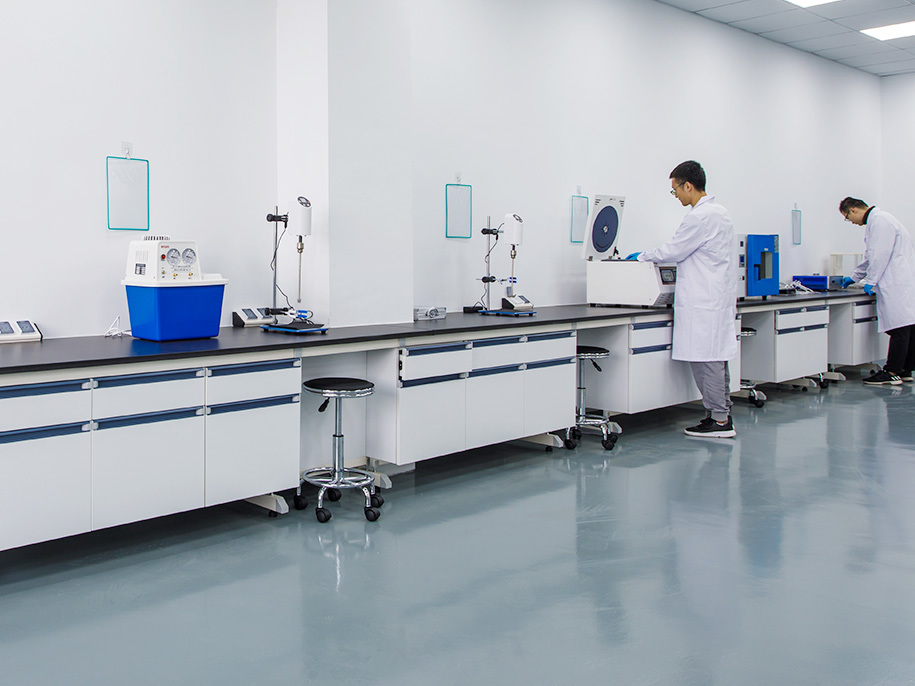
Binder-Free Electrode Concepts and Industrial Reality
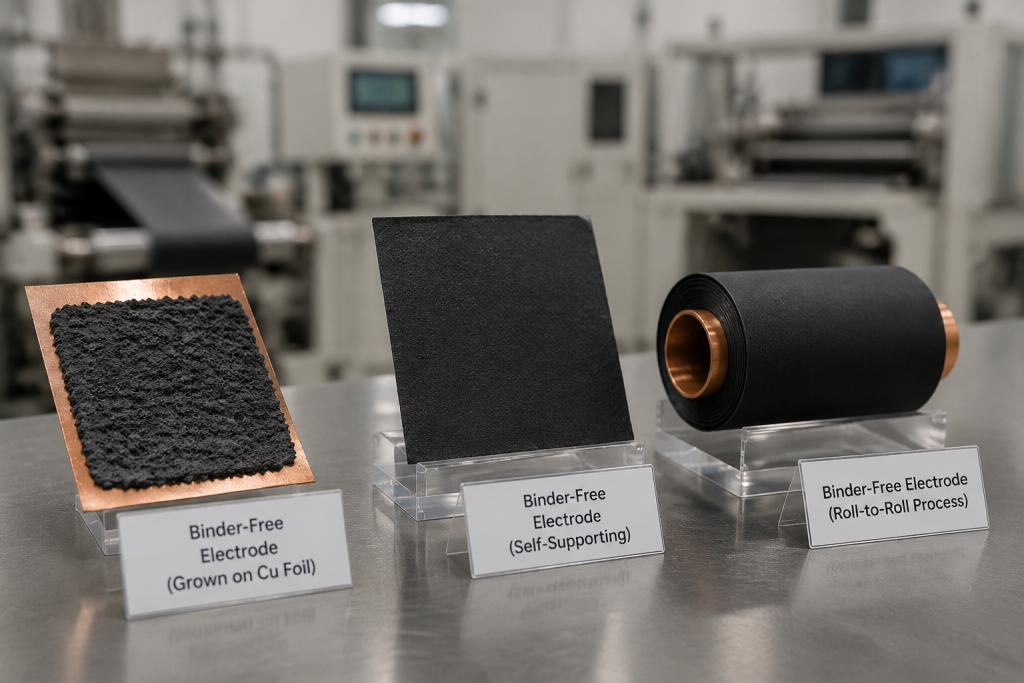
Battery manufacturers are continuously exploring new ways to improve energy density, simplify production, and reduce manufacturing costs.
One concept receiving increasing attention is the binder-free electrode.
Conventional lithium-ion battery electrodes typically contain active materials, conductive additives, and polymer binders. While binders provide mechanical integrity, they also occupy volume and add inactive weight to the electrode.
Binder-free electrode concepts aim to reduce or eliminate these inactive components, creating electrodes with higher active material content and potentially improved electrochemical performance.
Although the concept is attractive, translating binder-free electrodes from laboratory research into industrial manufacturing remains a significant challenge.
What Is a Binder-Free Electrode?
In traditional electrode manufacturing, polymer binders hold active material particles together and ensure strong adhesion to the current collector.
A binder-free electrode seeks to maintain structural integrity without relying on these conventional polymer systems.
Different approaches include:
- Self-supporting electrode structures
- Interconnected conductive carbon networks
- Carbon nanotube (CNT) frameworks
- Graphene-based conductive architectures
- Directly grown active materials on current collectors
Each approach aims to improve electrical pathways while reducing inactive material content.
Why Binder-Free Designs Are Attractive
Removing or reducing binder content offers several potential advantages.
Higher Energy Density
Replacing inactive binder with active material may increase the amount of energy stored within the same electrode volume.
Improved Electrical Conductivity
Continuous conductive networks can reduce internal resistance and improve electron transport.
Faster Ion Transport
Optimized electrode structures may shorten ion diffusion pathways, supporting higher charging and discharging rates.
Simplified Material Systems
Some binder-free concepts reduce formulation complexity and enable more direct integration of functional materials.
The Role of Advanced Carbon Materials
Advanced carbon materials play a central role in many binder-free electrode designs.
Carbon Nanotubes (CNTs)
CNTs can form highly interconnected conductive networks that provide both electrical conductivity and mechanical reinforcement.
Because of their high aspect ratio, CNTs are widely studied as structural components in binder-free electrodes.
Graphene
Graphene offers:
- High electrical conductivity
- Mechanical strength
- Large surface area
It can reinforce electrode structures while supporting efficient electron transport.
Hybrid Carbon Networks
Many researchers combine CNTs, graphene, and conductive carbon to balance conductivity, strength, and processability.
These hybrid architectures are increasingly explored for next-generation battery systems.
Challenges in Industrial Manufacturing
Despite promising laboratory results, binder-free electrodes face several manufacturing challenges.
Mechanical Stability
Without conventional binders, maintaining electrode integrity during handling and cycling becomes more difficult.
Cracking, particle loss, or delamination may occur if the structure is not sufficiently robust.
Adhesion to Current Collectors
Strong bonding between the electrode and the current collector is essential for reliable battery performance.
Achieving this consistently without polymer binders remains challenging.
Process Repeatability
Industrial production requires stable, repeatable manufacturing processes.
Binder-free architectures often demand tighter control of:
- Material distribution
- Compression pressure
- Electrode density
- Surface uniformity
Small process variations can significantly influence final performance.
Equipment Compatibility
Many existing production lines are designed for slurry-based electrode manufacturing.
Some binder-free concepts may require:
- New processing equipment
- Modified lamination systems
- Alternative handling methods
These changes can increase implementation complexity.
The Importance of Pilot Manufacturing
Pilot-scale validation is essential before binder-free electrodes can move toward commercial production.
Pilot manufacturing helps engineers evaluate:
- Continuous process stability
- Electrode integrity during production
- Mechanical handling performance
- Batch-to-batch consistency
- Manufacturing yield
Many issues become apparent only during extended pilot production rather than short laboratory experiments.
Quality Control Considerations
Reliable manufacturing depends on comprehensive quality control.
Typical evaluation methods include:
- Thickness measurement
- Density analysis
- Adhesion testing
- Electrical resistance measurement
- Surface inspection
- Mechanical durability testing
These measurements help ensure that binder-free electrodes meet industrial performance requirements.
Potential Applications
Binder-free electrodes are being investigated for a variety of energy storage technologies, including:
- High-energy lithium-ion batteries
- Silicon-rich anodes
- Lithium metal batteries
- Solid-state battery systems
- Fast-charging battery designs
As battery technology advances, binder-free concepts may become increasingly important in specialized applications.
Balancing Innovation and Manufacturability
One of the key questions facing the industry is not whether binder-free electrodes can improve battery performance, but whether they can be manufactured economically and consistently.
Successful commercialization requires balancing:
- Electrochemical performance
- Manufacturing efficiency
- Production cost
- Process robustness
- Product reliability
Pilot-scale development plays a crucial role in finding this balance.
Future Outlook
Research into binder-free electrodes continues to accelerate.
Future development is expected to focus on:
Advanced Carbon Frameworks
Improving structural stability and conductivity.
Dry Electrode Manufacturing
Combining binder-free concepts with solvent-free production technologies.
Intelligent Process Control
Using digital monitoring to improve manufacturing consistency.
Pilot Manufacturing Expansion
Accelerating the transition from laboratory research to commercial production.
As these technologies mature, binder-free electrodes may become an important part of next-generation battery manufacturing.
Binder-free electrode concepts offer exciting opportunities to increase energy density, improve electrical performance, and simplify certain aspects of battery design.
However, laboratory success alone is not enough to guarantee industrial adoption.
Manufacturing challenges—including mechanical stability, adhesion, process consistency, and equipment compatibility—must be addressed through careful engineering and pilot-scale validation.
For companies developing next-generation battery materials, the path to commercialization depends not only on innovative electrode concepts but also on building reliable, scalable manufacturing processes that can deliver consistent quality at industrial scale.