
CNT in Thermal Interface Materials (TIMs)
As power densities increase in AI servers, EV batteries, and high-performance electronics, efficient heat dissipation becomes a critical design challenge. Thermal Interface Materials (TIMs) are essential for transferring heat between components and heat sinks.
Carbon nanotubes (CNTs) are increasingly used in TIMs due to their exceptional thermal conductivity, network-forming ability, and mechanical compliance, making them a powerful additive for next-generation thermal management solutions.
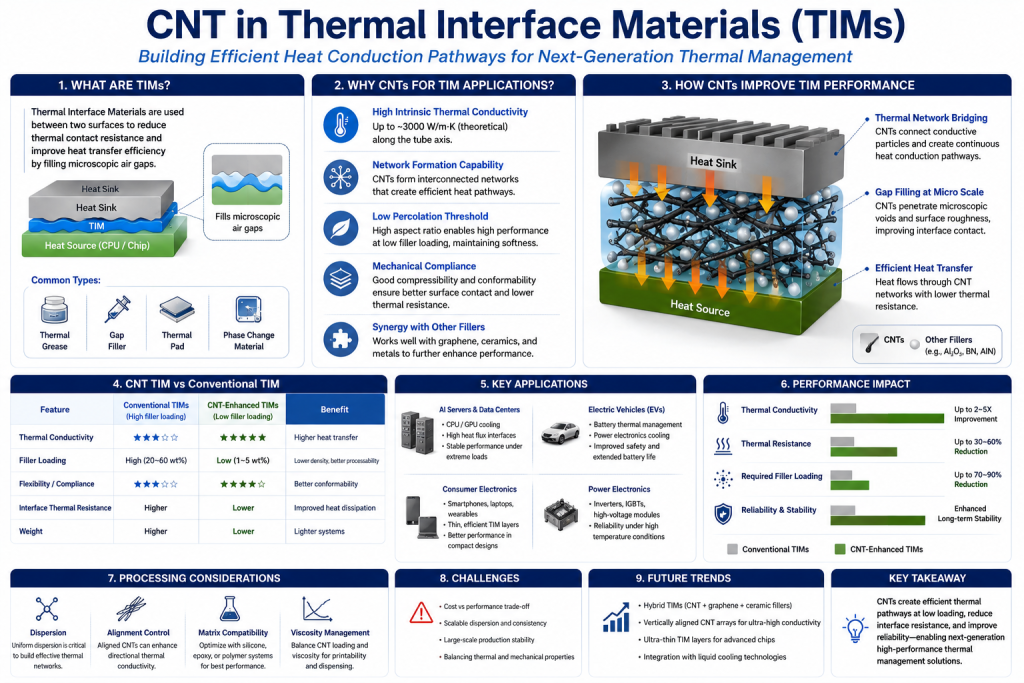
What Are Thermal Interface Materials (TIMs)?
TIMs are materials placed between two surfaces (e.g., chip and heat sink) to:
- Reduce thermal contact resistance
- Improve heat transfer efficiency
- Fill microscopic air gaps
Common TIM types include:
- Thermal greases
- Gap fillers
- Thermal pads
- Phase change materials
Why CNTs for TIM Applications?
1. High Intrinsic Thermal Conductivity
CNTs exhibit thermal conductivity up to:
- ~3000 W/m·K (theoretical along tube axis)
This makes them highly effective for heat transfer pathways when properly integrated.
2. Network Formation Capability
CNTs form interconnected thermal networks within the matrix:
- Enable efficient heat conduction across interfaces
- Reduce dependence on high filler loading
3. Low Percolation Threshold
Due to their high aspect ratio, CNTs can:
- Achieve thermal conductivity improvements at low concentrations
- Maintain material softness and flexibility
4. Mechanical Compliance
CNT-based TIMs offer:
- Good compressibility
- Ability to conform to uneven surfaces
This ensures better surface contact and reduced thermal resistance.
How CNTs Improve TIM Performance
Thermal Network Bridging
CNTs connect thermally conductive particles or regions, forming:
- Continuous heat conduction pathways
- Reduced interfacial resistance
Gap Filling at Micro Scale
CNTs can penetrate:
- Microscopic voids
- Surface roughness
Improving overall interface contact quality.
Synergy with Other Fillers
CNTs are often combined with:
- Graphene
- Ceramic fillers (e.g., Al₂O₃, BN)
- Metal particles
Result:
- Enhanced thermal conductivity
- Optimized viscosity and processability
Key Applications
1. AI Servers and Data Centers
- CPU/GPU cooling
- High heat flux interfaces
CNT TIMs help manage extreme thermal loads.
2. Electric Vehicles (EVs)
- Battery thermal management
- Power electronics cooling
Benefits:
- Improved safety
- Extended battery life
3. Consumer Electronics
- Smartphones
- Laptops
- Wearables
CNT TIMs enable thin, efficient heat dissipation layers.
4. Power Electronics
- Inverters
- IGBTs
- High-voltage modules
Critical for reliability under high ताप度 conditions.
Performance Advantages
| Property | Conventional TIMs | CNT-Enhanced TIMs |
|---|---|---|
| Thermal Conductivity | Moderate | Higher |
| Filler Loading | High | Lower |
| Flexibility | Moderate | High |
| Interface Resistance | Higher | Lower |
| Weight | Higher | Lower |
Processing Considerations
Dispersion Quality
- Uniform CNT distribution is essential
- Prevent agglomeration for effective networks
Alignment Control
- Random vs aligned CNTs impacts thermal performance
- Alignment can enhance directional conductivity
Matrix Compatibility
- Silicone, epoxy, or polymer systems must be optimized
- Surface functionalization improves integration
Viscosity Management
- CNTs can increase viscosity
- Balance needed for processability (printing, dispensing)
Challenges
- Cost vs performance trade-off
- Scalable dispersion techniques
- Consistency in large-scale production
- Balancing thermal and mechanical properties
Future Trends
- Hybrid TIMs (CNT + graphene + ceramic fillers)
- Vertically aligned CNT arrays for ultra-high conductivity
- Ultra-thin TIM layers for advanced chips
- Integration with liquid cooling systems
CNTs significantly enhance thermal interface materials by forming efficient heat conduction networks, reducing thermal resistance, and maintaining mechanical flexibility.
As thermal challenges continue to grow in advanced electronics and energy systems, CNT-based TIMs provide a scalable and high-performance solution for next-generation thermal management.