
How Pilot Lines Accelerate Battery Innovation
Battery innovation is advancing rapidly—from high-energy lithium-ion systems to solid-state and next-generation chemistries. However, the biggest challenge is not invention, but translation into scalable, manufacturable solutions.
This is where pilot lines play a decisive role. By bridging the gap between laboratory research and mass production, pilot lines significantly accelerate battery innovation, reduce risk, and shorten time-to-market.
What Is a Battery Pilot Line?
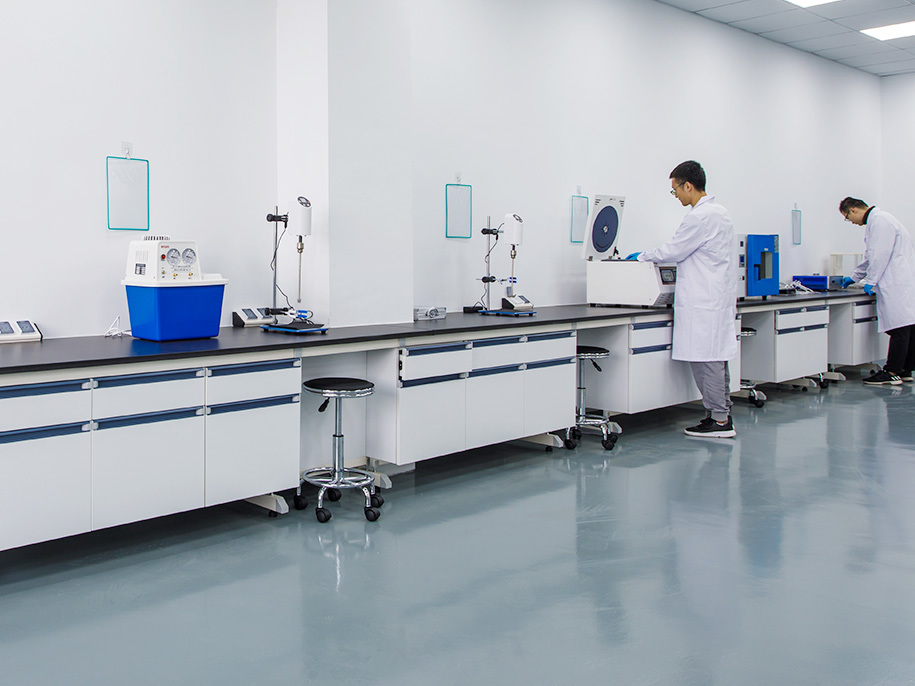
A battery pilot line is a semi-industrial production environment designed to replicate real manufacturing processes at a smaller scale.
It enables:
- Process validation under realistic conditions
- Small-batch production of prototype cells
- Testing of materials, equipment, and workflows
Pilot lines combine the flexibility of R&D with the discipline of manufacturing.
Why Innovation Needs Pilot Lines
1. Lab Success Does Not Equal Manufacturing Success
Materials that perform well in coin cells often fail when scaled due to:
- Coating inconsistencies
- Interface instability
- Process incompatibility
Pilot lines help verify whether innovations are truly manufacturable.
2. Process–Material Coupling
Battery performance depends on both:
- Material properties
- Processing conditions
Pilot lines allow engineers to co-optimize both simultaneously, which is essential for real-world applications.
Key Ways Pilot Lines Accelerate Innovation
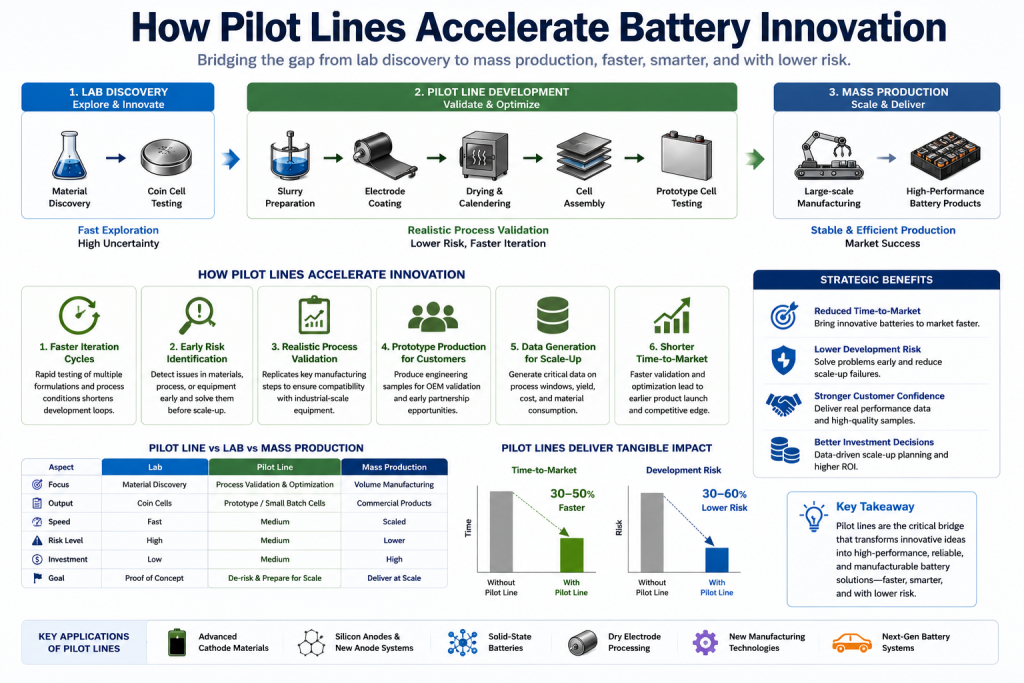
1. Faster Iteration Cycles
- Rapid testing of multiple formulations
- Immediate feedback on process adjustments
- Shortened development loops
👉 Result: Faster optimization and decision-making
2. Early Identification of Scale-Up Risks
Pilot lines reveal:
- Mixing and dispersion challenges
- Coating defects
- Yield limitations
👉 Result: Problems are solved before costly mass production
3. Realistic Process Validation
Simulates key steps such as:
- Slurry preparation
- Electrode coating (slot-die, रोल-to-roll)
- Drying and calendaring
- Cell assembly
👉 Ensures compatibility with industrial equipment
4. Prototype Production for Customers
Pilot lines can produce:
- Engineering samples
- A-samples / B-samples
👉 Enables OEM validation and early partnerships
5. Data Generation for Scale-Up
Pilot operations provide:
- Process windows (temperature, speed, pressure)
- Yield and efficiency data
- Material consumption metrics
👉 Supports design of full-scale production lines
Key Applications in Battery Development
Advanced Cathode Materials
- High-nickel NMC
- LFP optimization
- Next-gen chemistries
Anode Innovations
- Silicon-based anodes
- Graphene/CNT conductive systems
Solid-State Batteries
- Electrolyte processing
- Interface engineering
- Pressure-assisted assembly
New Manufacturing Technologies
- Dry electrode processing
- Advanced coating techniques
- Cell-to-pack integration
Pilot Line vs Lab vs Mass Production
| Stage | Focus | Output | Speed | Risk |
|---|---|---|---|---|
| Lab | Material discovery | Coin cells | Fast | High |
| Pilot | Process validation | Prototype cells | Medium | Medium |
| Production | Volume manufacturing | Commercial products | Scaled | Lower |
Pilot lines act as the critical acceleration layer between discovery and commercialization.
Strategic Benefits for Companies
Reduced Time-to-Market
- Faster transition from concept to product
Lower Development Risk
- Early failure detection
Stronger Customer Confidence
- Real samples instead of lab data
Better Investment Decisions
- Data-driven scale-up planning
Challenges of Pilot Lines
- High initial investment
- Need for skilled operators and engineers
- Balancing flexibility with process stability
- Limited throughput compared to full production
Future Trends
- Modular pilot lines for multi-chemistry support
- Digital twins for process simulation
- AI-driven optimization of parameters
- Integration with advanced materials platforms
Pilot lines are not just an intermediate step—they are a core enabler of battery innovation. By allowing rapid iteration, realistic validation, and early risk mitigation, they significantly accelerate the journey from lab discovery to commercial success.
For companies in the battery space, investing in pilot capabilities is a strategic move that directly impacts speed, reliability, and competitiveness.