
Industrializing Advanced Carbon Materials: Challenges and Opportunities
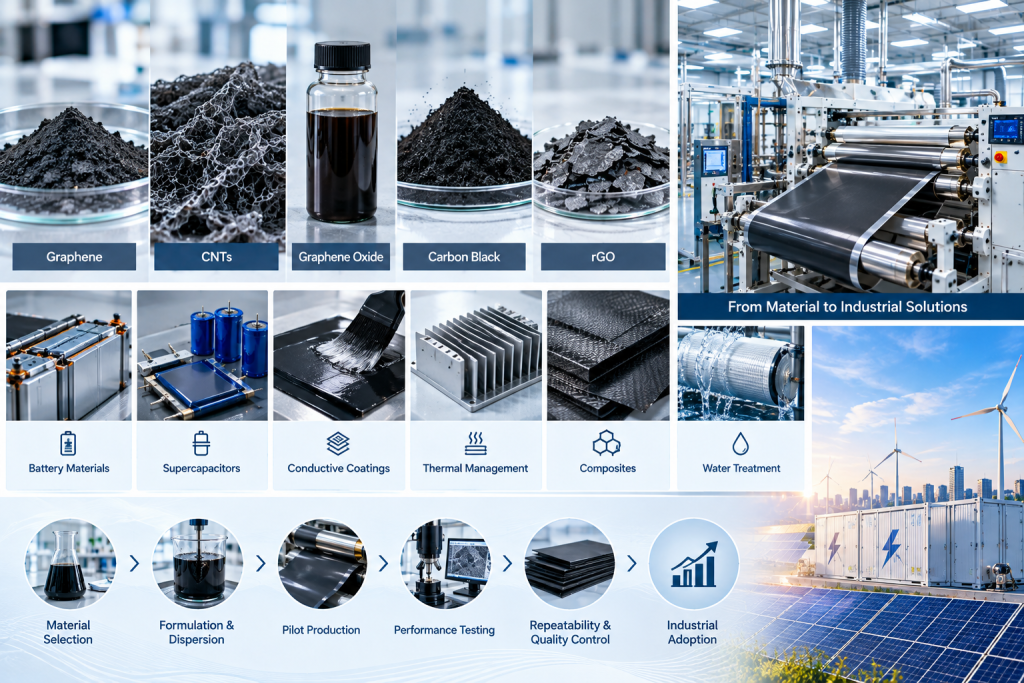
Advanced carbon materials are attracting increasing attention across energy storage, electronics, thermal management, conductive coatings, composite materials, water treatment, and other industrial sectors.
Materials such as graphene, carbon nanotubes (CNTs), graphene oxide (GO), reduced graphene oxide (rGO), and engineered carbon nanostructures offer a range of electrical, thermal, mechanical, and surface-related properties. These characteristics create opportunities to improve existing products and develop new functional materials.
However, translating promising material properties into commercially successful products remains a significant challenge.
Industrialization requires more than producing a material with attractive laboratory results. It involves establishing repeatable manufacturing processes, controlling material specifications, developing application-compatible formulations, validating performance, managing costs, and building reliable supply chains.
The industrialization of advanced carbon materials is ultimately a process of connecting material performance with manufacturing capability and measurable customer value.
1. What Does Industrialization Mean for Advanced Carbon Materials?
Industrialization is often understood as increasing production volume. For advanced carbon materials, however, it involves several interconnected stages.
A material may be successfully synthesized in a laboratory but remain unsuitable for industrial use because its properties vary between batches, its dispersion is difficult to control, or its processing requirements are incompatible with existing manufacturing equipment.
A practical industrialization pathway typically includes:
- Material discovery and laboratory characterization
- Application-specific material selection
- Formulation and process development
- Pilot-scale production and validation
- Repeatability and quality-control assessment
- Customer qualification and application testing
- Commercial manufacturing and supply-chain development
Each stage addresses a different uncertainty.
Laboratory research establishes whether a material has useful properties. Pilot-scale validation investigates whether those properties can be reproduced under more representative manufacturing conditions. Customer qualification determines whether the material or finished component meets the requirements of a particular application.
Commercial industrialization requires these elements to work together.
2. The Main Challenges in Industrializing Advanced Carbon Materials
2.1 Material Complexity and Specification
Advanced carbon materials are not interchangeable commodities.
Graphene nanoplatelets, graphene oxide, reduced graphene oxide, and CNTs differ in structure, surface chemistry, dimensions, purity, and processing behavior. Even materials within the same category may perform differently depending on their production route and intended application.
For graphene, relevant parameters may include flake-size distribution, layer characteristics, defect structure, surface chemistry, and impurity levels.
For CNTs, important characteristics may include diameter, length distribution, purity, catalyst residues, and surface functionalization.
These properties can influence conductivity, dispersion, rheology, interfacial behavior, and final product performance.
A specification that describes a material adequately for one application may be insufficient for another. Industrial development therefore requires identifying the characteristics that directly affect the customer’s process and performance requirements.
2.2 Scaling Up Manufacturing Processes
Laboratory processes often operate under relatively controlled conditions. Larger production volumes introduce additional challenges involving heat transfer, mass transfer, mixing efficiency, residence time, purification, and drying.
For example, a graphene dispersion prepared successfully in a small laboratory vessel may behave differently in a larger mixing system. Changes in shear conditions and circulation can affect agglomeration and dispersion stability.
Similarly, scaling up a carbon-material synthesis process may change yield, impurity levels, energy consumption, or downstream processing requirements.
Increasing equipment capacity alone does not guarantee that the original material characteristics will be preserved.
Successful scale-up requires understanding which process variables control the desired properties and establishing a practical operating window.
2.3 Dispersion and Formulation Compatibility
Dispersion is one of the most important challenges in many advanced carbon material applications.
Graphene and CNTs may form agglomerates because of their surface characteristics and interactions with the surrounding medium. Poor dispersion can prevent the formation of effective conductive networks or create nonuniform material distribution.
The difficulty becomes more pronounced when the material is incorporated into a complex formulation containing binders, solvents, polymers, active materials, or other additives.
A dispersion method that works in water may not be suitable for a solvent-based coating. A formulation optimized for a laboratory experiment may also require adjustment before it can be processed through an industrial coating line.
Industrial development should therefore evaluate the complete formulation rather than relying exclusively on the intrinsic properties of the carbon material.
2.4 Batch-to-Batch Consistency
Industrial customers require predictable material behavior across repeated production runs.
Variation in raw materials, manufacturing conditions, post-processing, storage, or testing methods can influence final performance.
Potential consequences include unstable viscosity, inconsistent coating resistance, variable electrode properties, reduced product yield, and additional quality-control requirements.
Repeatability must be demonstrated through representative batches, standardized testing, traceability, and application-level validation.
For advanced carbon materials, consistency is not merely a quality-control issue. It is part of the product’s commercial value.
2.5 Cost and Manufacturing Yield
A technically successful material may still struggle commercially if it is too expensive to manufacture or difficult to process efficiently.
The cost of an advanced carbon material may include raw materials, energy, equipment depreciation, purification, dispersion, drying, waste treatment, testing, and quality control.
The final cost also depends on the amount of material required to achieve the desired performance.
For example, a higher-priced graphene grade may be economically attractive if it delivers a measurable benefit at a lower loading level or reduces processing costs. Conversely, a low-cost material may become expensive in practice if it requires extensive formulation adjustments or generates excessive defects.
Industrial evaluation should therefore focus on total application economics rather than material price alone.
3. Opportunities Across Major Industrial Applications
Despite these challenges, advanced carbon materials offer opportunities in multiple markets.
The most promising applications are not necessarily those with the most impressive laboratory measurements. They are the applications where the material addresses a specific technical problem and delivers a benefit that customers can validate.
3.1 Energy Storage and Battery Manufacturing
Graphene and CNTs are being investigated as conductive additives, electrode components, and functional materials for batteries and supercapacitors.
Potential development objectives include improving conductive networks, supporting electrode structures, and modifying interfacial properties.
However, the commercial value depends on the battery chemistry, electrode design, formulation, material loading, and manufacturing process.
Pilot validation should connect material characterization with slurry behavior, coating uniformity, electrode properties, and relevant cell-level performance.
For suppliers and material developers, this creates opportunities in conductive additives, formulation support, electrode processing, and application-specific qualification.
3.2 Conductive Coatings and Functional Films
Advanced carbon materials can be incorporated into conductive coatings, antistatic layers, electromagnetic shielding materials, and other functional films.
Graphene and CNTs may provide conductive pathways, while the surrounding formulation determines adhesion, flexibility, coating uniformity, and environmental durability.
Opportunities exist in applications where conductivity must be combined with lightweight construction, flexibility, corrosion resistance, or other functional requirements.
The key development challenge is to achieve the required performance without sacrificing manufacturability, stability, or cost competitiveness.
3.3 Thermal Management
Carbon-based materials are being explored for thermal-management applications, including heat-spreading structures, thermal interface formulations, and thermally functional composites.
Their effectiveness depends on the complete material system.
Filler orientation, interface resistance, loading, binder characteristics, component geometry, and processing conditions can all influence heat transfer.
Industrial opportunities may arise where a carbon-based formulation can demonstrate a measurable improvement in the finished component under representative operating conditions.
3.4 Anticorrosion and Protective Coatings
Graphene and other carbon materials have attracted interest in protective coatings because of their barrier characteristics and potential influence on coating properties.
However, the result depends on dispersion, film integrity, binder compatibility, coating defects, and exposure conditions.
Poorly dispersed fillers or unsuitable formulations can fail to deliver the intended protection. In some systems, defects or interfacial effects may even undermine corrosion performance.
Industrial validation should therefore include appropriate adhesion, environmental exposure, corrosion, and durability testing rather than assuming that adding graphene automatically improves protection.
3.5 Water Treatment and Environmental Technologies
Graphene oxide and other functional carbon materials are being investigated for membranes, adsorption systems, surface modification, and water-treatment applications.
Potential performance depends on material chemistry, pore structure, surface functionality, substrate compatibility, and operating conditions.
For industrial water treatment, additional considerations include fouling, chemical stability, regeneration, pressure drop, material retention, and long-term operating cost.
The opportunity lies in demonstrating a reliable improvement in the treatment system, not simply a promising result in a short laboratory test.
3.6 Polymer Composites and Lightweight Structures
Advanced carbon materials can be used as fillers in polymer composites and other engineered materials.
Depending on the formulation and processing route, they may influence electrical conductivity, thermal behavior, stiffness, or other properties.
The main challenges include filler distribution, interface compatibility, processability, mechanical integrity, and cost.
Industrial adoption is more likely when the material provides a specific advantage that conventional fillers or existing formulations cannot achieve economically.
4. Why Application-Driven Development Matters
One common mistake in advanced carbon materials development is starting with the material rather than the problem.
A supplier may promote high conductivity, high surface area, or a particular nanoscale structure without first establishing whether these characteristics address the customer’s actual requirements.
An application-driven approach begins with the intended outcome.
For example:
- A battery manufacturer may need a stable conductive network without excessive slurry viscosity.
- A coating producer may require low sheet resistance, reliable adhesion, and uniform film thickness.
- A thermal-management developer may prioritize effective heat transfer at a defined component thickness.
- A water-treatment company may require improved contaminant removal without unacceptable pressure drop or material loss.
Once the target is defined, the development team can select suitable carbon materials, establish relevant test methods, and compare alternatives.
This approach reduces unnecessary experimentation and makes the resulting technical data more useful for commercial decisions.
5. The Role of Pilot-Scale Validation
Pilot-scale validation is a critical bridge between laboratory research and industrial manufacturing.
It allows developers to investigate whether a material and formulation can be processed under conditions that more closely represent the intended production environment.
A well-designed pilot program should address five questions.
Can the material be processed?
The formulation must be compatible with the required mixing, coating, compounding, or manufacturing equipment.
Can the target performance be achieved?
The finished material or component must meet predefined application requirements.
Can the result be reproduced?
Representative batches should demonstrate acceptable variation under documented conditions.
Can the process be transferred?
The results should provide useful information for the next manufacturing stage, including equipment requirements and critical process parameters.
Can the product be manufactured economically?
Yield, material consumption, processing time, testing, and supply availability must support a realistic commercial pathway.
A pilot trial that reveals a limitation can still be valuable if it identifies the cause and helps determine the next development step.
6. Building a Repeatable Manufacturing and Quality System
As production expands, quality management must evolve beyond occasional material testing.
A practical quality system should connect incoming materials, process conditions, finished-product performance, and batch traceability.
Material Specifications
Define the material properties that influence application performance. Avoid relying exclusively on generic specifications that may not predict behavior in the customer’s process.
Process Control
Identify critical parameters such as mixing conditions, temperature, reaction time, drying, purification, or formulation ratios, depending on the production route.
Standardized Testing
Use consistent sample preparation and testing methods to support meaningful comparisons between batches.
Batch Traceability
Maintain records linking material lots, production conditions, analytical results, and customer deliveries.
Change Management
Evaluate changes to raw materials, equipment, process parameters, or specifications when they could affect product performance.
These practices help manufacturers understand variation, respond to quality issues, and demonstrate that the product can meet agreed requirements consistently.
7. Supply Chains and Technical Collaboration
Industrializing advanced carbon materials rarely depends on a single organization.
A project may involve material producers, formulation specialists, equipment providers, contract manufacturers, testing laboratories, component manufacturers, and end users.
Each participant contributes different capabilities.
A material producer may understand synthesis and characterization but lack access to the customer’s manufacturing process. A coating manufacturer may possess industrial equipment but require assistance selecting or dispersing a suitable carbon additive. A research team may develop a promising formulation but lack a practical route to pilot production.
Technical collaboration can connect these capabilities without requiring every participant to build a complete development infrastructure.
Successful collaboration requires clearly defined responsibilities, technical deliverables, confidentiality arrangements, data ownership, and commercial expectations.
It is especially important to distinguish between supplying a material, processing a formulation, developing a new process, and validating the final application. These activities involve different levels of technical responsibility and should be scoped accordingly.
8. Intellectual Property and Commercialization Strategy
Advanced carbon materials projects can involve proprietary formulations, surface treatments, dispersion processes, application designs, and process improvements.
As development moves between organizations, intellectual property and confidential information should be managed deliberately.
Before a pilot project begins, the parties should clarify:
- Ownership of pre-existing materials, formulations, and processes
- Ownership of newly developed technology and process improvements
- Permitted use of confidential information
- Rights to technical reports and experimental data
- Conditions for transferring the process to another manufacturer
- Commercial supply arrangements following successful validation
An appropriate confidentiality agreement can help protect sensitive information, but it does not automatically determine ownership of newly developed intellectual property.
For projects involving substantial development work, these questions should be addressed in the project agreement before technical work begins.
9. Commercial Opportunities Beyond Material Sales
The industrialization of advanced carbon materials creates opportunities that extend beyond selling powders or dispersions.
Depending on technical capabilities and commercial positioning, potential service areas include:
- Application-specific material selection
- Formulation and dispersion development
- Pilot-scale processing
- Performance testing and technical validation
- Process optimization
- Supplier qualification
- Contract manufacturing coordination
- Technical documentation and quality support
These services address a central challenge in the advanced-materials market: customers often need help translating material specifications into reliable application performance.
Not every company needs to own every stage of the process. Specialized organizations can contribute value by connecting material supply, technical resources, manufacturing capabilities, and customer requirements.
The commercial opportunity is strongest when the service addresses a clearly defined development bottleneck and produces measurable value for the customer.
10. A Practical Roadmap for Industrialization
A disciplined industrialization roadmap can help reduce technical and commercial uncertainty.
| Stage | Main objective | Expected outcome |
|---|---|---|
| Application definition | Identify the customer’s technical problem | Defined requirements and success criteria |
| Material selection | Compare suitable carbon materials | Shortlisted candidates |
| Formulation development | Establish compatibility and processability | Initial workable formulation |
| Laboratory validation | Establish baseline performance | Documented test results |
| Pilot production | Evaluate representative processing conditions | Process and performance evidence |
| Repeatability assessment | Evaluate variation across batches | Better-defined quality requirements |
| Commercial assessment | Review yield, cost, and supply | Feasibility decision |
| Customer qualification | Confirm application suitability | Basis for commercial adoption |
The process is not always linear. Pilot trials may reveal a need to return to material selection or reformulate the product. This feedback is a normal and useful part of development.
The objective is to make each stage answer a specific question and provide evidence for the next decision.
Conclusion: Turning Advanced Carbon Materials Into Industrial Value
Advanced carbon materials offer opportunities across energy storage, conductive coatings, thermal management, protective systems, water treatment, and engineered composites.
However, their commercial success depends on much more than intrinsic material properties.
Manufacturing repeatability, dispersion, process compatibility, application-level validation, cost, quality control, and supply reliability all influence whether a promising material can achieve industrial adoption.
Companies that approach industrialization as a complete development process are better positioned to identify realistic applications, reduce scale-up risk, and establish reliable commercial pathways.
The future of advanced carbon materials will depend not only on discovering what these materials can do, but also on proving that they can deliver the required performance consistently, economically, and at industrial scale.
For material developers, manufacturers, and application teams, the priority is to connect scientific potential with measurable customer needs and repeatable manufacturing results.
Frequently Asked Questions
What are advanced carbon materials?
Advanced carbon materials include engineered carbon-based materials such as graphene, CNTs, graphene oxide, reduced graphene oxide, carbon black, and other specialized carbon structures used to modify electrical, thermal, mechanical, chemical, or surface properties.
What is the biggest challenge in industrializing graphene and CNTs?
There is no single universal challenge. Common issues include material variability, dispersion, process scale-up, batch consistency, application validation, manufacturing yield, and cost.
Why is pilot-scale validation important?
Pilot-scale validation helps determine whether laboratory results can be reproduced under more representative manufacturing conditions. It also reveals process limitations and provides evidence for further investment or commercialization.
Which industries offer opportunities for advanced carbon materials?
Potential applications include batteries, supercapacitors, conductive coatings, electronics, thermal management, anticorrosion systems, water treatment, and polymer composites. Commercial suitability depends on validated performance and application economics.
Can advanced carbon materials be commercialized without in-house pilot equipment?
Yes. Companies may work with external laboratories, pilot facilities, contract manufacturers, or application development partners. Responsibilities, testing requirements, intellectual property, and deliverables should be defined before the project begins.
How can companies evaluate the commercial potential of a carbon material?
They should assess whether the material addresses a measurable customer problem, delivers a reproducible performance benefit, integrates with existing manufacturing processes, and supports a viable cost and supply model.