
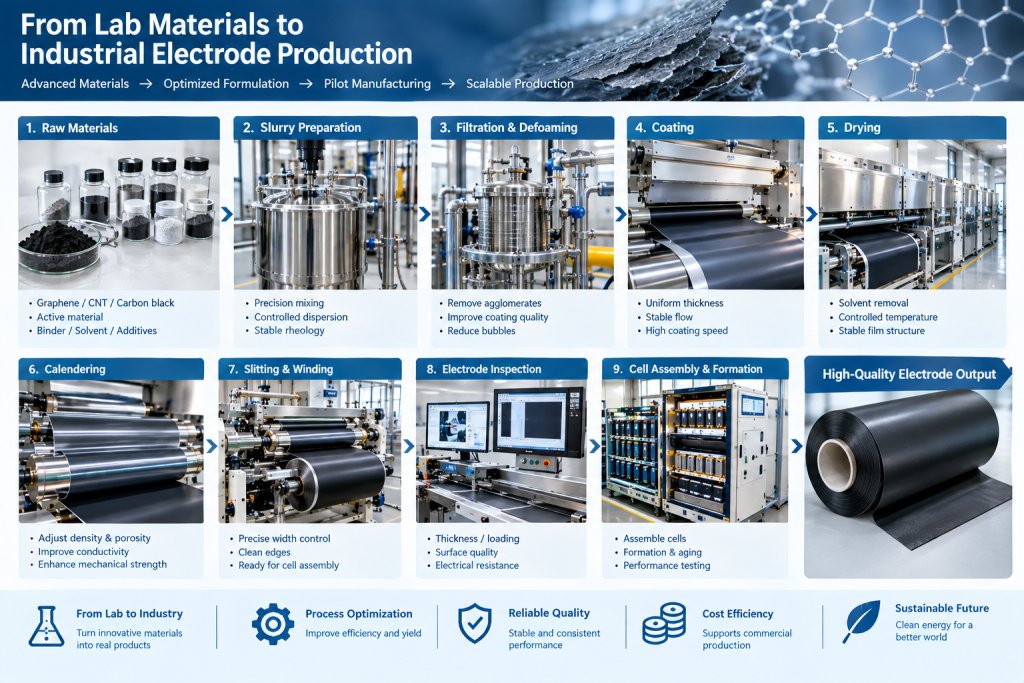
From Lab Materials to Industrial Electrode Production
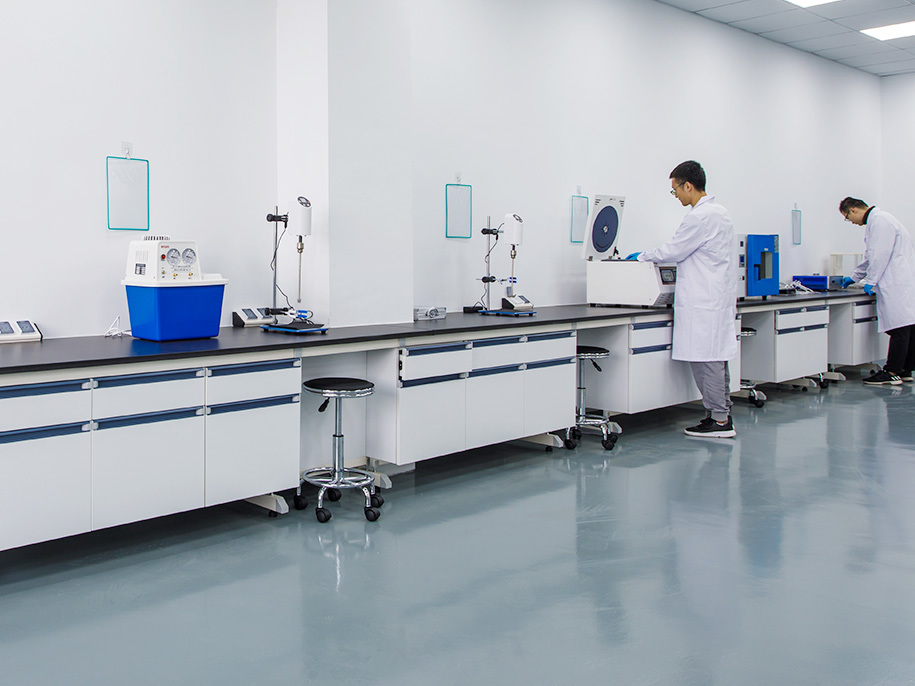
The development of advanced battery materials often begins with a small laboratory sample.
Researchers may start with a few grams of cathode powder, graphite, silicon, conductive carbon, graphene, carbon nanotubes (CNTs), binder, or electrolyte-related materials. At this stage, the focus is usually on material properties and electrochemical performance.
A promising material may demonstrate high capacity, good conductivity, improved rate capability, or other attractive characteristics.
But a material that works in a laboratory cell is only the starting point.
To become part of a commercial battery, it must eventually be converted into a stable electrode that can be manufactured repeatedly, coated uniformly, dried consistently, calendered accurately, assembled into cells, and validated under realistic operating conditions.
This transition from laboratory material to industrial electrode production is one of the most important steps in battery industrialization.
It requires the integration of materials science, formulation engineering, coating technology, drying, calendering, cell manufacturing, quality control, and process development.
The Electrode Is More Than a Mixture of Materials
A battery electrode is not simply active material deposited on a metal foil.
It is a carefully engineered structure containing several components that must work together.
A typical electrode formulation may contain:
- Active material
- Conductive additive
- Binder
- Solvent
- Functional additives
For advanced electrodes, the conductive system may include:
- Carbon black
- CNTs
- Graphene
- Graphite-based conductive materials
- Hybrid conductive networks
The final electrode must provide both electronic and ionic pathways while maintaining mechanical integrity and sufficient active-material loading.
This means that the quality of the final electrode depends not only on the raw materials but also on how those materials are formulated and processed.
Step 1: Define the Electrode Requirements
Before scaling production, the target electrode should be clearly defined.
Important parameters may include:
- Areal capacity
- Active-material loading
- Electrode thickness
- Density
- Porosity
- Electronic resistance
- Adhesion
- Flexibility
- Electrochemical performance
The requirements depend on the battery application.
A high-energy battery may prioritize high active-material loading and volumetric energy density.
A fast-charging battery may require greater attention to porosity, conductivity, ionic transport, and thermal behavior.
Therefore, electrode manufacturing should begin with the performance requirements of the final cell.
Step 2: Characterize the Raw Materials
Material characterization is the first step toward process control.
For active materials, relevant properties may include:
- Particle-size distribution
- Morphology
- Surface area
- Purity
- Moisture
- Tap density
- Electrochemical characteristics
For CNTs and graphene, additional properties may include:
- Diameter
- Length
- Layer structure
- Surface chemistry
- Dispersion behavior
- Electrical conductivity
For binders and solvents, compatibility and processing behavior are equally important.
The goal is not to measure every possible parameter.
It is to identify the material characteristics that have a meaningful effect on electrode manufacturing and cell performance.
Step 3: Develop the Slurry
The slurry is the first major manufacturing bridge between the laboratory material and the electrode.
The formulation determines how the particles are distributed and how the mixture behaves during processing.
Important variables may include:
- Solid content
- Active-material ratio
- Conductive-additive loading
- Binder concentration
- Solvent content
- Mixing sequence
- Dispersion energy
- Viscosity
For advanced carbon additives, dispersion is particularly important.
CNTs can form bundles.
Graphene can restack.
Carbon black can agglomerate.
If the conductive material is not distributed effectively, the final electrode may have uneven conductivity.
Slurry Rheology Matters
Electrode coating requires a slurry with controlled flow behavior.
Important rheological properties may include:
- Viscosity
- Shear thinning
- Yield stress
- Thixotropy
- Temperature dependence
A slurry may behave differently during:
- Mixing
- Pumping
- Filtration
- Coating
- Storage
This is why a single viscosity measurement may not fully describe process behavior.
The rheological profile should be evaluated across the range relevant to the actual coating process.
Mixing Is a Process, Not Just a Recipe
Laboratory developers sometimes focus heavily on ingredient ratios while paying less attention to mixing conditions.
At industrial scale, mixing itself becomes a critical process variable.
Important parameters may include:
- Mixing speed
- Mixing time
- Impeller geometry
- Temperature
- Vacuum
- Addition sequence
- Energy input
A formulation that works in a small laboratory mixer may behave differently in a larger vessel because the flow and shear environment have changed.
Pilot mixing is therefore essential for establishing how to reproduce the required dispersion state at larger scale.
Step 4: Filtration and Slurry Handling
Before coating, the slurry may need filtration to remove large agglomerates or foreign particles.
This step can improve coating quality.
However, filtration also introduces trade-offs.
A filter that is too fine may increase:
- Pressure
- Processing time
- Material loss
- Equipment loading
A filter that is too coarse may allow problematic agglomerates to reach the coating head.
Therefore, filtration should be optimized as part of the overall slurry-processing system.
Handling also matters.
The slurry must be transferred through pipes, pumps, and valves without significantly changing its structure or rheology.
Step 5: Coating the Electrode
Electrode coating converts the slurry into a controlled physical structure on the current collector.
Common coating technologies include:
- Slot-die coating
- Comma or knife coating
- Other continuous coating systems
During pilot development, critical variables may include:
- Web speed
- Slurry flow rate
- Coating gap
- Wet-film thickness
- Web tension
- Substrate alignment
- Edge control
The objective is to create a uniform electrode across the complete coating width.
Coating Uniformity Is Critical
A battery electrode can be visually acceptable while still containing significant local variation.
Differences in:
- Thickness
- Areal loading
- Composition
- Density
- Conductivity
can create non-uniform electrochemical behavior.
In larger cells, these local differences can become more important because they affect current distribution and thermal behavior.
Therefore, industrial electrode production requires quantitative control rather than visual inspection alone.
Step 6: Drying the Electrode
After coating, the solvent must be removed under controlled conditions.
Drying strongly influences the final electrode structure.
During drying:
- Solvent evaporates
- Particles move
- Binder redistributes
- Conductive networks develop
- Porosity evolves
- Mechanical stress develops
Drying conditions can therefore affect:
- Adhesion
- Conductivity
- Porosity
- Surface morphology
- Electrochemical performance
A formulation with excellent laboratory performance can produce a very different electrode if the drying profile is changed significantly.
Drying Rate Must Be Optimized
Faster drying is attractive because it can improve production throughput.
However, excessive drying rates can produce:
- Binder migration
- Surface defects
- Internal concentration gradients
- Cracking
- Uneven electrode structure
Very slow drying can increase energy consumption and reduce manufacturing efficiency.
Pilot-scale drying therefore aims to find a balanced process window that provides stable electrode quality at practical throughput.
Step 7: Calendering the Electrode
Drying produces an electrode with a certain thickness and porosity.
Calendering then compresses the electrode to achieve the required structure.
Calendering influences:
- Density
- Porosity
- Thickness
- Surface roughness
- Mechanical integrity
- Electrical contact
This step involves an important trade-off.
Higher density can improve volumetric energy density.
But excessive compression can reduce pore volume and make lithium-ion transport more difficult.
For fast-charging applications, this balance becomes particularly important.
Conductive Networks After Calendering
For electrodes containing CNTs, graphene, or other conductive additives, calendering can alter the conductive network.
Compression can improve particle contact in some systems.
However, it can also change pore structure and reduce electrolyte accessibility.
Therefore, conductive-network optimization cannot be separated from electrode-density optimization.
The target is not simply maximum conductivity.
It is a balanced structure that supports:
Electronic transport + ionic transport + mechanical stability + high active-material utilization
Electrode Density and Porosity
Porosity determines how easily electrolyte can penetrate the electrode and how effectively lithium ions can move through the structure.
Too much porosity can reduce volumetric energy density and mechanical strength.
Too little porosity can increase transport resistance.
The appropriate level depends on:
- Material characteristics
- Electrode thickness
- Cell design
- Charging requirements
- Target energy density
This is one reason why electrode design should be optimized at the system level.
Step 8: Electrode Inspection
After calendering, the electrode should be inspected before cell assembly.
Typical measurements may include:
- Thickness
- Areal loading
- Density
- Porosity
- Surface appearance
- Adhesion
- Electrical resistance
- Edge quality
Advanced inspection may also identify:
- Pinholes
- Cracks
- Coating streaks
- Foreign particles
- Local thickness variation
Early detection is important because defects can become much more expensive after the electrode has been converted into a finished cell.
From Electrode to Cell
A successful electrode still has to function in a real cell.
This introduces additional manufacturing stages:
Slitting → stacking or winding → assembly → electrolyte filling → sealing → formation → aging → testing
At this point, the influence of electrode design becomes easier to observe at the cell level.
For example, a coating that looks excellent during inspection may still result in poor cell performance if:
- Wetting is insufficient
- Electrolyte distribution is poor
- Electrode balance is inappropriate
- Formation conditions are not optimized
Electrode-to-Cell Transfer Is a Critical Milestone
Laboratory cell results can provide important evidence, but they do not fully represent larger-format manufacturing.
As the electrode area and cell size increase, issues such as:
- Current distribution
- Heat generation
- Mechanical pressure
- Electrolyte transport
- Manufacturing tolerances
become more relevant.
This is why advanced materials should progressively move through increasingly representative cell formats.
Formation and Aging
Formation is where the new electrode chemistry is integrated into the electrochemical behavior of the cell.
The process can influence:
- Initial efficiency
- Interfacial layers
- Gas generation
- Cell resistance
- Capacity development
For advanced materials, formation conditions may require optimization.
A laboratory electrode should therefore be evaluated under formation conditions that are relevant to the eventual manufacturing process.
Multi-Batch Validation
One successful electrode batch does not demonstrate manufacturing readiness.
Pilot production should include multiple batches.
The objective is to determine whether the process can consistently reproduce:
- Slurry rheology
- Coating thickness
- Areal loading
- Electrode density
- Porosity
- Resistance
- Electrochemical performance
This is where statistical process thinking becomes important.
The question changes from:
“Can we make a good electrode?”
to:
“Can we make good electrodes repeatedly?”
Yield Becomes a Key Metric
Commercial production must account for yield.
Material can be lost during:
- Slurry transfer
- Filtration
- Coating startup
- Edge trimming
- Electrode slitting
- Defect removal
- Cell assembly
Yield therefore affects both economics and production planning.
A material that improves electrochemical performance but causes a large increase in manufacturing losses may require further optimization.
Quality Control Should Follow the Process
A strong electrode-manufacturing quality system connects each process stage with measurable outputs.
For example:
Raw Materials
Particle size → moisture → purity → morphology
Slurry
Solid content → viscosity → dispersion → stability
Coating
Thickness → loading → uniformity → defects
Calendering
Density → porosity → thickness → resistance
Cell
Capacity → impedance → efficiency → cycling
This creates traceability throughout the manufacturing chain.
Process Windows Are More Valuable Than Single Setpoints
Industrial manufacturing should not depend on one ideal machine setting.
Instead, the process should have a stable operating range.
For example:
Slurry viscosity: acceptable range
Coating speed: acceptable range
Drying temperature: acceptable range
Electrode density: acceptable range
Calendering pressure: acceptable range
A process window provides greater robustness against normal variation.
This is especially important when manufacturing moves from pilot scale to commercial scale.
How Advanced Carbon Materials Enter Electrode Production
Graphene and CNTs are useful examples of why the full process must be considered.
A CNT can create highly interconnected conductive pathways at low loading.
Graphene can contribute to conductive and, in some systems, structural or thermal functions.
However, their value depends on:
- Dispersion
- Loading
- Interaction with the binder
- Distribution within the electrode
- Calendering
- Final cell design
Therefore, the best conductive additive is not necessarily the one with the highest conductivity as a standalone powder.
It is the one that creates the required electrode structure while remaining compatible with manufacturing.
Pilot Lines as the Technology Bridge
Battery pilot lines provide an important environment for this entire development process.
A representative pilot line may include:
Slurry preparation → coating → drying → calendering → slitting → electrode inspection → cell assembly → formation → testing
The purpose is not to reproduce a commercial factory in every detail.
Instead, the pilot line should reproduce the process variables that are critical to the technology.
This allows developers to identify scale-up risks before full commercial investment.
What Should Be Learned at Pilot Scale?
A useful pilot program should answer questions such as:
- Does slurry behavior remain stable at larger scale?
- Can the electrode be coated uniformly?
- Does drying create gradients?
- How does calendering affect porosity?
- Does conductive-network structure remain stable?
- Can multiple batches be reproduced?
- What is the realistic yield?
- What manufacturing parameters are most sensitive?
- Does cell performance remain consistent?
The answers create the knowledge needed for commercial process development.
Customer Validation
In many advanced battery projects, the final test is not performed by the material supplier.
The customer or cell manufacturer evaluates the electrode or material in its own application.
This may involve:
- Pilot-cell production
- Production-line trials
- Fast-charging tests
- Cycle-life testing
- Thermal evaluation
- Reliability testing
Pilot-produced electrodes are particularly valuable because they are closer to the eventual manufacturing reality than hand-made laboratory samples.
From Material Supplier to Process Partner
As battery technologies mature, material suppliers increasingly need to understand the downstream process.
A successful advanced-material supplier may need to discuss:
- Slurry formulation
- Coating compatibility
- Drying conditions
- Electrode loading
- Calendering
- Cell performance
This does not mean that every material supplier must become a battery manufacturer.
It means that material development is becoming increasingly connected to electrode manufacturing.
Common Mistakes in Electrode Scale-Up
Mistake 1: Focusing Only on Active Material Performance
Excellent material properties do not guarantee excellent electrode performance.
Mistake 2: Treating Slurry Formulation as Secondary
A poor slurry can undermine the entire electrode.
Mistake 3: Ignoring Drying and Calendering
These steps can significantly alter electrode structure.
Mistake 4: Scaling by Recipe Alone
Larger equipment changes the mixing and flow environment.
Mistake 5: Testing Only One Batch
Single-batch performance does not demonstrate manufacturing consistency.
Mistake 6: Ignoring Yield
A technically successful process may still be economically unattractive if losses are too high.
A Practical Development Roadmap
A structured path from laboratory materials to industrial electrode production can be summarized as:
Stage 1: Material Screening
Identify suitable active materials, binders, conductive additives, and other functional components.
Stage 2: Laboratory Formulation
Develop the slurry and establish preliminary rheology and dispersion conditions.
Stage 3: Laboratory Electrode
Produce coated electrodes and evaluate initial electrochemical behavior.
Stage 4: Pilot Slurry Production
Scale the formulation and validate mixing, transfer, filtration, and storage.
Stage 5: Pilot Coating
Test representative coating conditions, drying, and substrate handling.
Stage 6: Calendering and Electrode Optimization
Control thickness, density, porosity, and mechanical properties.
Stage 7: Pilot Cell Production
Assemble cells using representative electrodes.
Stage 8: Cell Validation
Evaluate capacity, resistance, rate capability, cycling, thermal behavior, and other application requirements.
Stage 9: Multi-Batch Reproducibility
Confirm process stability and yield across multiple pilot runs.
Stage 10: Commercial Process Design
Use the pilot data to define equipment, quality systems, process windows, and scale-up requirements.
The Real Goal: Manufacturing Compatibility
The ultimate objective of electrode development is not simply high electrochemical performance.
It is the ability to produce that performance repeatedly.
A commercially useful electrode should provide:
Performance + Processability + Uniformity + Reliability + Yield + Cost Efficiency
This is particularly important for emerging battery technologies.
A new material may be scientifically attractive, but if it requires unrealistic mixing, coating, drying, or calendering conditions, commercial adoption may become difficult.
From Laboratory Material to Industrial Electrode
The entire journey can be summarized as:
Raw Materials
↓
Slurry Formulation
↓
Dispersion & Mixing
↓
Coating
↓
Drying
↓
Calendering
↓
Electrode Inspection
↓
Cell Assembly
↓
Formation & Aging
↓
Cell Validation
↓
Pilot Reproducibility
↓
Commercial Production
Each stage adds another layer of manufacturing knowledge.
Skipping one of these stages may reduce development time initially, but it can also create larger scale-up risks later.
The transition from laboratory materials to industrial electrode production is one of the most important stages in battery commercialization.
A promising cathode, anode, CNT, graphene, conductive additive, or binder is only the beginning.
To become part of a commercial battery, the material must be transformed into a stable slurry, a uniform electrode, and ultimately a reliable cell.
That transformation depends on:
Material Selection → Formulation → Dispersion → Coating → Drying → Calendering → Cell Assembly → Formation → Validation
Pilot manufacturing provides the critical bridge between these stages.
It allows developers to understand how materials behave in larger batches, how electrodes respond to continuous processing, how manufacturing conditions affect electrochemical performance, and whether the process can be reproduced with acceptable yield.
The most valuable result of pilot electrode production is therefore not simply a larger quantity of electrode.
It is manufacturing knowledge.
It reveals which parameters matter, which process windows are stable, where variation comes from, and what must be controlled before commercial scale-up.
For advanced battery technologies, that knowledge can determine whether a promising laboratory material remains a research result—or becomes part of a real industrial battery.