
How to Choose the Right Pilot Partner for Advanced Materials
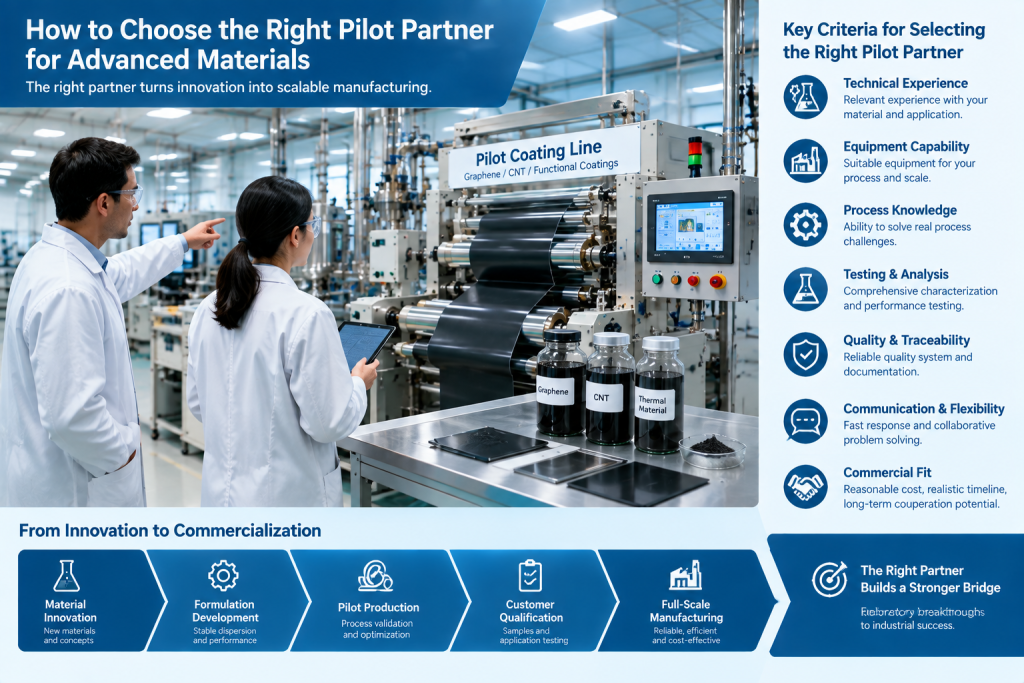
Developing an advanced material is only the beginning of commercialization.
For technologies such as graphene, carbon nanotubes (CNTs), thermal management materials, conductive inks, battery additives, functional coatings, and next-generation composites, the transition from laboratory success to industrial production represents one of the most challenging stages.
Many promising materials demonstrate excellent performance in research environments but face unexpected difficulties during scale-up.
The reason is simple:
A laboratory process and an industrial process are not the same.
Moving from grams to kilograms, from small samples to pilot batches, and from manual experiments to controlled production requires new knowledge, equipment, and process capability.
This is why selecting the right pilot partner is a critical decision.
A suitable pilot partner does not simply provide production capacity.
The right partner helps transform scientific innovation into a manufacturable product through:
- Process development
- Equipment adaptation
- Scale-up validation
- Quality control
- Manufacturing data generation
- Customer sample preparation
Choosing the wrong partner can result in wasted materials, unreliable data, delayed timelines, and increased commercialization risk.
Why Pilot Partners Matter in Advanced Materials Development
Advanced materials often fail during commercialization not because the material itself is ineffective, but because the manufacturing process is not sufficiently developed.
Common challenges include:
- Dispersion instability
- Batch-to-batch variation
- Coating defects
- Process sensitivity
- Equipment limitations
- Lack of quality standards
- Difficulty reproducing laboratory results
A pilot partner provides the bridge between innovation and production.
The role is not simply:
“Produce more material.”
The real objective is:
“Understand how to manufacture the material consistently.”
Pilot Scale Is a Learning Process
A common misunderstanding is that pilot production is only a small version of commercial manufacturing.
In reality, pilot production is an engineering learning stage.
During pilot development, teams discover:
- Which process parameters are critical
- Which variables influence quality
- How materials behave under realistic conditions
- What production limitations exist
- How to establish process windows
A strong pilot partner helps generate this knowledge.
The First Criterion: Relevant Technical Experience
The first question when selecting a pilot partner should be:
Have they worked with similar materials and processes before?
Advanced materials are highly application-specific.
A company experienced in conventional coatings may not necessarily understand graphene-based coatings.
A powder-processing company may not understand battery electrode manufacturing.
A polymer compounder may not have experience with nanoscale dispersion systems.
Relevant experience may include:
Graphene and CNT Materials
- Dispersion technology
- Functionalization
- Conductive formulations
- Composite development
Thermal Materials
- Thermal coatings
- Heat-spreading films
- Thermal interface materials
Battery Applications
- Electrode slurry preparation
- Coating
- Drying
- Calendering
- Cell-level validation
Functional Coatings
- Slot-die coating
- Roll-to-roll processing
- Curing
- Surface treatment
The closer the partner’s experience matches the project requirements, the lower the scale-up risk.
Equipment Capability Is More Important Than Equipment List
Many companies evaluate pilot partners by asking:
“What equipment do you have?”
However, equipment availability alone does not guarantee successful development.
The more important question is:
Can the equipment reproduce the critical conditions of the intended manufacturing process?
For example, for a coating project:
Important factors may include:
- Coating width
- Coating speed
- Drying capacity
- Temperature control
- Thickness control
- Substrate handling
For dispersion projects:
Important factors may include:
- Mixing energy
- Shear conditions
- Temperature control
- Batch volume
- Filtration capability
The equipment should match the technical challenge, not simply appear advanced.
Process Understanding Is the Real Value
A pilot partner should contribute process knowledge, not only machine time.
For example, a good partner should understand:
Why does viscosity change?
Why does dispersion become unstable?
Why does coating quality deteriorate at higher speed?
Why does thermal performance change after drying?
Why does a formulation work in a laboratory mixer but fail in a larger tank?
These questions require engineering experience.
The value of a pilot partner is often measured by how quickly they can identify and solve process problems.
Evaluate Their Development Approach
A professional pilot partner should have a structured development methodology.
A typical approach may include:
Step 1: Technical Review
Understand:
- Material properties
- Target application
- Performance requirements
- Existing laboratory data
Step 2: Process Assessment
Identify:
- Required equipment
- Potential challenges
- Critical parameters
Step 3: Small Pilot Trial
Validate:
- Process feasibility
- Material behavior
- Initial quality
Step 4: Optimization
Adjust:
- Formulation
- Processing conditions
- Equipment parameters
Step 5: Multi-Batch Validation
Confirm:
- Repeatability
- Stability
- Quality consistency
A structured approach reduces unnecessary trial-and-error.
Laboratory Capability Before Pilot Production
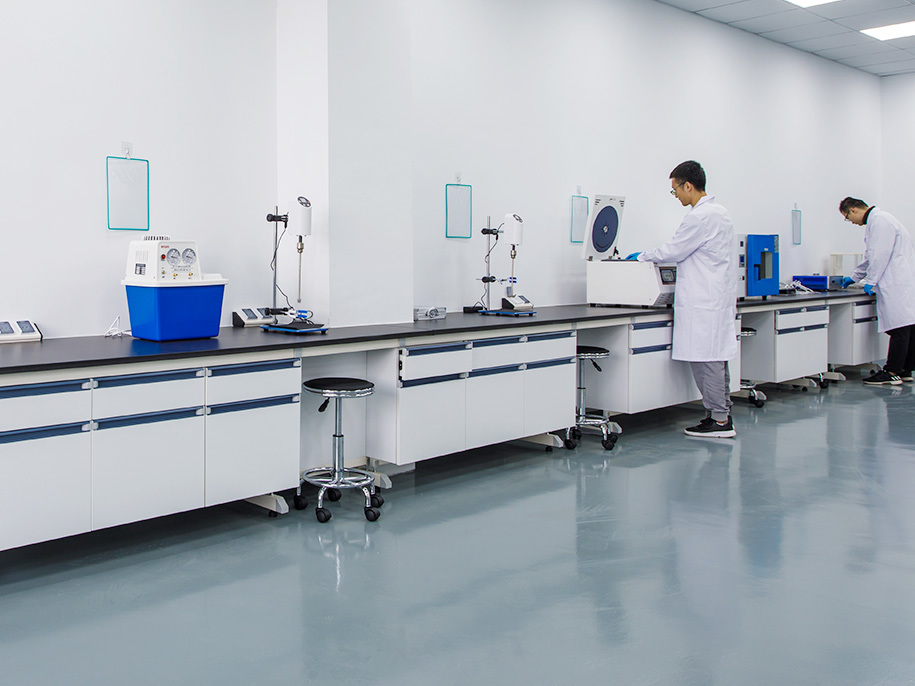
A good pilot partner should also have appropriate laboratory support.
Pilot production without analytical capability can create problems because the team cannot understand why performance changes.
Useful testing capabilities may include:
Material Characterization
- Particle size analysis
- Morphology analysis
- Surface chemistry
- Moisture analysis
Formulation Testing
- Viscosity
- Dispersion stability
- Solid content
- Surface tension
Product Testing
- Electrical conductivity
- Thermal conductivity
- Thermal resistance
- Mechanical properties
- Adhesion
Testing capability allows process changes to be connected with final performance.
Quality System and Documentation
Advanced materials often require detailed documentation, especially when customers are developing new products.
A pilot partner should be able to provide:
- Batch records
- Process parameters
- Material traceability
- Quality inspection reports
- Sample history
- Testing results
Good documentation helps customers understand:
“What exactly produced this result?”
Without traceability, successful samples may be difficult to reproduce.
Flexibility Is Essential During Development
Pilot projects rarely follow the original plan perfectly.
Unexpected issues often appear:
- Material behaves differently at larger scale
- Customer requirements change
- New testing data changes the direction
- Process conditions need adjustment
A suitable pilot partner should be flexible enough to support iterative development.
Large-scale commercial manufacturers may sometimes lack this flexibility because their systems are optimized for stable production rather than exploration.
Communication Speed Matters
Advanced material projects involve frequent technical discussion.
Important topics may include:
- Process adjustments
- Testing results
- Material feedback
- Experimental design
A pilot partner should provide effective technical communication.
Slow communication can significantly delay development cycles.
For early-stage technologies, development speed is often as important as production capability.
Intellectual Property Protection
Many advanced material projects involve proprietary formulations, customer requirements, or unpublished technology.
Before sharing detailed information, companies should consider:
- Non-disclosure agreements
- Data ownership
- Sample confidentiality
- Process confidentiality
- Intellectual property boundaries
A reliable pilot partner should respect confidentiality and clearly define responsibilities.
Avoid Choosing Only Based on Price
Pilot development is not the same as purchasing a standard product.
The lowest-cost option may create higher total costs if it results in:
- Failed experiments
- Poor reproducibility
- Additional development cycles
- Delayed customer validation
A better evaluation considers:
Technical capability + development experience + communication + quality + cost
The cheapest pilot partner is not always the most economical choice.
The Importance of Application Understanding
A strong pilot partner should understand the final application.
For example:
A thermal coating for electronics has different requirements from a thermal coating for batteries.
A conductive ink for sensors has different requirements from a conductive coating for EMI shielding.
Application knowledge helps the partner focus on the properties that actually matter.
The goal is not to maximize every material parameter.
The goal is to optimize the material for its intended use.
Pilot Partner Selection Checklist
A practical evaluation can include the following questions:
Technical Capability
- Have they worked with similar materials?
- Do they understand the relevant process?
- Can they solve scale-up problems?
Equipment
- Is the equipment suitable for the application?
- Can it represent future production conditions?
- Can parameters be controlled?
Testing
- Can they measure important properties?
- Can they connect process conditions with performance?
Quality
- Do they provide batch records?
- Can they ensure traceability?
- Are quality procedures established?
Communication
- Can engineers communicate directly?
- Are technical discussions efficient?
Commercial
- Are costs transparent?
- Are timelines realistic?
- Are responsibilities clearly defined?
Different Projects Need Different Pilot Partners
There is no single ideal pilot partner for all advanced materials.
The best choice depends on project stage.
Early Technology Validation
Priority:
- Technical flexibility
- Research capability
- Experimental support
Customer Prototype Development
Priority:
- Application understanding
- Sample consistency
- Larger quantity production
Pre-Commercial Scale-Up
Priority:
- Process stability
- Quality systems
- Manufacturing readiness
The right partner changes as the project matures.
Pilot Partner vs Contract Manufacturer
These roles are often confused.
A contract manufacturer mainly focuses on producing according to an established process.
A pilot partner focuses on developing and validating the process itself.
For advanced materials, especially early commercialization stages, the second role is often more valuable.
The project may still require engineering exploration before stable manufacturing begins.
The Best Pilot Partners Act Like Development Teams
The strongest partnerships are collaborative.
Instead of:
“Here is the material. Please produce it.”
A better approach is:
“Here is the technology goal. Let us develop the process together.”
A strong pilot partner contributes ideas about:
- Formulation
- Equipment settings
- Testing strategy
- Process optimization
- Scale-up planning
This collaboration can significantly accelerate commercialization.
Common Mistakes When Selecting a Pilot Partner
Mistake 1: Choosing Based Only on Capacity
Large equipment does not guarantee technical success.
Mistake 2: Ignoring Process Experience
Manufacturing knowledge is often more important than production size.
Mistake 3: Starting Without Clear Objectives
A pilot trial should answer specific questions.
Mistake 4: Not Defining Data Requirements
Results should be measurable and comparable.
Mistake 5: Treating Pilot Production as Simple Outsourcing
Pilot development requires cooperation, not only manufacturing.
How to Prepare Before Approaching a Pilot Partner
Before contacting a potential partner, prepare:
- Material information
- Target application
- Current laboratory results
- Required quantity
- Performance targets
- Expected production process
- Testing requirements
- Timeline expectations
Better preparation leads to more productive discussions.
The Role of Pilot Partners in Commercialization
A successful pilot partner helps answer the most important commercialization questions:
Can this material be processed?
Can it be produced consistently?
Can the quality be controlled?
Can the process be scaled?
Can customers validate it?
These answers determine whether a technology can move toward commercial adoption.
Building Long-Term Partnerships
Advanced material commercialization rarely happens through a single production trial.
Long-term cooperation may involve:
- Continuous process improvement
- New product development
- Customer validation
- Scale-up preparation
- Manufacturing transfer
A reliable pilot partner can become a strategic technology partner rather than simply a supplier.
Conclusion
Choosing the right pilot partner is one of the most important decisions in the commercialization journey of advanced materials.
The ideal partner is not simply the company with the largest equipment or the lowest price.
The right partner combines:
Relevant technical experience + suitable equipment + process knowledge + testing capability + quality control + effective communication
For graphene, CNTs, thermal materials, conductive inks, battery materials, and other emerging technologies, pilot production represents the critical bridge between laboratory innovation and industrial manufacturing.
A strong pilot partner helps transform uncertainty into data, experiments into processes, and promising materials into commercial products.
The ultimate goal is not just to produce a pilot batch.
It is to build a reliable pathway from:
Material Innovation → Process Development → Pilot Validation → Customer Qualification → Commercial Manufacturing
That is the foundation of successful advanced-material industrialization.