
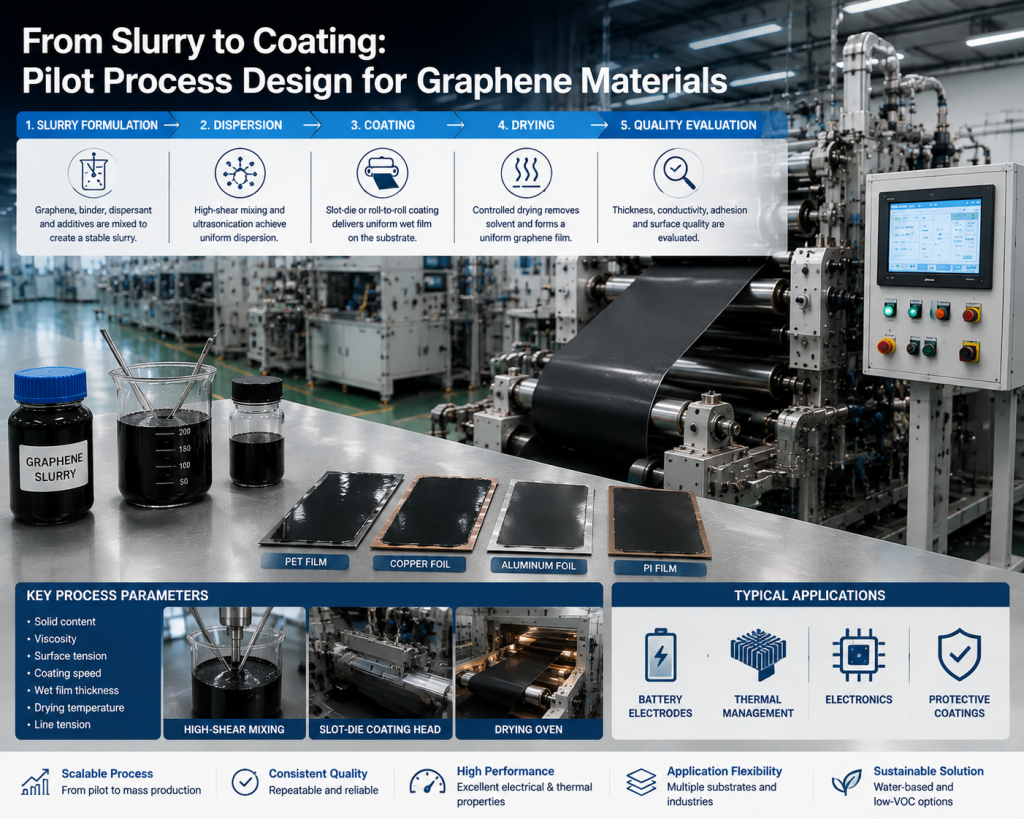
From Slurry to Coating: Pilot Process Design for Graphene Materials
Graphene has demonstrated outstanding potential in applications such as conductive coatings, thermal management films, battery electrodes, and functional composites. However, outstanding material properties alone are not enough to ensure successful industrial adoption.
The critical challenge lies in transforming a laboratory-developed graphene slurry into a stable, repeatable, and scalable coating process.
This transition requires careful pilot process design that connects material formulation with manufacturing capability. Every stage—from slurry preparation to coating and drying—must be optimized to achieve consistent product quality and reliable production.
Why Pilot Process Design Matters
Many graphene projects achieve promising laboratory results but encounter difficulties during scale-up.
Common problems include:
- Inconsistent dispersion
- Coating defects
- Poor adhesion
- Thickness variation
- Batch-to-batch inconsistency
Pilot process design helps identify these issues before mass production by validating both materials and manufacturing conditions under realistic operating environments.
Step 1: Slurry Formulation
The first stage is developing a stable graphene slurry.
A practical formulation typically includes:
- Graphene or graphene-based materials
- Binder system
- Dispersing agents
- Functional additives
- Water or other suitable solvent
The objective is to achieve a formulation that combines good dispersion stability with suitable processing characteristics.
Key considerations include:
- Solid content
- Viscosity
- Surface tension
- Particle distribution
- Storage stability
Step 2: Dispersion Optimization
Graphene sheets naturally tend to restack because of strong interactions between particles.
Without effective dispersion, the slurry may suffer from:
- Particle aggregation
- Non-uniform conductivity
- Surface defects
- Reduced coating performance
Pilot-scale mixing allows engineers to optimize dispersion methods while maintaining graphene structure and minimizing damage.
Step 3: Process Window Definition
Before coating begins, engineers establish a practical process window.
Typical variables include:
- Slurry viscosity
- Coating speed
- Pump flow rate
- Wet film thickness
- Line tension
- Ambient conditions
A well-defined process window improves repeatability and reduces production variability.
Step 4: Pilot Coating
Pilot coating bridges laboratory research and industrial manufacturing.
Common coating technologies include:
Slot-Die Coating
Suitable for:
- Precise film thickness
- High material utilization
- Continuous pilot production
Roll-to-Roll Coating
Designed for:
- Large-area manufacturing
- Flexible substrates
- Continuous processing
Spray Coating
Often selected for:
- Complex geometries
- Functional surface treatments
- Prototype development
The preferred method depends on the application and product requirements.
Step 5: Drying and Film Formation
Drying is more than simply removing solvent.
It influences:
- Film integrity
- Surface smoothness
- Adhesion
- Electrical performance
- Mechanical durability
Drying parameters should be optimized to promote uniform film formation while minimizing internal stress and defects.
Step 6: Quality Evaluation
After coating, the material is evaluated using a range of quality indicators.
Typical assessments include:
- Coating thickness
- Surface uniformity
- Adhesion
- Electrical conductivity
- Thermal performance
- Visual inspection
Consistent quality data helps define manufacturing standards for future production.
Common Challenges During Pilot Trials
Several issues frequently appear during pilot validation.
Dispersion Instability
Poor particle distribution can lead to inconsistent coating quality.
Edge Effects
Improper flow control may cause non-uniform coating near the substrate edges.
Drying Defects
Uneven drying may create cracks, wrinkles, or thickness variations.
Process Repeatability
Small changes in operating conditions can influence final coating performance.
Early identification of these issues improves scalability.
Designing for Industrial Scale
Successful pilot development should consider future production requirements from the beginning.
Important factors include:
- Continuous processing capability
- Material utilization
- Equipment compatibility
- Production efficiency
- Quality control strategy
A process that performs well on a pilot line is more likely to transition smoothly to commercial manufacturing.
The Role of Advanced Carbon Materials
Graphene is often combined with other advanced carbon materials to improve overall performance.
Examples include:
- Carbon nanotubes (CNTs) for conductive network formation
- Hybrid carbon systems for multifunctional coatings
- Functional fillers for mechanical reinforcement
Pilot validation helps determine the optimal formulation for each application.
Applications of Pilot-Coated Graphene Materials
Pilot-scale graphene coatings support a wide range of industries.
Examples include:
Battery Manufacturing
- Conductive electrode coatings
- Current collector modification
- Advanced electrode structures
Thermal Management
- Heat-spreading films
- Thermal interface coatings
- Electronic cooling components
Industrial Electronics
- Conductive coatings
- EMI shielding layers
- Smart functional surfaces
Protective Coatings
- Corrosion-resistant films
- Wear-resistant coatings
- Multifunctional barrier layers
Future Trends
Graphene coating technologies continue to evolve toward:
- Water-based formulations
- Higher production speeds
- Digital process monitoring
- AI-assisted coating optimization
- Sustainable manufacturing
Pilot process design will remain essential for converting laboratory innovation into scalable industrial production.
The journey from graphene slurry to an industrial coating is a complex engineering process that requires much more than an excellent material.
Successful commercialization depends on integrating formulation development, dispersion control, pilot coating, drying optimization, and quality evaluation into a robust manufacturing workflow.
Pilot process design provides the critical bridge between laboratory research and industrial production, reducing technical risk while improving manufacturing consistency and scalability.
As graphene applications continue to expand, companies that combine advanced material expertise with strong pilot manufacturing capabilities will be better positioned to accelerate commercialization and deliver reliable industrial solutions.