
From Prototype to Product: Graphene in Industrial Applications
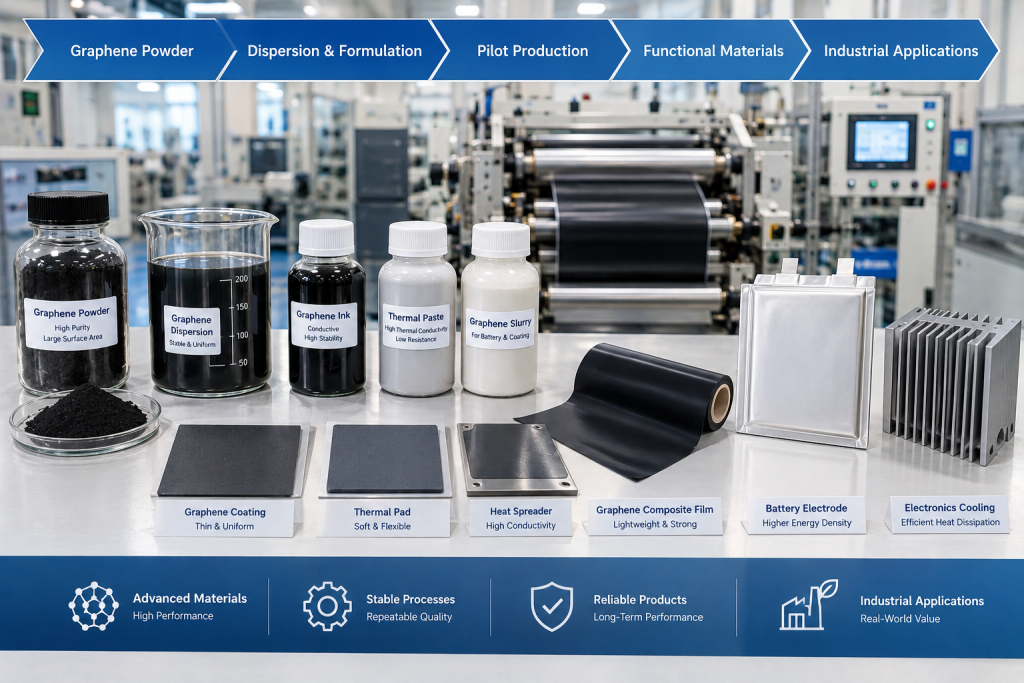
Graphene has moved far beyond the stage of being a purely laboratory-scale material.
Over the past decade, researchers and industrial developers have explored graphene for applications ranging from conductive coatings and thermal management materials to energy storage, EMI shielding, composites, sensors, inks, and advanced functional surfaces.
Yet there is a major difference between demonstrating that graphene works in a laboratory experiment and developing a graphene-based product that customers can purchase, manufacture, qualify, and use reliably.
The transition from prototype to product is where many graphene projects encounter their greatest challenges.
A successful industrial graphene product must combine material performance with processability, consistency, reliability, cost control, equipment compatibility, quality assurance, and application-specific performance.
In other words, industrialization is not simply about producing more graphene.
It is about engineering graphene into a product that solves a real industrial problem.
The Gap Between a Graphene Prototype and a Commercial Product
A laboratory prototype usually answers a relatively simple question:
Can graphene improve the target property?
A commercial product must answer much more difficult questions:
- Can the material be produced consistently?
- Can it be processed using industrial equipment?
- Can performance be maintained from batch to batch?
- Can customers integrate it into their existing process?
- Can the product survive long-term operation?
- Can production costs support a viable business model?
- Can the material pass customer qualification?
- Can supply remain stable as demand increases?
This creates a fundamental difference between research and industrial development.
A prototype demonstrates technical feasibility.
A product demonstrates repeatable industrial value.
Step 1: Define the Industrial Problem
Successful graphene commercialization usually begins with an application problem rather than with graphene itself.
For example, a customer may need:
- Higher thermal conductivity
- Lower electrical resistance
- Better EMI shielding
- Improved corrosion resistance
- Higher mechanical strength
- Better wear resistance
- Improved electrode conductivity
- Higher coating durability
- Lower material weight
Graphene is then evaluated as a potential solution.
This approach is more effective than simply searching for applications for a particular graphene powder.
The industrial question should therefore be:
What performance problem is the customer trying to solve?
Once the problem is clearly defined, graphene can be evaluated against alternative materials and technologies.
Step 2: Select the Right Graphene Material
“Graphene” is not a single standardized material.
Different applications may require completely different graphene characteristics.
Relevant parameters can include:
- Number of layers
- Lateral flake size
- Thickness
- Surface area
- Carbon purity
- Defect density
- Oxygen content
- Electrical conductivity
- Thermal conductivity
- Surface chemistry
- Moisture content
- Residual impurities
- Dispersion behavior
For example, a graphene material optimized for conductive ink may not be the best choice for a polymer thermal composite.
Similarly, graphene oxide designed for chemical functionalization has very different characteristics from highly conductive graphene nanoplatelets.
Therefore, industrial product development must begin with application-specific material selection.
Step 3: Develop the Formulation
In many industrial applications, graphene is not sold as a standalone powder.
It becomes part of a formulation.
Examples include:
- Graphene ink
- Graphene coating
- Graphene-polymer composite
- Graphene thermal interface material
- Graphene conductive paste
- Graphene battery slurry
- Graphene masterbatch
- Graphene adhesive
- Graphene anticorrosion coating
The formulation determines how graphene interacts with the rest of the system.
A material with excellent intrinsic properties can provide limited benefit if it cannot be properly dispersed or integrated into the matrix.
This is why formulation development is often more important than simply increasing graphene purity or conductivity.
Dispersion Is Often the Hidden Challenge
Graphene has a strong tendency to agglomerate.
At laboratory scale, researchers can often overcome this through carefully controlled mixing, sonication, or other dispersion methods.
Industrial processing is more complicated.
Large batches introduce changes in:
- Shear conditions
- Mixing efficiency
- Temperature
- Residence time
- Feeding sequence
- Viscosity
- Equipment geometry
Poor dispersion can result in inconsistent product performance.
For example, a graphene coating may show excellent conductivity in one area but much lower conductivity in another because the graphene network is not uniformly distributed.
Therefore, industrial graphene development requires a repeatable dispersion process, not simply a successful laboratory dispersion.
Step 4: Move From Laboratory to Pilot Scale
Pilot production is the bridge between formulation development and commercial manufacturing.
At this stage, the objective is no longer to produce the smallest possible quantity of material.
The objective is to reproduce the material under conditions that are closer to industrial production.
A pilot process can reveal problems that are difficult to identify in laboratory experiments.
These may include:
- Slurry instability
- Sedimentation
- Agglomeration
- Excessive viscosity
- Pumping difficulties
- Filter blockage
- Coating defects
- Uneven drying
- Batch-to-batch variation
Pilot-scale trials therefore provide critical information about the real manufacturing process.
Pilot Production Should Establish a Process Window
A good pilot project should not simply produce a larger batch.
It should identify the acceptable operating range.
For example:
Mixing speed → mixing time → temperature → viscosity → coating speed → drying conditions → final performance
Each parameter may affect the next stage.
The result should be a defined process window within which the product can be manufactured consistently.
This process knowledge becomes extremely valuable when moving toward commercial production.
Step 5: Validate Industrial Processing
A graphene product must fit into a real manufacturing environment.
This is one of the most important differences between a laboratory material and an industrial material.
Consider a graphene coating.
The customer may already have:
- A roll-to-roll coating line
- A slot-die coater
- A gravure system
- A spray system
- A screen-printing process
- An oven
- A curing system
The graphene formulation must be compatible with the existing process.
Important parameters may include:
- Viscosity
- Surface tension
- Solid content
- Drying temperature
- Coating speed
- Wet-film thickness
- Substrate compatibility
- Curing conditions
A product that requires a completely new manufacturing system may face a much higher barrier to adoption.
Step 6: Test the Finished Product
Material-level testing is not enough.
Industrial customers ultimately purchase a finished product or functional component.
Therefore, testing should progressively move through several levels:
Raw material → formulation → intermediate → finished product → application → system
For a graphene thermal material, for example, testing may progress from graphene thermal conductivity to composite thermal conductivity and finally to actual thermal performance in a device.
For a graphene battery additive, evaluation may progress from powder conductivity to slurry properties, electrode performance, and full-cell cycling.
The closer testing gets to the customer’s real application, the more commercially meaningful the results become.
Application-Specific Performance Matters
Graphene’s value depends heavily on the application.
A customer may not care whether a graphene material has an impressive laboratory conductivity number.
They may care about:
- Temperature reduction
- Cycle life
- Corrosion resistance
- Production speed
- Energy consumption
- Weight reduction
- Product lifetime
- Failure rate
- Total cost
Therefore, industrial graphene development should translate material properties into application-level benefits.
Instead of saying:
“Graphene has high thermal conductivity.”
A more useful industrial statement is:
“The graphene-enhanced interface material reduces thermal resistance under the customer’s operating conditions.”
The second statement directly addresses the customer’s problem.
Reliability Validation
A prototype can work for a few hours.
A commercial product may need to work for years.
This makes reliability testing essential.
Depending on the application, testing may include:
- Thermal cycling
- High-temperature aging
- Humidity exposure
- Mechanical fatigue
- Electrical cycling
- Corrosion testing
- Abrasion testing
- Chemical exposure
- UV exposure
- Repeated charge-discharge cycles
The objective is to determine whether the graphene network and the surrounding matrix remain stable throughout the expected service life.
Batch-to-Batch Consistency
Consistency is one of the most important requirements for industrial graphene.
A customer does not want one excellent batch followed by another batch with significantly different performance.
Important quality parameters may include:
| Material / Product | Key Quality Parameters |
|---|---|
| Graphene powder | Layer number, particle size, purity, conductivity |
| Graphene dispersion | Concentration, viscosity, stability |
| Graphene ink | Conductivity, viscosity, surface tension |
| Thermal composite | Thermal conductivity, density, hardness |
| Conductive coating | Sheet resistance, thickness, adhesion |
| Battery additive | Dispersion, conductivity, moisture |
| Graphene masterbatch | Graphene content, dispersion, melt processability |
A well-designed quality-control system converts these parameters into measurable specifications.
Quality Control Must Start With Raw Materials
Industrial consistency cannot be created at the final inspection stage alone.
It begins with raw-material control.
Graphene batches should be evaluated according to the parameters that are actually relevant to the application.
Depending on the product, these may include:
- Particle-size distribution
- Moisture
- Ash content
- Surface chemistry
- Raman characteristics
- Specific surface area
- Electrical conductivity
- Thermal properties
- Dispersion stability
The exact specification should be determined by the final application rather than by creating an unnecessarily large list of laboratory measurements.
Cost Is Part of Product Development
A graphene product can be technically excellent and still fail commercially if its economics do not work.
Industrial customers evaluate the total cost impact.
This includes:
- Graphene material cost
- Formulation cost
- Processing cost
- Energy consumption
- Equipment requirements
- Labor
- Scrap
- Yield
- Packaging
- Logistics
- Quality control
The key metric is therefore often not the price per kilogram of graphene.
It is the cost of achieving the required functional performance.
If a small amount of graphene can replace a much larger amount of conventional conductive or thermal filler, the economics may be attractive even if graphene itself is more expensive per kilogram.
Cost Per Function Is More Meaningful Than Cost Per Kilogram
Consider two materials.
Material A costs less per kilogram but requires 10% loading.
Material B costs more per kilogram but achieves the required performance at 1% loading.
Comparing only price per kilogram may lead to the wrong conclusion.
Industrial development should instead consider:
Cost per unit of required performance.
This can be particularly important for high-value applications such as:
- Power electronics
- AI infrastructure
- Battery systems
- Aerospace
- Advanced coatings
- Specialty composites
Customer Qualification Is a Separate Stage
Even after a graphene product passes internal testing, customers may require their own qualification process.
A customer may test:
- Performance
- Reliability
- Compatibility
- Safety
- Production stability
- Environmental resistance
- Documentation
- Supply consistency
This process can take significantly longer than the original laboratory development.
Therefore, graphene commercialization should include customer qualification as part of the development roadmap rather than treating it as the final administrative step.
Co-Development Can Accelerate Commercialization
For many advanced graphene applications, supplier and customer need to work together.
The customer understands the application and manufacturing environment.
The graphene supplier understands:
- Material characteristics
- Dispersion
- Formulation
- Processing
- Scale-up
Combining these capabilities can shorten the development cycle.
A typical co-development model may involve:
Customer requirement → material screening → formulation → prototype → pilot trial → application testing → optimization → qualification → production
This approach can be particularly effective when the graphene product needs to be customized for a specific process.
Design for Manufacturing
One of the most important lessons in industrial graphene development is to consider manufacturing from the beginning.
A laboratory formulation may use:
- Small-volume mixing
- Manual coating
- Long drying times
- Highly controlled conditions
Commercial manufacturing may require:
- Continuous mixing
- High-speed coating
- Automated feeding
- Controlled drying
- Inline inspection
- High material utilization
A formulation that cannot transition between these environments may require significant redesign.
Therefore, design for manufacturing should be considered during the prototype stage.
Scale-Up Does Not Mean Simply Making More Material
Scaling graphene production or graphene formulations is not a linear process.
Changing from 1 liter to 100 liters can change:
- Mixing behavior
- Heat transfer
- Shear distribution
- Dispersion time
- Material residence time
- Foaming
- Sedimentation
Similarly, increasing coating width and speed can change:
- Wet-film stability
- Drying requirements
- Coating uniformity
- Edge quality
- Defect rates
This is why pilot-scale equipment is so important.
It allows developers to understand the physical processes that control product quality before committing to full-scale production.
Digital Process Monitoring
As graphene manufacturing becomes more industrialized, process monitoring can improve consistency.
Relevant parameters may include:
- Mixing torque
- Temperature
- Viscosity
- Pressure
- Flow rate
- Coating thickness
- Drying temperature
- Surface resistance
- Thermal performance
Collecting these parameters allows manufacturers to connect process conditions with final product performance.
Over time, this can support statistical process control and predictive quality management.
Sustainability and Resource Efficiency
Industrial graphene development is also increasingly connected with sustainability.
Customers may evaluate:
- Solvent consumption
- Energy consumption
- Waste generation
- Material utilization
- Recycling
- Production yield
- Process emissions
Water-based formulations, efficient coating technologies, lower filler loading, and improved production yield can all contribute to a more sustainable graphene product.
Sustainability therefore should not be treated as a separate marketing feature.
It can be part of the overall manufacturing strategy.
The Industrialization Roadmap
A practical graphene product-development roadmap can be summarized as:
1. Identify the application problem
↓
2. Define performance requirements
↓
3. Select graphene material
↓
4. Develop formulation
↓
5. Produce laboratory prototype
↓
6. Validate application performance
↓
7. Conduct pilot-scale production
↓
8. Establish process window
↓
9. Conduct reliability testing
↓
10. Complete customer qualification
↓
11. Optimize production economics
↓
12. Scale to commercial production
Each stage reduces a different type of risk.
Skipping stages may accelerate early development but can create much greater problems later.
What Makes a Graphene Product Commercially Successful?
A successful graphene product does not necessarily contain the highest-quality graphene.
It does not necessarily have the highest graphene concentration.
And it does not necessarily demonstrate the highest laboratory performance.
Instead, commercial success usually comes from achieving the right balance between:
Performance + Processability + Consistency + Reliability + Cost
This is the foundation of industrial graphene development.
A slightly less advanced material that can be produced consistently at a competitive cost may have a much greater commercial opportunity than a scientifically superior material that is difficult to manufacture.
From Prototype to Product
The graphene industry is gradually moving from a material-centric development model toward an application-centric model.
The key question is no longer simply:
“What can graphene do?”
The more commercially relevant question is:
“Where can graphene create measurable value within an existing industrial process?”
This shift changes how graphene products should be developed.
Material properties remain important, but they must be connected to formulation, manufacturing, application performance, reliability, and economics.
Pilot production becomes the bridge.
Customer testing becomes part of product development.
Process control becomes as important as material characterization.
And cost becomes part of technical design.
The journey from graphene prototype to industrial product is a complex engineering process.
It requires much more than producing high-quality graphene powder.
Developers must understand the customer’s problem, select the appropriate graphene structure, develop a stable formulation, establish a scalable process, validate application performance, control batch-to-batch variation, complete reliability testing, and demonstrate commercial economics.
Pilot-scale production plays a particularly important role because it reveals the manufacturing challenges that laboratory experiments cannot fully capture.
Ultimately, the value of graphene is determined not by its reputation as an extraordinary nanomaterial, but by its ability to deliver repeatable, measurable, and economically meaningful improvements in real industrial products.
The companies most likely to succeed in graphene commercialization will therefore be those that can connect material science with process engineering, pilot production, quality control, customer qualification, and application-specific design.
That is the real journey from prototype to product.