
Graphene Thermal Management Materials: Pilot-Scale Validation
Graphene has attracted considerable attention in thermal management because of its exceptional intrinsic thermal conductivity, large surface area, low density, and compatibility with a wide range of polymer and composite systems.
However, the thermal conductivity of graphene measured at the material or nanoscale level does not automatically translate into improved thermal performance in a commercial thermal management product.
The real challenge begins when graphene moves from laboratory formulation to pilot-scale manufacturing.
For thermal interface materials, coatings, heat spreaders, thermal pads, thermal composites, and other heat-management products, pilot-scale validation must demonstrate that graphene can maintain its functional advantages while remaining compatible with mixing, dispersion, coating, curing, forming, assembly, and quality-control processes.
This makes pilot-scale validation a critical bridge between graphene research and commercial thermal management applications.
Why Laboratory Thermal Conductivity Is Not Enough
Graphene can exhibit extremely high intrinsic thermal conductivity under ideal conditions.
Yet a graphene-enhanced composite may show a much lower effective thermal conductivity.
The difference comes from the structure of the final material.
Several factors influence thermal transport:
- Graphene loading
- Graphene flake size
- Layer structure
- Dispersion quality
- Filler orientation
- Polymer matrix properties
- Interfacial thermal resistance
- Filler-filler contact
- Porosity
- Processing conditions
- Composite thickness
In a real thermal management product, heat must travel through multiple interfaces.
Therefore, the relevant question is not simply:
“How conductive is the graphene?”
The more important question is:
“How effectively does the graphene network transfer heat through the final engineered material?”
Pilot-scale validation is designed to answer that question.
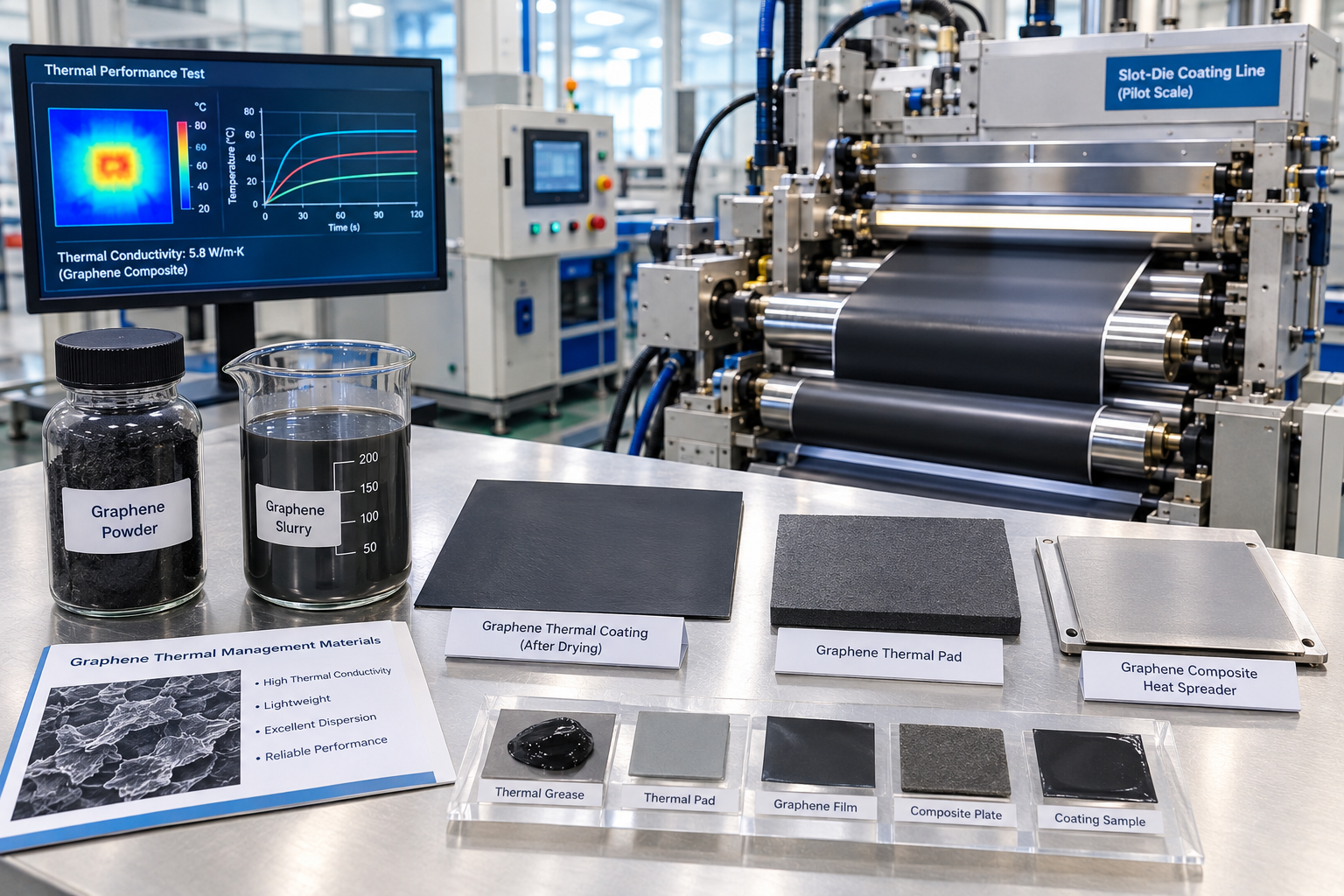
From Graphene Powder to Thermal Management Material
The industrial development pathway usually involves several stages:
Graphene powder → dispersion → formulation → composite processing → pilot production → thermal testing → reliability validation → commercial production
At laboratory scale, researchers may prepare a few grams or hundreds of grams of material.
Pilot production introduces completely different variables.
Mixing energy, batch volume, residence time, temperature, shear rate, coating speed, drying conditions, and material handling can all influence the final graphene network.
A formulation that performs well in a laboratory beaker may therefore behave differently in a pilot-scale mixer.
This is one reason why scale-up should be treated as a process-development problem rather than simply increasing the batch size.
Graphene Dispersion Is a Critical Step
One of the most important variables in graphene thermal composites is dispersion.
Graphene sheets have a strong tendency to interact with each other and form agglomerates.
Poor dispersion can create several problems:
- Localized graphene-rich regions
- Uneven thermal conductivity
- Increased viscosity
- Coating defects
- Poor mechanical properties
- Reduced reproducibility
- Difficult process control
A well-dispersed graphene system, by contrast, can create more continuous thermal transport pathways throughout the matrix.
This means dispersion quality should be evaluated together with thermal performance.
A material with a higher graphene concentration but poor dispersion may perform worse than a lower-loading formulation with a more effective conductive network.
Pilot-Scale Mixing Changes the Dispersion Problem
Laboratory mixing and pilot-scale mixing are not equivalent.
When the batch volume increases, the relationship between:
- Shear rate
- Mixing time
- Power input
- Temperature
- Viscosity
- Residence time
can change significantly.
A laboratory formulation may require a particular mixing sequence to achieve uniform dispersion.
At pilot scale, that same sequence may produce insufficient dispersion or excessive shear.
Therefore, pilot-scale development should establish a reproducible mixing window rather than relying on a fixed laboratory recipe.
Important variables may include:
- Mixing speed
- Mixing time
- Addition sequence
- Filler feeding rate
- Matrix temperature
- Vacuum conditions
- Dispersant concentration
- Solvent content
The objective is to create a process that can consistently produce the same thermal network from batch to batch.
Graphene Loading Must Be Optimized
Increasing graphene concentration does not necessarily produce a proportional increase in thermal conductivity.
At low concentrations, graphene particles may remain isolated.
As concentration increases, conductive pathways begin to form.
Once a sufficiently connected network is established, thermal conductivity can increase more rapidly.
Beyond a certain point, however, additional graphene may provide diminishing returns.
Excessive loading can also cause:
- Higher viscosity
- Poor processability
- Increased material cost
- Reduced flexibility
- Difficult coating
- Poor wetting
- Increased agglomeration
The optimum formulation is therefore determined by the complete balance between thermal performance and manufacturing requirements.
Thermal Percolation and Network Formation
Graphene-based thermal composites often rely on the formation of a continuous heat-transfer network.
This is related to the concept of thermal percolation.
Before network formation, heat must travel mainly through the matrix.
Once graphene sheets begin connecting with each other, additional heat-transfer pathways become available.
However, thermal transport through such a network is influenced by contact resistance between graphene structures.
Therefore, a high graphene loading alone does not guarantee efficient thermal transport.
The quality of the network is equally important.
This is why pilot-scale characterization should include both thermal conductivity measurements and structural analysis.
Orientation Can Influence Thermal Performance
Graphene is highly anisotropic.
Heat transport along the graphene plane can be substantially different from transport through the thickness direction.
This becomes particularly important for thermal management products with a defined heat-flow direction.
For example, a thermal coating, thermal pad, or heat-spreading film may require different thermal properties in-plane and through-plane.
Processing conditions can influence graphene orientation.
Coating shear, calendaring, extrusion, compression, and other manufacturing operations may cause graphene sheets to align.
Therefore, pilot-scale validation should determine whether the manufacturing process creates the desired orientation.
Coating and Film Manufacturing
Graphene thermal coatings are particularly sensitive to process conditions.
A graphene-containing coating formulation must provide sufficient thermal performance while also maintaining:
- Stable viscosity
- Good wetting
- Uniform coating thickness
- Strong substrate adhesion
- Controlled drying
- Low defect density
- Reproducible surface morphology
At pilot scale, coating speed becomes an important variable.
Increasing coating speed can change wet-film formation, solvent evaporation, drying behavior, and graphene distribution.
The final thermal conductivity may therefore differ from laboratory samples produced using slower manual coating.
This is why pilot coating trials are essential before commercial scale-up.
Drying Conditions Can Change Thermal Networks
For solvent-based or water-based graphene formulations, drying is more than a solvent-removal step.
As the liquid phase evaporates, graphene sheets and other components move closer together.
The drying rate can influence:
- Graphene distribution
- Agglomeration
- Film density
- Porosity
- Surface roughness
- Internal stress
- Thermal pathways
Rapid drying may create concentration gradients or surface defects.
Very slow drying may increase production time and alter particle migration.
Pilot-scale drying trials should therefore evaluate temperature, airflow, residence time, and film thickness together.
Curing and Polymer Matrix Effects
For graphene-enhanced polymer thermal materials, curing is another critical stage.
The polymer matrix determines mechanical properties, flexibility, adhesion, and thermal stability.
The curing process can also influence the graphene network.
Important parameters may include:
- Cure temperature
- Cure time
- Crosslinking conditions
- Heating rate
- Atmosphere
- Matrix viscosity during curing
If the polymer shrinks significantly during curing, graphene sheets may become more closely connected.
In other systems, excessive crosslinking or poor compatibility may restrict graphene movement and reduce effective thermal transport.
Therefore, thermal performance should be measured after the complete curing process rather than only in the uncured formulation.
Thermal Interface Materials Require More Than High Conductivity
Thermal interface materials, or TIMs, illustrate the difference between laboratory performance and practical performance.
A TIM must not only conduct heat.
It must also fill microscopic surface irregularities between two components.
A useful TIM therefore requires a combination of:
- Thermal conductivity
- Low interfacial resistance
- Appropriate viscosity or softness
- Good surface conformity
- Mechanical stability
- Electrical properties appropriate to the application
- Long-term reliability
A graphene-enhanced TIM with high bulk thermal conductivity may still perform poorly if it cannot establish good contact with the mating surfaces.
For this reason, pilot-scale testing should include actual interface measurements rather than relying only on bulk thermal conductivity.
Measuring Thermal Performance at Pilot Scale
A robust pilot-scale validation program should use multiple measurement methods.
Depending on the product, these may include:
- In-plane thermal conductivity
- Through-plane thermal conductivity
- Thermal diffusivity
- Thermal resistance
- Interfacial thermal resistance
- Thermal impedance
- Temperature rise under controlled power
- Infrared thermal imaging
Different techniques measure different aspects of thermal behavior.
For example, a material may demonstrate excellent in-plane heat spreading but relatively limited through-plane conductivity.
Therefore, the test method must match the intended application.
Pilot-Scale Validation Should Include Process Data
Thermal performance is only one part of pilot-scale validation.
Process data should also be collected.
Typical parameters include:
| Category | Example Parameters |
|---|---|
| Dispersion | Particle/agglomerate size, stability |
| Rheology | Viscosity, shear behavior |
| Coating | Speed, thickness, uniformity |
| Drying | Temperature, residence time |
| Curing | Temperature, time, conversion |
| Thermal | Conductivity, diffusivity, resistance |
| Mechanical | Adhesion, flexibility, strength |
| Reliability | Thermal cycling, aging |
| Quality | Batch-to-batch variation |
This data provides the basis for establishing a practical process window.
Thermal Cycling Is Essential
A thermal management material may experience thousands of heating and cooling cycles during its service life.
Repeated temperature changes can generate mechanical stress because different materials have different coefficients of thermal expansion.
For graphene-polymer composites, thermal cycling can affect:
- Polymer matrix integrity
- Graphene-matrix interfaces
- Adhesion
- Internal microcracks
- Thermal resistance
- Electrical properties
Pilot-scale samples should therefore be subjected to thermal cycling before commercial qualification.
The important question is not only whether the initial thermal conductivity is high, but whether the material can maintain its performance after repeated thermal stress.
Moisture and Environmental Stability
Environmental exposure can also influence graphene-based thermal materials.
Depending on the matrix and application, relevant conditions may include:
- High humidity
- Temperature cycling
- Salt exposure
- UV exposure
- Chemical contact
- High-temperature aging
For electronics, EVs, battery systems, and outdoor energy infrastructure, environmental stability can be just as important as initial thermal conductivity.
Pilot-scale validation should therefore reproduce realistic environmental conditions whenever possible.
Electrical Conductivity Must Also Be Considered
Graphene is electrically conductive.
This can be beneficial in applications where electrical conductivity is desired, but it can be problematic where electrical insulation is required.
For example, certain thermal interface applications require:
High thermal conductivity + low electrical conductivity.
Adding graphene may improve thermal transport while simultaneously increasing electrical conductivity.
Therefore, formulation development may need to balance graphene with electrically insulating fillers or surface modifications.
This illustrates an important principle:
Thermal optimization cannot be separated from the electrical requirements of the final application.
Scale-Up Can Reveal Hidden Manufacturing Problems
Pilot production often exposes problems that are invisible in laboratory experiments.
Examples include:
- Mixer dead zones
- CNT or graphene agglomeration
- Sedimentation
- Viscosity drift
- Coating streaks
- Filter blockage
- Foaming
- Poor substrate adhesion
- Uneven drying
- Thickness variation
These problems may have little relationship to the intrinsic properties of graphene.
They are process-engineering problems.
This is precisely why pilot-scale validation is so valuable.
It identifies the difference between a material that works in principle and a material that can be manufactured consistently.
Establishing a Pilot-Scale Process Window
A successful pilot project should not simply produce several batches of graphene thermal material.
It should establish a process window.
For example, the development team may determine acceptable ranges for:
- Graphene concentration
- Mixing speed
- Mixing time
- Slurry viscosity
- Coating speed
- Wet-film thickness
- Drying temperature
- Curing temperature
- Final density
- Thermal conductivity
Operating within this window should produce stable product quality.
A defined process window is one of the most important outputs of pilot-scale development because it provides a foundation for future scale-up.
Batch-to-Batch Consistency
Commercial customers typically require much more than a high-performing prototype.
They need consistent products.
Two batches produced one month apart should demonstrate comparable:
- Thermal conductivity
- Thickness
- Density
- Viscosity
- Adhesion
- Mechanical properties
- Reliability
This makes statistical process control increasingly important as graphene thermal materials move toward commercialization.
Pilot production provides enough material and process history to begin evaluating this consistency.
From Pilot Validation to Commercial Production
Once the pilot process is validated, the next step is larger-scale production.
However, scale-up should not be treated as simply multiplying every parameter by a constant factor.
Equipment geometry, heat transfer, mixing efficiency, drying capacity, material residence time, and coating width can all change.
The pilot line therefore serves as an intermediate engineering platform.
It allows developers to identify which parameters are fundamental to product performance and which parameters are specific to laboratory equipment.
This information can dramatically reduce the risk of commercial-scale failures.
Why Pilot-Scale Validation Matters for Graphene Thermal Materials
Graphene offers extraordinary potential for thermal management, but industrial value depends on more than intrinsic material properties.
A commercially successful graphene thermal material must satisfy four requirements simultaneously:
Thermal performance + processability + reliability + economic feasibility.
Pilot-scale validation provides the environment where these four factors can be evaluated together.
It connects graphene science with real manufacturing conditions.
It also creates the data needed to optimize formulation, establish process windows, improve quality control, and prepare for larger-scale production.
Graphene thermal management materials represent an important opportunity for advanced electronics, batteries, EV power systems, AI infrastructure, power electronics, and other high-heat-flux applications.
But the path from graphene’s exceptional intrinsic thermal conductivity to a reliable commercial thermal management product is not straightforward.
Dispersion, filler loading, orientation, matrix compatibility, coating, drying, curing, interface resistance, thermal cycling, and environmental stability can all influence the final result.
This is why pilot-scale validation is so important.
The objective is not simply to demonstrate that graphene can improve thermal conductivity in a laboratory sample.
The objective is to determine whether graphene can create a repeatable, manufacturable, reliable, and economically viable thermal-management solution.
For industrial developers, the most valuable pilot-scale result is therefore not a single record thermal-conductivity number.
It is a validated process that consistently produces the required thermal performance under realistic manufacturing and operating conditions.
That is the point where graphene thermal management moves from promising material technology toward industrial application.