
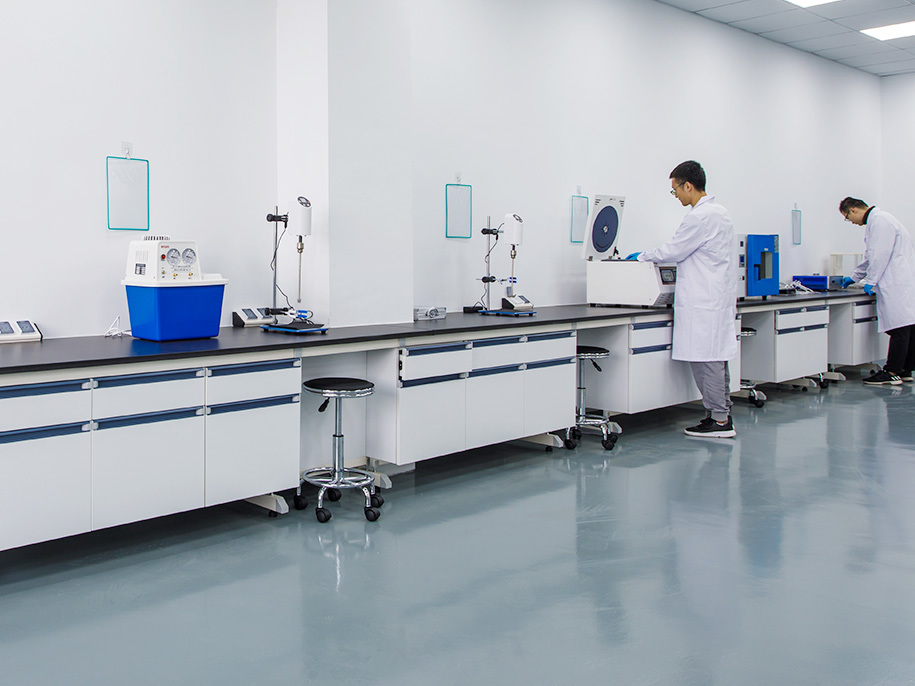
From Small Batch to Roll-to-Roll: The Scaling Challenge
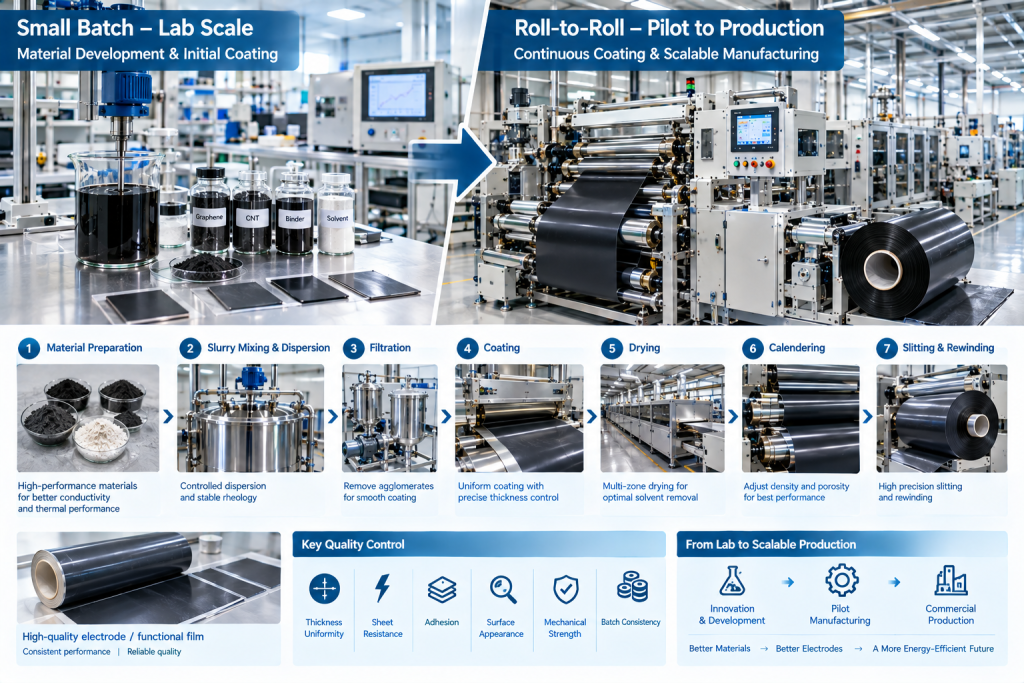
Many advanced-material products begin with a small batch.
A researcher may prepare a few hundred grams of graphene dispersion, CNT slurry, conductive ink, thermal coating, or battery electrode formulation and successfully produce a small laboratory sample.
The results may look promising.
The material disperses.
The coating is uniform.
The electrical or thermal performance reaches the target.
The prototype works.
Then the project reaches an important transition point:
How do you move from small-batch production to continuous roll-to-roll manufacturing?
This is where many advanced-material projects encounter unexpected challenges.
Roll-to-roll (R2R) processing offers major advantages for large-area films, coatings, conductive layers, thermal materials, battery electrodes, flexible electronics, and other continuous products.
However, R2R manufacturing is not simply a larger version of laboratory coating.
It introduces continuous material flow, web handling, coating stability, drying constraints, tension control, startup and shutdown losses, inline quality requirements, and much longer operating times.
The challenge is therefore not just producing more material.
It is maintaining stable material behavior and consistent product quality over time and across an entire moving web.
What Changes When a Small Batch Becomes a Roll-to-Roll Process?
At laboratory scale, production may involve:
Small batch → manual mixing → small-area coating → laboratory drying → sample testing
A roll-to-roll process may involve:
Larger batch → controlled dispersion → pumping → filtration → continuous coating → multi-zone drying → curing → rewinding → inline inspection
Each additional stage introduces another source of variation.
The laboratory experiment asks:
“Can we make a good sample?”
The R2R process asks:
“Can we make a good product continuously?”
That difference defines the scaling challenge.
Why Small-Batch Success Is Not Enough
Small-batch experiments are valuable because they allow developers to screen materials and formulations quickly.
They also make it easier to adjust:
- Material ratios
- Mixing conditions
- Solvent content
- Binder concentration
- Conductive additive loading
- Drying conditions
But laboratory processing often has a high degree of manual control.
A researcher can visually inspect the slurry.
The coating can be stopped immediately when a defect appears.
The sample can be dried slowly.
A formulation can be remixed before every experiment.
Continuous manufacturing does not provide the same flexibility.
Once the web is moving, every process variable has to remain inside an acceptable operating window.
The First Challenge: Batch Size
Moving from a small laboratory vessel to a larger mixing tank changes the process environment.
Mixing geometry changes.
Fluid circulation changes.
Heat transfer changes.
Residence time changes.
Shear distribution changes.
This is particularly important for graphene and CNT systems because their dispersion behavior can be highly sensitive to processing conditions.
A laboratory batch may achieve excellent dispersion under a specific mixing sequence.
A larger batch may produce:
- Larger agglomerates
- Different viscosity
- Longer dispersion time
- Temperature gradients
- Incomplete circulation
Therefore, scale-up should preserve the dispersion mechanism, not merely multiply ingredient quantities.
Dispersion Must Remain Stable
For advanced carbon materials, dispersion is often the foundation of the entire R2R process.
CNTs can form bundles.
Graphene can restack.
Carbon black can agglomerate.
Once these structures enter a continuous coating line, the consequences can become much more serious.
Agglomerates may cause:
- Coating streaks
- Pinholes
- Surface roughness
- Local conductivity variation
- Thickness defects
- Filter blockage
A stable dispersion must therefore remain stable not only in the mixing tank but throughout:
Storage → pumping → filtration → coating → drying
This is a much higher standard than simply obtaining good dispersion immediately after mixing.
The Second Challenge: Slurry Rheology
Small-batch coating often provides limited information about full industrial behavior.
R2R coating requires the formulation to flow predictably through pipes, pumps, filters, and the coating head.
Rheology therefore becomes critical.
Relevant properties can include:
- Viscosity
- Shear-thinning behavior
- Yield stress
- Thixotropy
- Temperature sensitivity
The formulation may experience very different shear conditions at different points of the process.
For example:
Mixing → pumping → filtration → slot-die → wet film
The ink or slurry must behave appropriately at each stage.
A formulation that looks stable in a beaker may therefore behave very differently during continuous processing.
The Third Challenge: Pumpability
In a laboratory experiment, slurry may be transferred manually.
In R2R manufacturing, the material usually needs to be pumped continuously.
This introduces additional requirements.
The formulation must:
- Flow consistently
- Avoid excessive pressure buildup
- Minimize pulsation
- Resist sedimentation
- Avoid clogging
- Maintain stable concentration
Pump selection also matters.
Some formulations are sensitive to shear.
Others may be affected by pressure changes or residence time inside the pump and tubing.
Therefore, pumpability should be validated before full R2R operation.
The Fourth Challenge: Filtration
Filtration becomes increasingly important as coating quality requirements become stricter.
Large agglomerates or foreign particles can create visible defects on a continuous web.
However, filtration also introduces trade-offs.
An overly aggressive filter may:
- Increase pressure
- Reduce throughput
- Remove useful conductive structures
- Increase material loss
- Require frequent replacement
A pilot line provides an opportunity to find the right balance between particle removal and material efficiency.
Slot-Die Coating Requires a Stable Process Window
Slot-die coating is particularly attractive for R2R production because it can provide precise and continuous coating.
However, its performance depends strongly on the relationship among:
- Slurry flow rate
- Web speed
- Viscosity
- Surface tension
- Die geometry
- Gap
- Wet thickness
The objective is to create a stable coating window.
When the system operates outside that window, the result may include:
- Uneven coating
- Ribbing
- Streaks
- Edge instability
- Air entrainment
- Thickness variation
Therefore, successful slot-die development requires more than selecting a die.
It requires understanding the interaction between formulation and equipment.
Line Speed Changes Everything
Increasing line speed can improve production efficiency.
However, it also changes the process.
Higher speed means:
- Less residence time in the drying system
- Higher material flow requirements
- Greater sensitivity to web stability
- Different wet-film behavior
- Potentially more difficult defect detection
A coating that works at low speed may not remain stable at a higher speed.
This is why pilot R2R trials should evaluate multiple operating conditions rather than only one target speed.
Wet Thickness Is a Production Variable
In a small laboratory sample, thickness can often be adjusted manually.
In continuous production, thickness must be controlled continuously.
Important factors include:
- Slurry flow
- Web speed
- Coating gap
- Solids content
- Viscosity
- Web tension
Even small changes can affect the final dry-film thickness.
For functional products, thickness may directly influence:
- Electrical resistance
- Thermal performance
- Mass loading
- Adhesion
- Flexibility
- Material cost
Therefore, thickness uniformity is one of the core requirements of R2R manufacturing.
Drying Becomes a Major Bottleneck
Laboratory drying can often be performed slowly.
R2R production is constrained by available drying capacity.
The coated web must travel through the drying system while maintaining sufficient solvent removal before the next process stage.
Higher line speed reduces available drying time.
Thicker coatings increase solvent load.
Higher solids concentration changes evaporation behavior.
Different solvents require different drying conditions.
These variables are highly interconnected.
Multi-Zone Drying
A multi-zone dryer can provide greater process control than a single-temperature oven.
The drying profile can be divided into stages such as:
Initial evaporation → controlled leveling → final solvent removal → curing or post-treatment
This can help manage:
- Binder migration
- Surface skin formation
- Film cracking
- Internal stress
- Residual solvent
The exact drying profile depends on the formulation and substrate.
Pilot production is an important stage for establishing that profile.
Residual Solvent Matters
Incomplete drying can create several problems.
Residual solvent may affect:
- Mechanical properties
- Adhesion
- Electrical performance
- Thermal stability
- Storage stability
In battery electrodes and other sensitive systems, residual solvent can also create downstream processing issues.
Therefore, drying validation should include verification that the final product meets the required solvent-removal conditions.
The Fifth Challenge: Web Tension
A roll-to-roll line is fundamentally a web-handling system.
The substrate must move through multiple rollers while remaining dimensionally stable.
Web tension that is too low can cause:
- Wrinkles
- Lateral movement
- Poor registration
Tension that is too high can contribute to:
- Stretching
- Deformation
- Edge damage
- Mechanical defects
For thin polymer films and metal foils, tension control can be particularly important.
Substrate Compatibility
The same coating can behave differently on different substrates.
Potential substrates include:
- PET
- PI
- Aluminum foil
- Copper foil
- Metal sheets
- Composite films
Surface energy, roughness, cleanliness, and chemical compatibility all influence coating behavior.
Before moving into continuous production, the relationship between formulation and substrate should therefore be validated.
The Sixth Challenge: Coating Starts and Stops
Laboratory samples usually represent the middle of a process.
Commercial R2R production must also deal with startup and shutdown.
At startup:
- Equipment may not yet be thermally stable
- Flow may fluctuate
- Web tension may change
- Coating quality may be unstable
During shutdown:
- Slurry may remain in the system
- Coating heads may need cleaning
- Material may need to be discarded
- The final web section may be off-specification
These losses are often overlooked during early laboratory development.
However, they directly affect production yield.
Material Utilization Becomes Important
Small-batch projects can tolerate relatively high material losses.
Commercial production cannot.
Material may be lost during:
- Mixing
- Tank transfer
- Filtration
- Pump priming
- Line startup
- Coating transitions
- Edge trimming
- Cleaning
For expensive graphene, CNTs, specialty fillers, or customized formulations, these losses can significantly affect economics.
Pilot R2R production provides realistic material-utilization data.
The Seventh Challenge: Long-Duration Stability
A laboratory experiment may run for 20 minutes.
A pilot line may run continuously for hours.
A commercial line may operate for much longer.
During extended operation, new problems can emerge:
- Sedimentation
- Viscosity drift
- Temperature changes
- Filter loading
- Pump wear
- Coating-head contamination
- Dryer temperature variation
A formulation that is stable for a short experiment may therefore not be stable over long continuous production.
Long-duration pilot trials are essential for identifying these problems.
Batch Consistency Is Not Enough
There are actually two levels of consistency.
Batch-to-Batch Consistency
Different batches should have similar properties.
Within-Roll Consistency
The beginning, middle, and end of a roll should also meet the required specifications.
This is a major difference between batch production and continuous manufacturing.
A roll-to-roll product must achieve consistency in both:
Time
and
Position across the web.
Cross-Web Uniformity
A coating may be uniform in the machine direction but still vary across the width.
Possible causes include:
- Uneven die flow
- Pressure differences
- Edge effects
- Substrate deformation
- Drying imbalance
Cross-web variation can lead to functional differences across the final product.
For wide coatings, cross-web inspection becomes increasingly important.
Machine Direction Stability
The opposite problem can also occur.
The coating may vary along the length of the roll.
Potential causes include:
- Slurry concentration drift
- Viscosity changes
- Temperature changes
- Pump pulsation
- Filter loading
- Coating-head contamination
This is why continuous monitoring is valuable.
Inline Quality Control
Laboratory quality control often relies on testing after production.
R2R manufacturing increasingly benefits from inline or at-line inspection.
Possible measurements include:
- Coating thickness
- Surface defects
- Optical appearance
- Sheet resistance
- Web tension
- Temperature
- Width
- Weight per unit area
The more quickly defects can be detected, the less off-specification material is produced.
Electrical Performance Must Remain Uniform
For conductive inks and coatings, electrical uniformity is just as important as visual appearance.
A continuous film may need consistent:
- Sheet resistance
- Conductivity
- Contact resistance
Across:
Batch → Roll → Web width → Finished part
This is particularly important for:
- Printed electronics
- EMI shielding
- Conductive heaters
- Sensors
- Battery electrodes
Thermal Performance Can Also Vary
For thermal coatings and heat-spreading materials, thickness and dispersion variations can produce local differences in thermal behavior.
A roll may therefore need to be characterized for:
- Thermal conductivity
- Thermal resistance
- Heat-spreading performance
This becomes particularly relevant when the material will later be laminated, cut, or integrated into high-performance electronics.
Mechanical Performance Changes With Scale
Continuous processing can introduce mechanical stresses that do not appear in small samples.
Examples include:
- Web bending
- Roller contact
- Drying stress
- Winding tension
- Repeated flexing
These stresses can affect:
- Adhesion
- Flexibility
- Cracking
- Delamination
Therefore, R2R validation should include mechanical evaluation of the final roll product.
Roll Winding and Storage
The final product is often wound into a roll.
This introduces additional considerations.
Winding tension can affect:
- Film deformation
- Blocking
- Surface damage
- Telescoping
- Edge alignment
Storage conditions can also affect the product.
For example, moisture or temperature changes may alter:
- Residual solvent
- Adhesion
- Electrical properties
- Dispersion-related behavior
A successful coating process should therefore extend beyond the coating head and dryer.
The Eighth Challenge: Process Window Development
A successful pilot line should not identify only one “good” setting.
It should establish a process window.
For example:
Slurry viscosity → acceptable range
Web speed → acceptable range
Wet thickness → acceptable range
Drying temperature → acceptable range
Web tension → acceptable range
Pump flow → acceptable range
Within this window, the process should produce acceptable quality.
This makes the process more robust and easier to transfer to commercial equipment.
Pilot Trials Should Be Designed Around Risk
Not every variable needs to be optimized simultaneously.
A more efficient approach is to identify the major risks first.
For example:
Risk 1: Dispersion Stability
Test larger batch mixing and storage.
Risk 2: Coating Stability
Test line speed and flow conditions.
Risk 3: Drying
Test different drying profiles.
Risk 4: Mechanical Integrity
Test winding and flexing.
Risk 5: Consistency
Run multiple batches and longer-duration trials.
This approach turns pilot manufacturing into a structured learning process.
Small-Batch Data Should Be Carried Forward
Laboratory development should not be disconnected from pilot manufacturing.
Important laboratory relationships should be transferred into the pilot program.
For example:
Material concentration → viscosity
Viscosity → coating behavior
Coating thickness → conductivity
Drying conditions → film structure
Film structure → final performance
These relationships allow pilot engineers to understand why performance changes during scale-up.
What Changes From 100 mL to Continuous Production?
A practical comparison illustrates the challenge.
| Parameter | Small-Batch Laboratory | Roll-to-Roll Pilot |
|---|---|---|
| Material handling | Manual | Controlled transfer |
| Mixing | Batch | Larger-scale batch or continuous |
| Dispersion | Short experiments | Long-duration stability |
| Flow | Manual transfer | Pumped continuously |
| Coating | Small area | Continuous web |
| Drying | Laboratory oven | Multi-zone drying |
| Tension | Usually minimal | Critical |
| Quality control | Offline | At-line / inline where possible |
| Defects | Small sample | Continuous web loss |
| Yield | Often secondary | Major economic parameter |
The difference shows why R2R scale-up should be treated as a new engineering stage.
A Practical R2R Scale-Up Workflow
A structured development pathway can include:
Stage 1: Laboratory Formulation
Establish:
- Material system
- Dispersion
- Rheology
- Preliminary performance
Stage 2: Small-Scale Coating
Evaluate:
- Coating behavior
- Thickness
- Adhesion
- Drying
Stage 3: Pilot Mixing
Validate:
- Larger batch dispersion
- Temperature control
- Transfer
- Filtration
Stage 4: Pilot R2R Coating
Test:
- Web speed
- Flow rate
- Wet thickness
- Web tension
- Drying
Stage 5: Long-Duration Run
Evaluate:
- Stability over time
- Filter loading
- Viscosity drift
- Process fluctuations
Stage 6: Multi-Batch Production
Confirm:
- Repeatability
- Yield
- Within-roll uniformity
- Batch-to-batch consistency
Stage 7: Application Validation
Test the actual finished material in the intended application.
Stage 8: Commercial Scale-Up
Transfer the validated process to larger production equipment.
When Is a Material Ready for R2R?
A formulation does not necessarily need to be perfect before R2R testing begins.
It should, however, have several characteristics:
- Reproducible laboratory performance
- Stable dispersion
- Controlled rheology
- Known substrate compatibility
- Preliminary drying conditions
- Defined target thickness
- Clear application requirements
At that point, R2R development can answer the next set of questions.
The Purpose of Pilot R2R Production
The purpose of pilot production is not simply to produce a longer roll.
It is to learn:
How does the formulation behave under continuous manufacturing conditions?
This includes:
- Process stability
- Equipment compatibility
- Coating quality
- Drying performance
- Defect behavior
- Material utilization
- Long-duration operation
- Quality consistency
These results provide the foundation for commercial scale-up.
Common Scale-Up Mistakes
Mistake 1: Simply Multiplying the Laboratory Recipe
Larger batch size changes mixing and heat-transfer behavior.
Mistake 2: Using Only One Coating Speed
A process window is more valuable than one successful condition.
Mistake 3: Ignoring Long-Duration Operation
Short tests may not reveal sedimentation or viscosity drift.
Mistake 4: Focusing Only on Average Thickness
Cross-web and machine-direction variation may be more important.
Mistake 5: Ignoring Startup and Shutdown
These periods can create substantial yield losses.
Mistake 6: Measuring Only Final Performance
Process data is necessary to understand why quality changes.
Mistake 7: Treating Drying as a Separate Problem
Drying directly influences final film structure and performance.
Economics of R2R Scale-Up
Roll-to-roll manufacturing can significantly reduce cost per unit area at sufficient volume.
However, economic benefits depend on:
- Production speed
- Coating width
- Yield
- Material utilization
- Drying energy
- Labor
- Equipment utilization
- Downtime
- Scrap
A high-speed process with poor yield may be less economical than a slower process with excellent stability.
Therefore, the real target is not maximum speed.
It is maximum useful output at acceptable quality and cost.
The Importance of Yield
Yield should be tracked throughout pilot production.
A useful metric may be:
Good coated area / total processed area
This can be affected by:
- Startup waste
- Edge defects
- Coating streaks
- Drying problems
- Web breaks
- Off-specification sections
- Cleaning losses
Yield data provides one of the most important links between engineering development and commercial economics.
From Pilot Roll to Commercial Roll
A successful pilot R2R campaign should produce three things:
1. A functional roll
The product meets application requirements.
2. A stable process
The process can operate continuously.
3. A defined process window
The important variables and acceptable ranges are understood.
Only when these three elements are established does commercial scale-up become significantly more predictable.
Moving from small-batch production to roll-to-roll manufacturing is one of the most important scaling challenges for advanced-material technologies.
Graphene coatings, CNT inks, conductive films, thermal materials, battery electrodes, flexible electronics, and other functional materials all face the same fundamental issue:
A laboratory sample is produced one batch at a time. A commercial product must be produced continuously.
That difference changes everything.
Mixing becomes a scale-up problem.
Dispersion becomes a long-duration stability problem.
Rheology becomes a pumping and coating problem.
Drying becomes a throughput problem.
Web tension becomes a mechanical-control problem.
Quality becomes a continuous monitoring problem.
And material losses become an economic problem.
The most effective approach is to treat R2R development as a separate engineering stage rather than simply increasing laboratory production volume.
The development pathway can be summarized as:
Small-Batch Formulation → Prototype Coating → Pilot Mixing → Pilot R2R Coating → Drying & Winding → Multi-Batch Validation → Application Testing → Commercial Scale-Up
The objective is not simply to make a longer roll.
It is to create a stable, reproducible, high-yield process that can continuously convert advanced materials into a consistent industrial product.
That is the real bridge from laboratory manufacturing to scalable production.