
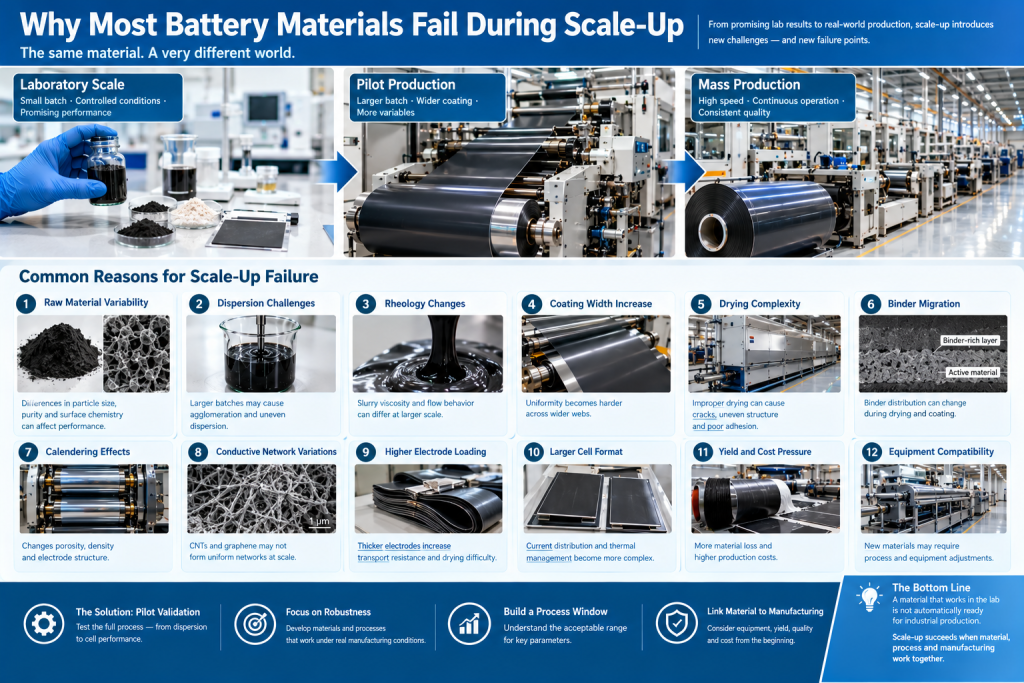
Why Most Battery Materials Fail During Scale-Up
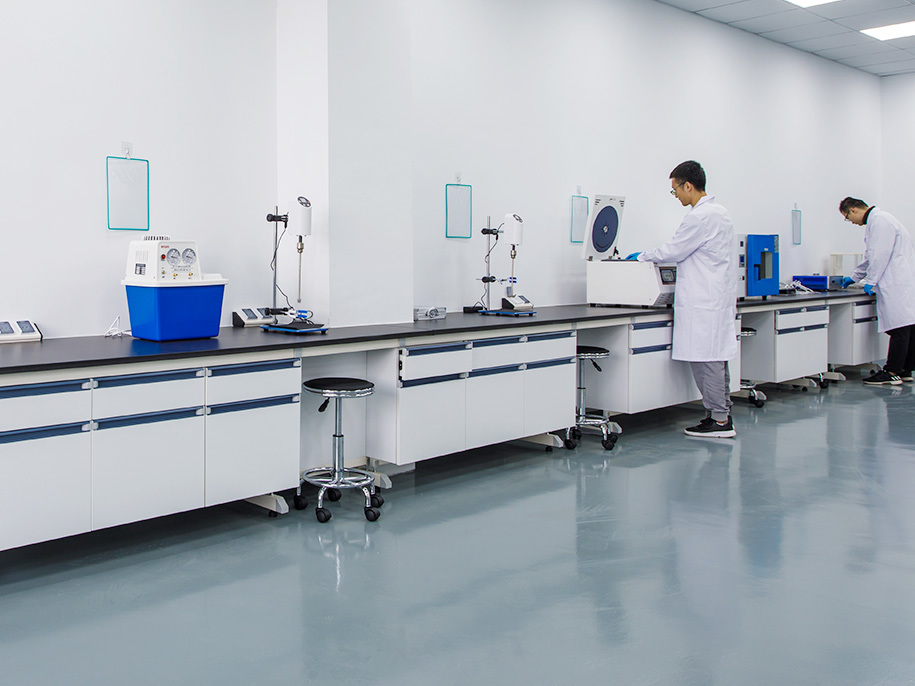
Battery material development often begins with an encouraging laboratory result.
A new cathode powder delivers strong capacity. A silicon-based anode shows impressive specific capacity. A graphene or CNT additive improves electrode conductivity. A new binder produces excellent adhesion. A new electrolyte formulation appears to improve cycling performance.
Small laboratory cells may confirm that the technology works.
Then the project moves toward pilot production.
The batch size increases.
The electrode becomes wider and thicker.
Mixing changes.
Coating speed increases.
Drying becomes more complex.
Calendering becomes more demanding.
Cell dimensions become larger.
And suddenly, the performance achieved in the laboratory is no longer reproduced as expected.
This is one of the most important challenges in battery industrialization.
The problem is not necessarily that the material “does not work.”
More often, the material is interacting with a manufacturing system that is fundamentally different from the laboratory environment.
This is why many battery materials encounter difficulties during scale-up.
The central lesson is:
A material that works in a laboratory experiment is not automatically a material that can be manufactured consistently.
Commercialization requires the material, formulation, electrode structure, manufacturing process, and cell architecture to remain compatible as scale increases.
The Difference Between Material Performance and Manufacturing Performance
Laboratory development usually focuses on intrinsic or cell-level performance.
Typical targets include:
- Specific capacity
- Coulombic efficiency
- Rate capability
- Conductivity
- Cycle life
- Energy density
Industrial manufacturing adds another group of requirements:
- Dispersion
- Rheology
- Coating uniformity
- Drying behavior
- Electrode density
- Porosity
- Adhesion
- Yield
- Batch consistency
- Equipment compatibility
- Cost
A material may satisfy the first group while failing the second.
For example, a conductive additive may substantially reduce electrode resistance in a small laboratory cell.
However, if the additive is difficult to disperse in a larger slurry batch, creates excessive viscosity, blocks filtration, or causes coating defects, its industrial value can become much lower.
This distinction explains why scale-up is such a critical stage.
Why Laboratory Conditions Can Be Misleading
Laboratory experiments offer a high degree of control.
Researchers may work with:
- Small quantities
- Short processing times
- Narrow coating widths
- Carefully controlled temperatures
- Manual adjustments
- Highly selected raw materials
When a problem appears, the experiment can often be stopped and repeated.
Industrial manufacturing is different.
The process must operate continuously and repeatedly.
A production system cannot rely on constant manual intervention.
Therefore, laboratory optimization may sometimes produce a process that is highly effective but too sensitive for industrial manufacturing.
The most valuable materials for commercialization are often not those with the highest theoretical performance, but those that provide strong performance within a robust manufacturing window.
Failure Point 1: Raw-Material Variability
One of the earliest scale-up problems can occur before processing even begins.
Advanced battery materials are rarely perfectly identical from batch to batch.
Variation may occur in:
- Particle size
- Morphology
- Surface area
- Moisture
- Purity
- Surface chemistry
- Tap density
- Functionalization
- Impurity level
At laboratory scale, a carefully selected batch may produce excellent results.
At pilot scale, the process must tolerate realistic raw-material variation.
If small changes in incoming material create large changes in slurry or electrode behavior, the process is not yet robust enough.
This is why material specifications should be connected to actual manufacturing performance.
Failure Point 2: Dispersion Changes With Scale
Dispersion is one of the most common scale-up challenges.
Conductive additives such as CNTs, graphene, and carbon black can have a major influence on electrode performance.
But their behavior depends on:
- Mixing energy
- Mixing sequence
- Solvent interaction
- Binder interaction
- Temperature
- Residence time
A small laboratory mixer can create a particular shear environment.
A much larger mixer does not automatically reproduce that environment simply because it operates at the same rotational speed.
At larger scale, the material may experience different:
- Shear distribution
- Circulation
- Heat generation
- Residence time
The result can be incomplete dispersion or unexpected agglomeration.
Failure Point 3: Slurry Rheology Changes
A slurry that is easy to handle in a laboratory may become difficult to pump or coat after scale-up.
This can happen because:
- Solid content changes
- Dispersion changes
- Temperature changes
- Binder structure changes
- Shear history changes
Important rheological properties include:
- Viscosity
- Shear thinning
- Yield stress
- Thixotropy
- Temperature dependence
For industrial coating, one viscosity value is rarely enough.
The slurry needs to behave predictably across the shear conditions encountered during:
Mixing → pumping → filtration → coating
If it does not, the coating process can become unstable.
Failure Point 4: Coating Width Changes the Problem
Laboratory electrodes may be only a few centimeters wide.
Pilot and commercial coating systems can be much wider.
This creates new challenges.
The process must maintain:
- Uniform thickness
- Uniform loading
- Stable edges
- Constant composition
- Consistent drying
A formulation that works well in the center of a narrow laboratory sample may not coat uniformly across a wide web.
Cross-web variation can affect:
- Capacity
- Resistance
- Current distribution
- Thermal behavior
- Cycle life
This is one reason why pilot coating is such an important stage in battery development.
Failure Point 5: Drying Creates Microstructural Variation
Drying is often underestimated during material development.
Once a coated slurry enters the dryer, its internal structure begins to change.
During solvent evaporation:
- Particles move
- Binder redistributes
- Conductive additives form networks
- Porosity develops
- Surface concentration can change
If drying is too rapid, the electrode may develop unfavorable concentration gradients.
If drying is too slow, production efficiency suffers.
For advanced formulations, drying conditions can influence the final electrochemical behavior even when the original slurry composition is identical.
Therefore, a “good formulation” is not enough.
The formulation needs a compatible drying process.
Failure Point 6: Binder Migration
Binder distribution can change during drying.
Under certain drying conditions, binder may become concentrated in particular regions of the electrode.
This can influence:
- Adhesion
- Mechanical strength
- Surface properties
- Ionic transport
- Electrical connectivity
A laboratory electrode may therefore show strong adhesion under one drying condition while a pilot coating produced under a different thermal profile behaves differently.
This is one example of how process conditions can alter the effective material system.
Failure Point 7: Calendering Changes the Electrode
An electrode that looks excellent after drying may not behave the same way after calendering.
Calendering changes:
- Thickness
- Density
- Porosity
- Particle contact
- Surface structure
Increasing density can improve volumetric energy density.
But excessive compression can reduce pore volume and hinder electrolyte transport.
For fast-charging batteries, this trade-off becomes particularly important.
The optimal electrode is not simply the densest electrode.
It is the electrode with an appropriate balance between:
Energy density + electronic conductivity + ionic transport + mechanical stability
Failure Point 8: Conductive Networks Do Not Always Scale Linearly
Carbon additives illustrate another common problem.
CNTs and graphene can create efficient conductive networks at relatively low loading.
However, their effectiveness depends on how they are distributed through the electrode.
At laboratory scale, a small difference in dispersion may have limited visible consequences.
At larger scale, the same variation can create local regions with different resistance.
This can lead to:
- Non-uniform current distribution
- Localized heating
- Reduced rate capability
- Cell-to-cell variation
The objective is therefore not maximum conductive-additive loading.
It is a stable and reproducible conductive network.
Failure Point 9: Electrode Loading Increases
Commercial battery development often seeks higher areal capacity.
Higher active-material loading can improve energy density per unit area.
But thicker electrodes also make transport more difficult.
Potential limitations include:
- Longer ion-transport distance
- Higher tortuosity
- More difficult electrolyte penetration
- Greater resistance
- More difficult drying
- More demanding calendering
A material that works perfectly in a thin laboratory electrode may perform differently when placed in a thick industrial electrode.
This is why scale-up should evaluate realistic electrode loading early enough.
Failure Point 10: Laboratory Cells Are Small
Small cells are excellent for material screening.
They are not necessarily representative of larger commercial cells.
As cell dimensions increase, new issues emerge:
- Current distribution
- Thermal gradients
- Electrolyte distribution
- Mechanical pressure
- Manufacturing tolerances
A material that works well in a small-format test cell may therefore require additional development before it can be used reliably in a larger format.
This does not make the laboratory result invalid.
It means that the result answers a different question.
Failure Point 11: Electrolyte Wetting Changes
Electrolyte behavior can also become more challenging at scale.
Thicker electrodes require the electrolyte to penetrate a larger and more complex structure.
Factors such as:
- Porosity
- Pore size distribution
- Electrode thickness
- Surface chemistry
- Calendering
can influence wetting.
If wetting is incomplete or inconsistent, the resulting cell performance may vary even when the original material is identical.
Therefore, electrode manufacturing and electrolyte wetting must be considered together.
Failure Point 12: Formation Conditions Change the Outcome
Formation is a critical stage in battery manufacturing.
It influences interfacial layers and early cell behavior.
Advanced materials may respond differently under different:
- Current rates
- Voltage limits
- Temperature
- Rest periods
- Pressure conditions
A material may look excellent during initial laboratory cycling but behave differently after industrial formation.
This is another reason why pilot-scale cell production is necessary.
Failure Point 13: Long-Duration Operation Reveals Hidden Problems
Laboratory testing may focus on short or moderate-duration experiments.
Pilot production introduces longer operating times.
This can reveal:
- Slurry sedimentation
- Viscosity drift
- Filter loading
- Temperature drift
- Equipment contamination
- Pump instability
- Coating-head buildup
A process can therefore be stable for the first hour and become unstable later.
Long-duration pilot runs are important because commercial manufacturing requires sustained process stability.
Failure Point 14: Batch-to-Batch Reproducibility
One excellent batch does not demonstrate industrial readiness.
At least several batches should be compared to determine whether the process can reproduce:
- Slurry properties
- Coating quality
- Electrode density
- Porosity
- Resistance
- Electrochemical performance
The critical question changes from:
“Can we make a good electrode?”
to:
“Can we make the same good electrode repeatedly?”
This is one of the clearest differences between laboratory research and industrial manufacturing.
Failure Point 15: Yield Becomes Important
Laboratory development can tolerate material losses.
Commercial production cannot.
Material can be lost through:
- Transfer lines
- Filtration
- Coating startup
- Edge trimming
- Defect removal
- Cleaning
- Off-specification batches
A new material may technically improve cell performance while simultaneously reducing yield.
In that case, the overall commercial value must be reconsidered.
This is why manufacturing yield should be measured during pilot development rather than waiting until full-scale production.
Failure Point 16: Equipment Compatibility
A new material may require equipment conditions that do not match the existing production line.
Possible problems include:
- Excessive slurry viscosity
- Filter blockage
- Pump incompatibility
- Coating-window instability
- Drying limitations
- Calendering sensitivity
If adopting the material requires major equipment changes, commercialization may become more difficult.
This does not automatically eliminate the technology.
It simply changes the economics and development pathway.
Failure Point 17: Quality Specifications Are Not Defined
A material cannot be manufactured consistently if nobody knows what “good” means.
For advanced battery materials, specifications may eventually need to cover:
- Particle size
- Moisture
- Purity
- Surface properties
- Conductivity
- Slurry viscosity
- Dispersion state
For electrodes, specifications may include:
- Thickness
- Areal loading
- Density
- Porosity
- Resistance
- Adhesion
- Surface uniformity
These specifications should be linked to cell performance.
Otherwise, quality control can become a collection of measurements without clear manufacturing value.
Failure Point 18: Cost Changes During Scale-Up
Laboratory costs can be misleading.
Small quantities may involve:
- Manual processing
- Expensive analytical work
- Low material efficiency
- Long processing times
Commercial economics depend on:
- Raw-material cost
- Production throughput
- Yield
- Energy
- Labor
- Equipment utilization
- Scrap
- Quality control
A material that looks attractive at laboratory scale may become less competitive when its full manufacturing cost is calculated.
Why Pilot Production Is So Important
Pilot manufacturing exists precisely because of these uncertainties.
A well-designed pilot program can evaluate:
- Larger-batch dispersion
- Slurry stability
- Coating behavior
- Drying
- Calendering
- Electrode uniformity
- Cell assembly
- Formation
- Multi-batch consistency
- Yield
This information cannot always be generated reliably from laboratory experiments alone.
Pilot production is therefore not just a small manufacturing run.
It is an industrial learning platform.
The Importance of Risk-Driven Scale-Up
Not every project needs to solve every problem before entering pilot production.
Instead, the pilot program should focus on the largest remaining uncertainties.
For example:
If Dispersion Is the Risk
Test larger-scale mixing and stability.
If Coating Is the Risk
Test realistic width and line speed.
If Drying Is the Risk
Evaluate drying profiles and electrode microstructure.
If Fast Charging Is the Risk
Use realistic electrode loading and cell configuration.
If Reproducibility Is the Risk
Run multiple batches and compare statistical variation.
This makes pilot development more efficient.
Material Development Should Be Linked to Manufacturing Early
One of the strongest ways to reduce scale-up problems is to involve manufacturing considerations early.
Instead of:
Material discovery → laboratory optimization → manufacturing problems
a stronger development pathway is:
Material discovery + manufacturing requirements → formulation → prototype → pilot validation
This approach helps developers avoid creating materials that require unrealistic processing conditions.
The Role of Design for Manufacturing
Design for manufacturing should be considered for:
- Particle size
- Surface chemistry
- Dispersion requirements
- Binder compatibility
- Electrode thickness
- Drying conditions
- Calendering
- Cell architecture
The goal is not to compromise innovation.
It is to ensure that the innovation can eventually be manufactured.
What Makes a Battery Material More Scalable?
A scalable material typically demonstrates several characteristics.
Stable Raw-Material Characteristics
The material can be specified and reproduced.
Robust Formulation
Small process variations do not cause catastrophic changes in behavior.
Practical Rheology
The slurry can be mixed, pumped, filtered, and coated.
Stable Electrode Structure
Drying and calendering produce consistent electrodes.
Application-Level Benefits
The material provides measurable value in the actual cell.
Acceptable Economics
The benefit is sufficient to justify material and process costs.
These characteristics are often more important for commercialization than a single record laboratory performance value.
A Practical Scale-Up Roadmap
A structured development pathway can be:
Stage 1: Material Screening
Select candidate materials according to application requirements.
Stage 2: Laboratory Formulation
Develop dispersion, binder, solvent, and conductive-additive systems.
Stage 3: Laboratory Electrode
Evaluate coating, drying, calendering, and cell performance.
Stage 4: Pilot Slurry Production
Validate larger-batch mixing and dispersion.
Stage 5: Pilot Coating
Test realistic coating width, speed, and drying.
Stage 6: Electrode Optimization
Control thickness, density, porosity, and resistance.
Stage 7: Pilot Cell Production
Produce representative cells.
Stage 8: Reliability and Rate Testing
Evaluate cycling, fast charging, thermal behavior, and degradation.
Stage 9: Multi-Batch Validation
Measure reproducibility and yield.
Stage 10: Commercial Process Design
Translate pilot knowledge into production equipment, quality control, and cost models.
What Should Be Measured During Scale-Up?
A strong development program should collect process and product data together.
Material Data
- Particle size
- Moisture
- Purity
- Morphology
- Conductivity
Slurry Data
- Solid content
- Viscosity
- Dispersion stability
- Temperature
Electrode Data
- Thickness
- Loading
- Density
- Porosity
- Resistance
- Adhesion
Cell Data
- Capacity
- Efficiency
- Impedance
- Rate capability
- Cycle life
- Temperature
Manufacturing Data
- Yield
- Scrap
- Process time
- Energy consumption
- Batch variation
Connecting these datasets makes it easier to identify the true source of performance changes.
The Real Reason Materials Fail During Scale-Up
The phrase “material failure” can sometimes be misleading.
In many cases, the material itself has not failed.
The material-process interaction has failed.
The formulation may not be compatible with the equipment.
The electrode structure may not be compatible with the target loading.
The drying process may change the microstructure.
The cell format may introduce new transport limitations.
The manufacturing variability may overwhelm the original laboratory performance advantage.
Understanding this distinction is essential.
From Material Innovation to Manufacturing Robustness
The ultimate goal of scale-up is not to reproduce one laboratory cell.
It is to build a system in which acceptable performance remains stable despite normal manufacturing variation.
That means developing:
Robust materials
Robust formulations
Robust processes
Robust quality controls
This is what separates a promising battery technology from a manufacturable battery technology.
Most battery materials do not encounter scale-up problems simply because their chemistry stops working.
They encounter them because the manufacturing environment becomes more complex.
Batch size changes.
Mixing changes.
Rheology changes.
Coating width increases.
Drying becomes more demanding.
Electrode loading increases.
Calendering changes the structure.
Cell dimensions increase.
Operating times become longer.
And normal material variation becomes unavoidable.
These changes expose weaknesses that may remain invisible in laboratory experiments.
That is why battery commercialization requires a deliberate transition from:
Material → Formulation → Electrode → Pilot Process → Cell → Multi-Batch Validation → Commercial Manufacturing
The purpose of pilot production is not merely to produce more batteries.
It is to discover which parts of the technology are robust, which are sensitive, and which need further engineering.
The most commercially valuable battery material is therefore not necessarily the one with the best laboratory record.
It is the material that can deliver meaningful performance while remaining compatible with:
Stable processing + uniform electrodes + reliable cells + acceptable yield + practical cost.
That is the real definition of scale-up readiness.