Graphene Ink vs Graphene Slurry: What’s the Difference in Coating Applications?
As graphene-based materials continue to expand into industrial applications, terms like graphene ink and graphene slurry are often used interchangeably.
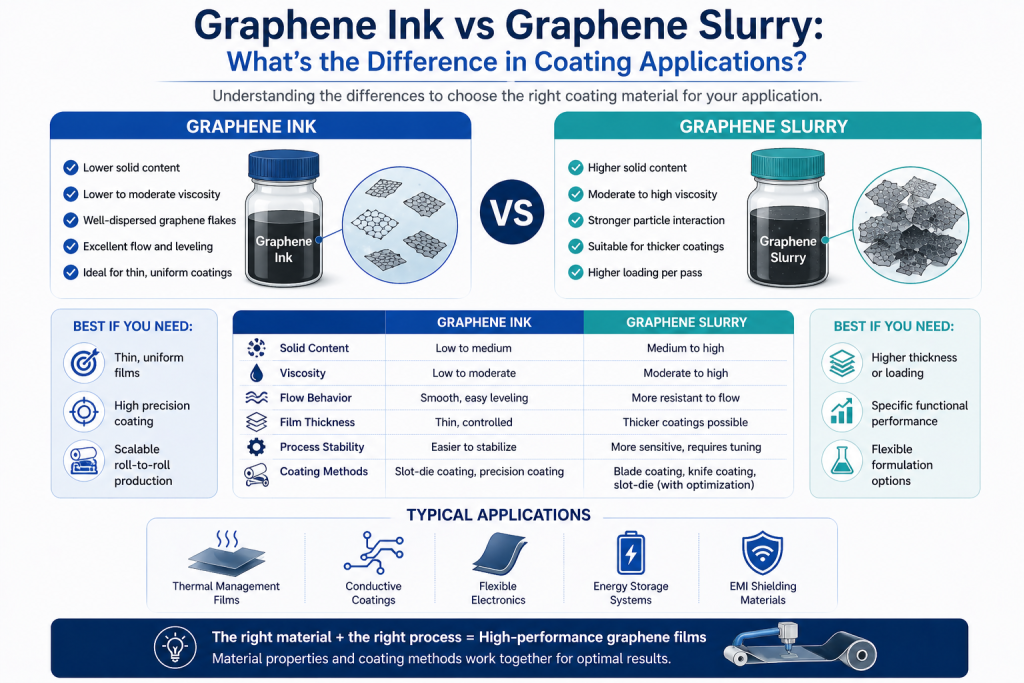
However, in real coating processes, these two material forms can behave very differently. Understanding their differences is essential for selecting the right coating materials and achieving consistent film performance.
What is Graphene Ink?
Graphene ink is typically a low to medium viscosity dispersion of graphene in a liquid medium, designed for controlled and uniform coating.
Key Characteristics:
- Lower solid content (typically dilute systems)
- Moderate viscosity (flowable and stable)
- Fine and well-dispersed graphene flakes
- Suitable for thin and uniform coatings
Typical Advantages:
- Easy to handle in precision coating systems
- Better flow behavior and leveling
- High uniformity across substrates
What is Graphene Slurry?
Graphene slurry generally refers to a higher solid content system, often with increased viscosity and particle interaction.
Key Characteristics:
- Higher solid content
- Higher viscosity
- Stronger particle-particle interaction
- May contain larger or less uniform flakes
Typical Advantages:
- Higher material loading per coating pass
- Suitable for thicker films
- Potentially higher functional performance (depending on formulation)
Key Differences Between Graphene Ink and Graphene Slurry
| Parameter | Graphene Ink | Graphene Slurry |
|---|---|---|
| Solid Content | Low to medium | Medium to high |
| Viscosity | Low to moderate | Moderate to high |
| Flow Behavior | Smooth, easy leveling | More resistant to flow |
| Film Thickness | Thin, controlled | Thicker coatings possible |
| Process Stability | Easier to stabilize | Requires more tuning |
Impact on Coating Applications
The choice between graphene ink vs graphene slurry directly affects the coating process and final film quality.
1. Coating Method Selection
- Graphene ink
→ Ideal for slot-die coating and other precision methods
→ Enables uniform thin films - Graphene slurry
→ Often used in blade or knife coating
→ Can be adapted to slot-die with proper tuning
2. Film Uniformity
- Ink systems typically provide:
- Better leveling
- Fewer defects
- Higher consistency
- Slurry systems may introduce:
- Thickness variation
- Surface irregularities if not optimized
3. Process Stability
In continuous coating systems:
- Graphene ink
→ Faster stabilization
→ Wider process window - Graphene slurry
→ More sensitive to:- Shear conditions
- Pumping stability
- Drying behavior
4. Scalability Considerations
For industrial production:
- Ink-based systems are generally easier to scale due to:
- Stable flow characteristics
- Compatibility with continuous coating
- Slurry-based systems may require:
- Additional process optimization
- Stronger control of parameters
Which One Should You Choose?
There is no universal answer—it depends on your application.
Choose Graphene Ink if you need:
- Thin, uniform films
- High precision coating
- Scalable roll-to-roll production
Choose Graphene Slurry if you need:
- Higher thickness or loading
- Specific functional performance
- Flexible formulation options
The Role of Process in Material Selection
One of the most important considerations is that:
The best material is not just about formulation—it must match the coating process.
A well-designed coating system can expand the usable range of both graphene ink and slurry.
For example, advanced techniques such as slot-die coating can handle a wider range of viscosities when properly optimized.
Bridging Material and Manufacturing
In practical applications, the boundary between graphene ink and slurry is not always fixed. Many systems fall somewhere in between, depending on:
- Solid content
- Dispersion quality
- Additives and formulation design
This is why collaboration between material development and process engineering is essential.
Understanding the difference between graphene ink and graphene slurry is key to successful coating and film production.
While both are based on graphene dispersions, their behavior in coating processes can vary significantly. Selecting the right material—and aligning it with the appropriate coating method—ensures better performance, higher consistency, and smoother scale-up.
Contact us to explore how different graphene coating materials can be matched with scalable coating processes for your application.