How to Scale Graphene Coatings from Lab to Industrial Production
As graphene continues to move from research labs into real-world applications, one of the biggest challenges companies face is scaling graphene coatings from lab to industrial production.
While many formulations perform well in small-scale experiments, achieving consistent performance in large-scale manufacturing requires a completely different approach.
Successful graphene coating scale up is not just about materials—it is about process integration, stability, and scalability.
Why Scaling Graphene Coatings is Challenging
In laboratory conditions, graphene coatings are typically produced using:
- Small batch processes
- Manual or semi-controlled coating methods
- Short production runs
However, when moving to industrial production, new challenges arise:
- Maintaining uniform film thickness across large areas
- Ensuring dispersion stability during continuous operation
- Controlling drying and solvent evaporation
- Achieving repeatability across long production runs
This gap between lab success and industrial consistency is where many projects struggle.
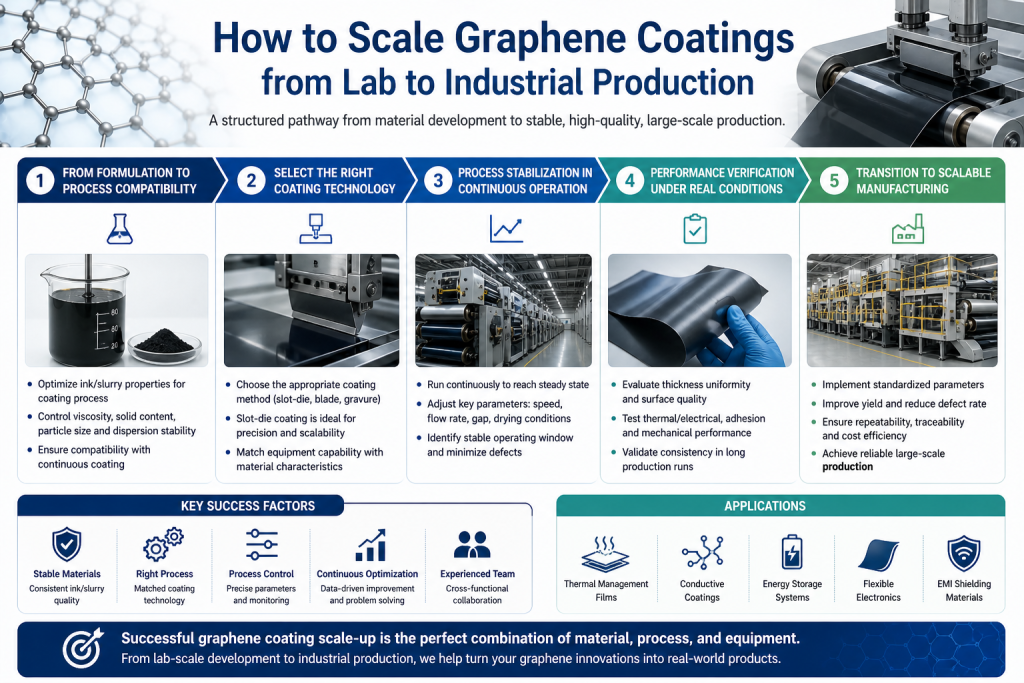
Step 1: From Formulation to Process Compatibility
The first step in scaling graphene coatings is ensuring that the graphene ink or slurry is compatible with industrial coating processes.
Key considerations include:
- Viscosity range suitable for continuous coating
- Stable dispersion under shear conditions
- Controlled solid content for thickness consistency
- Particle size distribution for uniform film formation
A formulation that works in the lab may require adjustment to meet these process requirements.
Step 2: Selecting the Right Coating Technology
Choosing the correct coating method is critical for successful scale-up.
Common Options:
- Slot-die coating
→ High precision, ideal for uniform thin films
→ Strong scalability for continuous production - Blade / knife coating
→ Flexible and widely used in early-stage development - Gravure coating
→ Suitable for patterned or specific applications
For most industrial-scale graphene coatings, continuous roll-to-roll (R2R) coating systems provide the best balance between performance and scalability.
Step 3: Process Stabilization in Continuous Operation
One of the most overlooked aspects of graphene production is that:
Stable product quality is achieved only after the process reaches a steady operating state.
During the initial phase of production:
- Flow conditions are still stabilizing
- Film thickness may fluctuate
- Defects are more likely to occur
Process stabilization involves:
- Running the coating line continuously
- Adjusting parameters such as speed, flow rate, and drying
- Identifying the stable operating window
This stage is essential for ensuring reliable production performance.
Step 4: Performance Verification Under Real Conditions
Once the process is stabilized, the next step is to verify product performance under continuous production conditions.
Key validation points include:
- Thickness uniformity across width and length
- Thermal or electrical performance consistency
- Adhesion to substrate
- Mechanical flexibility
Testing under realistic production conditions ensures that the graphene coating meets application requirements.
Step 5: Transition to Scalable Manufacturing
After successful validation, the process can move to industrial production.
Key elements of scalable graphene production include:
- Continuous coating with defined process parameters
- Reduced variability after stabilization
- Improved yield and lower defect rates
- Consistent performance across batches
At this stage, the focus shifts from experimentation to efficiency, repeatability, and cost optimization.
The Importance of Process Integration
Scaling graphene coatings is not just about coating itself. It often involves integration with additional processes, such as:
- Surface treatment (e.g., corona treatment)
- Lamination or multi-layer structures
- Controlled drying and curing
- Downstream processing and conversion
A fully integrated production workflow ensures that each step supports the final product performance.
Common Mistakes in Graphene Coating Scale-Up
Many projects face delays due to avoidable issues:
- Trying to scale directly from lab without process validation
- Using coating methods that are not suitable for continuous production
- Underestimating the importance of process stability
- Focusing only on material formulation instead of manufacturing
Avoiding these pitfalls can significantly improve the chances of successful scale-up.
A Structured Pathway to Industrial Production
A reliable graphene coating scale-up strategy typically follows:
- Material validation
- Process compatibility assessment
- Continuous process stabilization
- Performance verification
- Scalable production implementation
This structured approach ensures a smooth transition from lab to industry.
Applications Driving Graphene Production Scale-Up
The demand for scalable graphene coatings is growing across industries:
- Thermal management films
- Conductive coatings
- Energy storage systems
- Flexible electronics
- EMI shielding materials
As these applications mature, the need for reliable graphene production continues to increase.
Scaling graphene coatings from lab to industrial production is a complex but achievable process.
Success depends on aligning material formulation, coating technology, and process stability within a structured manufacturing framework.
With the right approach, graphene coatings can transition from promising lab results to consistent, high-quality industrial products.
Contact us to explore how we can support your graphene coating scale-up and industrial production needs.