

Selecting the Right Carbon Material for Your Application
Carbon-based materials—such as graphene, carbon nanotubes (CNTs), carbon black, and graphite—are widely used across industries for their electrical, thermal, and mechanical properties. However, selecting the right carbon material is not straightforward.
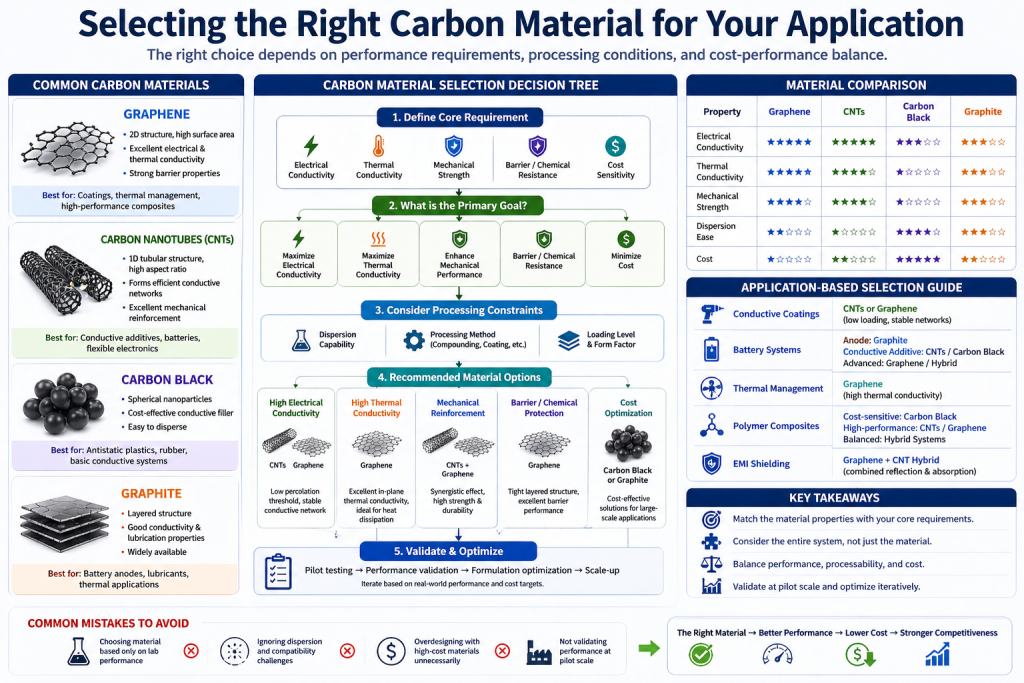
Each material offers distinct advantages, and the optimal choice depends on application requirements, processing conditions, and cost-performance balance. Making the right selection is critical to achieving reliable performance and scalable production.
Overview of Common Carbon Materials
1. Graphene
- 2D structure with high surface area
- Excellent electrical and thermal conductivity
- Strong barrier properties
Best for:
- Coatings, thermal management, high-performance composites
2. Carbon Nanotubes (CNTs)
- 1D tubular structure with high aspect ratio
- Forms efficient conductive networks
- Excellent mechanical reinforcement
Best for:
- Conductive additives, batteries, flexible electronics
3. Carbon Black
- Spherical nanoparticles
- Cost-effective conductive filler
- Easy to disperse
Best for:
- Antistatic plastics, rubber, basic conductive systems
4. Graphite
- Layered structure
- Good conductivity and lubrication properties
- Widely available
Best for:
- Battery anodes, lubricants, thermal applications
Key Selection Criteria
1. Electrical Conductivity Requirements
- High conductivity needed: CNTs or graphene
- Moderate conductivity: Carbon black
- Bulk conductive structures: Graphite
👉 CNTs are ideal for forming low percolation conductive networks
2. Thermal Conductivity
- High thermal performance: Graphene
- Moderate improvement: CNTs and graphite
Used in:
- Thermal interface materials (TIMs)
- Electronics cooling
3. Mechanical Reinforcement
- Best reinforcement: CNTs + graphene
- Moderate: Graphite
- Low: Carbon black
4. Dispersion and Processability
- Easy dispersion: Carbon black
- Moderate: Graphite
- Challenging: CNTs and graphene (require functionalization or additives)
5. Cost Considerations
- Lowest cost → Carbon black
- Medium → Graphite
- Higher → CNTs and graphene
Balancing performance vs cost is key for industrial adoption.
6. Application Environment
- Corrosive environments: Graphene coatings
- Flexible systems: CNT-based networks
- High-load structures: Hybrid systems
Application-Based Selection Guide
Conductive Coatings
- Preferred: CNTs or graphene
- Reason: Stable conductive networks and low loading
Battery Systems
- Anode: Graphite
- Conductive additive: CNTs / carbon black
- Advanced systems: Graphene or hybrid carbon materials
Thermal Management
- Preferred: Graphene
- Reason: High in-plane thermal conductivity
Polymer Composites
- Cost-sensitive: Carbon black
- High-performance: CNTs or graphene
- Balanced: Hybrid systems
EMI Shielding
- Preferred: Graphene + CNT hybrid
- Reason: Combined reflection and absorption mechanisms
Hybrid Approach: When One Material Is Not Enough
In many advanced applications, a single material cannot meet all requirements.
Hybrid systems offer:
- Improved conductivity
- Better dispersion stability
- Multi-functional performance
Example:
👉 Graphene (barrier + conductivity) + CNTs (network formation)
Common Mistakes to Avoid
- Choosing material based only on lab performance
- Ignoring dispersion challenges
- Overdesigning with high-cost materials unnecessarily
- Not validating performance at pilot scale
Decision Framework
A practical selection approach:
- Define core requirement (conductivity, thermal, mechanical)
- Identify processing constraints
- Evaluate cost-performance balance
- Validate at pilot scale
- Optimize formulation iteratively
Future Trends
- Application-specific functionalized carbons
- Hybrid material systems becoming standard
- AI-driven material selection tools
- Sustainable and scalable carbon production methods
Selecting the right carbon material is not about choosing the “best” material—but the most suitable one for your specific application and process.
By understanding the strengths and limitations of graphene, CNTs, carbon black, and graphite—and leveraging hybrid systems when needed—companies can achieve optimal performance, cost efficiency, and scalability.