
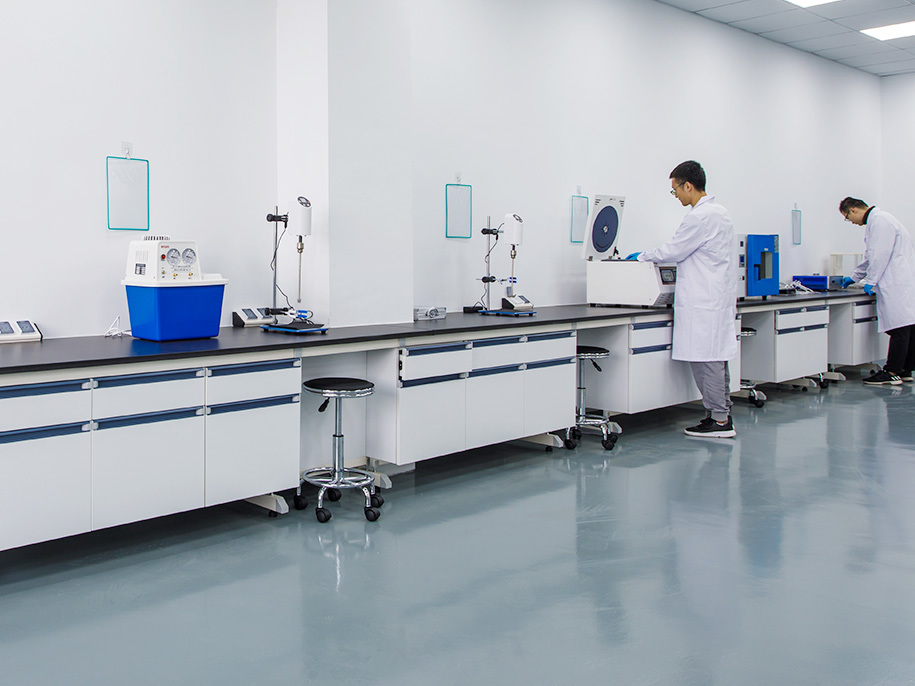
Pilot Production of Graphene Coatings for Battery Applications
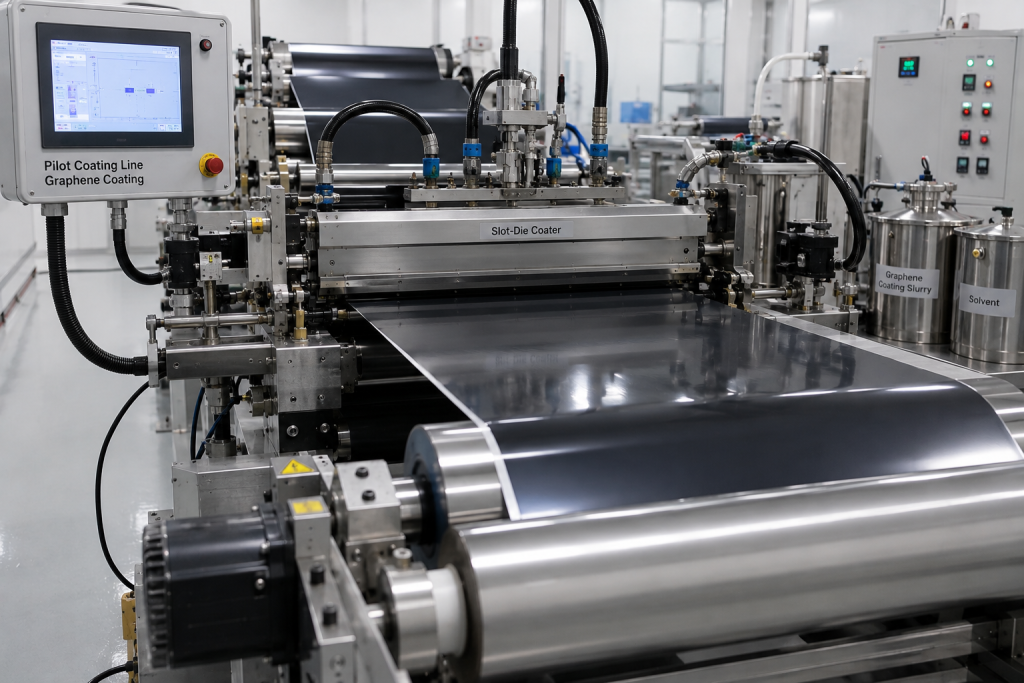
As battery technologies continue to evolve, manufacturers are increasingly looking for materials and coating technologies that can improve electrical conductivity, thermal management, electrode performance, corrosion resistance, and overall cell reliability.
Among emerging solutions, graphene coatings for battery applications have attracted significant attention because graphene combines high electrical conductivity, large surface area, mechanical strength, chemical stability, and excellent potential for forming thin functional layers.
However, demonstrating a graphene coating in a laboratory is very different from producing it consistently on a pilot line.
A laboratory sample may show excellent conductivity or electrochemical performance, while pilot production can reveal challenges related to dispersion stability, coating uniformity, drying, adhesion, production speed, material utilization, and process repeatability.
This is why pilot production of graphene coatings is an important step between laboratory research and commercial battery manufacturing.
The objective of pilot production is not simply to manufacture a larger quantity of coated material. It is to establish a stable, repeatable, and scalable process that can eventually support industrial production.
Why Graphene Coatings Are Being Considered for Batteries
Graphene can be incorporated into battery-related coating systems in several different ways.
Potential applications include:
- Conductive coatings
- Electrode surface modification
- Current collector coatings
- Protective coatings
- Thermal management layers
- Interface coatings
- Anti-corrosion coatings
- Functional separator coatings
Depending on the formulation and application, graphene may contribute to electrical conductivity, interfacial contact, mechanical reinforcement, heat spreading, or surface protection.
One important advantage is that graphene can potentially provide functional performance at relatively low coating thicknesses.
This makes it attractive for applications where additional material weight or volume needs to be minimized.
However, the actual benefit depends strongly on graphene type, formulation, dispersion, coating structure, substrate, and manufacturing conditions.
From Laboratory Coating to Pilot Production
A typical development pathway can be described as:
Material Selection → Formulation Development → Laboratory Coating → Pilot Coating → Process Optimization → Cell Validation → Scale-Up → Commercial Production
Each stage answers a different question.
Laboratory development asks:
Can the coating work?
Pilot production asks:
Can the coating be produced consistently?
Industrialization asks:
Can it be produced consistently, economically, and at commercial scale?
This distinction is extremely important.
A coating formulation that works on a small laboratory substrate may not automatically work on a wider continuous coating line.
Selecting the Right Graphene Material
The first step in pilot production is selecting a graphene material appropriate for the target battery application.
Graphene is not a single standardized material. Different grades can have substantially different characteristics.
Relevant parameters may include:
- Number of layers
- Lateral flake size
- Thickness
- Specific surface area
- Electrical conductivity
- Surface chemistry
- Defect density
- Purity
- Moisture content
- Bulk density
- Dispersion characteristics
The best graphene material is therefore not necessarily the one with the highest reported conductivity.
For a coating application, processability may be equally important.
For example, graphene with a very high aspect ratio may provide excellent electrical network formation but may also increase viscosity and create dispersion challenges.
A commercially viable material needs to provide an appropriate balance between performance, processability, availability, and cost.
Developing the Graphene Coating Formulation
Once the graphene material has been selected, the next step is formulation development.
A graphene coating formulation may contain:
- Graphene
- Solvent or water
- Binder
- Dispersant
- Conductive additives
- Functional additives
- Rheology modifiers
The exact formulation depends on the substrate and intended battery application.
For example, an electrode coating may require strong adhesion and compatibility with the electrode chemistry, while a protective coating may require different mechanical and chemical properties.
Important formulation parameters include:
- Graphene concentration
- Solid content
- Viscosity
- Surface tension
- pH
- Dispersion stability
- Particle size distribution
- Binder ratio
These parameters should be controlled before moving to pilot production.
Dispersion: One of the Most Important Challenges
Graphene has a strong tendency to form agglomerates because of interactions between individual graphene layers.
Poor dispersion can create:
- Coating defects
- Conductivity variation
- Thickness variation
- Surface roughness
- Poor adhesion
- Reduced functional performance
For this reason, dispersion development is often one of the most important parts of graphene coating pilot production.
The process may involve high-shear mixing, homogenization, ultrasonic treatment, bead milling, or other dispersion technologies depending on the formulation.
The goal is not simply to maximize dispersion energy.
Excessive processing can alter graphene morphology or unnecessarily increase production cost.
The objective is to establish a controlled dispersion process that produces the required particle distribution while maintaining the desired graphene structure.
Choosing the Coating Technology
Different coating methods may be suitable for graphene battery coatings.
Common technologies include:
Slot-Die Coating
Slot-die coating is particularly attractive for precise and continuous coating.
It provides good control of wet-film thickness and can be integrated into roll-to-roll pilot lines.
Blade Coating
Blade coating is relatively simple and useful for laboratory and small-scale process development.
It can be useful for screening formulations before moving to more controlled continuous coating methods.
Gravure Coating
Gravure coating can provide high-speed continuous coating and may be suitable for certain thin-layer applications.
Spray Coating
Spray coating can be useful for complex geometries and certain surface treatment applications.
The choice should depend on:
- Required coating thickness
- Substrate type
- Production speed
- Coating width
- Formulation viscosity
- Surface quality
- Required uniformity
- Future production scale
For pilot production intended to support future industrial manufacturing, it is often beneficial to use equipment that represents the eventual commercial process as closely as practical.
Establishing the Pilot Process Window
One of the main objectives of pilot production is to establish a process window.
For graphene coating, important parameters may include:
- Coating speed
- Coating flow rate
- Coating gap
- Web tension
- Wet-film thickness
- Dry-film thickness
- Drying temperature
- Drying time
- Ink viscosity
- Ink temperature
- Substrate temperature
- Environmental humidity
These parameters interact with each other.
For example, increasing coating speed may require a change in flow rate to maintain the target coating thickness.
Similarly, increasing coating thickness may require additional drying capacity.
Therefore, pilot production should evaluate the process as an integrated system rather than optimizing one parameter independently.
Coating Thickness and Uniformity
Coating thickness is one of the most important variables in graphene battery applications.
A coating that is too thin may not provide sufficient functional performance.
A coating that is too thick can:
- Increase resistance
- Increase material consumption
- Add unnecessary weight
- Reduce energy density
- Increase drying requirements
- Increase manufacturing cost
Uniformity is equally important.
A coating may have the correct average thickness but still contain significant local variation.
This can create inconsistent electrical or electrochemical behavior.
Pilot production should therefore evaluate both average coating thickness and cross-web / machine-direction uniformity.
Drying Is Part of the Coating Process
The coating process does not end when the graphene formulation reaches the substrate.
Drying can strongly influence the final microstructure.
During drying, several phenomena can occur:
- Solvent evaporation
- Binder migration
- Graphene rearrangement
- Film shrinkage
- Internal stress development
- Agglomeration
- Surface skin formation
If drying is too fast, the surface may dry before the lower layer has properly released solvent.
If drying is too slow, production throughput may become impractical.
A pilot line allows engineers to determine the appropriate combination of temperature, airflow, residence time, and coating speed.
Adhesion and Interface Engineering
For battery applications, coating adhesion can be as important as electrical conductivity.
The graphene coating must remain attached to the substrate during:
- Drying
- Calendering
- Cell assembly
- Electrolyte exposure
- Cycling
- Thermal changes
Poor adhesion can lead to cracking, delamination, increased resistance, or loss of functional performance.
Surface preparation may therefore be required.
The interface between the graphene layer and substrate should be evaluated using appropriate adhesion and mechanical testing methods.
This is especially important when the coating is intended for continuous battery manufacturing processes.
Pilot Production for Electrode Applications
Graphene can potentially be incorporated into or applied onto battery electrodes as a conductive or functional coating.
The objective may include improving:
- Electronic conductivity
- Current distribution
- Interface contact
- Mechanical stability
- High-rate performance
- Surface protection
However, a graphene coating must be evaluated together with the entire electrode structure.
Important variables include:
- Active material loading
- Electrode porosity
- Binder system
- Conductive additive content
- Coating thickness
- Calendering conditions
- Electrolyte compatibility
A coating that improves conductivity but significantly reduces ion transport may not provide an overall battery benefit.
Therefore, optimization must consider the complete electrochemical system.
Pilot Production of Current Collector Coatings
Another potential application is coating current collectors with graphene-based conductive or protective layers.
The objective can include improving interfacial conductivity or protecting the metal surface under demanding operating conditions.
Pilot trials should evaluate:
- Coating adhesion
- Surface resistance
- Thickness
- Corrosion behavior
- Thermal stability
- Electrochemical compatibility
- Long-term stability
The coating must also be compatible with downstream electrode manufacturing.
A technically excellent coating is not commercially useful if it cannot survive subsequent manufacturing steps.
Quality Control During Pilot Production
Quality control should be integrated into the pilot process from the beginning.
Potential measurements include:
Material Testing
- Graphene purity
- Particle size
- Moisture
- Surface chemistry
- Dispersion stability
Coating Testing
- Thickness
- Surface roughness
- Sheet resistance
- Adhesion
- Defect density
- Uniformity
Electrochemical Testing
Depending on the application:
- Cell capacity
- Coulombic efficiency
- Rate capability
- Internal resistance
- Cycle life
- Impedance
The purpose is to establish a relationship between process parameters and final battery performance.
Pilot Scale-Up and Material Utilization
Material utilization becomes increasingly important as production scale increases.
At laboratory scale, a small amount of coating material may be wasted during:
- Equipment filling
- Line setup
- Cleaning
- Parameter adjustment
- Sample collection
At pilot scale, these losses become more significant.
Engineers should therefore monitor:
Material input → Coating deposition → Drying → Final coated material → Waste
This information helps determine the actual material cost of the process.
For expensive graphene materials, improving utilization can have a significant impact on commercial economics.
From Pilot Coating to Battery Cell Validation
Producing a uniform graphene-coated substrate is only one part of the development process.
The coated material must eventually be incorporated into representative battery cells.
A typical validation sequence may be:
Coated substrate → Electrode fabrication → Cell assembly → Formation → Electrochemical testing → Aging → Post-mortem analysis
This allows engineers to determine whether the coating provides a measurable improvement at the cell level.
Laboratory material performance should therefore not be treated as the final success criterion.
The ultimate question is:
Does the graphene coating improve the target battery performance sufficiently to justify its manufacturing cost and process complexity?
Scale-Up Challenges
Several problems may appear when moving from laboratory coating to pilot production.
Wider Coating Width
Uniformity becomes more difficult as coating width increases.
Higher Production Speed
Higher line speed reduces drying residence time and can change coating behavior.
Larger Material Volume
Dispersion consistency becomes more difficult to maintain in larger tanks.
Longer Production Runs
Long-duration trials can reveal sedimentation, viscosity drift, temperature changes, or equipment instability.
Equipment Integration
Pumps, filters, coating heads, dryers, rollers, and web handling systems must operate together.
These challenges are exactly why pilot production is necessary.
Building a Robust Process Window
The final objective is to establish a robust operating window rather than a single laboratory optimum.
For example, a pilot project may identify:
- A target viscosity range
- A stable graphene concentration
- An acceptable coating-speed range
- A target wet-film thickness
- A stable drying-temperature range
- An acceptable web-tension range
The process can then be classified into:
Target Range → Acceptable Range → Warning Range → Failure Range
This information becomes the foundation for future manufacturing specifications.
Why Pilot Production Reduces Commercialization Risk
Pilot production provides several benefits before large-scale investment.
It helps determine:
- Whether the formulation is scalable
- Whether the coating equipment is suitable
- Whether production speed can be increased
- Whether coating quality is repeatable
- Whether material utilization is acceptable
- Whether battery performance improves
- Whether the process can be automated
- Whether commercial manufacturing is economically realistic
This reduces the risk of moving directly from laboratory research to expensive production equipment.
Co-Development Between Material and Equipment Partners
Graphene coating commercialization often benefits from cooperation between multiple parties.
A typical project may involve:
Graphene Supplier + Formulation Developer + Coating Equipment Supplier + Battery Manufacturer + Testing Laboratory
Each participant contributes different expertise.
The graphene supplier understands material characteristics.
The formulation developer understands dispersion and rheology.
The equipment supplier understands coating and drying behavior.
The battery manufacturer understands cell requirements.
The testing laboratory provides independent characterization.
This type of co-development model can significantly accelerate process optimization.
Future Outlook
As battery manufacturers search for higher performance, lower cost, and greater manufacturing efficiency, advanced functional coatings are likely to become increasingly important.
Graphene-based coatings may play a role in future:
- Lithium-ion batteries
- Silicon-anode batteries
- Sodium-ion batteries
- Solid-state battery systems
- High-power cells
- Advanced energy storage systems
Future development is likely to focus on thinner coatings, lower graphene loading, improved dispersion, better interface engineering, continuous roll-to-roll manufacturing, and lower-cost production.
The most important development will not simply be achieving higher graphene content or higher conductivity.
Instead, it will be achieving the right performance at the right cost through a stable industrial process.
Pilot production of graphene coatings for battery applications represents an important bridge between laboratory innovation and commercial battery manufacturing.
The development process involves much more than selecting a high-performance graphene material. Formulation, dispersion, coating technology, drying, adhesion, thickness control, quality inspection, material utilization, and battery validation must all work together.
A successful pilot project should establish a reproducible process window and demonstrate that the coating can be manufactured consistently under realistic production conditions.
The most valuable outcome of pilot production is therefore not simply a batch of coated material. It is the process knowledge required to answer three critical questions:
Can the graphene coating be manufactured consistently?
Does it provide a meaningful improvement at the cell level?
Can it eventually be produced at commercially acceptable cost and scale?
When these questions are answered through systematic pilot trials, process optimization, and cell-level validation, graphene coating technology has a much clearer pathway toward industrial battery applications.
The transition from laboratory coating to pilot production is ultimately a transition from material discovery to manufacturing engineering—and that transition is essential for turning promising graphene technology into a commercially viable battery solution.