

The Missing Layer in Energy Storage Innovation: Pilot Validation
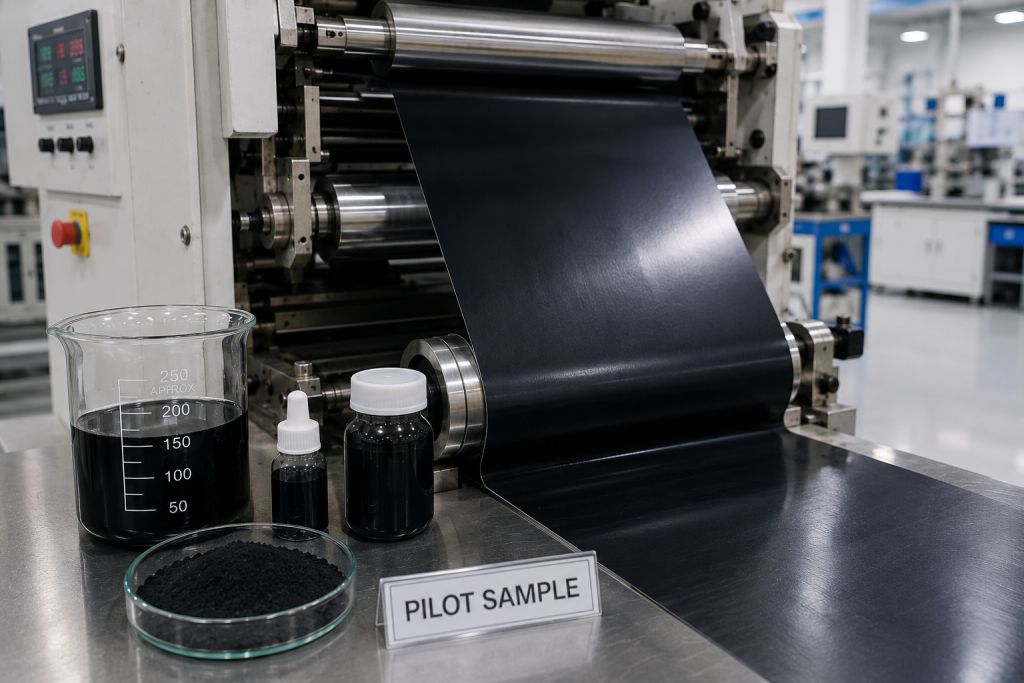
The global energy storage industry is advancing rapidly, driven by increasing demand for:
- Renewable energy integration
- Grid stabilization
- Electric vehicles
- AI data center infrastructure
- Backup power systems
At the center of this growth are next-generation battery technologies promising:
- Higher energy density
- Faster charging
- Longer cycle life
- Improved safety
However, many energy storage innovations fail before reaching commercial deployment.
The reason is often not the material itself, but the absence of one critical stage:
Pilot validation.
Pilot-scale validation has become the missing layer between laboratory innovation and successful industrial energy storage manufacturing.
Why Laboratory Success Is Not Enough
In early-stage R&D, battery technologies are typically evaluated through:
- Coin cells
- Small pouch cells
- Laboratory-scale coatings
- Controlled testing conditions
These environments are ideal for:
- Material discovery
- Electrochemical analysis
- Performance optimization
But they do not fully represent industrial manufacturing realities.
The Hidden Gap in Energy Storage Development
Many companies focus heavily on:
- Material chemistry
- Cell performance
- Laboratory cycling data
while underestimating:
- Manufacturing integration
- Process stability
- Electrode scalability
- Industrial yield performance
This creates a major commercialization gap between:
Scientific innovation
and
Manufacturable energy storage systems
What Is Pilot Validation?
Pilot validation refers to the process of testing battery materials and manufacturing methods under semi-industrial or pilot-scale conditions before mass production.
This typically includes:
- Pilot roll coating
- Continuous electrode manufacturing
- Pilot-scale slurry mixing
- Drying optimization
- Process repeatability testing
Pilot validation helps determine whether a battery technology can operate reliably in real manufacturing environments.
Why Pilot Validation Matters
1. Materials Behave Differently at Scale
A material that performs well in laboratory testing may behave very differently during industrial processing.
Scale introduces challenges such as:
- Slurry instability
- Graphene restacking
- CNT entanglement
- Coating inconsistency
- Drying non-uniformity
Pilot validation helps identify these problems early.
2. Electrode Manufacturing Is Complex
Battery performance depends heavily on:
- Coating quality
- Electrode density
- Conductive network formation
- Drying behavior
- Calendaring consistency
Pilot-scale production validates whether electrode systems remain stable during continuous manufacturing.
3. Industrial Yield Determines Commercial Viability
In industrial battery production:
Yield is critical.
Even small process variations can lead to:
- Scrap increase
- Performance inconsistency
- Cost escalation
- Qualification failure
Pilot validation reduces these risks before large capital investment.
4. Process Stability Matters as Much as Chemistry
Modern energy storage systems rely on increasingly complex materials such as:
- Silicon anodes
- Solid-state electrolytes
- CNT conductive networks
- Graphene-enhanced electrodes
These materials require highly stable manufacturing processes.
Pilot validation helps optimize:
- Rheology
- Coating parameters
- Drying profiles
- Process windows
Why Many Energy Storage Projects Fail
Many battery projects move directly from:
- Laboratory success
to - Commercial production attempts
without adequate pilot-scale validation.
This often causes:
- Manufacturing instability
- Electrode cracking
- Poor repeatability
- Yield loss
- Scale-up failure
Pilot validation is frequently the missing industrialization layer.
Key Areas Where Pilot Validation Is Essential
Advanced Battery Materials
- Silicon anodes
- High-nickel cathodes
- Sodium-ion systems
- Solid-state batteries
Conductive Networks
- CNT conductive additives
- Graphene conductive systems
- Hybrid carbon architectures
Thick Electrode Manufacturing
- High-loading electrodes
- Fast-charging systems
- Energy-dense battery architectures
Energy Storage Systems (ESS)
- Grid storage batteries
- Commercial & industrial ESS
- Renewable integration systems
Pilot Validation and Battery Qualification
OEMs and battery manufacturers increasingly require pilot-scale validation for:
- Process qualification
- Reliability verification
- Production scalability
- Long-term manufacturing stability
Pilot-scale data provides much stronger industrial confidence than laboratory-only testing.
The Role of Pilot Lines in Industrialization
Pilot lines help bridge the gap between:
Material R&D
and
Gigafactory-scale production
They provide realistic evaluation of:
| Validation Area | Importance |
|---|---|
| Coating stability | Manufacturing consistency |
| Slurry behavior | Process reliability |
| Drying optimization | Electrode integrity |
| Yield performance | Commercial feasibility |
| Equipment compatibility | Scale-up readiness |
The Industry Shift Toward Manufacturability
The energy storage industry is increasingly shifting from:
“Can the battery work?”
toward:
“Can the battery be manufactured consistently at scale?”
This shift is making pilot validation one of the most important stages in battery commercialization.
Co-Development Is Becoming Essential
Successful energy storage innovation increasingly requires collaboration between:
- Material suppliers
- Pilot manufacturing teams
- Equipment companies
- Cell manufacturers
- OEMs
The future of battery industrialization is becoming:
Integrated material + process + manufacturing engineering.
Future Trends in Pilot Validation
The next generation of pilot manufacturing will include:
- AI-assisted process optimization
- Digital twin manufacturing systems
- Smart in-line monitoring
- Automated coating analysis
- Dry electrode pilot production
Pilot validation is evolving into a strategic industrial capability.
The missing layer in many energy storage innovations is not better chemistry—it is pilot validation.
Successful commercialization requires more than strong laboratory data. It requires proving that battery technologies can achieve:
- Stable processing
- Scalable manufacturing
- Reliable production
- Commercial viability
Pilot validation plays a critical role in transforming energy storage innovation into real industrial deployment.