
Water-Based Graphene Coatings for Scalable Manufacturing
Graphene has attracted significant attention as an advanced material due to its excellent electrical conductivity, thermal properties, mechanical strength, and barrier performance.
However, transforming graphene from a laboratory material into an industrial coating solution requires solving a critical challenge:
How can graphene coatings be manufactured consistently, efficiently, and at large scale?
While many early graphene coating developments focused on solvent-based systems, water-based graphene coatings are becoming increasingly important because of their advantages in:
- Environmental compatibility
- Manufacturing safety
- Process scalability
- Cost control
For industrial applications, the challenge is not only achieving high graphene performance, but also developing a stable coating system compatible with existing manufacturing processes.
Why Water-Based Graphene Coatings Are Important
Traditional coating systems often rely on organic solvents to achieve:
- Good dispersion
- Low viscosity
- Fast drying
- Process compatibility
However, solvent-based systems may introduce challenges including:
- VOC emissions
- Safety requirements
- Higher production costs
- Complex solvent recovery systems
Water-based graphene coatings provide an alternative approach by using water as the primary dispersion medium.
Potential advantages include:
- Reduced environmental impact
- Easier handling
- Improved workplace safety
- Compatibility with large-scale coating processes
The Challenge of Graphene Dispersion in Water
Graphene has excellent properties, but its large surface area creates dispersion challenges.
Graphene sheets naturally tend to:
- Aggregate
- Restack
- Form uneven clusters
Poor dispersion can reduce:
- Electrical performance
- Thermal performance
- Coating uniformity
Therefore, dispersion control is one of the most important factors in water-based graphene coating development.
Key Components of a Water-Based Graphene Coating System
A commercial graphene coating is not simply graphene mixed with water.
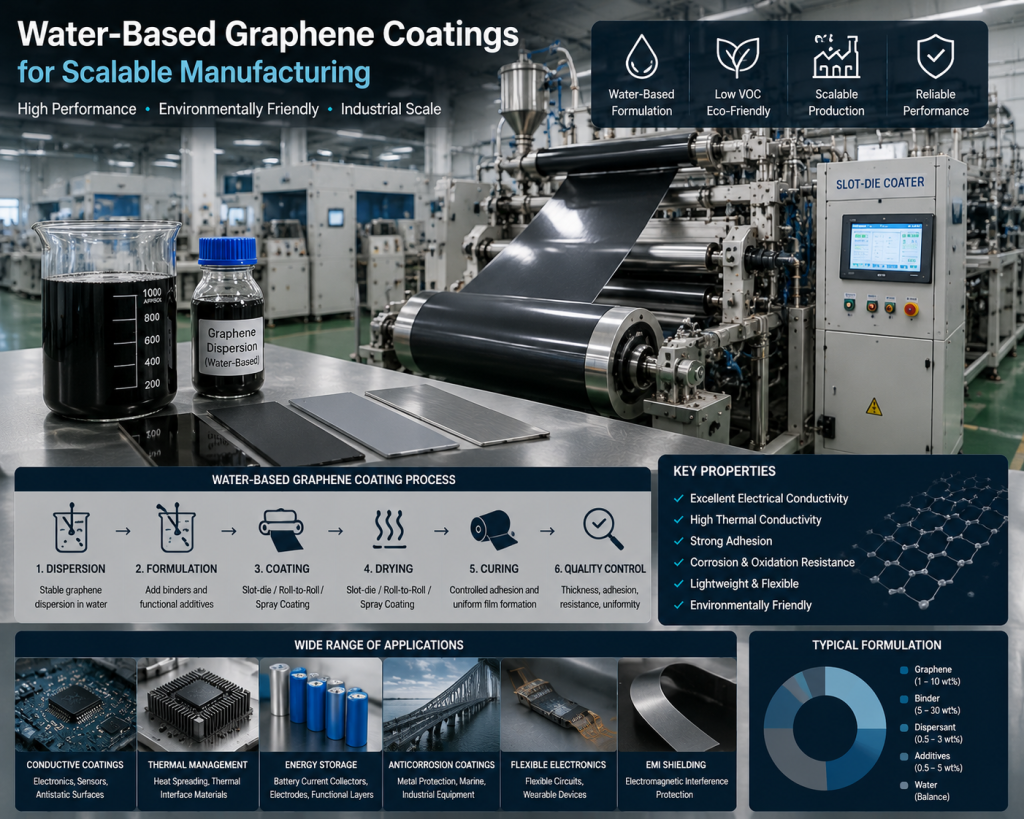
A practical formulation usually includes:
Graphene Material
The graphene type influences:
- Conductivity
- Surface coverage
- Thermal performance
- Cost
Factors include:
- Layer number
- Particle size
- Purity
- Surface chemistry
Dispersing Agents
Dispersants help maintain graphene stability in water.
They influence:
- Particle separation
- Storage stability
- Coating performance
Binders
Binders provide:
- Adhesion
- Mechanical strength
- Film formation
The binder selection must balance:
- Conductivity
- Flexibility
- Durability
Functional Additives
Additional additives may improve:
- Wetting behavior
- Drying characteristics
- Surface compatibility
Coating Process Compatibility
For industrial applications, graphene coatings must work with scalable manufacturing methods.
Common processes include:
Spray Coating
Advantages:
- Flexible equipment
- Suitable for complex surfaces
Applications:
- Metal protection
- Functional surfaces
Roll-to-Roll Coating
Roll-to-roll processing enables continuous production.
Advantages include:
- High throughput
- Large-area coating
- Lower production cost potential
Applications:
- Flexible films
- Conductive layers
Slot-Die Coating
Slot-die coating provides precise control of:
- Wet thickness
- Coating uniformity
- Material utilization
It is particularly suitable for:
- Pilot production
- Battery-related coatings
- Functional films
Applications of Water-Based Graphene Coatings
1. Conductive Coatings
Graphene coatings can provide electrical functionality for:
- Electronic components
- Sensors
- Smart surfaces
- Anti-static applications
Key requirements include:
- Stable conductivity
- Strong adhesion
- Long-term reliability
2. Thermal Management Coatings
With increasing demand for efficient heat dissipation, graphene coatings are being explored for:
- Electronic devices
- Power systems
- AI infrastructure components
Potential functions include:
- Heat spreading
- Temperature uniformity improvement
- Thermal protection
3. Anticorrosion Coatings
Graphene’s barrier properties make it attractive for protective coatings.
Applications include:
- Metal protection
- Industrial equipment
- Marine environments
Graphene layers can help reduce penetration of:
- Moisture
- Oxygen
- Corrosive substances
Challenges in Industrial Scale-Up
Laboratory coating results do not always translate directly to production.
Several challenges must be addressed.
Dispersion Stability
Large-scale production requires consistent dispersion over:
- Longer storage periods
- Larger batch volumes
- Continuous operation
Coating Uniformity
Industrial customers require:
- Stable coating thickness
- Consistent surface properties
- Repeatable performance
Drying Control
Water-based coatings require careful drying optimization.
Important parameters include:
- Drying temperature
- Airflow
- Film formation behavior
Poor drying control may affect:
- Adhesion
- Conductivity
- Surface quality
Production Speed
Scaling from laboratory coating to industrial production requires balancing:
- Coating speed
- Material utilization
- Film quality
The Role of Pilot Manufacturing
Pilot coating lines play an essential role in graphene commercialization.
Pilot trials help evaluate:
- Formulation stability
- Coating window
- Equipment compatibility
- Production repeatability
Important parameters include:
- Viscosity control
- Surface tension
- Wet thickness
- Dry film thickness
- Adhesion performance
Pilot validation reduces the risk between research development and industrial production.
Improving Scalability Through Process Engineering
Successful industrial graphene coatings require integration between:
Material Science
Formulation Engineering
Coating Technology
Quality Control
A high-performance graphene material alone is not enough.
The complete coating system must be designed for manufacturing.
Future Trends
Sustainable Functional Coatings
Water-based graphene coatings align with the industry’s movement toward:
- Lower emissions
- Safer manufacturing
- Sustainable materials
Multifunctional Coatings
Future graphene coatings may combine:
- Electrical conductivity
- Thermal management
- Corrosion protection
- Mechanical reinforcement
Advanced Manufacturing Integration
Future production may combine graphene coatings with:
- Roll-to-roll manufacturing
- Automated quality monitoring
- AI-assisted process optimization
Conclusion
Water-based graphene coatings represent an important pathway toward scalable industrial graphene applications.
The challenge is not simply producing graphene with excellent properties.
The real challenge is creating a complete coating system that delivers:
- Stable dispersion
- Reliable processing
- Uniform coating quality
- Industrial scalability
Through advanced formulation development, pilot validation, and manufacturing optimization, water-based graphene coatings have the potential to support applications ranging from electronics and energy storage to thermal management and protective coatings.
The future of graphene commercialization will depend not only on material innovation but also on the ability to manufacture consistent, scalable, and application-ready coating systems.