
Advanced Carbon Materials for Battery Industrialization
The global battery industry is undergoing rapid transformation as demand for electric vehicles, renewable energy storage, and AI-driven infrastructure continues to grow.
To meet higher expectations for energy density, charging speed, cycle life, safety, and manufacturing efficiency, battery manufacturers are looking beyond traditional material systems.
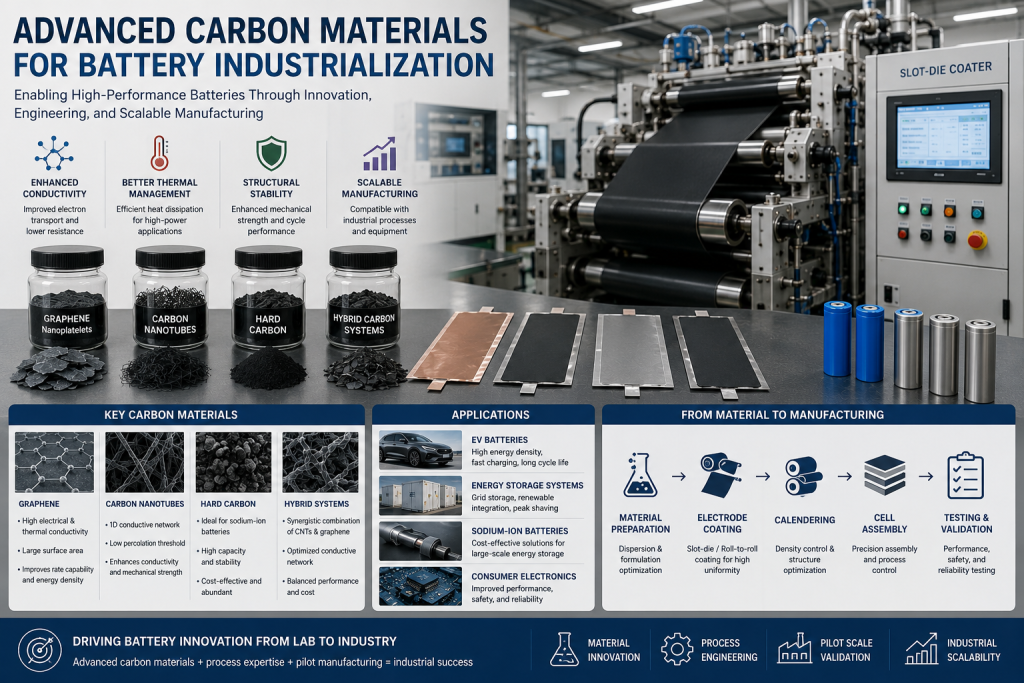
Among the most promising innovations are advanced carbon materials, including graphene, carbon nanotubes (CNTs), hard carbon, and hybrid carbon architectures.
These materials are no longer viewed simply as laboratory research topics. They are increasingly becoming key enablers of battery industrialization by improving electrode performance, manufacturing stability, and production scalability.
The challenge is no longer whether advanced carbon materials can improve battery performance—it is how to integrate them into reliable, repeatable, and cost-effective manufacturing processes.
Why Advanced Carbon Materials Matter
Conventional battery materials have supported decades of industrial growth, but next-generation batteries require improved electrical, thermal, and mechanical performance.
Advanced carbon materials offer several functional advantages:
- Enhanced electrical conductivity
- Improved thermal management
- Mechanical reinforcement
- Better electrode integrity
- Support for high-loading electrode designs
These properties contribute not only to battery performance but also to manufacturing reliability.
Key Advanced Carbon Materials
Graphene
Graphene is a two-dimensional carbon material with exceptional electrical and thermal conductivity.
Potential industrial applications include:
- Conductive additives
- Heat-spreading layers
- Functional coatings
- Current collector modification
Its large surface area and thin structure make it attractive for improving charge transport and thermal distribution.
Carbon Nanotubes (CNTs)
CNTs form one-dimensional conductive networks with extremely high aspect ratios.
Industrial advantages include:
- Efficient electron transport
- Low percolation threshold
- Mechanical reinforcement
- Improved conductive pathways
CNTs are widely studied as conductive additives for lithium-ion and sodium-ion batteries.
Hard Carbon
Hard carbon has become one of the leading anode materials for sodium-ion batteries.
Its disordered structure provides suitable sodium storage capability while remaining compatible with scalable manufacturing.
Hybrid Carbon Systems
Many industrial formulations now combine multiple carbon materials.
Hybrid systems can integrate:
- CNT conductive bridges
- Graphene conductive platforms
- Optimized particle connectivity
These multifunctional architectures help balance electrical, thermal, and mechanical performance.
Applications Across Battery Manufacturing
Advanced carbon materials influence several stages of battery production.
Slurry Formulation
Proper dispersion of conductive carbon materials is essential for achieving:
- Stable viscosity
- Uniform particle distribution
- Consistent coating quality
Formulation engineering plays a critical role in maintaining repeatable production.
Electrode Coating
Uniform electrode coatings are necessary for high-performance batteries.
Carbon materials can improve:
- Conductive network formation
- Electrode uniformity
- Mechanical stability during processing
Compatibility with slot-die and roll-to-roll coating processes is an important consideration.
Calendering and Electrode Structure
During electrode densification, conductive networks must remain intact.
Advanced carbon materials help maintain electrical pathways while supporting structural integrity.
Supporting Next-Generation Battery Technologies
Advanced carbon materials are increasingly relevant for emerging battery systems.
High-Energy Lithium-Ion Batteries
Applications include:
- High-nickel cathodes
- Silicon-rich anodes
- Fast-charging cells
These systems require efficient conductive networks and improved thermal control.
Sodium-Ion Batteries
Sodium-ion batteries present new challenges in material selection and electrode engineering.
Advanced carbon materials can contribute to:
- Improved conductivity
- Better electrode stability
- Optimized hard carbon performance
Dry Electrode Manufacturing
Dry electrode technologies reduce solvent use but require robust conductive architectures.
CNTs and graphene may help create interconnected networks that support solvent-free electrode processing.
Manufacturing Challenges
Although advanced carbon materials offer excellent laboratory performance, industrial implementation requires overcoming several challenges.
Dispersion Stability
Carbon materials naturally tend to aggregate.
Achieving uniform dispersion is essential for maintaining product consistency.
Batch-to-Batch Consistency
Industrial customers expect repeatable material quality across large production volumes.
This requires strict control of:
- Raw materials
- Mixing procedures
- Process parameters
- Quality inspection
Process Compatibility
Materials must be compatible with existing manufacturing equipment, including:
- Mixing systems
- Slot-die coaters
- Roll-to-roll production lines
- Drying systems
- Calendering equipment
Successful integration minimizes disruption to established production processes.
The Role of Pilot Manufacturing
Pilot manufacturing serves as the bridge between laboratory development and commercial production.
Pilot-scale validation allows manufacturers to evaluate:
- Formulation robustness
- Coating performance
- Electrode quality
- Process repeatability
- Manufacturing scalability
Pilot lines reduce technical risk before large-scale investment and provide valuable data for customer qualification.
From Material Innovation to Industrialization
Battery industrialization depends on more than discovering high-performance materials.
Successful commercialization requires integration of:
- Material science
- Process engineering
- Equipment optimization
- Quality management
- Manufacturing expertise
Only by combining these elements can advanced carbon materials deliver reliable value in industrial production.
Future Trends
The future of battery manufacturing is expected to focus on:
- Higher energy density electrodes
- Sustainable manufacturing processes
- Intelligent process control
- Flexible pilot production platforms
- Hybrid carbon material systems
Advanced carbon materials will increasingly serve as enabling technologies that support both product performance and manufacturing efficiency.
Advanced carbon materials are becoming essential components of next-generation battery industrialization.
Graphene, carbon nanotubes, hard carbon, and hybrid carbon systems each contribute unique advantages that improve conductivity, thermal management, mechanical stability, and electrode design.
However, successful industrial adoption depends not only on material properties but also on formulation engineering, pilot validation, scalable manufacturing, and consistent quality control.
As battery technologies continue to evolve, the companies that effectively integrate advanced carbon materials into industrial production will be better positioned to accelerate innovation while maintaining manufacturing reliability.