
Understanding Wet Electrode Processing in Lithium Batteries
From Slurry Preparation to Industrial Manufacturing
Lithium-ion batteries power everything from electric vehicles and energy storage systems to consumer electronics and AI infrastructure. While much attention is given to battery chemistry, one of the most critical aspects of battery manufacturing is often overlooked:
Electrode processing.
Among the various manufacturing methods used today, wet electrode processing remains the dominant production route for lithium-ion batteries worldwide.
Whether producing LFP batteries, NCM cells, silicon-anode batteries, or advanced energy storage systems, wet electrode manufacturing serves as the foundation of modern battery production.
Understanding how wet electrode processing works is essential for evaluating:
- Battery manufacturability
- Production scalability
- Electrode quality
- Process stability
- Commercialization readiness
What Is Wet Electrode Processing?
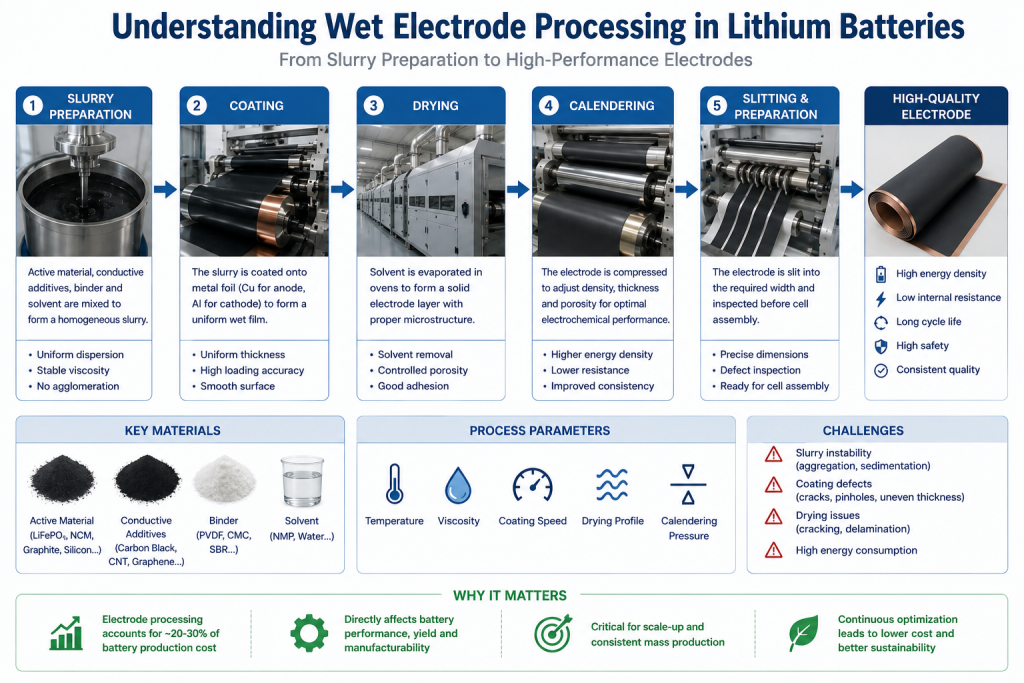
Wet electrode processing is the conventional method used to manufacture battery electrodes.
The process involves:
- Mixing active materials into a slurry
- Coating the slurry onto metal foil
- Drying the coated electrode
- Compressing the electrode through calendaring
- Preparing the electrode for cell assembly
The term “wet” refers to the use of liquid solvents during slurry preparation and coating.
Today, the majority of lithium-ion batteries rely on wet electrode manufacturing.
Why Electrode Processing Matters
Battery performance depends on more than chemistry alone.
Electrode processing directly affects:
- Energy density
- Internal resistance
- Fast-charging capability
- Cycle life
- Safety
- Manufacturing yield
Even an excellent battery material can fail if electrode processing is poorly controlled.
This is why battery industrialization increasingly focuses on process engineering as much as material development.
Step 1: Slurry Preparation
The first stage of wet electrode processing is slurry mixing.
A typical cathode slurry contains:
- Active material
- Conductive additives
- Binder
- Solvent
Anode slurries contain similar components with graphite or silicon-based active materials.
The objective is to create a stable and homogeneous mixture.
Why Slurry Quality Is Critical
Poor slurry preparation can lead to:
- Agglomeration
- Sedimentation
- Viscosity instability
- Uneven conductive networks
These issues often become more severe during scale-up.
For advanced systems containing CNTs or graphene, dispersion quality becomes even more important.
Step 2: Electrode Coating
After mixing, the slurry is coated onto current collectors.
Typically:
Cathodes
- Aluminum foil
Anodes
- Copper foil
Industrial coating methods include:
- Slot-die coating
- Comma coating
- Doctor blade coating
- Roll-to-roll coating
Among these, slot-die coating has become the dominant industrial solution.
Why Coating Quality Matters
The coating process determines:
- Electrode thickness
- Loading uniformity
- Surface quality
- Production consistency
Coating defects may result in:
- Capacity variation
- Increased resistance
- Yield loss
In industrial manufacturing, coating stability is often more important than laboratory material performance.
Step 3: Drying
Once coated, electrodes enter drying ovens.
The purpose is to remove solvents while maintaining electrode integrity.
Drying affects:
- Porosity
- Binder distribution
- Mechanical strength
- Conductive pathways
Improper drying can cause:
- Cracking
- Delamination
- Uneven microstructure
Drying optimization is one of the most important aspects of battery process development.
Step 4: Calendaring
Calendaring compresses the electrode using precision rollers.
This process adjusts:
- Density
- Thickness
- Porosity
Proper calendaring improves:
- Energy density
- Contact resistance
- Electrode consistency
However, excessive compression may reduce ion transport efficiency.
Finding the correct balance is critical.
Step 5: Electrode Slitting and Preparation
After calendaring, electrodes are:
- Slit into required widths
- Inspected
- Prepared for cell assembly
Any defects introduced during earlier processing stages become visible at this point.
This is why quality control throughout the process is essential.
Challenges in Wet Electrode Processing
Although wet processing is widely adopted, it presents several manufacturing challenges.
Solvent Management
Many cathode systems use NMP solvent, which requires:
- Recovery systems
- Environmental controls
- Additional processing costs
Energy Consumption
Drying ovens consume substantial amounts of energy.
For large-scale battery factories, drying can represent a major operating expense.
Process Complexity
Multiple manufacturing stages must remain stable simultaneously.
Variations in:
- Temperature
- Humidity
- Viscosity
- Coating speed
can affect final battery quality.
Why Wet Processing Remains Dominant
Despite emerging alternatives such as dry electrode technology, wet processing remains the industry standard because it offers:
- Proven reliability
- Mature equipment ecosystems
- High manufacturing consistency
- Broad material compatibility
Most commercial lithium-ion batteries continue to use wet electrode production.
Wet Processing and Advanced Battery Materials
As battery technology evolves, wet processing must adapt to new materials.
Examples include:
Silicon Anodes
Require careful control of:
- Expansion behavior
- Binder systems
- Electrode integrity
CNT Conductive Networks
Need optimized dispersion to maintain:
- Conductivity
- Coating stability
- Production consistency
Graphene-Enhanced Electrodes
Require advanced slurry engineering and coating optimization to achieve scalable manufacturing.
Thick Electrodes
Need precise control over:
- Drying profiles
- Conductive pathways
- Porosity distribution
The Importance of Pilot-Scale Validation
Many battery technologies perform well in laboratory cells but fail during industrial production.
Pilot-scale manufacturing helps validate:
- Slurry stability
- Coating quality
- Drying performance
- Process repeatability
- Equipment compatibility
Before moving to gigafactory-scale production, pilot validation is essential.
Future Trends in Electrode Manufacturing
The battery industry is actively developing:
- Dry electrode technologies
- AI-assisted process optimization
- Smart in-line monitoring
- Digital twin manufacturing
- High-speed coating systems
However, wet electrode processing will remain a cornerstone of battery production for many years to come.
Wet electrode processing is the foundation of modern lithium-ion battery manufacturing.
From slurry preparation and coating to drying and calendaring, every step influences battery performance, yield, and commercial viability.
As the industry moves toward higher-energy batteries, silicon anodes, advanced conductive materials, and large-scale energy storage systems, understanding electrode processing becomes increasingly important.
Successful battery commercialization depends not only on innovative materials, but also on the ability to manufacture those materials consistently, efficiently, and at scale.