
How Graphene Improves Thermal Management Systems
Effective thermal management is crucial for modern electronics, electric vehicles (EVs), and energy storage systems (ESS). Overheating can degrade performance, reduce lifespan, and pose safety risks. Graphene, with its exceptional thermal conductivity, is revolutionizing the way engineers design cooling systems and thermal interface materials.
Incorporating graphene into thermal management systems provides:
- Faster heat spreading
- Reduced hotspots
- Enhanced device reliability
- Opportunities for lighter, thinner cooling components
Understanding how graphene functions in these systems helps manufacturers design more efficient and safer devices.
Why Thermal Management Matters
Heat generation is unavoidable in:
- High-capacity batteries
- Power electronics
- CPUs/GPUs in data centers
- Renewable energy inverters
Without effective heat dissipation:
- Battery cells degrade faster
- Electronic components may fail
- Energy efficiency declines
- Safety risks increase (thermal runaway in batteries)
Advanced materials like graphene can directly address these challenges.
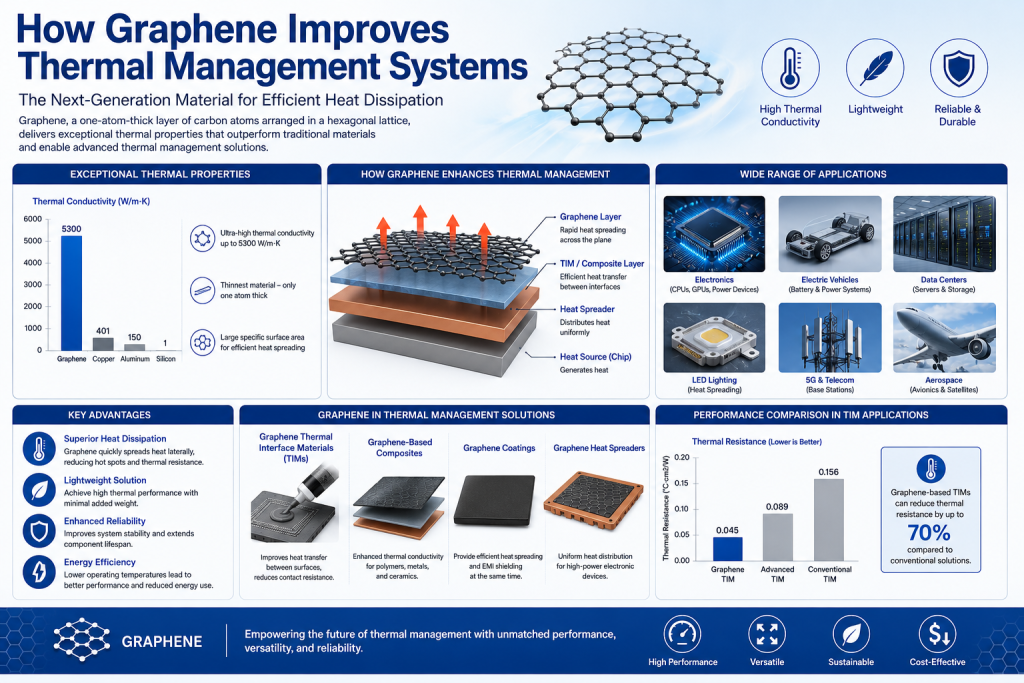
Graphene’s Thermal Properties
Graphene exhibits:
- Thermal conductivity up to 5000 W/m·K (in-plane)
- High surface area for heat spreading
- Low density for lightweight solutions
- Excellent mechanical flexibility
These properties make graphene ideal for:
- Thermal interface materials (TIMs): Graphene enhances thermal contact between heat sources and sinks.
- Composite heat spreaders: Graphene can be embedded in polymers or metals to improve overall thermal conductivity.
- Coatings and films: Thin graphene layers dissipate heat efficiently across surfaces.
Applications in Battery Thermal Management
Battery packs, especially in EVs and ESS, face critical thermal challenges:
- Uniform temperature distribution: Prevents hotspots that accelerate aging
- Rapid heat removal during fast charging: Avoids thermal runaway
- Lightweight and compact solutions: Minimizes energy loss while maintaining safety
Graphene-enhanced thermal pads, pastes, and composite plates help achieve these objectives by providing high thermal conductivity without significantly increasing weight or thickness.
Advantages of Graphene-Based Thermal Materials
| Feature | Benefit |
|---|---|
| High in-plane conductivity | Rapid lateral heat spreading, preventing hotspots |
| Flexibility & mechanical strength | Conforms to uneven surfaces for better thermal contact |
| Lightweight | Reduces total system weight in EVs and electronics |
| Scalable composites | Compatible with polymers, metals, and ceramics for diverse applications |
| Stability | Maintains performance under repeated thermal cycles |
Integration Strategies
Graphene can be incorporated in multiple forms:
- Graphene flakes or powders – mixed into polymer TIMs to improve conductivity.
- Graphene sheets or films – laminated or coated on metal plates for efficient heat spreaders.
- Graphene hybrid composites – combined with metals or ceramics for high-performance cooling modules.
Each approach must consider:
- Orientation: Align graphene for maximum in-plane conductivity
- Loading fraction: Optimize concentration for conductivity without compromising processability
- Interface adhesion: Ensure good contact with heat source and sink
Graphene in High-Power Electronics and Data Centers
Besides batteries, high-performance electronics generate significant heat. Graphene is increasingly used in:
- CPU/GPU cooling solutions
- Power modules and inverters
- Heat dissipation layers in LEDs
Benefits include lower operating temperatures, higher reliability, and energy efficiency improvements.
Future Outlook
As devices become more powerful and compact, traditional cooling methods (aluminum plates, thermal pastes) reach their limits. Graphene-enabled solutions offer:
- Faster adoption in EV battery packs and ESS modules
- Integration into lightweight, high-performance electronics
- Next-generation thermal interface and heat-spreading materials
Research continues to enhance scalability, reduce costs, and improve integration methods, pushing graphene toward mainstream adoption in thermal management.
Graphene’s exceptional thermal conductivity, flexibility, and lightweight nature make it a transformative material for modern thermal management systems. From batteries to high-power electronics, graphene improves heat dissipation, enhances reliability, and enables safer, more efficient devices.
By incorporating graphene into TIMs, heat spreaders, and composite cooling solutions, manufacturers can meet the growing demand for high-performance, thermally stable systems in energy, transportation, and electronics.