
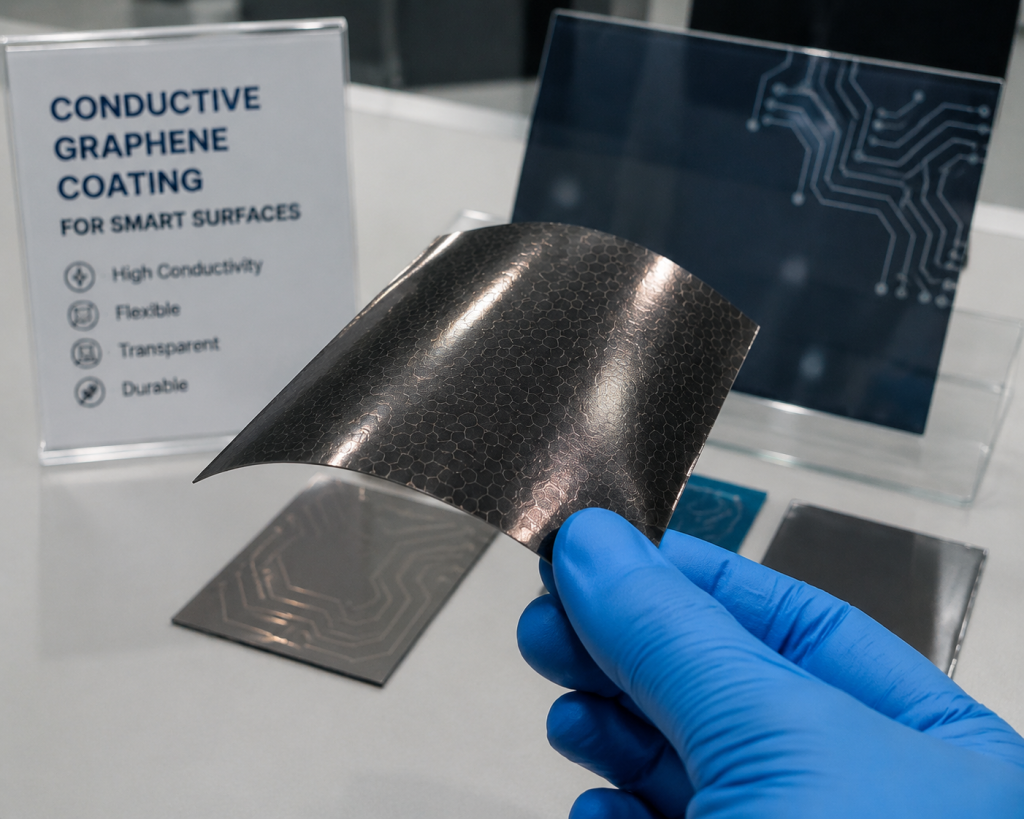
Conductive Graphene Coatings for Smart Surfaces
Modern industries are moving toward smarter, more connected surfaces.
Traditional materials such as glass, polymers, metals, and composite structures are increasingly expected to provide additional functions beyond mechanical support.
These functions include:
- Electrical conductivity
- Touch sensing
- Heating capability
- Electromagnetic shielding
- Static control
- Signal transmission
This transformation is driving interest in smart surfaces—materials that combine structural functions with electronic capabilities.
Among advanced materials, graphene has attracted significant attention due to its excellent electrical conductivity, mechanical flexibility, and thin-film compatibility.
Graphene-based conductive coatings provide a pathway to transform conventional surfaces into functional electronic platforms.
What Are Smart Surfaces?
Smart surfaces are engineered surfaces capable of interacting with their environment or performing additional functions.
Unlike traditional passive materials, smart surfaces may provide:
- Electrical response
- Thermal control
- Sensing capability
- Energy management
- Communication functions
Examples include:
- Touch-sensitive panels
- Heated surfaces
- Conductive housings
- Flexible electronics
- EMI shielding structures
Conductive coatings are one of the key technologies enabling these applications.
Why Graphene for Conductive Coatings?
Graphene offers several properties that make it attractive for smart surface applications.
High Electrical Conductivity
Graphene can create efficient conductive pathways within coating systems.
This enables applications requiring:
- Surface conductivity
- Charge dissipation
- Electrical signal transmission
Thin and Lightweight Structure
Graphene coatings can provide electrical functionality without significantly increasing:
- Thickness
- Weight
- Material complexity
This is valuable for lightweight electronic systems.
Mechanical Flexibility
Unlike many traditional conductive materials, graphene-based coatings can maintain functionality under bending and deformation.
This makes them suitable for:
- Flexible electronics
- Wearable devices
- Composite structures
Environmental Protection
Graphene may also contribute additional functions such as:
- Barrier properties
- Corrosion resistance
- Chemical resistance
This allows multifunctional coating development.
Applications of Conductive Graphene Coatings
Smart Electronics
Graphene coatings can support:
- Touch interfaces
- Flexible circuits
- Conductive surfaces
They provide an alternative approach for creating thin functional layers.
EMI Shielding
Modern electronic systems require protection against electromagnetic interference.
Graphene-based coatings can help reduce electromagnetic leakage while maintaining lightweight structures.
Applications include:
- Electronic housings
- Communication equipment
- Aerospace components
Electrostatic Discharge Protection
Sensitive electronics require controlled charge dissipation.
Conductive graphene coatings can provide:
- Anti-static surfaces
- Controlled conductivity
- Improved electronic reliability
Transparent Conductive Surfaces
Graphene is being studied for transparent conductive applications where traditional materials may have limitations.
Potential uses include:
- Display technologies
- Sensors
- Flexible electronic devices
Heating Surfaces
Conductive graphene coatings can generate heat through electrical resistance.
Potential applications include:
- Smart heating panels
- Defrosting systems
- Thermal management components
From Graphene Material to Functional Coating
Producing a useful conductive coating requires more than adding graphene powder.
A successful coating system requires optimization of:
- Graphene dispersion
- Binder selection
- Solvent system
- Rheology control
- Coating method
- Curing conditions
The final performance depends on the interaction between all components.
Importance of Graphene Dispersion
Dispersion quality directly affects conductivity.
Poor dispersion can cause:
- Graphene agglomeration
- Uneven conductive pathways
- Higher electrical resistance
- Surface defects
Industrial applications require stable dispersion systems that maintain performance during storage and production.
Coating Technologies for Smart Surfaces
Different applications require different coating processes.
Slot-Die Coating
Suitable for:
- Continuous production
- Thin functional films
- High precision coating
Roll-to-Roll Processing
Useful for:
- Flexible substrates
- Large-area manufacturing
- High-volume production
Spray Coating
Suitable for:
- Complex shapes
- Large components
- Industrial surfaces
Printing Technologies
Applicable for:
- Electronic patterns
- Functional circuits
- Smart devices
Challenges in Commercialization
Although graphene conductive coatings show strong potential, several challenges remain.
Consistent Conductivity
Maintaining uniform electrical performance across large areas is challenging.
Adhesion and Durability
Industrial coatings must withstand:
- Mechanical stress
- Temperature changes
- Environmental exposure
Manufacturing Repeatability
Commercial customers require:
- Stable quality
- Reliable supply
- Consistent performance
Cost Optimization
Graphene coating solutions must balance:
- Material loading
- Performance requirements
- Manufacturing efficiency
The Role of Pilot Manufacturing
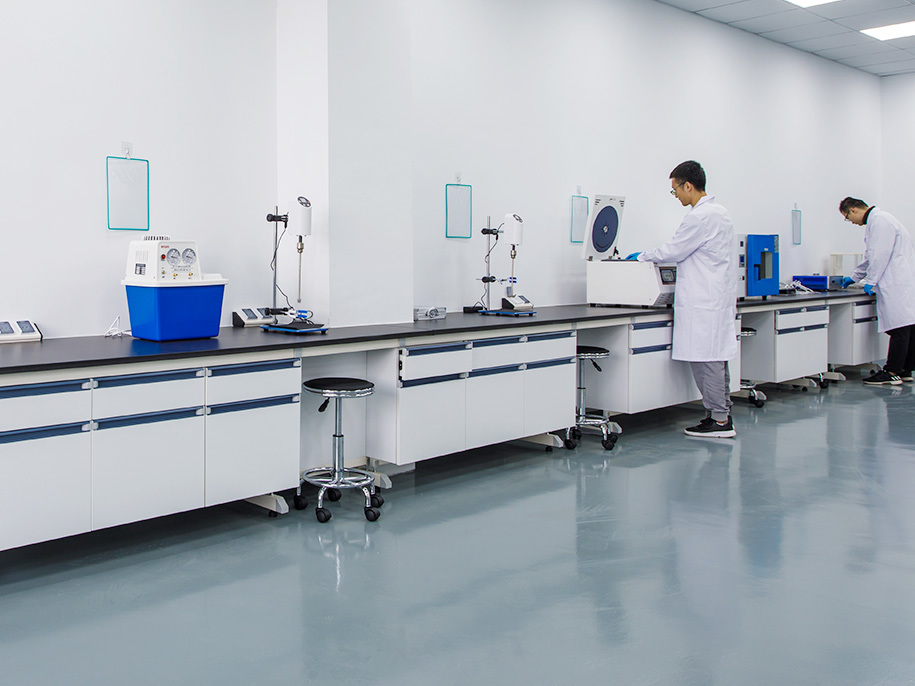
Pilot manufacturing provides the critical connection between laboratory research and commercial production.
Pilot trials help validate:
- Coating formulation
- Dispersion stability
- Process parameters
- Production repeatability
- Customer sample requirements
For graphene smart surface technologies, pilot validation is often the key step before industrial adoption.
Future Development Trends
Multifunctional Smart Coatings
Future coatings may combine:
- Electrical conductivity
- Thermal management
- Corrosion protection
- Sensing capability
Hybrid Carbon Systems
Combining:
- Graphene
- CNTs
- Other conductive materials
may improve conductivity and processing performance.
Sustainable Coating Technologies
Future development will focus on:
- Water-based systems
- Lower energy processing
- Environmentally friendly manufacturing
Intelligent Manufacturing
Advanced monitoring and automation will improve coating consistency and scalability.
Conductive graphene coatings represent an important pathway toward next-generation smart surfaces.
By combining electrical functionality with lightweight, flexible, and durable coating systems, graphene enables traditional materials to become active components in modern electronic and industrial systems.
However, successful commercialization requires more than excellent material properties.
Stable dispersion, optimized coating processes, pilot-scale validation, and scalable manufacturing are essential for transforming graphene from an advanced material into a practical industrial solution.
The future of smart surfaces will depend not only on new materials, but on the ability to engineer complete coating systems that deliver reliable performance at industrial scale.