
Pilot Manufacturing Challenges for Sodium-Ion Batteries
Sodium-ion batteries are emerging as one of the most promising alternatives to traditional lithium-ion battery technologies.
With advantages including:
- Abundant sodium resources
- Lower raw material cost potential
- Reduced dependence on critical lithium resources
sodium-ion batteries are attracting increasing attention for:
- Grid energy storage
- Renewable energy systems
- Low-cost electric mobility
However, moving sodium-ion batteries from laboratory research to commercial production remains a significant engineering challenge.
The transition requires more than developing high-performance materials.
It requires reliable pilot manufacturing processes that can validate:
- Electrode production
- Cell assembly
- Material compatibility
- Process stability
- Scale-up feasibility
Why Pilot Manufacturing Is Critical for Sodium-Ion Batteries
Lithium-ion battery manufacturing has benefited from decades of optimization.
Sodium-ion technology, however, is still evolving.
Different companies and research teams are exploring:
- Various cathode materials
- Different anode structures
- New electrolyte systems
- Alternative electrode manufacturing methods
Because of this diversity, pilot manufacturing becomes essential.
A pilot line provides the bridge between:
Laboratory Innovation
↓
Engineering Validation
↓
Commercial Production
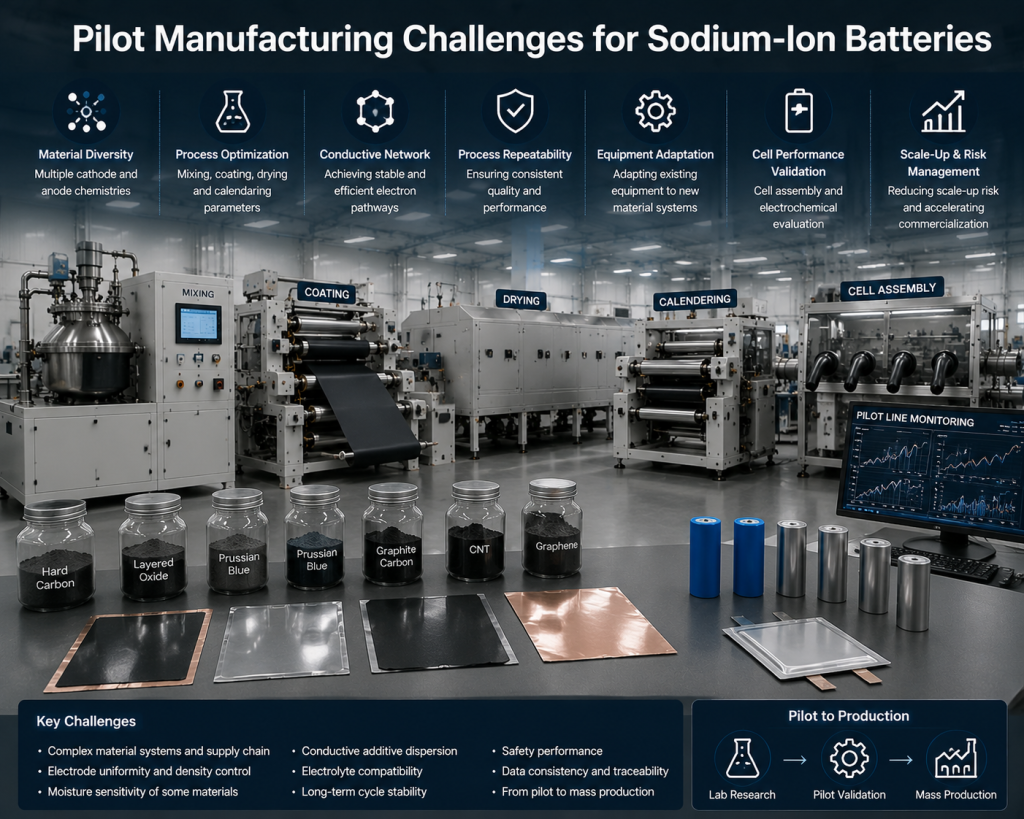
Challenge 1: Material System Diversity
One of the unique characteristics of sodium-ion batteries is the wide range of possible material combinations.
Cathode Materials
Common research directions include:
- Layered oxide materials
- Prussian blue analogues
- Polyanionic compounds
Each material has different:
- Particle size
- Moisture sensitivity
- Processing behavior
- Mechanical characteristics
Anode Materials
Hard carbon is currently one of the most widely studied sodium-ion anode materials.
However, performance depends on:
- Carbon structure
- Porosity
- Surface chemistry
- Manufacturing process
Different carbon materials may require different production conditions.
Challenge 2: Electrode Manufacturing Optimization
A material that performs well in laboratory testing may behave differently during pilot production.
Important electrode parameters include:
Mixing Process
Engineers must control:
- Powder distribution
- Conductive additive dispersion
- Binder interaction
Poor mixing can create:
- Uneven conductivity
- Performance variation
- Reduced cycle life
Coating Process
Pilot coating must achieve:
- Uniform thickness
- Stable coating quality
- Controlled loading
Important parameters include:
- Coating speed
- Viscosity
- Solid content
- Drying conditions
Calendering Process
Electrode compression affects:
- Density
- Porosity
- Ion transport
- Mechanical strength
Optimization is required for each material system.
Challenge 3: Conductive Network Design
Sodium-ion electrode materials often require conductive additives to improve electrical performance.
Advanced carbon materials such as:
- Carbon nanotubes (CNT)
- Graphene
- Hybrid CNT + graphene systems
can help create efficient conductive networks.
However, their effectiveness depends on:
- Dispersion quality
- Material ratio
- Electrode formulation
- Processing method
A small change in formulation can significantly affect final performance.
Challenge 4: Process Repeatability
Laboratory experiments often focus on achieving the best performance.
Pilot manufacturing must focus on consistency.
Industrial customers require:
- Stable production batches
- Repeatable electrode properties
- Predictable cell performance
Key monitoring factors include:
- Material quality
- Mixing consistency
- Coating uniformity
- Moisture control
- Equipment stability
Challenge 5: Equipment Adaptation
Many sodium-ion battery developers use existing lithium-ion manufacturing equipment.
However, sodium-ion materials may behave differently.
Potential challenges include:
- Different slurry characteristics
- Different drying requirements
- Different electrode mechanical properties
Pilot lines allow engineers to determine:
- Which equipment can be reused
- Which parameters require adjustment
- Which processes need redesign
Challenge 6: Cell-Level Validation
Electrode performance alone does not guarantee successful battery cells.
Pilot manufacturing must evaluate:
- Electrode compatibility
- Cell assembly process
- Electrolyte interaction
- Cycling performance
Important testing includes:
- Capacity retention
- Rate performance
- Safety evaluation
- Long-term stability
The Role of Flexible Pilot Platforms
A flexible pilot platform enables rapid optimization.
It allows developers to test:
- Different material combinations
- Multiple electrode formulations
- Various coating parameters
without requiring a complete industrial production line.
This flexibility is especially valuable for emerging technologies like sodium-ion batteries.
Pilot Manufacturing and Commercial Risk Reduction
Large-scale battery production requires significant investment.
Before committing to gigawatt-hour manufacturing, companies need confidence in:
- Technology performance
- Manufacturing stability
- Supply chain readiness
Pilot validation reduces risks by identifying problems early.
It helps answer:
- Can this material be manufactured consistently?
- Can production parameters be controlled?
- Can performance be reproduced at larger scale?
Future Trends in Sodium-Ion Battery Pilot Manufacturing
More Flexible Production Platforms
Future battery development will require adaptable manufacturing environments capable of testing multiple technologies.
Digital Manufacturing Control
Advanced monitoring systems will improve:
- Process stability
- Quality control
- Production efficiency
Integration of Advanced Materials
Future sodium-ion batteries may increasingly use:
- Graphene additives
- CNT conductive networks
- Advanced carbon structures
to improve performance.
Faster Commercialization Cycles
Flexible pilot platforms will shorten the time between:
Material discovery
and
Commercial battery production.
Sodium-ion batteries have significant potential to become an important part of future energy storage systems.
However, commercialization depends not only on battery chemistry innovation but also on manufacturing capability.
Pilot manufacturing plays a critical role in solving challenges related to:
- Material processing
- Electrode production
- Equipment compatibility
- Process repeatability
- Scale-up validation
The companies that successfully connect advanced materials with flexible pilot manufacturing platforms will have a stronger advantage in bringing sodium-ion technologies from the laboratory into real-world applications.
The future of sodium-ion batteries will depend not only on discovering better materials, but also on building better manufacturing systems.