
Why Many Material Projects Never Reach Industrial Scale
Across industries such as batteries, electronics, energy storage, and advanced manufacturing, thousands of new materials are developed every year.
Many of these materials demonstrate impressive performance in laboratory testing:
- Higher conductivity
- Better thermal properties
- Improved mechanical strength
- Enhanced chemical stability
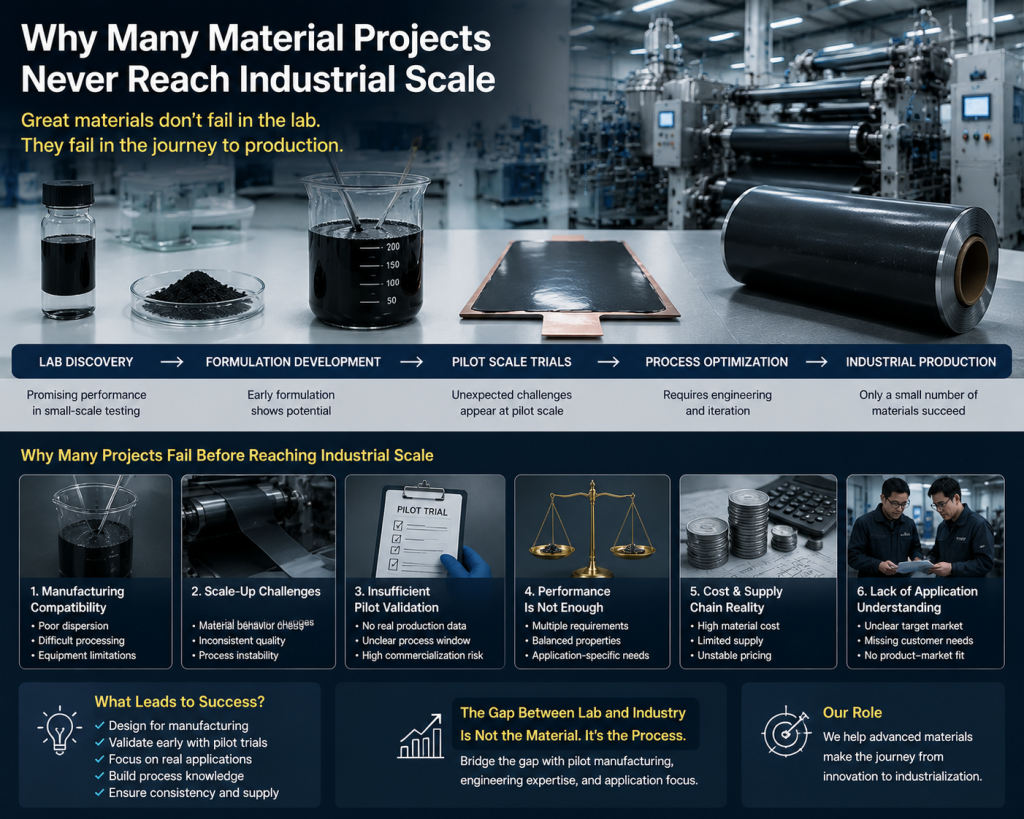
However, only a small percentage successfully reach industrial production.
The reason is often not a lack of material performance.
The real challenge is the transition from:
Laboratory Discovery
↓
Engineering Validation
↓
Pilot Manufacturing
↓
Industrial Production
Many promising materials fail because they cannot successfully complete this journey.
Laboratory Performance Does Not Equal Industrial Success
One of the most common misunderstandings in advanced materials development is assuming that excellent laboratory data automatically indicates commercial potential.
Laboratory experiments usually focus on:
- Maximum achievable performance
- Controlled conditions
- Small sample sizes
Industrial manufacturing requires much more:
- Consistent quality
- Stable production
- Cost control
- Process compatibility
- Supply reliability
A material must perform not only in a research environment but also within a complex manufacturing system.
Challenge 1: Lack of Manufacturing Compatibility
A new material may demonstrate excellent properties but fail because it does not fit existing production processes.
Manufacturers must consider:
- Mixing behavior
- Coating compatibility
- Drying requirements
- Equipment limitations
- Processing temperature
For example, a conductive material may show excellent conductivity in a laboratory test but create difficulties during:
- Slurry preparation
- Dispersion
- Coating
- Film formation
Industrial success requires designing materials with manufacturing processes in mind.
Challenge 2: Scaling Changes Material Behavior
Many materials behave differently when production volume increases.
At laboratory scale:
- Mixing is easier
- Conditions are highly controlled
- Variations are limited
At industrial scale:
- Batch size increases
- Equipment effects become significant
- Small variations accumulate
Common scale-up problems include:
- Dispersion inconsistency
- Particle aggregation
- Coating defects
- Performance variation
A successful material must maintain performance during larger-scale processing.
Challenge 3: Insufficient Pilot Validation
Pilot manufacturing is often the missing bridge between research and commercialization.
Without pilot validation, companies may not understand:
- How the material behaves in continuous production
- Whether process parameters are stable
- Whether quality can be repeated
Pilot trials help answer critical questions:
Can the material be produced consistently?
Can manufacturing parameters be controlled?
Can customers evaluate realistic samples?
Without these answers, moving directly to mass production involves significant risk.
Challenge 4: Performance Alone Is Not Enough
Industrial customers rarely select materials based only on one performance parameter.
A successful material must balance multiple requirements.
For example:
Battery Materials
Customers evaluate:
- Conductivity
- Cycle performance
- Electrode processing
- Cost
- Supply stability
Functional Coatings
Customers evaluate:
- Performance
- Adhesion
- Durability
- Coating process compatibility
- Production efficiency
Thermal Materials
Customers evaluate:
- Thermal performance
- Reliability
- Mechanical properties
- Manufacturing repeatability
The best industrial material is not always the one with the highest laboratory performance, but the one with the best overall balance.
Challenge 5: Cost and Supply Chain Reality
A material may technically work but still fail commercially due to economic limitations.
Industrial customers consider:
- Raw material availability
- Production capacity
- Manufacturing cost
- Quality consistency
- Long-term supply capability
A technology must have a realistic path toward competitive production.
Challenge 6: Lack of Application-Specific Development
Many material projects focus on creating a superior material without clearly defining the final application.
However, industrial customers usually need solutions rather than materials.
Successful development requires understanding:
- Target product requirements
- Manufacturing environment
- Performance expectations
- Customer qualification process
For example, graphene for:
- Battery electrodes
- Thermal coatings
- Conductive films
requires different specifications and processing approaches.
The Importance of Application Engineering
Advanced materials commercialization requires close cooperation between:
Material Scientists
Process Engineers
Manufacturing Teams
End Users
Application engineering helps transform a material from a technical concept into a practical industrial solution.
The Role of Pilot Manufacturing Platforms
Flexible pilot platforms help reduce commercialization risks.
They provide an environment to evaluate:
- Material formulations
- Manufacturing processes
- Coating technologies
- Electrode production
- Customer samples
Pilot platforms allow companies to optimize before committing to full-scale investment.
Why Some Technologies Succeed
Successful material commercialization usually follows several principles:
1. Design for Manufacturing
Materials should be developed with production requirements in mind.
2. Validate Early
Pilot testing should begin before large investments are made.
3. Focus on Applications
Materials should solve real industrial problems.
4. Build Process Knowledge
Manufacturing expertise is as important as material innovation.
5. Maintain Consistency
Industrial customers require reliable performance over time.
Future Trends in Material Commercialization
The future of advanced materials development will increasingly emphasize:
- Faster pilot validation
- Digital manufacturing monitoring
- AI-assisted process optimization
- Flexible production platforms
- Application-driven material design
The companies that successfully combine material innovation with manufacturing capability will have the strongest advantage.
Many advanced material projects fail to reach industrial scale not because the materials lack potential, but because commercialization challenges are underestimated.
The journey from laboratory discovery to industrial production requires solving problems in:
- Manufacturing compatibility
- Process scalability
- Quality control
- Cost structure
- Customer validation
Advanced materials become successful technologies only when excellent scientific performance is combined with practical engineering and reliable manufacturing.
The future of material innovation will not belong only to those who discover better materials, but to those who can successfully bring those materials into real-world production.