
Why Coating Compatibility Matters More Than Lab Conductivity
When developing advanced conductive materials such as graphene, carbon nanotubes (CNTs), and other nanocarbon additives, electrical conductivity is often one of the first performance indicators researchers evaluate.
A material with exceptionally high conductivity can look highly attractive in laboratory testing.
However, when that same material is introduced into a real coating process, the expected performance may not translate into a better commercial product.
The reason is simple:
A coating material is only valuable when it can be processed, coated, dried, and integrated consistently into the final application.
This is particularly important for graphene-based materials used in batteries, EMI shielding, thermal management, conductive coatings, and electronic applications.
A graphene powder may have excellent intrinsic electrical conductivity, but if it cannot be dispersed properly, produces unstable viscosity, clogs the coating head, adheres poorly to the substrate, or creates a non-uniform film, its practical value can be significantly reduced.
This is why coating compatibility can matter more than laboratory conductivity when advanced materials move toward pilot production and commercial manufacturing.
Laboratory Conductivity vs. Real Coating Performance
Laboratory conductivity measurements are useful for understanding the intrinsic or composite electrical properties of a material.
They can help researchers compare different graphene grades and determine whether a conductive network has formed.
But laboratory conductivity does not answer several critical manufacturing questions:
- Can the material be dispersed consistently?
- Is the formulation stable?
- Is the viscosity suitable for coating?
- Does the coating wet the substrate properly?
- Can the coating be applied uniformly?
- Does it maintain adhesion after drying?
- Can it run continuously at production speed?
- Does the coating survive downstream processing?
- Can the process achieve acceptable manufacturing yield?
These questions become increasingly important as development moves from laboratory research to pilot production.
A material with slightly lower conductivity but excellent processability may ultimately outperform a highly conductive material that is difficult to manufacture.
What Does Coating Compatibility Mean?
Coating compatibility refers to the ability of a material or formulation to work reliably with the complete coating system.
This includes compatibility with:
- The substrate
- The binder
- The solvent or aqueous medium
- Dispersants
- Coating equipment
- Drying equipment
- Downstream processing
- Storage conditions
- The final application
For graphene-based coatings, compatibility is especially important because graphene has a high surface area and strong interactions with surrounding materials.
The coating formulation therefore needs to be engineered as a complete system.
It is not enough to select a highly conductive graphene powder and simply add it to a solvent.
Why High Conductivity Can Be Misleading
Graphene’s intrinsic electrical properties are impressive.
However, the conductivity of a graphene powder does not directly represent the conductivity of a finished coating.
The final coating may contain:
- Graphene
- Binder
- Solvent
- Dispersant
- Other conductive additives
- Functional additives
- Voids
- Interfaces
All of these components influence the final conductive network.
A highly conductive graphene material may produce a poor coating if the graphene flakes become heavily agglomerated.
In contrast, a graphene grade with somewhat lower intrinsic conductivity may form a more uniform and interconnected network when properly dispersed.
Therefore:
Intrinsic conductivity ≠ coating conductivity ≠ device-level performance
These are three different measurements.
Dispersion Is the First Compatibility Challenge
Graphene-based coatings often depend on achieving a stable dispersion.
Graphene sheets naturally tend to interact with one another and can form agglomerates.
Poor dispersion may cause:
- Large particles
- Uneven coating
- Surface defects
- Conductivity variation
- Sedimentation
- Filter blockage
- Coating-head contamination
A formulation can therefore have excellent theoretical conductivity while producing poor real-world performance.
Dispersion quality should be evaluated using both material characterization and actual coating trials.
The key question is not simply:
“Is the graphene conductive?”
It is:
“Can the graphene form a stable and reproducible conductive network during the coating process?”
Viscosity Matters to Coating Quality
Viscosity is one of the most important process parameters in liquid coating.
The optimal viscosity depends on the selected coating technology.
For example, slot-die coating, blade coating, gravure coating, and spray coating have different rheological requirements.
If viscosity is too high, the formulation may cause:
- Poor flow
- Pumping difficulties
- Pressure fluctuations
- Coating streaks
- Equipment blockage
If viscosity is too low, it may lead to:
- Poor coating control
- Excessive spreading
- Edge instability
- Uneven film formation
Therefore, viscosity should be optimized together with coating speed, flow rate, coating gap, and substrate characteristics.
Surface Tension and Wetting
A coating formulation must also wet the substrate properly.
Surface tension affects how the liquid spreads across the surface.
Poor wetting can produce:
- Pinholes
- Voids
- Islands
- Uneven coverage
- Edge defects
This becomes especially important when graphene coatings are applied to metal foils, polymer films, current collectors, or other substrates with different surface energies.
Surface treatment may sometimes be required to improve adhesion and wetting.
The objective is to create a stable interface between the coating and substrate.
Adhesion Can Be More Important Than Conductivity
A highly conductive coating has limited value if it cannot remain attached to the substrate.
Adhesion must often survive multiple subsequent processes.
For battery-related applications, this may include:
- Drying
- Calendering
- Cutting
- Stacking
- Winding
- Electrolyte exposure
- Formation
- Thermal cycling
Poor adhesion can result in:
- Delamination
- Cracking
- Increased resistance
- Particle loss
- Reduced reliability
Therefore, coating development should evaluate both electrical performance and mechanical integrity.
Drying Changes the Final Coating
The wet coating is not the final product.
During drying, solvent or water is removed and the internal structure of the coating changes.
Graphene particles may:
- Move
- Reorient
- Aggregate
- Form conductive pathways
- Become concentrated near certain interfaces
The binder may also migrate during drying.
Drying temperature, airflow, residence time, and coating thickness can therefore influence the final electrical and mechanical properties.
This means that a formulation that looks excellent in a wet-state laboratory test may behave differently after industrial drying.
Coating Thickness Must Be Optimized
A common assumption is that increasing coating thickness will automatically improve conductivity or shielding.
In practice, there is an optimum range.
A coating that is too thin may have:
- Incomplete coverage
- Higher resistance
- Poor shielding
- Insufficient protection
A coating that is too thick may:
- Increase material consumption
- Increase weight
- Reduce energy density
- Increase drying requirements
- Increase manufacturing cost
For battery applications, excessive coating thickness can be particularly problematic because inactive material occupies space that could otherwise contribute to active energy storage.
The objective should therefore be:
Minimum effective thickness + required performance + stable manufacturing
Slot-Die Coating and Graphene Compatibility
Slot-die coating is attractive for many advanced material applications because it provides precise control over coating deposition and is suitable for continuous production.
However, the formulation must be compatible with the slot-die system.
Important factors include:
- Viscosity
- Surface tension
- Solid content
- Particle size
- Dispersion stability
- Flow behavior
- Filtration
- Pumping stability
Large agglomerates can create problems inside the coating system.
Long-duration pilot trials are particularly valuable because a formulation may run successfully for several minutes but become unstable during extended production.
Roll-to-Roll Processing Introduces New Variables
Roll-to-roll manufacturing creates additional challenges.
The web moves continuously through:
Unwinding → Coating → Drying → Inspection → Rewinding
The coating must remain stable throughout the entire process.
Variables such as:
- Web tension
- Line speed
- Roller alignment
- Coating pressure
- Drying temperature
- Environmental humidity
can influence the final coating.
A formulation designed only for small laboratory samples may require significant optimization before it can operate reliably on a continuous pilot line.
Why Pilot Production Is Essential
Pilot production provides the bridge between laboratory formulation and industrial manufacturing.
During pilot trials, engineers can evaluate the complete relationship between:
Material → Formulation → Equipment → Process → Coating → Final Performance
This is much more informative than testing the raw material alone.
Pilot production can reveal problems that laboratory testing cannot easily identify.
For example:
- Dispersion changes during long runs
- Viscosity drift
- Pump instability
- Filter blockage
- Coating-head contamination
- Drying limitations
- Surface defects
- Batch-to-batch variation
These problems need to be solved before commercial production.
A Practical Example: Graphene Conductive Coating
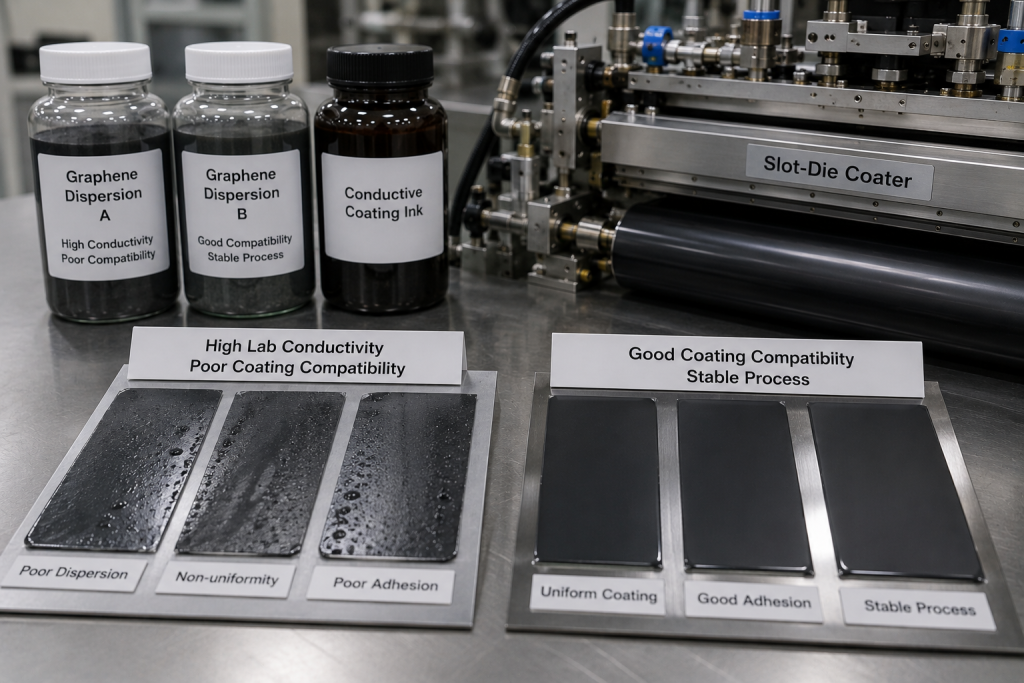
Consider two graphene materials.
Graphene A
- Very high intrinsic conductivity
- Large surface area
- Difficult dispersion
- High formulation viscosity
- Strong agglomeration tendency
Graphene B
- Slightly lower intrinsic conductivity
- Good dispersion
- Stable viscosity
- Excellent substrate wetting
- Consistent coating behavior
In a laboratory conductivity comparison, Graphene A may appear superior.
But during pilot coating, Graphene B may produce:
- More uniform films
- Better coating yield
- More stable production
- Lower defect rates
- Better adhesion
- More consistent electrical resistance
In this situation, Graphene B may be the better commercial material.
This example illustrates an important principle:
The best material is not always the material with the best isolated laboratory property.
The best material is the one that delivers the required final performance within a practical manufacturing process.
Coating Compatibility in Battery Applications
Battery manufacturing makes this issue particularly important.
A graphene coating may be designed to improve:
- Electrical conductivity
- Electrode interface
- Current distribution
- Thermal management
- Surface stability
- Corrosion resistance
But the coating must remain compatible with the rest of the cell manufacturing process.
For electrode applications, engineers may need to evaluate:
- Active material compatibility
- Binder compatibility
- Electrolyte compatibility
- Calendering behavior
- Electrode flexibility
- Porosity
- Adhesion
- Electrical resistance
A coating that improves one parameter but negatively affects ion transport or manufacturing yield may not provide an overall benefit.
The Importance of Binder Selection
The binder is often overlooked when discussing conductive coatings.
However, the binder can strongly influence:
- Adhesion
- Flexibility
- Mechanical strength
- Dispersion stability
- Drying behavior
- Electrical resistance
Too much binder can interrupt conductive pathways.
Too little binder may produce weak adhesion.
The optimum formulation therefore requires a balance between mechanical integrity and electrical connectivity.
Graphene Loading Should Not Be Maximized Automatically
More graphene does not always produce better results.
As graphene loading increases, conductivity may improve until a sufficiently connected conductive network is established.
Beyond that point, additional graphene may provide diminishing returns.
At the same time, high loading can increase:
- Viscosity
- Cost
- Density
- Dispersion difficulty
- Processing complexity
Therefore, industrial development should focus on the minimum effective graphene loading.
This approach can improve both processability and economics.
Quality Control Must Reflect the Coating Process
Material quality control should be connected to coating performance.
For graphene raw materials, relevant parameters may include:
- Purity
- Particle size
- Layer structure
- Surface chemistry
- Moisture
- Electrical properties
For the coating, important parameters may include:
- Wet thickness
- Dry thickness
- Sheet resistance
- Surface roughness
- Adhesion
- Defect density
- Uniformity
The goal is to establish a clear relationship between raw material properties and final product performance.
In-Line Inspection Becomes Important at Scale
Commercial production cannot rely entirely on laboratory inspection.
As coating widths and production speeds increase, manufacturers increasingly need rapid or in-line monitoring.
Potential inspection methods include:
- Optical inspection
- Thickness measurement
- Surface resistance measurement
- Weight-per-area measurement
- Defect detection
- Web tension monitoring
In-line inspection helps identify process drift before large quantities of material are produced outside specification.
Coating Compatibility and Total Cost
The economic value of a graphene coating should be evaluated at the process level.
Consider the complete cost structure:
Graphene → Formulation → Mixing → Coating → Drying → Inspection → Waste → Final Product
A material that costs less per kilogram may require more processing.
A premium graphene material may actually reduce total manufacturing cost if it enables:
- Lower loading
- Better coating yield
- Faster production
- Fewer defects
- Less waste
- Better performance
This is why cost per kilogram is often less meaningful than cost per functional product.
How to Evaluate a New Graphene Coating Material
A structured evaluation can reduce development risk.
Step 1: Characterize the Raw Material
Measure relevant physical, chemical, and electrical properties.
Step 2: Develop a Stable Formulation
Optimize graphene concentration, binder, solvent, dispersant, and rheology.
Step 3: Conduct Laboratory Coating Trials
Evaluate wetting, coating appearance, thickness, and adhesion.
Step 4: Measure Electrical Performance
Determine surface resistance or conductivity of the dried coating.
Step 5: Evaluate Mechanical Properties
Test adhesion, flexibility, abrasion resistance, or other application-specific properties.
Step 6: Conduct Pilot Coating
Run the formulation using representative equipment.
Step 7: Perform Extended Runs
Evaluate stability over realistic production durations.
Step 8: Validate the Final Application
For batteries, this means moving from coated material to representative electrode and cell testing.
This sequence helps identify whether the material is genuinely suitable for industrialization.
From Material Optimization to Process Optimization
A common mistake is to keep changing the graphene material when the real problem is the process.
For example, if coating resistance is inconsistent, possible causes may include:
- Poor dispersion
- Coating thickness variation
- Drying instability
- Substrate surface variation
- Binder distribution
- Incorrect coating parameters
Changing the graphene grade alone may not solve the problem.
Industrial development therefore requires engineers to consider the complete process.
The goal is to determine which variable actually controls the final performance.
Coating Compatibility Is a System-Level Property
It is useful to think of coating compatibility as a system rather than a single material characteristic.
A successful coating requires compatibility between:
Graphene + Formulation + Substrate + Coating Equipment + Drying Process + Downstream Manufacturing
If one element is incompatible, the overall process may fail.
This is particularly important for advanced materials because their properties are often highly sensitive to processing conditions.
Why Commercial Customers Care About Repeatability
A customer purchasing an advanced coating material is not simply purchasing today’s performance.
They need confidence that the same performance can be achieved:
- Next month
- Next production batch
- At larger scale
- With different operators
- Over longer production periods
Repeatability is therefore a core requirement for commercial adoption.
A material with excellent performance but poor batch consistency can create major qualification and manufacturing problems.
From Pilot Production to Commercial Qualification
Once the coating process is stable at pilot scale, the next step is commercial qualification.
This normally requires:
- Defined material specifications
- Approved formulation
- Process parameters
- Quality-control standards
- Production records
- Reliability data
- Customer validation
The objective is to demonstrate that the coating can be produced consistently under controlled manufacturing conditions.
This is the point where material development becomes manufacturing qualification.
The Future of Advanced Conductive Coatings
As industries demand thinner, lighter, more conductive, and more multifunctional materials, advanced coatings are likely to become increasingly important.
Graphene may be combined with:
- Carbon nanotubes
- Carbon black
- Conductive polymers
- Metal particles
- Ceramic materials
- Other two-dimensional materials
These hybrid systems can be designed around specific performance requirements.
Future development is also likely to focus on:
- Water-based formulations
- Lower graphene loading
- Faster coating speeds
- Improved dispersion technology
- Continuous roll-to-roll manufacturing
- In-line quality control
- AI-assisted process optimization
The commercial objective remains the same:
Achieve the required performance through a stable, scalable, and economically viable process.
Laboratory conductivity is an important indicator, but it is only one part of advanced material development.
For graphene-based coatings, real-world performance depends on much more than the intrinsic conductivity of the graphene itself.
Dispersion, viscosity, surface tension, wetting, adhesion, coating thickness, drying behavior, equipment compatibility, process stability, and downstream manufacturing all influence the final result.
This is why coating compatibility can matter more than laboratory conductivity when an advanced material moves toward pilot production and commercial deployment.
A slightly less conductive graphene material that disperses well, coats uniformly, adheres strongly, and runs reliably at production speed may create significantly more commercial value than a highly conductive material that is difficult to process.
The most effective development strategy is therefore not:
“Find the most conductive graphene.”
It is:
“Find the graphene formulation that delivers the required final performance within a robust manufacturing process.”
For batteries, EMI shielding, electronics, thermal management, and other advanced applications, this shift from material-centric development to process-and-application-centric development is essential.
Ultimately, commercial success is determined not by what a material can achieve in an isolated laboratory measurement, but by what it can achieve reliably, repeatedly, and economically in a real manufacturing environment.