
Graphene in Energy Storage: From Pilot to Commercial Deployment
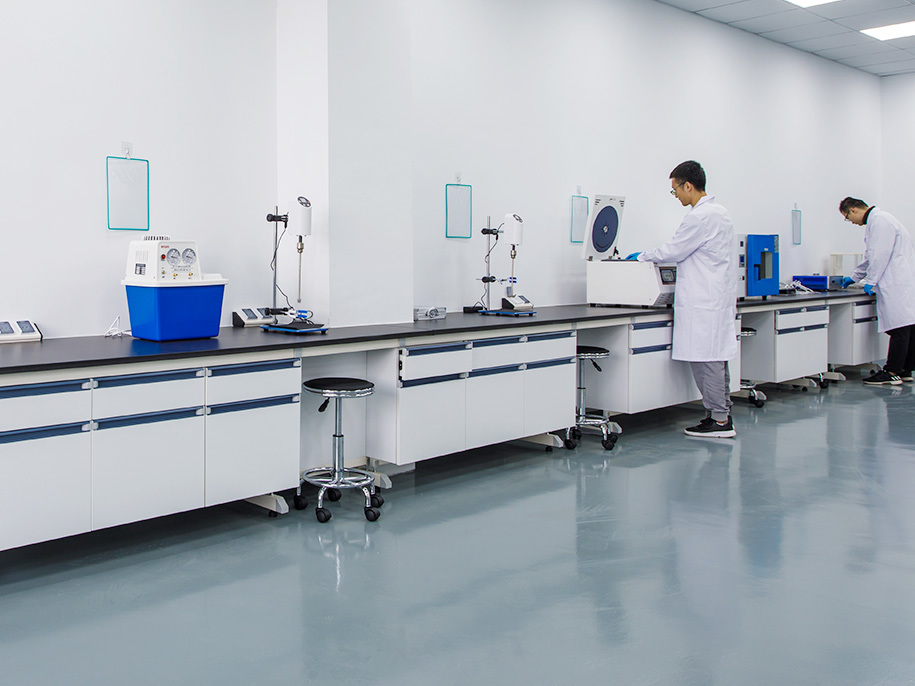
Graphene has been studied for energy storage applications for more than a decade, with research demonstrating its potential to improve electrical conductivity, thermal management, electrode stability, interfacial performance, and other properties of batteries and supercapacitors.
Yet laboratory performance alone does not determine whether graphene will become commercially valuable.
The real challenge is moving graphene technology through the development chain:
Laboratory Research → Prototype → Pilot Production → Cell Validation → Manufacturing Qualification → Commercial Deployment
This transition requires more than a high-performance graphene material. It requires a reproducible manufacturing process, stable raw material quality, application-specific formulation, equipment compatibility, cost control, and reliable performance at the battery or energy storage system level.
For this reason, the commercialization of graphene in energy storage should be viewed as a process and application development challenge, rather than simply a materials development challenge.
This article examines how graphene-based technologies can move from pilot-scale validation toward commercial deployment and the key factors that determine whether a graphene solution can achieve industrial adoption.
Why Graphene Is Being Considered for Energy Storage
Graphene is attractive for energy storage because of its combination of electrical, thermal, mechanical, and surface properties.
Depending on the application and material architecture, graphene may be used to improve:
- Electrical conductivity
- Electron transport
- Electrode stability
- Interface performance
- Thermal dissipation
- Mechanical integrity
- Surface protection
- Conductive network formation
- Cycle stability
Graphene can be introduced into an energy storage system in several different forms.
These may include:
- Graphene nanoplatelets
- Graphene powder
- Graphene oxide
- Reduced graphene oxide
- Graphene dispersions
- Graphene conductive inks
- Graphene-based slurries
- Graphene-polymer composites
- Graphene-coated substrates
The appropriate form depends on the target application and manufacturing process.
The most commercially attractive solution is not necessarily the graphene material with the highest laboratory performance. It is the material that provides a measurable improvement while remaining compatible with existing manufacturing processes and commercial cost requirements.
The Commercialization Pathway
A graphene energy storage technology normally passes through several development stages.
Stage 1: Laboratory Research
The first stage focuses on demonstrating the scientific or technical concept.
Researchers may evaluate:
- Electrical conductivity
- Electrochemical performance
- Thermal properties
- Surface chemistry
- Material morphology
- Mechanical properties
- Interface behavior
At this stage, sample quantities are usually small and processing conditions can be tightly controlled.
The main question is:
Does graphene provide a measurable technical advantage?
Stage 2: Prototype Development
Once the initial concept has been validated, graphene is incorporated into a more realistic material or cell structure.
For example, the development team may move from a small material sample to:
- Electrode coating
- Conductive slurry
- Functional coating
- Prototype pouch cell
- Coin cell
- Cylindrical cell
- Prismatic cell
The objective is to determine whether the laboratory effect remains when graphene is integrated into a complete battery architecture.
This is an important transition because interactions between graphene and other battery components can significantly influence the final result.
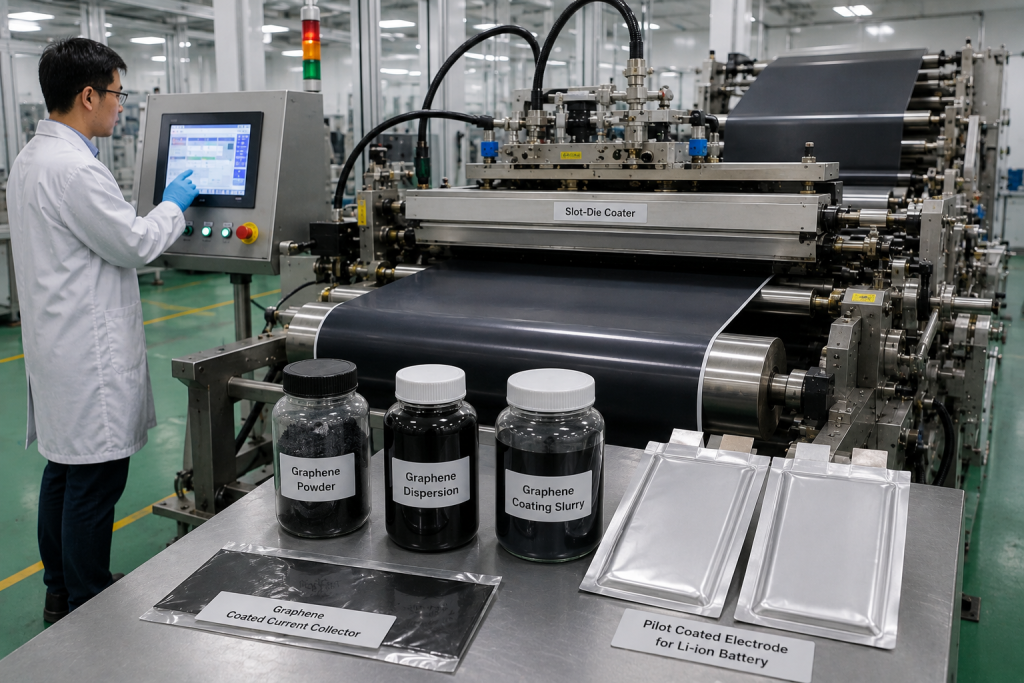
Stage 3: Pilot Production
Pilot production is where the technology begins to encounter real manufacturing conditions.
A pilot line allows engineers to evaluate:
- Mixing
- Dispersion
- Coating
- Drying
- Calendering
- Cutting
- Cell assembly
- Formation
- Testing
For graphene-based materials, pilot production is particularly important because nanoscale material behavior can change significantly when production volume increases.
A formulation that performs well in a 100 mL laboratory batch may behave differently in a 100 L or larger production environment.
Mixing energy, heat transfer, viscosity, sedimentation, and particle distribution can all change.
Why Pilot Production Is Critical
The primary purpose of pilot production is not to manufacture a large quantity of product.
It is to generate manufacturing knowledge.
A pilot program can answer questions such as:
- Can graphene be dispersed consistently?
- Does the formulation remain stable during production?
- Can the coating be applied uniformly?
- Can the target thickness be maintained?
- Does the process work at realistic production speeds?
- Does graphene loading remain consistent?
- Does the material survive downstream processing?
- Does cell performance improve after integration?
These answers are essential before commercial production begins.
Developing a Stable Graphene Formulation
Formulation development is one of the most important steps in commercialization.
A graphene-based energy storage formulation may contain graphene, a solvent or aqueous medium, binders, dispersants, conductive additives, and other functional components.
Important parameters include:
- Graphene concentration
- Solid content
- Viscosity
- Surface tension
- Particle size
- Dispersion stability
- pH
- Binder compatibility
- Drying behavior
The formulation must satisfy two requirements simultaneously.
First, it must provide the required technical performance.
Second, it must be compatible with industrial equipment.
A formulation with excellent laboratory conductivity but extremely high viscosity may be unsuitable for continuous coating.
Commercial development therefore requires optimization of material performance and manufacturing performance together.
Dispersion Stability at Pilot Scale
Graphene dispersion becomes increasingly important as production volume increases.
Poor dispersion can result in:
- Agglomeration
- Uneven coating
- Conductivity variation
- Surface defects
- Inconsistent electrochemical performance
During pilot production, engineers need to determine whether dispersion remains stable throughout the entire process.
This includes evaluating:
- Mixing sequence
- Mixing time
- Shear rate
- Temperature
- Tank geometry
- Filtration
- Storage time
- Recirculation
The objective is to establish a repeatable process rather than rely on operator experience.
Coating and Manufacturing Compatibility
For electrode-related applications, graphene may be introduced through coating processes.
Potential technologies include:
- Slot-die coating
- Blade coating
- Gravure coating
- Spray coating
- Other continuous coating methods
The choice depends on coating thickness, substrate characteristics, formulation rheology, production speed, and future manufacturing requirements.
For commercial deployment, it is advantageous to evaluate the graphene formulation on equipment that is representative of the intended production process.
This allows potential problems to be identified before commercial equipment is installed.
Process Window Development
A commercial graphene coating process should have a defined operating window.
Important parameters can include:
- Coating speed
- Flow rate
- Wet-film thickness
- Dry-film thickness
- Viscosity
- Drying temperature
- Drying residence time
- Web tension
- Substrate temperature
- Environmental humidity
The goal is not to identify one perfect setting.
Instead, engineers need to determine a range of conditions within which the process remains stable and the final product meets specifications.
This is known as the process window.
A robust process window is one of the foundations of commercial manufacturing.
Cell-Level Validation
A graphene material should ultimately be evaluated at the cell level.
Material characterization alone cannot determine commercial value.
Depending on the application, cell-level testing may include:
- Initial capacity
- Coulombic efficiency
- Rate capability
- Internal resistance
- Impedance
- Cycle life
- Thermal behavior
- Fast-charging performance
- Low-temperature performance
- Safety testing
The testing program should compare graphene-enabled cells against a suitable baseline.
For example:
Baseline electrode vs. graphene-enhanced electrode
This allows the actual contribution of graphene to be quantified.
Measuring the Real Value of Graphene
Commercial customers do not purchase graphene simply because it is an advanced material.
They purchase improved performance or manufacturing value.
The value proposition may involve:
- Higher power capability
- Improved cycle life
- Reduced resistance
- Better thermal behavior
- Improved electrode stability
- Reduced degradation
- Better processability
- Lower material loading
- Improved reliability
The improvement must be large enough to justify the additional material and manufacturing costs.
This is one of the most important principles in graphene commercialization.
Technical improvement must translate into economic value.
Cost Is a Major Commercialization Factor
Graphene commercialization is strongly influenced by cost.
The effective cost of a graphene solution includes more than the price per kilogram of graphene.
It may also include:
- Dispersion costs
- Solvent costs
- Mixing energy
- Equipment requirements
- Coating costs
- Drying energy
- Quality control
- Material losses
- Waste treatment
- Additional production steps
A low-cost graphene material may not necessarily result in a low-cost coating if processing requirements are complex.
Therefore, commercial evaluation should focus on cost per functional unit or cost per finished battery, rather than simply graphene price.
Material Loading Optimization
More graphene does not automatically mean better performance.
Increasing graphene loading may improve conductivity up to a certain point, but excessive loading can create disadvantages.
Potential problems include:
- Higher material cost
- Reduced active material fraction
- Increased viscosity
- Difficult dispersion
- Increased electrode density
- Reduced energy density
- Processing difficulties
The ideal solution is often to determine the minimum effective graphene loading that provides the required improvement.
This approach can significantly improve the commercial economics of graphene-based energy storage technologies.
Quality Control for Commercial Production
Commercial deployment requires much stronger quality control than laboratory research.
The graphene material may need specifications covering:
- Purity
- Particle size
- Surface area
- Layer number
- Moisture
- Surface chemistry
- Electrical conductivity
The coating or electrode may require:
- Thickness
- Uniformity
- Surface resistance
- Adhesion
- Loading
- Defect rate
The battery itself may require:
- Capacity
- Resistance
- OCV
- ACIR or impedance
- Cycle performance
- Safety characteristics
Quality control should be connected across the entire production chain.
Raw Material → Formulation → Coating → Electrode → Cell → Final Product
This makes it easier to identify the source of performance variation.
Supply Chain Readiness
A commercial graphene energy storage solution also requires a reliable supply chain.
Before deployment, customers may need to evaluate:
- Production capacity
- Batch consistency
- Lead time
- Packaging
- Logistics
- Technical support
- Quality documentation
- Backup supply
- Long-term capacity expansion
A material that works technically but cannot be supplied consistently is difficult to commercialize.
This is particularly important for battery manufacturers because changes in raw material quality can affect qualification and production stability.
Customer Qualification
Before graphene technology is adopted commercially, battery manufacturers usually need to qualify the material or process.
Qualification can include:
Material Qualification
Confirming that the graphene material consistently meets agreed specifications.
Process Qualification
Confirming that the material can be processed using the customer’s manufacturing equipment.
Cell Qualification
Confirming that the resulting cells meet performance requirements.
Reliability Qualification
Evaluating long-term stability and performance.
Production Qualification
Demonstrating that the technology can operate reliably during extended production.
This staged approach reduces the risk of introducing a new material directly into mass production.
Co-Development Can Accelerate Commercial Deployment
For emerging graphene technologies, collaboration between different companies can significantly shorten the path to commercialization.
A typical co-development project may include:
Graphene Supplier + Formulation Developer + Equipment Partner + Battery Manufacturer
The graphene supplier provides material expertise.
The formulation team develops the coating or slurry.
The equipment partner helps optimize production conditions.
The battery manufacturer validates the technology at the cell level.
This model allows technical issues to be identified much earlier.
It also ensures that the final material is designed around real manufacturing requirements rather than laboratory conditions alone.
Application-Specific Graphene Solutions
One reason graphene commercialization can be challenging is that there is no single graphene formulation suitable for every battery application.
Different applications may require different characteristics.
For example:
High-Power Batteries
The priority may be low resistance and rapid electron transport.
Long-Life Energy Storage
The focus may be stability and reduced degradation.
Fast-Charging Batteries
Electrical and thermal management may become particularly important.
High-Energy-Density Cells
Additional coating or additive loading must be carefully controlled to avoid reducing active material content.
Stationary Energy Storage
Cost, cycle life, safety, and long-term reliability may be more important than maximum power density.
Therefore, successful graphene commercialization is likely to be application-specific rather than based on a universal material solution.
Graphene in Different Energy Storage Technologies
Graphene is being investigated across multiple energy storage technologies.
Lithium-Ion Batteries
Potential roles include conductive additives, electrode surface modification, current collector coatings, and thermal management.
Silicon-Based Anodes
Graphene can potentially help accommodate mechanical changes associated with silicon expansion and improve conductive networks.
Sodium-Ion Batteries
Graphene-based conductive structures may support electrode conductivity and structural stability.
Supercapacitors
Graphene’s high surface area and electrical conductivity make it attractive for electrode development.
Solid-State Batteries
Graphene may potentially be explored in conductive networks and interface engineering, although compatibility with solid electrolytes and processing conditions must be carefully evaluated.
Commercial potential varies significantly across these technologies, and each requires application-specific validation.
From Pilot Data to Manufacturing Specifications
One of the most valuable outputs of pilot production is a set of manufacturing specifications.
These may include:
- Raw material specification
- Formulation recipe
- Mixing parameters
- Coating parameters
- Drying parameters
- Acceptable thickness range
- Quality limits
- Inspection methods
- Storage conditions
These specifications transform experimental knowledge into a repeatable manufacturing process.
Without this step, commercial production may remain dependent on individual engineers or operators.
Scaling from Pilot to Commercial Production
The transition from pilot production to commercial production introduces another set of challenges.
Production equipment becomes larger.
Production speed increases.
Material consumption increases dramatically.
Quality control must become faster.
Small process variations can affect thousands of cells.
Therefore, scale-up should be performed progressively.
A typical pathway may be:
Laboratory → Small Pilot → Larger Pilot → Engineering Production → Commercial Manufacturing
At each stage, process stability and quality should be re-evaluated.
The Importance of Long-Duration Trials
Short pilot trials may not reveal every manufacturing problem.
Long-duration trials can identify issues such as:
- Sedimentation
- Viscosity drift
- Filter blockage
- Pump instability
- Coating-head contamination
- Temperature changes
- Material batch variation
- Equipment wear
For this reason, commercial readiness should include extended production trials rather than relying only on short sample runs.
The goal is to demonstrate that the process can remain stable over realistic production periods.
Sustainability Considerations
Commercial deployment also requires consideration of environmental impact.
Graphene production and processing may involve energy consumption, solvents, chemical treatments, and waste streams.
Sustainable commercialization therefore requires attention to:
- Production energy
- Solvent selection
- Water-based formulations
- Material utilization
- Waste reduction
- Recycling
- Process efficiency
A graphene technology that improves battery performance while significantly increasing manufacturing environmental impact may face additional barriers to adoption.
What Does Commercial Readiness Look Like?
A graphene energy storage technology can be considered closer to commercial readiness when several conditions are satisfied.
Technical Readiness
The performance advantage has been demonstrated consistently.
Manufacturing Readiness
The material can be processed using scalable equipment.
Quality Readiness
Specifications and quality-control procedures are established.
Supply Chain Readiness
Materials can be supplied consistently at the required volume.
Economic Readiness
The performance improvement justifies the additional cost.
Customer Readiness
The technology has passed relevant customer qualification requirements.
Commercial deployment occurs when these factors converge.
Common Mistakes in Graphene Commercialization
Several mistakes can slow down commercialization.
Focusing Only on Laboratory Performance
High conductivity or impressive cell data does not automatically guarantee industrial viability.
Scaling Too Quickly
Moving directly from laboratory experiments to mass production can create significant technical and financial risks.
Ignoring Processability
A material must work with real manufacturing equipment.
Using Excessive Graphene Loading
More graphene can increase cost and reduce energy density without providing proportional benefits.
Underestimating Quality Control
Small variations in graphene properties can affect downstream performance.
Failing to Define a Baseline
Commercial value is difficult to demonstrate without comparison with an existing material or process.
A Practical Framework for Graphene Commercialization
A structured development program can follow these steps:
1. Define the application requirement
Identify the exact performance problem that graphene is expected to solve.
2. Select the appropriate graphene material
Evaluate morphology, conductivity, surface chemistry, purity, and processability.
3. Develop the formulation
Optimize concentration, binder, solvent, dispersion, and rheology.
4. Conduct laboratory validation
Establish initial technical performance.
5. Run pilot production
Evaluate the formulation using realistic manufacturing equipment.
6. Establish the process window
Identify stable operating conditions.
7. Produce representative cells
Validate the technology at the cell level.
8. Conduct extended testing
Evaluate performance, reliability, and consistency.
9. Establish manufacturing specifications
Define material, process, and quality requirements.
10. Begin customer qualification
Work with the end customer toward production validation.
11. Scale production progressively
Move from pilot to engineering and commercial production.
The Future of Graphene in Energy Storage
The future of graphene in energy storage will likely depend less on the novelty of graphene itself and more on the ability to integrate it economically into existing manufacturing systems.
The most promising solutions are likely to be those that require limited changes to established battery production processes while providing a measurable improvement in performance or reliability.
This creates opportunities for:
- Thin functional coatings
- Low-loading conductive additives
- Graphene-enhanced electrode structures
- Current collector surface treatments
- Thermal management materials
- Hybrid graphene-CNT systems
- Graphene-based composite materials
As battery manufacturers continue to increase energy density, power capability, charging speed, and cycle life, the value of advanced conductive and interface materials is likely to increase.
The commercialization of graphene in energy storage is not simply a question of whether graphene works.
The more important questions are:
Can it be manufactured consistently?
Can it be integrated into existing battery processes?
Can its performance advantage be demonstrated at the cell level?
Can it be supplied reliably?
Can the improvement justify the additional cost?
These questions define the transition from pilot technology to commercial deployment.
Pilot production provides the critical bridge between laboratory research and industrial manufacturing. It allows companies to optimize formulation, dispersion, coating, drying, quality control, and process stability before committing to large-scale production.
The most successful graphene energy storage projects will therefore combine material innovation, process engineering, pilot-scale validation, cell-level testing, supply-chain development, and economic analysis.
Ultimately, the commercial opportunity for graphene will not be determined by laboratory performance alone. It will be determined by the ability to transform that performance into a repeatable, scalable, cost-effective, and application-specific manufacturing solution.
That is the real journey of graphene in energy storage—from pilot to commercial deployment.