
R2R Coating Technologies for Thermal Management Materials
As thermal management requirements continue to increase across electronics, energy storage, and industrial systems, manufacturers are seeking scalable ways to produce high-performance thermal materials with consistent quality.
Among the most important manufacturing approaches is R2R coating (roll-to-roll coating), a continuous production technology widely used for functional films and advanced material applications.
From thermal interface layers to heat spreading films, thermal materials coating has become a critical part of modern thermal management manufacturing.
What is R2R Coating?
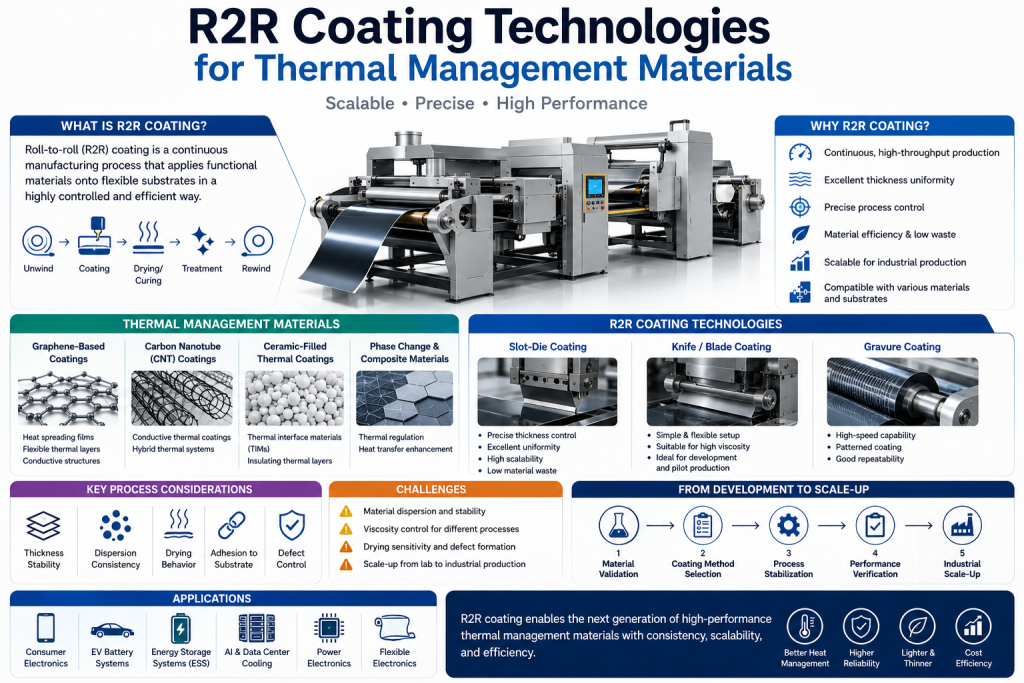
R2R coating, also known as roll-to-roll coating, is a continuous manufacturing process in which functional materials are coated onto flexible substrates moving through a production line.
The process typically includes:
- Material feeding
- Coating application
- Drying or curing
- Surface treatment
- Rewinding or lamination
Because the substrate moves continuously, R2R coating enables efficient large-scale production with stable process control.
Why R2R Coating is Important for Thermal Materials
Thermal management materials often require:
- Uniform thickness
- Consistent thermal performance
- Large-area scalability
- Flexible substrate compatibility
R2R coating technologies are particularly suitable because they provide:
- Continuous and repeatable production
- Precise coating control
- High throughput
- Compatibility with multiple material systems
These advantages make R2R coating a key manufacturing method for advanced thermal materials.
Common Thermal Management Materials Used in R2R Coating
R2R systems support a wide range of thermal materials, including:
Graphene-Based Coatings
Used for:
- Heat spreading films
- Flexible thermal layers
- Conductive thermal structures
Carbon Nanotube (CNT) Coatings
Used for:
- Conductive thermal coatings
- Hybrid thermal systems
Ceramic-Filled Thermal Coatings
Used in:
- Thermal interface materials (TIMs)
- Electrically insulating thermal layers
Phase Change and Composite Materials
Used for:
- Thermal regulation
- Heat transfer enhancement
This flexibility allows manufacturers to adapt R2R coating to different thermal management applications.
Key R2R Coating Technologies
Different coating methods are used depending on the material properties and final product requirements.
Slot-Die Coating
Slot-die coating is one of the most widely used precision coating methods in R2R systems.
Advantages:
- Precise thickness control
- Uniform coating across wide substrates
- High scalability for industrial production
- Efficient material utilization
Typical Applications:
- Graphene thermal films
- Thin conductive coatings
- Functional multilayer structures
Knife / Blade Coating
Knife coating uses a controlled gap to spread material across the substrate surface.
Advantages:
- Flexible process setup
- Suitable for higher viscosity materials
- Common in development and pilot production
Typical Applications:
- Thermal interface coatings
- Composite thermal layers
Gravure Coating
Gravure coating transfers material using engraved rollers.
Advantages:
- High-speed production
- Patterned coating capability
- Good repeatability in continuous operation
Typical Applications:
- Patterned thermal films
- Functional coating structures
Process Stability in Thermal Materials Coating
For thermal management materials, consistency is critical.
Key process considerations include:
- Coating thickness stability
- Material dispersion consistency
- Drying behavior
- Adhesion to substrate
- Defect control
In continuous R2R production, stable process conditions are essential for achieving reliable thermal performance.
Challenges in R2R Thermal Coating
Despite its advantages, R2R coating of thermal materials presents several technical challenges:
Material Dispersion
Advanced materials such as graphene and CNTs require stable dispersion to avoid aggregation.
Viscosity Control
Different coating methods require different viscosity ranges for stable operation.
Drying Sensitivity
Improper drying can cause:
- Surface defects
- Cracking
- Non-uniform performance
Scale-Up
A process that works in small-scale testing may behave differently during continuous production.
From Development to Scalable Manufacturing
A successful thermal materials coating project typically follows several stages:
- Material validation
- Coating method selection
- Process stabilization
- Performance verification
- Industrial scale-up
This structured approach reduces technical risk and improves manufacturing consistency.
Applications of R2R Thermal Materials
R2R coating technologies are increasingly used in:
- Consumer electronics
- EV battery systems
- Energy storage systems (ESS)
- AI and data center cooling
- Power electronics
- Flexible electronics
As thermal requirements continue to increase, scalable coating technologies are becoming more important across industries.
The Future of Thermal Materials Manufacturing
The combination of advanced materials and scalable R2R production is driving the next generation of thermal management solutions.
Future trends include:
- Thinner and lighter thermal films
- Hybrid graphene/CNT systems
- Integrated multifunctional coatings
- Higher precision continuous manufacturing
R2R coating technologies will continue to play a central role in enabling these developments.
R2R coating technologies provide a scalable and efficient pathway for manufacturing advanced thermal management materials.
By combining continuous production with precise process control, manufacturers can produce high-performance thermal films and coatings suitable for modern industrial applications.
As demand for thermal management continues to grow, R2R coating will remain a key technology in the evolution of thermal materials coating and functional film manufacturing.
Contact us to learn more about scalable R2R coating solutions for thermal management materials and advanced functional films.